

CFTC (Commodities Futures Trading Commission)
The CFTC (Commodity Futures Trading Commission) is an independent federal regulatory agency established by the U.S. government to oversee the nation's futures and options markets. It holds authority to audit and enforce rules across regulated exchanges and market participants, ensuring fair and transparent trading.
This article covers the CFTC's history, core responsibilities, and organizational structure, along with its most widely referenced market data release, the Commitments of Traders (COT) Report. We also demonstrate how to use the Titan FX CFTC tool to quickly view and interpret positioning data for practical trading decisions.
What You Will Learn
- How the CFTC was founded and what role it plays in U.S. derivatives markets
- The current organizational structure and commissioner appointments
- What the COT Report is and who its three trader categories represent
- How to read gold market COT data with a practical example
- Where to access COT charts and apply them to your trading strategy
1. History and Role of the CFTC
The Commodity Futures Trading Commission (CFTC) is a federal independent regulatory agency established under the Commodity Exchange Act (CEA), with exclusive jurisdiction over futures and derivatives markets. The CFTC was created in 1974 through a major amendment to the CEA, granting it dedicated oversight authority over futures trading in the United States.
Before the CFTC existed, futures market regulation fell under the Commodity Exchange Authority within the U.S. Department of Agriculture. However, as traded products expanded from agricultural commodities to industrial materials and financial assets, and amid a series of unregulated trading scandals and extreme price volatility in the early 1970s, the existing oversight framework proved inadequate.
The core of this regulatory reform was transferring oversight from the Agriculture Department to an independent agency with financial expertise and market sensitivity. This shift reflected the diversification of traded products and addressed the knowledge and resource limitations Agriculture faced in handling complex financial instruments and high-frequency trading environments.
The CFTC's mission is to protect market participants and the public from fraud, market manipulation, abusive practices, and systemic risk in futures, options, and swaps trading. It works to foster open, transparent, competitive, and financially sound markets.
Key authorities granted to the CFTC under the Commodity Exchange Act:
- Designating and supervising futures and options exchanges
- Registering and overseeing futures commission merchants and related intermediaries
- Drafting and enforcing CFTC regulations
- Monitoring market activity and position trends
- Investigating violations and pursuing administrative or legal action
2. CFTC Organizational Structure and Members
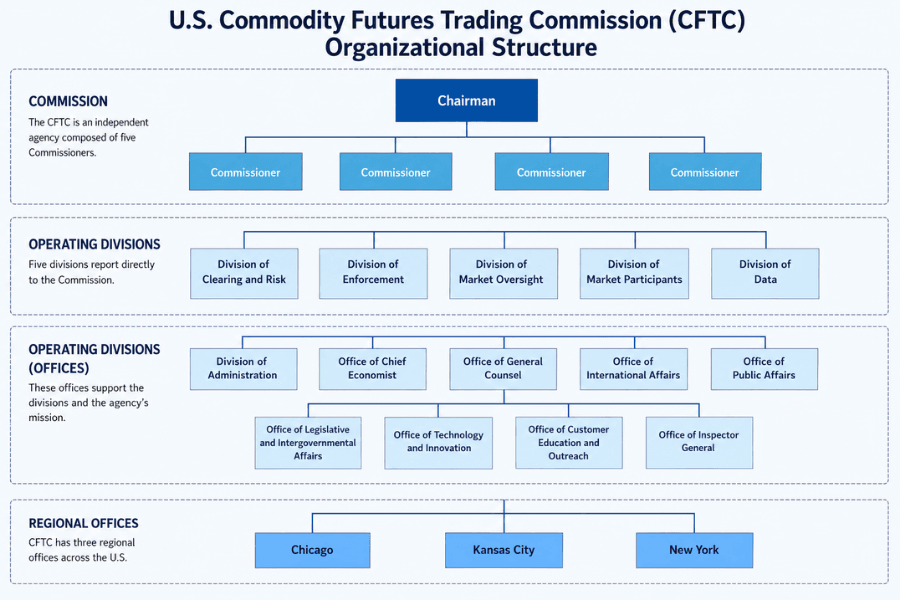
The CFTC is an independent federal agency overseeing derivatives markets. Its organizational structure comprises a five-member Commission and 14 operating divisions and offices, ensuring checks and balances between policymaking and enforcement.
The Commission consists of one Chairman and four Commissioners, each nominated by the President and confirmed by the Senate for staggered five-year terms. To maintain political neutrality, no more than three commissioners may belong to the same political party. When the Chair position is vacant, the Commission selects an Acting Chairman from the sitting commissioners.
The CFTC maintains three regional offices across the United States: New York (financial and energy derivatives oversight), Chicago (agricultural futures hub), and Kansas City (Midwestern commodity markets), enabling closer supervision and improved regulatory efficiency.
Current Chairman and Commission Status (as of May 2026)
The CFTC is currently operating with a significantly reduced Commission. Following the departure of former Chairman Rostin Behnam and the subsequent exits of Commissioners Kristin N. Johnson, Christy Goldsmith Romero, and Summer K. Mersinger, the agency experienced a leadership transition period.
Michael S. Selig was sworn in as the 16th CFTC Chairman on December 22, 2025, after being nominated by President Trump and confirmed by the Senate. As of May 2026, Chairman Selig is the sole sitting commissioner, with the remaining four seats vacant and awaiting presidential nominations and Senate confirmation.
| Position | Name | Sworn In | Background |
|---|---|---|---|
| 16th Chairman | Michael S. Selig | December 22, 2025 | Former CFTC General Counsel; derivatives regulatory and policy experience |
| Commissioner | Vacant | - | Awaiting nomination |
| Commissioner | Vacant | - | Awaiting nomination |
| Commissioner | Vacant | - | Awaiting nomination |
| Commissioner | Vacant | - | Awaiting nomination |
Note: The CFTC is legally authorized for five commissioners, but only one seat is currently filled. Such vacancies are not unusual in independent U.S. agencies and are typically related to political cycles, nomination timelines, and Senate confirmation schedules. The Commission remains operational with a quorum of one for routine matters.
Organizational Structure
The CFTC's administrative organization operates across three tiers:
1. Office of the Chairman
Leads daily administration, policy coordination, and institutional oversight. This is the CFTC's top executive center.
2. Executive Leadership Team
Comprising the Chairman, division heads, and the Chief Operating Officer, this team executes policy, manages regulatory and enforcement programs, and coordinates cross-division efforts.
3. 14 Operating Divisions and Offices
These units span market oversight, enforcement, data management, international affairs, and consumer education.
Among them, the Division of Enforcement (DOE), Division of Market Oversight (DMO), Division of Clearing and Risk (DCR), and Division of Data (DOD) are the core units most closely tied to market operations, compliance, and risk management.
| Level | Name | Key Responsibilities |
|---|---|---|
| Commission | Office of the Chairman | Led by the Chairman and support staff; manages daily operations, coordinates Commission business, and sets regulatory and enforcement agendas. |
| Commission | Executive Leadership Team | Division heads, COO, and Chairman execute administrative, regulatory, and enforcement agendas. |
| Operating | Division of Clearing and Risk (DCR) | Oversees derivatives clearing organizations, clearing members, and clearing risks across swaps, futures, and options. |
| Operating | Division of Enforcement (DOE) | Investigates and prosecutes CEA and regulation violations, including fraud and manipulation; houses the Whistleblower Office. |
| Operating | Division of Market Oversight (DMO) | Promotes market transparency by overseeing derivatives platforms and swap data repositories; reviews new applications and compliance. |
| Operating | Market Participants Division (MPD) | Supervises derivatives intermediaries such as commodity pool operators, futures commission merchants, and swap dealers. |
| Operating | Division of Data (DOD) | Manages data strategy and governance; builds data architecture and supports regulatory analytics. |
| Operating | Division of Administration (DA) | Manages HR, finance, IT, and security resources to ensure operational continuity. |
| Operating | Office of the Chief Economist (OCE) | Provides economic analysis, policy research, and staff training to support new regulations. |
| Operating | Office of the General Counsel (OGC) | Provides legal services, represents the Commission in litigation, and drafts regulations. |
| Operating | Office of International Affairs (OIA) | Handles cross-border regulatory issues and represents the Commission in international organizations. |
| Operating | Office of Public Affairs (OPA) | Manages public communications, outreach, and the CFTC's institutional credibility. |
| Operating | Office of Legislative and Intergovernmental Affairs (OLIA) | Serves as the Commission's liaison with Congress and federal agencies. |
| Operating | Office of Technology Innovation (OTI) | A fintech innovation hub supporting regulatory technology and industry collaboration. |
| Operating | Office of Customer Education and Outreach (OCEO) | Develops educational programs to help the public identify and report commodity trading fraud. |
| Operating | Office of the Inspector General (OIG) | Independent oversight unit detecting waste and fraud; publishes semiannual reports. |
3. What Is the CFTC Position Report (COT)?
The CFTC Position Report is a weekly data release compiled by the Commodity Futures Trading Commission, reflecting the positions held by major market participants across U.S. futures and options exchanges. Officially known as the COT (Commitments of Traders) Report, it is a key tool for gauging market sentiment and institutional positioning.
While the raw report may appear to be a dense collection of numbers and text, the underlying information holds significant value for trading decisions. By reading the COT data, traders can observe the directional leanings and capital flows of different participant categories.
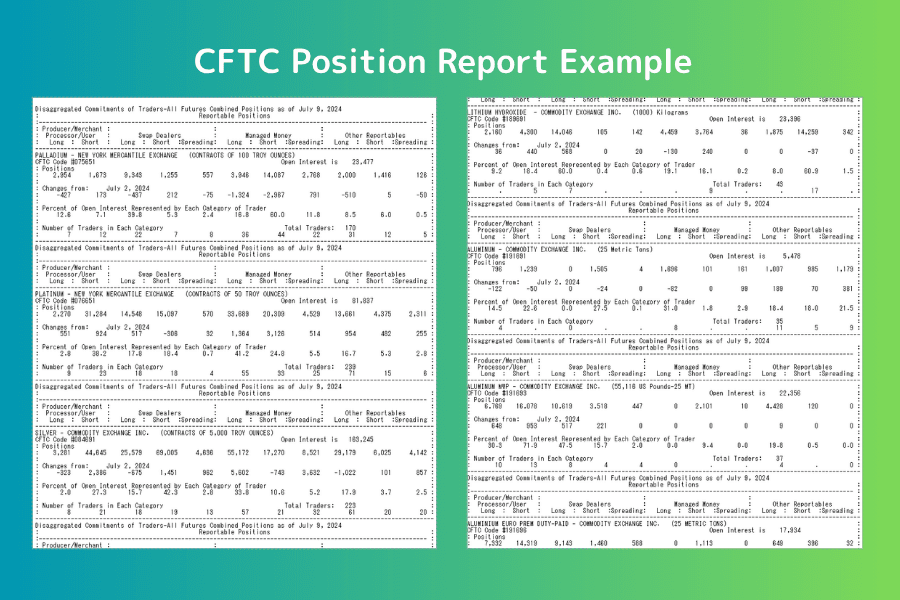
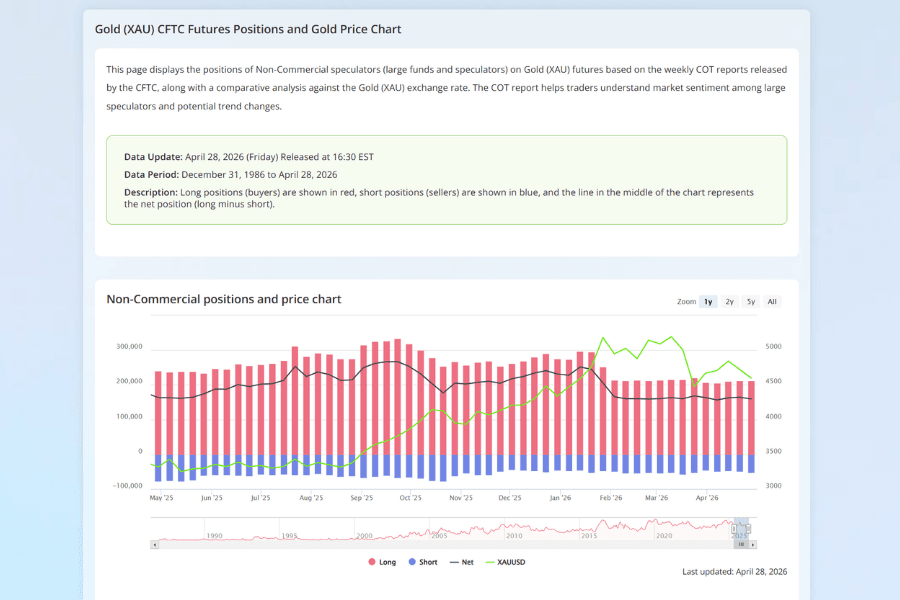
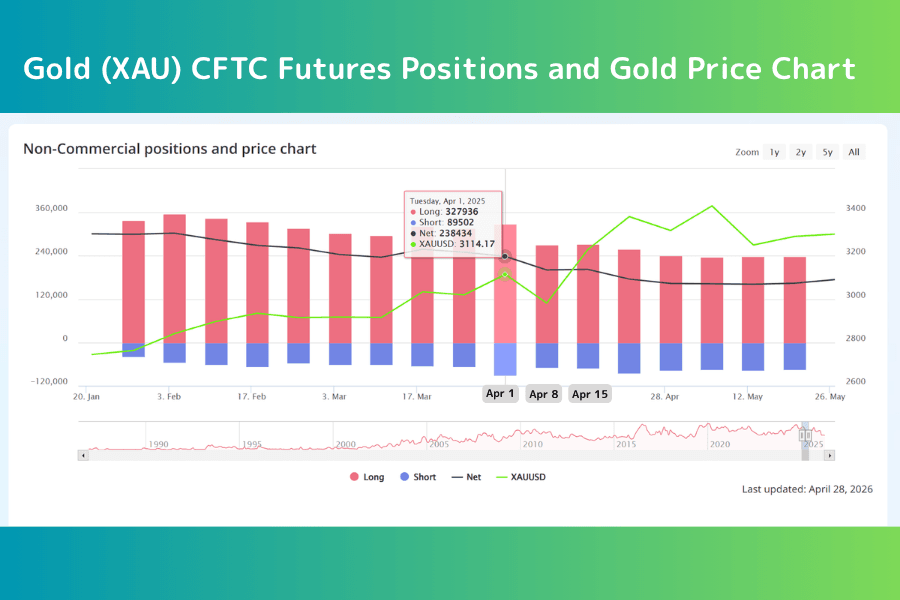
The original COT report is published in plain text, which can be difficult for beginners to parse. For a more accessible view, the Titan FX CFTC analysis tool presents the data as interactive charts, making it easy to track long, short, and net position trends alongside the behavior of key market participants. Below is an example showing the Gold COT index chart:
The following sections explain the main participant categories found in the report.
Market Participants in the COT Report
The COT Report classifies market participants into three categories based on their purpose and nature:
1. Commercial Traders
Also known as "hedgers" or "real-demand participants," these are businesses that face price risk in their physical operations. Examples include manufacturers that need raw materials or banks hedging interest rate exposure. For them, futures trading is a risk management tool to lock in prices and reduce cost volatility.
2. Non-Commercial Traders
Often called "large speculators," this category includes hedge funds, CTAs (Commodity Trading Advisors), and CPOs (Commodity Pool Operators). They enter futures markets primarily to profit from price movements and tend to hold strong directional views.
3. Nonreportable Traders
These are "small speculators" whose positions fall below the CFTC's reporting threshold. They include proprietary traders, small funds, and retail investors. With the growth of electronic trading and low-barrier platforms, this category's market participation has increased steadily.
Asset Classes Covered by the COT Report
The CFTC Position Report covers a broad range of assets traded on U.S. futures and options exchanges, including precious metals, stock indices, currencies, cryptocurrencies, energy, agriculture, bonds, and other financial indices.
| Asset Class | Covered Instruments |
|---|---|
| Currencies | EUR, GBP, JPY, AUD, NZD, CAD, ZAR, CHF, MXN |
| Metals | Gold, Silver, Copper, Platinum, Palladium |
| Stock Indices | Dow Jones, S&P 500, Nasdaq 100, Nikkei, E-mini S&P 500, E-mini Nasdaq 100 |
| Crypto | Bitcoin, Micro Bitcoin, Ethereum |
| Energy | WTI Crude Oil, Natural Gas |
| Agriculture | Wheat, Corn, Soybeans, Sugar, Oats |
| Bonds / Rates | U.S. Treasury Yields: 2-Year, 5-Year, 10-Year, 30-Year |
| Other Indices | VIX, U.S. Dollar Index |
4. Practical Example: Analyzing the Gold Market with COT Data
The following table summarizes the non-commercial (large speculator) COT data and price changes for gold futures in April 2025. These figures are drawn from published CFTC reports and serve as illustrative examples of how positioning data relates to price action.
| Date | Longs | Change | Shorts | Change | Net Position | Change | Gold Price (USD) | Change |
|---|---|---|---|---|---|---|---|---|
| 2025-04-01 | 327,936 | +11,364 | 89,502 | +22,726 | 238,434 | -11,362 | 3,114.17 | +94.54 |
| 2025-04-08 | 269,833 | -58,103 | 69,118 | -20,384 | 200,715 | -37,719 | 2,981.83 | -132.34 |
| 2025-04-15 | 271,707 | +1,874 | 69,497 | +379 | 202,210 | +1,495 | 3,229.20 | +247.37 |
Data Analysis and Trend Observations
April 1:
Both longs and shorts increased, but short-side growth was larger, causing a slight decline in net positioning. Despite this, gold prices still rose that week, suggesting bullish sentiment persisted even as opposing forces intensified. This kind of divergence between positioning and price can sometimes signal weakening momentum ahead.
April 8:
A clear cooldown emerged. Both longs and shorts dropped sharply, with net positioning falling by over 37,000 contracts. Gold prices declined more than $130 in parallel, reflecting capital withdrawal and fading risk appetite.
April 15:
Positioning recovered only marginally, yet prices surged over $240. This likely reflected an oversold bounce from the prior week, short covering, or a technical support rebound. The strong price recovery despite minimal position rebuilding suggests the market may have already priced in the negative news.
Practical Reminder: COT Data Is One Input, Not a Standalone Signal
While the COT Report is a valuable tool for observing institutional flows and sentiment shifts, gold price forecasting benefits from combining it with additional analysis:
- Inflation data, monetary policy, and central bank actions
- U.S. Dollar Index and real interest rate movements
- Technical indicators and key levels such as support and resistance zones
- Geopolitical risk, conflict developments, and safe-haven demand
The COT Report is best suited for medium- to long-term sentiment observation. It should be used alongside fundamental analysis, technical analysis, and event-driven research to build a more complete trading strategy and improve risk management.
5. CFTC Position Report FAQ
Q1. What types of COT Reports does the CFTC publish, and which is most widely used?
The CFTC releases two versions of the weekly COT Report:
- Futures Only: Covers positions in futures contracts only
- Futures-and-Options Combined: Includes both futures and options positions
Most traders focus on the Futures Only version because futures markets are more actively traded and the data is more stable, eliminating noise that options positions can introduce. This makes it easier to track the movements of major market participants.
Q2. What is the difference between the Long and Short format COT Reports?
The COT Report comes in two formats:
- Short Format: Lists large trader categories (Commercial, Non-Commercial, Nonreportable) and their respective positions
- Long Format: Adds detail on Nonreportable Positions, providing a fuller picture of overall market structure and participant distribution
The Long Format is more comprehensive and useful for understanding the complete breakdown of market participation.
Q3. When is the COT Report released, and what date does it reflect?
The CFTC publishes the COT Report every Friday at 3:30 PM Eastern Time (2:30 PM during daylight saving time). The data reflects positions as of the close of trading on the preceding Tuesday, resulting in approximately a three-day lag.
For example, the report published on Friday, May 23, 2025 reflects positions from Tuesday, May 20, 2025.
Q4. Where can I quickly access COT data with charts and analysis tools?
The CFTC's official website provides raw tables in PDF or TXT format, which can be difficult to work with. For a more intuitive experience with charts and visual analysis, you can use the Titan FX COT analysis tool, which supports multiple asset classes, tracks non-commercial net positioning against price charts, and offers practical reference value for trading strategies.
6. Summary
The CFTC serves as the cornerstone regulator of U.S. derivatives markets. Its structure and functions are central not only to market integrity but also to providing traders with critical reference data through the weekly COT Report.
This article has walked through the CFTC's organizational framework, data sources, trader classifications, and a hands-on gold market example. While COT data offers valuable insight, it is most effective when combined with macroeconomic indicators and technical analysis to build well-rounded trading logic.
To explore positioning data for specific assets, visit the Titan FX CFTC Position Report tool for interactive chart-based analysis.
Further Reading
- What Is the FOMC? -- Understanding the Federal Reserve's policy-setting body
- FX Trading Basics -- Foundation concepts for currency markets
- U.S. Economic Indicators -- Key data releases that move markets
- Titan FX CFTC Tool -- Interactive COT data charts and analysis
Titan FX's financial market research and analysis team produces investor education content across a wide range of financial instruments, including foreign exchange (FX), commodities (crude oil, precious metals, and agricultural products), stock indices, U.S. equities, and crypto assets.
Primary Sources by Category
- Regulatory and official data: CFTC Official Website, Commodity Exchange Act (CEA), CFTC Commitments of Traders Reports
- Market data and analysis tools: Titan FX CFTC Tool, CME Group, ICE Futures
- Industry and educational resources: National Futures Association (NFA), Investopedia COT Report Guide