

CPI Now
CPI Now is a real-time forecasting tool for the U.S. Consumer Price Index (CPI), developed by the Federal Reserve Bank of Cleveland. By integrating high-frequency data such as daily and weekly price signals, it provides a daily estimate of the current month's CPI change, giving policymakers, economists, and traders an early read on inflation trends weeks before the official release.
Because the Bureau of Labor Statistics publishes CPI data only once a month, CPI Now fills the gap with a continuously updated forecast that has become an influential market signal.
- How CPI Now works and which 10 data series feed the model
- Why the nowcasting method achieves near-Greenbook accuracy
- The role of Sticky-Price CPI in measuring embedded inflation
- Practical trading applications and key companion indicators
- Future challenges and implications for monetary policy
1. Core Features and Data Composition of CPI Now
CPI Now (also called the Cleveland Fed Inflation Nowcast) is an inflation estimation tool maintained by the Federal Reserve Bank of Cleveland. It produces daily estimates of U.S. CPI and Personal Consumption Expenditures (PCE) price index readings, bridging the publication lag of official statistics.
Its core value lies in synthesizing high-frequency inputs into a single, timely inflation signal that traders and analysts can act on before the BLS release date.
Data Sources and Structure
CPI Now draws on 10 data series across monthly and weekly frequencies.
- Monthly data (8 series)
- Bureau of Labor Statistics (BLS): headline CPI, core CPI (excluding food and energy), food CPI, food-at-home CPI, gasoline CPI
- Bureau of Economic Analysis (BEA): PCE price index, core PCE, food and beverage PCE
- Weekly data (2 series)
- Retail gasoline prices (U.S. Energy Information Administration, released every Monday)
- Brent crude spot price (Financial Times or EIA)
- Update cadence: refreshed daily on the Cleveland Fed's Inflation Nowcasting page
The blend of monthly government releases with weekly energy prices allows the model to capture fast-moving cost pressures that monthly-only models miss.
2. Forecasting Methods and Precision Advantages
How the Nowcast Model Works
CPI Now uses a nowcasting framework that combines weighted averaging and statistical estimation to project the current month's CPI before the BLS publishes its figure around the 15th of the following month. Two features set it apart:
- Timeliness: updated every business day, giving a multi-week head start over official data
- Accuracy: the Cleveland Fed reports that its forecast precision rivals the Federal Reserve's internal Greenbook projections and consistently outperforms the market consensus
Market Impact
When CPI Now diverges from Wall Street expectations, it can trigger pre-release positioning across asset classes.
For example, if the nowcast signals an upside surprise in inflation, bond markets tend to price in tighter policy, and USD/JPY may rally on short-term dollar strength. Many institutional traders now track CPI Now as a leading signal and adjust exposure days before the official print, underscoring its growing influence.
3. Role and Economic Significance of Sticky-Price CPI
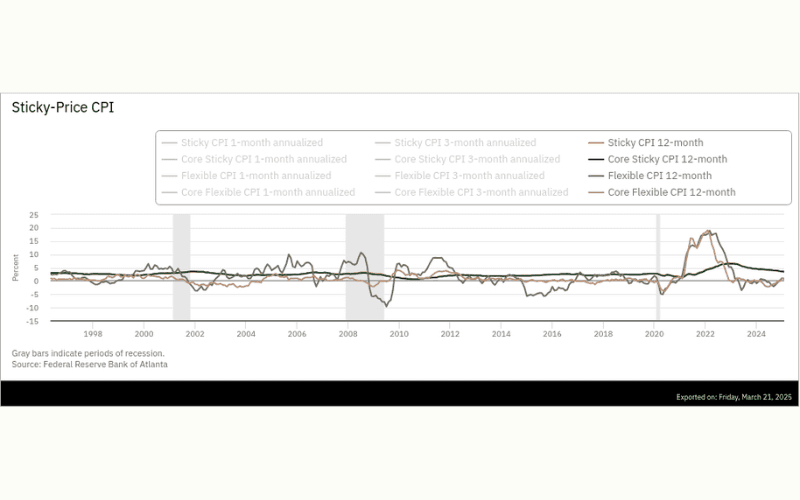
Sticky-Price CPI is a companion indicator published by the Federal Reserve Bank of Atlanta (Sticky-Price CPI). It splits CPI components into two buckets:
- Flexible-price items: goods and services whose prices change frequently, such as food and fuel
- Sticky-price items: goods and services whose prices adjust slowly, such as rent, medical care, and education
Sticky-price items account for roughly 70% of the CPI basket weight. Because they reprice infrequently, their movements are widely regarded as a better gauge of long-run inflation expectations.
Interpreting the Data
- Lagging peaks: sticky-price inflation typically peaks several months to a year after flexible-price inflation. Rent adjustments, for instance, take 6 to 12 months to work through, signaling persistent underlying pressure.
- Policy signal: when headline CPI falls but Sticky-Price CPI remains elevated, it suggests embedded inflation that the FOMC must weigh before easing policy.
4. Market Applications and Related Indicators
Practical Uses
- Policy guidance: CPI Now provides the real-time inflation pulse, while Sticky-Price CPI reveals the structural trend. In 2022, Sticky-Price CPI flagged rising rents, reinforcing the Fed's decision to accelerate rate hikes. The dollar gained roughly 3% in a single month during that tightening phase.
- Trading strategy: when CPI Now shows cooling inflation but Sticky-Price CPI stays elevated, traders may position for a "higher-for-longer" rate path by going long the dollar or adjusting duration in U.S. Treasuries.
Key Companion Indicators
| Indicator | Relevance |
|---|---|
| Official CPI (BLS) | The benchmark used to verify CPI Now's accuracy after each monthly release |
| PPI (Producer Price Index) | Tracks upstream cost changes; gasoline and energy inputs overlap with CPI Now's weekly data |
| PCE Price Index | The Fed's preferred inflation gauge; directly modeled within CPI Now via BEA data |
| U.S. Economic Calendar | Schedule for CPI, PCE, PPI, and other releases that move markets |
| Non-Farm Payrolls (NFP) | Labor costs feed through to service prices in the Sticky-Price CPI basket |
5. Future Challenges and Policy Impacts
Data and Technical Challenges
- Noise sensitivity: weekly inputs such as gasoline prices are vulnerable to short-term shocks (natural disasters, geopolitical events), which can temporarily skew the forecast.
- Globalization effects: ongoing supply-chain restructuring and shifting trade patterns may reduce the explanatory power of models trained on historical domestic data.
Monetary-Policy Implications
- Inflation persistence: if Sticky-Price CPI remains above the 2% target due to service-price stickiness, the Fed may extend its restrictive stance even after headline CPI falls to the 3% range. Such a scenario could support sustained dollar strength, pushing USD/JPY higher.
- Recession risk: prolonged high rates carry the side effect of intensifying economic slowdown pressures, challenging the Fed's aim for a soft landing.
Frequently Asked Questions (FAQ)
Q1: How closely does CPI Nowcasting match actual CPI?
CPI Nowcasting is a real-time estimate and does not perfectly match official CPI. However, its directional accuracy (whether CPI is rising or falling) is generally reliable.
Q2: Where can I check CPI Nowcasting?
The Cleveland Fed's Inflation Nowcasting dashboard provides updated estimates before each monthly CPI release, serving as a reference for market participants.
Q3: How can CPI Nowcasting be used in forex trading?
By checking Nowcasting before CPI announcements, traders can gauge the potential surprise factor. When Nowcasting diverges from market consensus, post-release volatility tends to be higher.
6. Summary
CPI Now is a daily inflation nowcasting tool that uses high-frequency data to estimate the current month's CPI ahead of the official release. Its timeliness and near-Greenbook accuracy have made it an essential reference for traders, economists, and policymakers.
As data science techniques improve, CPI Now's forecast precision is expected to increase further, though globalization shifts and data noise remain ongoing challenges. To stay current, bookmark these primary resources:
- Cleveland Fed CPI Now: https://www.clevelandfed.org/indicators-and-data/inflation-nowcasting
- Atlanta Fed Sticky-Price CPI: https://www.atlantafed.org/research/inflationproject/stickyprice
Further Reading
- What Is FOMC? How the Fed Sets Monetary Policy
- What Is CPI? Understanding the Consumer Price Index
- What Is Inflation? Causes, Effects, and How It Is Measured
- U.S. Economic Indicators Calendar
Titan FX's financial market research and analysis team produces investor education content across a wide range of financial instruments, including foreign exchange (FX), commodities (crude oil, precious metals, and agricultural products), stock indices, U.S. equities, and crypto assets.
Primary Sources by Category
- Central banks and official statistics: Cleveland Fed Inflation Nowcasting, Atlanta Fed Sticky-Price CPI, Bureau of Labor Statistics CPI, Bureau of Economic Analysis PCE
- Academic research: Are Some Prices More Forward-Looking? (Cleveland Fed Economic Commentary)
- Market and energy data: EIA Weekly Petroleum Status Report