

Currency Basket
A currency basket is a portfolio of multiple currencies combined in set proportions; central banks and investors use it to diversify exchange-rate risk and avoid over-reliance on any single currency.
Rather than tracking a single currency's ups and downs, markets often use a currency basket as a yardstick for value — observing several currencies together gives a more objective read on how strong or weak one currency really is.
Currency baskets appear frequently in exchange rate indices, international trade settlement, and foreign reserve systems. They offer diversity, stability, and representativeness as reference tools.
By combining multiple currencies, a basket reduces the impact of volatility in any single currency on the broader economy or financial markets. The International Monetary Fund's Special Drawing Rights (SDR) and the US Dollar Index (DXY) are two of the most recognized examples.
1. Characteristics of a Currency Basket
A currency basket brings together currencies from multiple countries to gauge the relative value of a specific currency. It is widely used in forex markets and economic analysis. The three defining characteristics are:
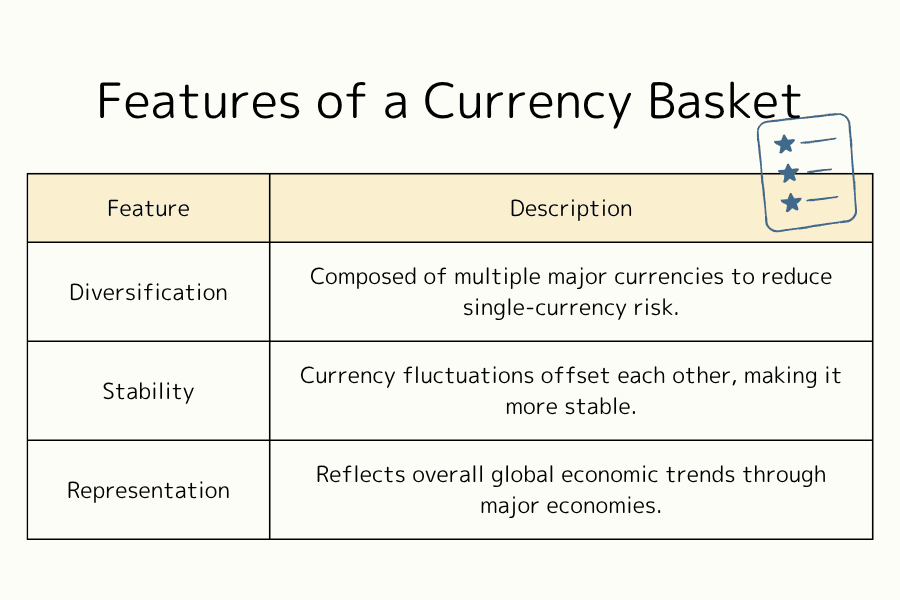
Diversity
A currency basket includes major currencies from countries that carry significant weight in the global economy. This variety represents the strength of different economic zones and avoids the concentration risk inherent in tracking a single currency.
Stability
Because exchange rate movements among the constituent currencies tend to offset each other, a currency basket is generally less volatile than any individual currency. This natural hedging effect makes baskets useful for risk management.
Representativeness
Baskets are typically composed of currencies from the world's most influential economies. As a result, they reflect global economic dynamics more accurately than any single currency pair and serve as a reliable benchmark for overall economic health.
2. Advantages of Investing in a Currency Basket
Currency baskets offer several practical advantages as investment tools:
Risk Diversification
Since a basket spreads exposure across multiple economies, a downturn in one country's currency has a limited effect on the overall position. This diversification reduces portfolio-level volatility.
Stable Returns
The built-in dampening effect of multiple currencies makes baskets appealing for conservative strategies. Investors seeking to avoid sharp swings in a single currency often prefer basket-based instruments.
Reflection of Global Economic Trends
Rather than depending on the economic performance of a single nation, a currency basket captures the broader direction of the world economy. This is particularly valuable when macro trends -- such as shifting monetary policy from the FOMC -- affect multiple currencies simultaneously.
Trading Flexibility
Modern financial markets offer a range of instruments for accessing currency baskets, including CFDs, ETFs, and futures. These tools allow traders to implement global diversification efficiently within a single position.
3. How to Trade a Currency Basket
Investors can gain exposure to currency baskets through three main channels:
Derivatives Trading: Futures, options, and other derivatives allow traders to speculate on or hedge against movement in a currency basket. These instruments are available on major exchanges and through CFD brokers.
Exchange-Traded Funds (ETFs): Several ETFs are designed to track the performance of specific currency baskets, giving investors indirect access without the complexity of managing multiple positions.
Forex Market: By opening positions in multiple currency pairs simultaneously, traders can construct a synthetic currency basket. For example, selling EUR/USD, GBP/USD, and JPY/USD in the correct proportions effectively replicates a long position on the US Dollar Index.
4. Common Tradable Currency Baskets in Global Markets
Tradable currency baskets are financial products built from weighted combinations of multiple currencies. They serve two primary purposes: hedging currency risk and tracking the performance of a specific currency group. The most widely followed baskets include:
4.1 US Dollar Index (DXY)
The US Dollar Index (DXY) measures the value of the US dollar against a weighted basket of six major currencies. It is the most recognized currency basket in the world.
The composition and weights are as follows:
| Currency | Weight |
|---|---|
| Euro (EUR) | 57.6% |
| Japanese Yen (JPY) | 13.6% |
| British Pound (GBP) | 11.9% |
| Canadian Dollar (CAD) | 9.1% |
| Swedish Krona (SEK) | 4.2% |
| Swiss Franc (CHF) | 3.6% |
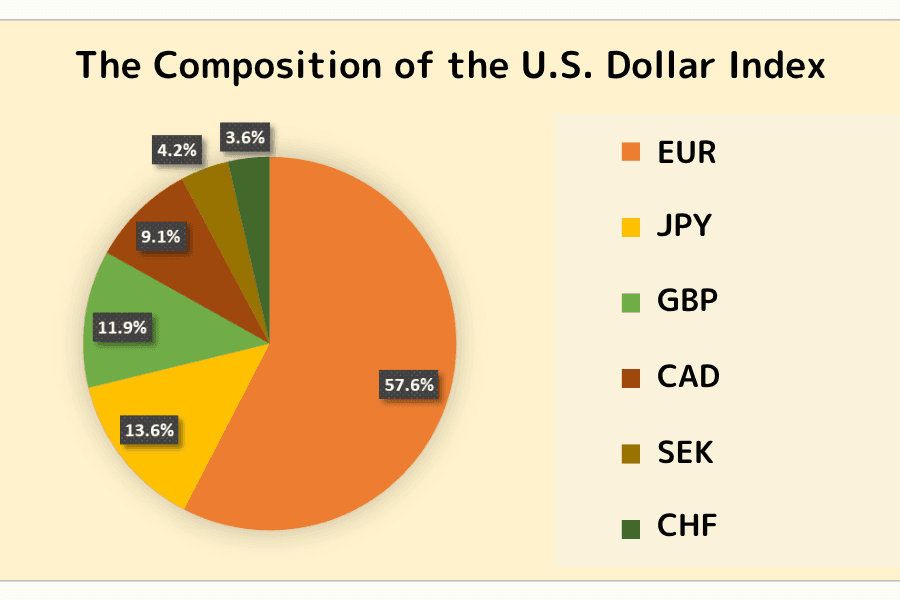
The DXY reflects the relative strength of the US dollar and is one of the most important tools for analyzing global economic direction. It tends to move sharply around FOMC rate decisions, non-farm payrolls, and other major US economic releases.
Because the euro carries a 57.6% weight, the DXY is sometimes viewed as an inverse EUR/USD proxy. Traders should be aware of this concentration when using the index as a broad dollar-strength gauge.
What Is the US Dollar Index? Composition and Features4.2 Special Drawing Rights (SDR)
SDR is an international reserve asset created by the International Monetary Fund (IMF). Its currency basket consists of the US dollar, euro, Chinese yuan, Japanese yen, and British pound.
While SDR itself is not a directly tradable asset, some financial products and indices are designed around the SDR's currency composition. Central banks hold SDR-denominated reserves, and the IMF uses SDR as its unit of account.
4.3 Euro Area Currency Index (EUR Index)
The EUR Index measures the euro's value against a basket of currencies including the US dollar, British pound, Swiss franc, and Japanese yen. It provides a broader view of euro strength than any single EUR-based pair.
4.4 Commodity Currency Basket
This basket groups currencies from major commodity-exporting nations, such as the Australian dollar (AUD), Canadian dollar (CAD), and New Zealand dollar (NZD). These currencies tend to correlate with commodity prices -- particularly crude oil, metals, and agricultural products -- making the basket useful for tracking global resource demand.
4.5 Asia-Pacific Currency Basket
An Asia-Pacific basket typically includes the Singapore dollar (SGD), South Korean won (KRW), Thai baht (THB), and other regional currencies. These baskets are used in financial products tied to Asian economic growth and trade flows.
4.6 Emerging Market Currency Basket
This basket brings together major emerging market currencies such as the Brazilian real (BRL), Russian ruble (RUB), South African rand (ZAR), and Turkish lira (TRY). Emerging market baskets carry higher volatility and yield potential but also greater geopolitical and liquidity risk.
5. How to Trade the US Dollar Index (DXY) -- Practical Example
After opening a Titan FX trading account, you can trade the US Dollar Index as a CFD on the MT4 and MT5 platforms. Here is a step-by-step guide.
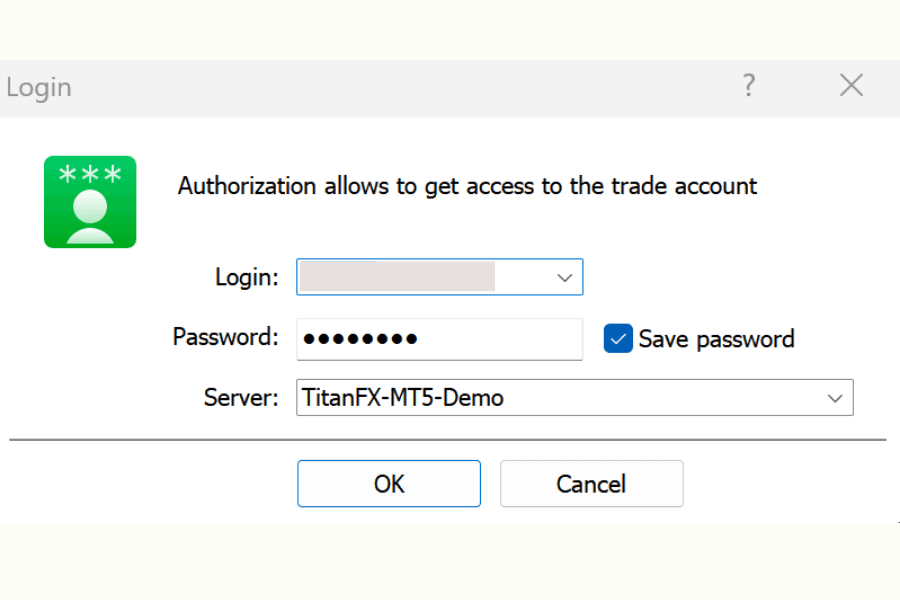
Register a Titan FX Trading AccountStep 1: Log in to Your Trading Account
Download MT4 or MT5 and enter your account number and password to log in.
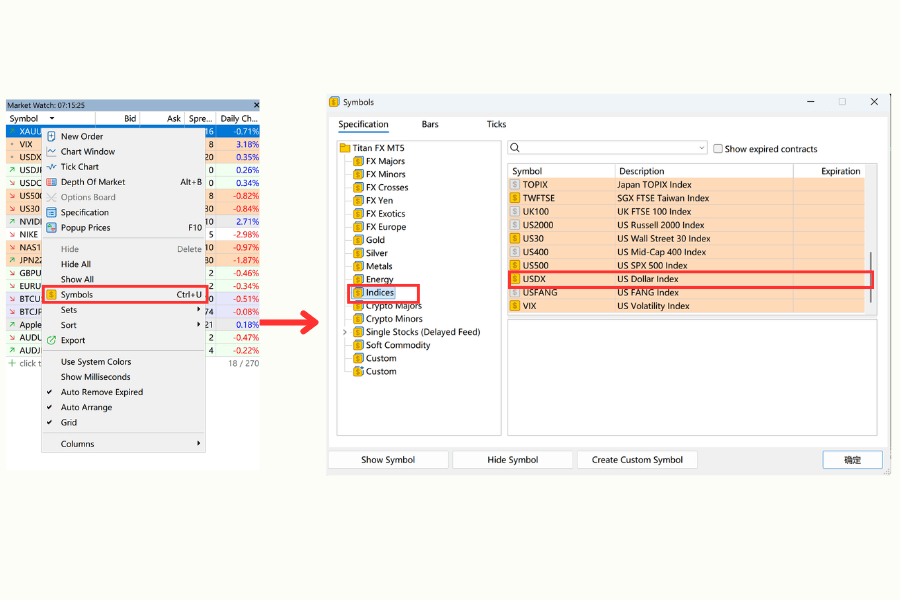
Step 2: Add USDX to Market Watch
In the Market Watch window, right-click and select "Symbols." Expand the "Indices" folder, then double-click "USDX" to add the US Dollar Index to your quote list.
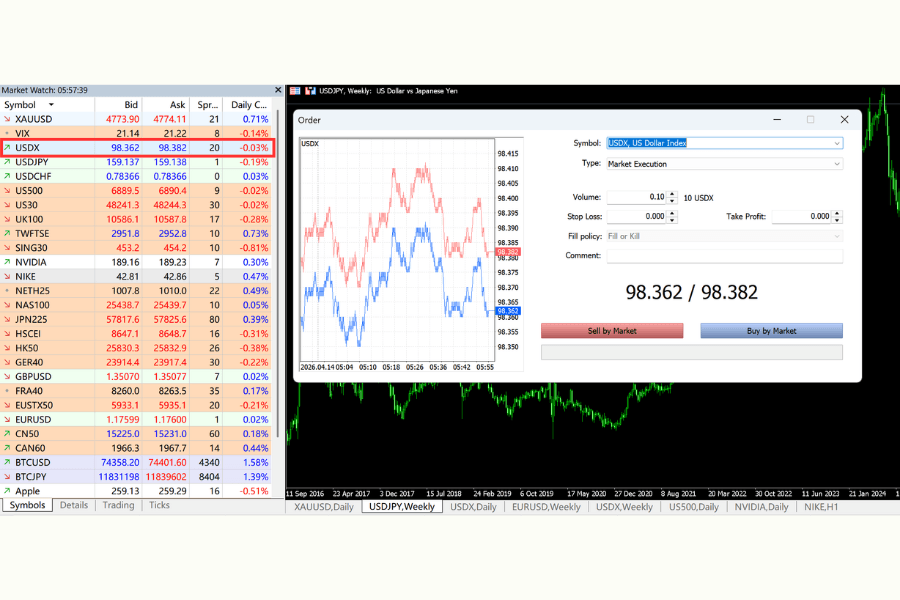
Step 3: Place a Trade
Double-click the USDX quote or open its chart to access the order window. Enter your lot size, choose Buy or Sell, and execute the trade to begin trading the US Dollar Index CFD.
Frequently Asked Questions (FAQ)
Q1: What is the relationship between a currency basket and the Dollar Index (DXY)?
DXY is a type of currency basket composed of 6 currencies. The euro has the largest weight at approximately 57.6%, so DXY movements are heavily influenced by EUR/USD.
Q2: Can individual investors use currency baskets?
Few direct trading products exist, but understanding basket compositions helps investors grasp correlations between currency pairs and design diversified or hedged strategies.
Q3: Is the SDR (Special Drawing Rights) a currency basket?
Yes. The SDR is a currency basket managed by the IMF, composed of USD, EUR, CNY, JPY, and GBP. Its composition is reviewed every five years.
6. Summary
A currency basket is a weighted combination of multiple currencies designed to measure relative value, diversify risk, and track broad economic trends. The US Dollar Index (DXY) and IMF's Special Drawing Rights are the most prominent examples, but traders also encounter commodity, regional, and emerging market baskets.
For individual traders, CFD platforms like MT4 and MT5 provide the most accessible way to trade currency baskets. The DXY, in particular, is available as a single CFD instrument, offering exposure to global dollar dynamics without needing to manage six separate currency pairs.
Understanding how currency baskets are constructed -- and which currencies carry the most weight -- helps traders interpret macro signals more effectively and build better-diversified FX strategies.
Further Reading
- FX Basics: Getting Started in Forex Trading
- What Is the US Dollar Index? Composition and Features
- What Is the FOMC? How Rate Decisions Affect Markets
Titan FX's financial market research and analysis team produces investor education content across a wide range of financial instruments, including foreign exchange (FX), commodities (crude oil, precious metals, and agricultural products), stock indices, U.S. equities, and crypto assets.
Primary Sources (by Category)
- International institutions and currency systems: IMF Special Drawing Rights (SDR) Factsheet, ICE US Dollar Index (DXY) Methodology and Rulebook
- Foreign exchange markets and indices: BIS Triennial Central Bank Survey (2022), Federal Reserve Board Trade-Weighted Dollar Index
- Trading platforms: Titan FX Official Website (MT4/MT5 trading conditions and instruments)