

Interbank market
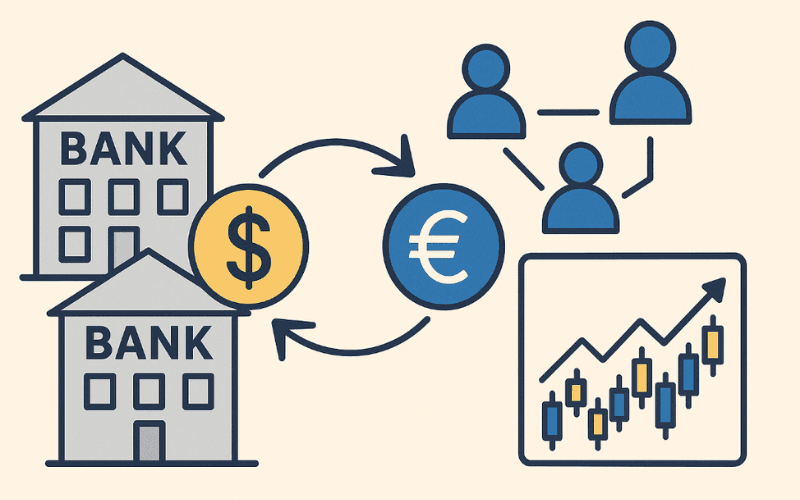
The interbank market refers to a trading market where financial institutions conduct transactions with each other, including foreign exchange, short-term lending, and interest rate swaps. Also known as the "interbank trading market," it plays a critical role in global capital flows and exchange rate formation.
This article explains the definition, mechanisms, participants, characteristics, and frequently asked questions about the interbank market.
Key Takeaways
- What the interbank market is and how it differs from the client (retail) market
- How interbank exchange rates are formed through supply and demand
- Scale and liquidity figures based on BIS statistics
- Why understanding the interbank market matters for individual traders
1. Definition of the Interbank Market
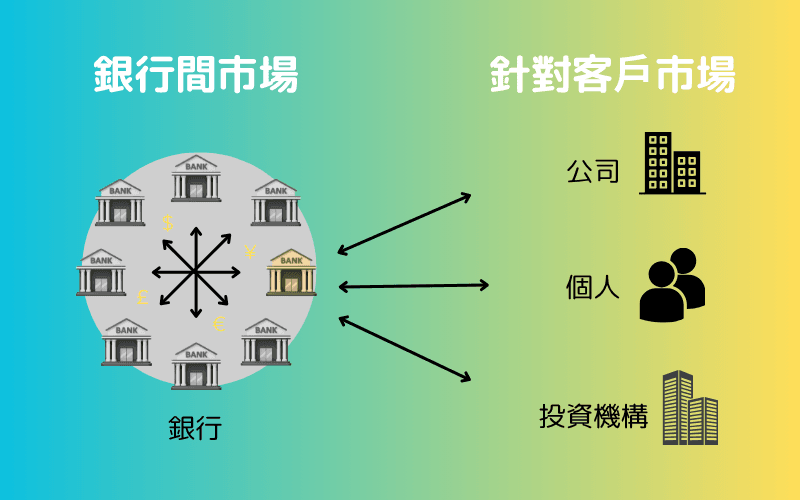
The interbank market is a trading market exclusively for financial institutions. Individual investors and general corporations cannot participate directly.
In this market, banks, central banks, and securities firms engage in short-term lending, foreign exchange trading, and interest rate swaps. Because participants are highly specialized, the interbank market is often described as the "wholesale market" of the financial system. Transactions with retail clients, by contrast, take place in the "client market" or "retail market."
2. How the Interbank Market Works
Despite being called a "market," the interbank market has no physical trading floor. It is a virtual network where transactions occur through electronic systems, telephone lines, and brokers.
- Trading methods: Institutions trade directly with each other or through forex brokers who match orders
- Rate formation: The exchange rates formed in the interbank market are known as interbank rates, which serve as the benchmark rates reported by financial media
- Market layers: The interbank market functions as the "wholesale market" among financial institutions, while transactions offered to corporations and individuals constitute the "retail market" (client market)
3. Key Participants
The main participants in the interbank market include:
- Central banks: Regulate market liquidity and interest rates
- Commercial and investment banks: Conduct foreign exchange transactions and short-term lending
- Major securities firms and money market dealers: Actively trade in capital and forex markets
- Forex brokers: Facilitate and match transactions
Notably, individuals and general corporations cannot participate directly in the interbank market.
4. Three Key Characteristics
- Characteristic 1: Extremely high liquidity and massive scale
- Characteristic 2: Exchange rates determined by supply and demand
- Characteristic 3: Hub for short-term interest rate transactions
Characteristic 1: Extremely High Liquidity and Massive Scale
According to the Bank for International Settlements (BIS), as of April 2022, the global foreign exchange market's average daily turnover exceeded $7.5 trillion.
For comparison:
- Microsoft market cap: approximately $3.1 trillion
- Apple market cap: approximately $2.6 trillion
- NVIDIA market cap: approximately $2.5 trillion
In other words, the interbank market processes daily trading volumes equivalent to the combined market capitalizations of these tech giants, reflecting its exceptionally high liquidity.
Characteristic 2: Exchange Rates Determined by Supply and Demand
Exchange rates in the interbank market are naturally formed through supply and demand among financial institutions. Rates offered to retail clients are derived from interbank rates plus the bank's profit margin (spread).
As a result, interbank rates are regarded as the most transparent and reliable price benchmark.
Characteristic 3: Hub for Short-Term Interest Rate Transactions
Beyond foreign exchange, the interbank market also serves as a core platform for short-term lending and borrowing.
Common transaction types:
- Secured transactions: Using government or municipal bonds as collateral
- Unsecured transactions: Lending based on creditworthiness (call transactions)
- Bill transactions: Facilitating funds through bills of exchange
Short-term interest rates in the interbank market (such as the call rate) fluctuate according to supply and demand and serve as benchmarks for overall financial market interest rates.
5. FAQ
Q1: Does the interbank market have a physical location?
No. The interbank market is an abstract market concept with no physical exchange. All transactions take place through electronic networks, bilateral trading systems, or broker platforms.
Q2: What other financial markets exist besides the interbank market?
Financial markets can be classified as follows:
| Market Type | Trading Content |
|---|---|
| Short-term financial market | Interbank lending, open market operations, short-term securities (CP, CD) |
| Long-term financial market | Stocks, corporate bonds, government bonds, municipal bonds |
| Foreign exchange market | Currency trading, interbank forex transactions |
| Derivatives market | Futures, options, swaps, and other financial derivatives |
The interbank market spans both the short-term financial market and the foreign exchange market, making it a central pillar of global financial flows.
Q3: What is the relationship between the interbank market and retail forex trading?
Retail forex trading occurs in the client market, but prices are derived from interbank rates. Forex brokers add a spread to interbank rates before offering them to individual traders.
Q4: Where can I check interbank rates?
Interbank rates are available through Bloomberg, Reuters, and central bank websites. However, real-time interbank rates are typically provided through institutional-grade services.
Q5: Why does the BIS survey forex market turnover every three years?
The BIS Triennial Survey is a large-scale study conducted in cooperation with central banks worldwide. The preparation and aggregation process requires significant time, hence the three-year cycle. The most recent 2022 survey reported daily turnover of $7.5 trillion.
6. Summary
The interbank market is a critical platform where financial institutions trade capital and foreign exchange. It boasts extremely high liquidity and directly influences global exchange rates and interest rates.
- The interbank market is a virtual market structure with no physical location
- Participation is limited to financial institutions; exchange rates and interest rates fluctuate based on supply and demand
- It plays a vital role in the global economy and monetary policy
Understanding the interbank market helps in grasping how foreign exchange rates, interest rates, and market prices are formed.
Related Articles
Titan FX Research. We produce educational content for investors, covering a wide range of financial instruments including forex, commodities (crude oil, precious metals, agricultural products), stock indices, U.S. equities, and digital assets.
Primary Sources (by category)
- Statistics: Bank for International Settlements (BIS) — Triennial Central Bank Survey
- Regulatory: Financial Services Agency (Japan); Bank of Japan — Financial Markets Report
- Educational: Financial Futures Association of Japan (FFAJ) — Learn FX