

What Is the CAC 40 Index (FRA40)? Components & Trading Guide
FRA40 tracks the performance of France's flagship stock market index, compiled by Euronext Paris. It comprises the 40 largest and most liquid companies listed on the Paris stock exchange. From LVMH and TotalEnergies to Sanofi, these constituents represent the most influential corporations in the French and broader European economy.
For CFD traders, the CAC 40 offers one of the most direct routes to the French and eurozone markets. Index movements are driven by ECB monetary policy, French domestic economic data, global energy prices, and luxury goods demand, providing abundant trading opportunities. This article covers the index definition, constituent stocks, price drivers, and practical trading methods to give you a comprehensive understanding of CAC 40 trading.
What Is the France CAC 40 Index (FRA40)?
The CAC 40 (Cotation Assistee en Continu) is France's premier stock market benchmark index, launched on December 31, 1987 with a base value of 1,000 points. In CFD trading, the CAC 40 uses the ticker symbol FRA40.
The index selects the 40 largest companies by free-float market capitalization and liquidity from those listed on Euronext Paris, serving as a key gauge of French equity market performance and European economic health.
| Item | Details |
|---|---|
| Official Name | CAC 40 (Cotation Assistee en Continu) |
| Trading Symbol | FRA40 (CFD) |
| Launch Date | December 31, 1987 (base value: 1,000 points) |
| Index Provider | Euronext Paris |
| Weighting Method | Free-float market capitalization weighted |
| Number of Constituents | 40 |
| Review Frequency | Quarterly (March, June, September, December) |
The name CAC 40 derives from the French "Cotation Assistee en Continu," meaning "Continuous Assisted Quotation," reflecting its real-time market tracking capability. As the flagship index of the eurozone's second-largest economy, the CAC 40 ranks alongside the German DAX Index (GER40) and the UK FTSE 100 Index (UK100) as one of Europe's three major equity benchmarks.
Methodology and Constituents
Selection Criteria
CAC 40 constituents are selected based on the following criteria:
| Criterion | Description |
|---|---|
| Listing Venue | Must be listed on Euronext Paris |
| Free-Float Market Cap | Top 40 by free-float market capitalization |
| Liquidity | Must meet minimum trading volume thresholds over the past 12 months |
| Representativeness | Must adequately represent France's major industries |
| Quarterly Review | Expert committee reviews in March, June, September, and December |
Representative Constituents by Sector
The CAC 40's sector composition is highly internationalized, with many constituents generating the majority of their revenue from global markets.
Luxury Goods and Consumer
The luxury sector is CAC 40's most distinctive feature, with French companies dominating the global luxury market:
| Company | Subsector |
|---|---|
| LVMH | Luxury conglomerate (Louis Vuitton, Dior, etc.) |
| Hermes | High-end fashion and leather goods |
| Kering | Luxury conglomerate (Gucci, Saint Laurent, etc.) |
| L'Oreal | Beauty and personal care |
Energy and Utilities
| Company | Subsector |
|---|---|
| TotalEnergies | Integrated energy (oil, gas, renewables) |
| Engie | Natural gas and electric utilities |
| EDF (when included) | Power generation and distribution |
Financials and Insurance
| Company | Subsector |
|---|---|
| BNP Paribas | Commercial banking |
| Societe Generale | Commercial banking |
| AXA | Insurance and asset management |
| Credit Agricole | Commercial banking |
Industrials and Aerospace
| Company | Subsector |
|---|---|
| Airbus | Aerospace manufacturing |
| Safran | Aerospace engines and defense |
| Schneider Electric | Energy management and automation |
| Saint-Gobain | Building materials |
Healthcare and Technology
| Company | Subsector |
|---|---|
| Sanofi | Pharmaceuticals |
| EssilorLuxottica | Optics and lenses |
| Capgemini | IT services |
| Dassault Systemes | Industrial software |
Sector Composition Characteristics
The most notable feature of the CAC 40 is the high weighting of the luxury goods sector. LVMH, Hermes, Kering, and L'Oreal combined account for approximately 25-30% of the index, making the CAC 40 the most luxury consumption-sensitive major stock index globally. Furthermore, CAC 40 constituents are extremely internationalized, with over 70% of total revenue generated outside France. This means the index reflects not just the French domestic economy but also serves as a barometer for global economic conditions.
Key Price Drivers
1. ECB Monetary Policy and Macroeconomics
The European Central Bank's interest rate decisions and quantitative easing programs are among the most significant macro factors affecting the CAC 40.
-
France GDP Growth Rate: A core indicator measuring French economic momentum
-
France Manufacturing PMI: A leading indicator where readings above the 50 threshold are typically positive for the CAC 40
-
France Consumer Price Index (CPI): Inflation data influences the ECB's monetary policy direction
-
France Consumer Confidence Index: Reflects household spending willingness, impacting retail and luxury sectors
2. Luxury Demand and Global Consumption Trends
Given the luxury sector's outsized weighting in the CAC 40, global luxury consumption trends have a unique influence on index performance:
-
Purchasing power of consumers in China and Asia-Pacific directly impacts the earnings of LVMH, Hermes, and other luxury giants
-
U.S. consumer confidence and high-end spending are also key drivers
-
Currency effects -- a weaker euro benefits luxury groups' overseas revenue translation
3. Energy Prices and Geopolitics
TotalEnergies and Engie hold significant weight in the index:
-
Fluctuations in international crude oil and natural gas prices directly affect energy stock performance
-
European energy policy and the energy transition process influence long-term valuations
-
Geopolitical events (Middle East tensions, EU-Russia relations) can trigger sharp energy price movements
4. French Political and Fiscal Environment
France's domestic political environment has a notable impact on market sentiment:
-
Presidential and parliamentary election outcomes affect fiscal policy expectations
-
Social movements (strikes, protests) can temporarily weigh on market sentiment
-
Fiscal deficits and public debt levels influence sovereign credit ratings
5. Euro Exchange Rate and International Capital Flows
-
The EUR/USD trend has a dual impact on the CAC 40: a weaker euro boosts earnings for export-oriented companies but may reflect eurozone economic weakness
-
EUR/JPY is an important reference for observing capital flows between Europe and Japan
-
Changes in global capital allocation to European markets affect the CAC 40's medium- to long-term trajectory
Use Titan FX's Economic Calendar and France Economic Indicators page to track release schedules and market expectations for these key data points in real time.
Index Comparison and Trading Strategies
CAC 40 vs GER40 vs UK100
| Item | FRA40 (CAC 40) | GER40 (DAX) | UK100 (FTSE 100) |
|---|---|---|---|
| Number of Constituents | 40 | 40 | 100 |
| Country | France | Germany | United Kingdom |
| Sector Focus | Luxury, energy, aerospace | Automotive, chemicals, industrials | Energy, financials, mining |
| Luxury Weighting | ~25-30% (highest globally) | Low | Very low |
| Internationalization | ~70% revenue from overseas | ~60% revenue from overseas | ~75% revenue from overseas |
| Trading Currency | EUR | EUR | GBP |
| Volatility | Medium | Medium-high | Medium |
| Titan FX Symbol | FRA40 | GER40 | UK100 |
Strategy Highlights
-
Luxury sector dominance: The CAC 40 is most significantly influenced by global high-end consumption trends. Watch for signals of Chinese consumer market recovery and global tourism rebounds
-
ECB policy sensitivity: ECB rate decisions and monetary policy statements are the primary short-term volatility catalysts. Rate-cutting cycles are generally positive for equities
-
Energy price linkage: Major energy companies like TotalEnergies keep the CAC 40 sensitive to oil price fluctuations. Rising energy prices can lift the index
-
European index correlation: The CAC 40, DAX, and FTSE 100 are highly correlated, but differences in sector composition can lead to divergent performance in specific market conditions
How to Trade FRA40 on Titan FX
On the Titan FX platform, the France CAC 40 Index is available under the symbol FRA40. It is supported on both MT4 and MT5, traded as a CFD with leverage up to 500x. You can also trade directly in your browser using WebTrader.
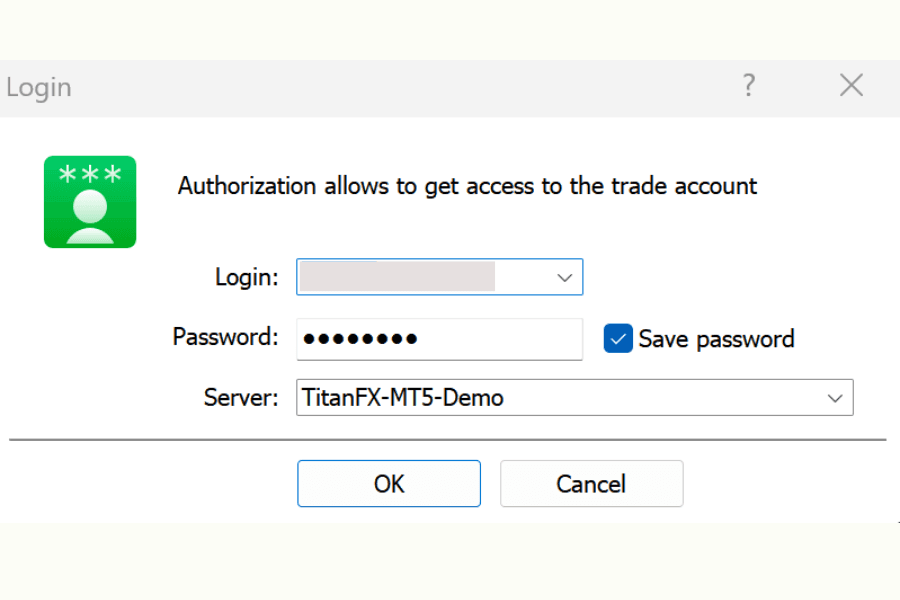
Step 1: Log In to Your Trading Account
Open a Titan FX trading account (Zero Standard or Zero Blade), complete your deposit, then download the MT4 or MT5 platform and log in with your credentials.
Step 2: Add FRA40 to Market Watch
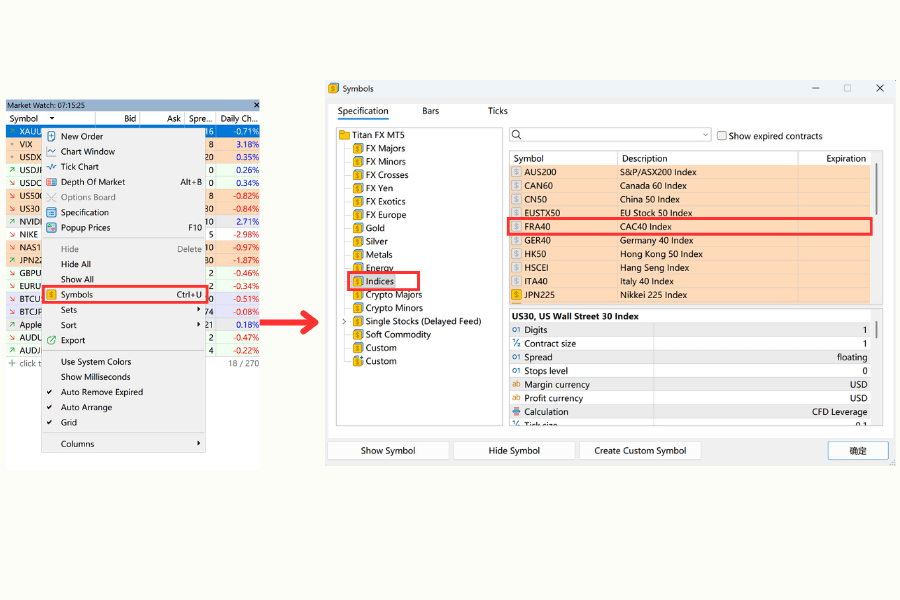
Right-click in the Market Watch window, select "Symbols," expand the "Indices" category, find FRA40 (France 40 Index), and double-click to add it to your quote list.
Step 3: Start Trading
Double-click the FRA40 quote or open a chart to access the order window. Enter the lot size (minimum 0.01 lots), select buy or sell, set your stop loss and take profit, and execute the trade.
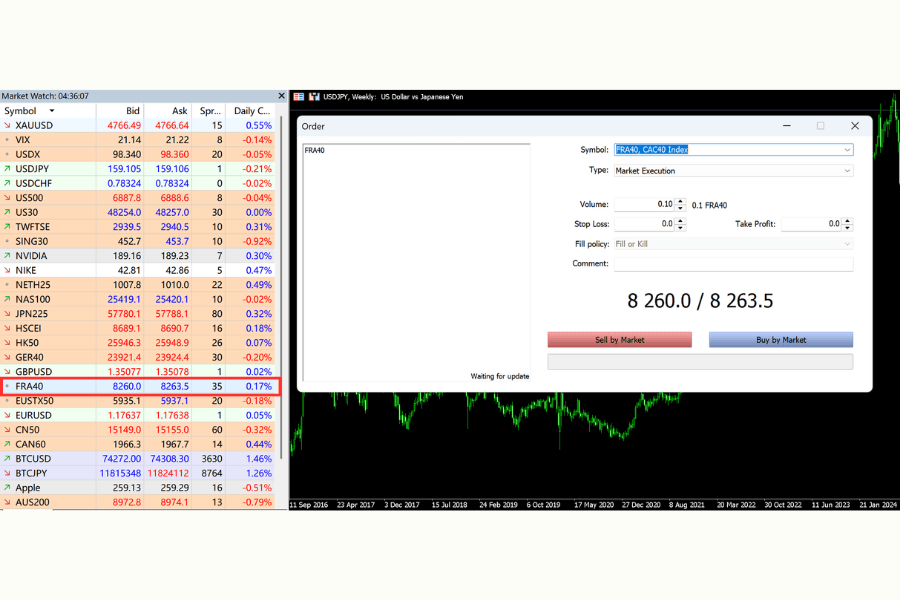
Titan FX offers free demo accounts so you can practice FRA40 trading flows and platform operations in a risk-free environment.
Trading Hours
FRA40 trading hours are as follows:
| Time Zone | Winter Time (GMT+2) | Summer Time (GMT+3) |
|---|---|---|
| MT4/MT5 Server | 09:05-23:00 | 09:05-23:00 |
| London (GMT) | 07:05-21:00 | 07:05-21:00 |
| Tokyo (GMT+9) | 16:05-06:00 next day | 15:05-05:00 next day |
Liquidity is highest during the overlap of European and U.S. trading sessions.
Titan FX Analysis Tools
Titan FX provides a range of analysis tools to help traders assess the technical outlook for FRA40:
- Support and Resistance: Identify key price levels for FRA40 and assess breakout or bounce potential
- Order Book (Position Info): View other traders' pending order distribution and long/short ratios
- Trend Analysis: Determine whether FRA40 is in an uptrend, downtrend, or ranging phase
- RSI Analysis: Identify overbought or oversold conditions to assist with reversal timing
- Volatility Heatmap: Understand FRA40 volatility patterns across different trading sessions
- Percentage Change Ranking: Compare FRA40's real-time performance against other indices
- Swap Calendar: Check overnight financing rates for FRA40
- Dividend Calendar: Track the impact of constituent ex-dividends on CFD accounts
- Margin Calculator: Calculate required margin and appropriate position sizes
For the latest trading conditions and spreads, please refer to the official page.
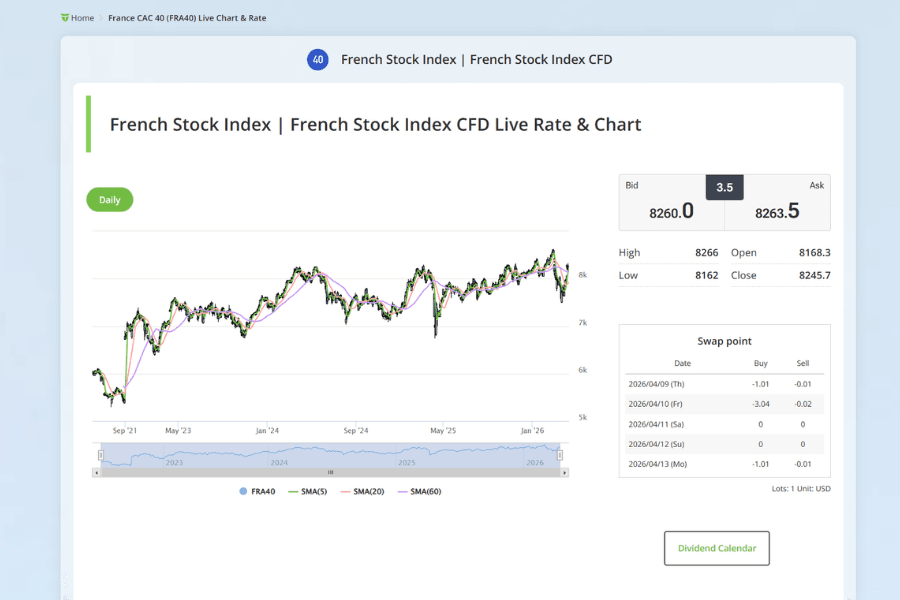
For the latest trading conditions and live prices, see the FRA40 instrument page.
Start Trading the CAC 40 Index
Trade FRA40 CFDs on Titan FX with up to 500x leverage, tight spreads, and the flexibility to go long or short. Both Zero Standard and Zero Blade accounts support index CFD trading (Zero Micro accounts do not support index CFDs).
FAQ
Is the CAC 40 suitable for long-term investment?
The CAC 40 has characteristics suited to both long-term investing and short-term trading. From a long-term perspective, its constituents span the core industries of the French and global economy, with leading companies in luxury goods, aerospace, and energy offering stable long-term growth potential. However, the CAC 40 is relatively sensitive to ECB policy and global consumption trends, and short-term volatility can be significant. Long-term investors should track macroeconomic fundamentals using France's economic indicators.
What are the main risks of investing in the CAC 40?
Key risks include: policy risk, as unexpected ECB policy shifts (such as accelerated rate hikes or tapering) can trigger sharp market movements; geopolitical risk, as European conflicts and trade disputes may affect corporate earnings expectations; sector concentration risk, as the high luxury sector weighting means the index can face substantial pressure when high-end consumption demand slows; and leverage risk, as FRA40 supports up to 500x leverage, requiring strict stop-loss settings and limiting single-trade risk to 1-2% of account equity.
How does the CAC 40 differ from the DAX in terms of performance?
The CAC 40 and DAX are both core eurozone indices with highly correlated movements, but differences in sector composition can lead to performance divergence. The CAC 40 is more influenced by luxury consumption and global tourism demand, while the DAX is dominated by automotive, chemical, and industrial manufacturing sectors, making it more sensitive to global manufacturing conditions and Chinese industrial demand. When global high-end consumption is strong, the CAC 40 tends to outperform the DAX; conversely, during global industrial expansion cycles, the DAX typically delivers relatively stronger performance.
Summary
The France CAC 40 Index (FRA40) is one of Europe's most representative equity benchmark indices, bringing together leading companies in luxury goods, energy, aerospace, financials, and healthcare. Given the high degree of internationalization among its constituents, the CAC 40 serves not only as a measure of French economic performance but also as an important barometer for global economic trends.
Understanding ECB policy direction, tracking global luxury consumption trends and energy price movements, and using technical analysis tools to time entries and exits form the fundamental framework for trading FRA40.
Use Titan FX's FRA40 live quotes and chart page to stay on top of market developments, and check out the Dow Jones (US30) trading guide and Nasdaq 100 (NAS100) trading guide for more international index trading strategies.