

What Is the FTSE 100 Index (UK100)? Components & Trading Guide
UK100 is the flagship index tracking the performance of the UK stock market. Launched by FTSE Russell in 1984, it comprises the approximately 100 largest companies listed on the London Stock Exchange. From HSBC and Shell to AstraZeneca, these constituents represent the most influential multinational corporations in the British and global economy.
For CFD traders, UK100 is one of the most important indices for accessing the European market. The index is driven by multiple factors including UK macroeconomic data, Bank of England (BoE) monetary policy, the sterling exchange rate, and global market sentiment, providing abundant trading opportunities. This article provides a comprehensive analysis of UK100's trading logic, covering the index definition, constituents, price drivers, and practical trading methods.
What Is the FTSE 100 Index (UK100)?
The FTSE 100 Index is a benchmark stock market index launched on January 3, 1984, by FTSE Russell, one of the world's leading index providers. In CFD trading, the FTSE 100 Index uses UK100 as its trading symbol.
The index selects the approximately 100 largest companies by free-float market capitalization listed on the London Stock Exchange (LSE), making it the core measure of UK stock market performance and one of Europe's most important equity benchmarks.
| Item | Details |
|---|---|
| Official Name | FTSE 100 Index |
| Trading Symbol | UK100 (CFD) |
| Launch Date | January 3, 1984 |
| Index Provider | FTSE Russell |
| Weighting Method | Free-float market capitalization weighted |
| Number of Constituents | Approximately 100 |
| Review Frequency | Quarterly (March, June, September, December) |
| Denomination Currency | British Pound (GBP) |
The FTSE 100 holds a distinct position among major European indices. While the German DAX 40 Index (GER40) focuses on German industrial and manufacturing leaders and the Euro Stoxx 50 Index (EUSTX50) covers blue-chip stocks across the eurozone, UK100 is characterized by its high degree of internationalization -- over 70% of constituent revenues are generated outside the UK, making it both a barometer of the British economy and an important reference for global economic trends.
Index Methodology and Constituents
Constituent Selection Criteria
The FTSE 100 Index applies the following screening criteria for constituent selection:
| Criterion | Description |
|---|---|
| Listing Venue | Companies listed on the London Stock Exchange (LSE) Main Market |
| Free-Float Market Cap | Ranked by free-float market capitalization; top ~100 selected |
| Liquidity Requirements | Must meet minimum trading volume and frequency thresholds |
| Nationality Requirement | Must be incorporated in the UK or designated countries/territories |
| Quarterly Review | Constituent adjustments in March, June, September, and December |
It is worth noting that due to some companies having dual share class structures (e.g., different classes of ordinary shares), the actual number of constituents may slightly exceed 100.
Sector Composition (2025)
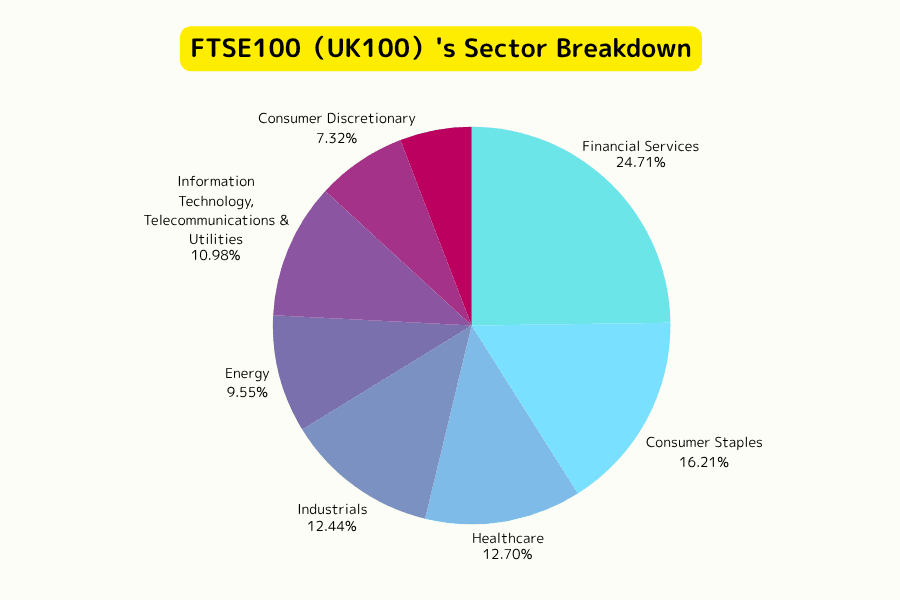
The FTSE 100 Index covers the core sectors of the UK economy. Below are the weightings and representative companies for each sector:
| Sector | Weight | Representative Companies |
|---|---|---|
| Financial Services | 24.71% | HSBC, Barclays, Lloyds, Prudential |
| Consumer Staples | 16.21% | Unilever, Diageo, British American Tobacco |
| Healthcare | 12.70% | AstraZeneca, GlaxoSmithKline, Smith & Nephew |
| Industrials | 12.44% | Rolls-Royce, BAE Systems, Intertek |
| Tech / Utilities / Telecom | 10.98% | Sage Group, BT Group, Vodafone |
| Energy | 9.55% | Shell, BP, SSE |
| Consumer Discretionary | 7.32% | Compass Group, Next, InterContinental Hotels |
| Basic Materials | 5.82% | Rio Tinto, BHP, Anglo American |
Sector Composition Characteristics
UK100's sector composition reflects the UK economy's unique positioning. Financial services is the largest sector, with HSBC, Barclays, and other banking stocks carrying significant weight due to London's status as a global financial center. The presence of multinational companies such as Shell, BP, and Rio Tinto in the energy and basic materials sectors makes UK100 highly sensitive to commodity prices. The healthcare sector benefits from the global operations of pharmaceutical giants AstraZeneca and GSK.
Key Price Drivers
1. UK Macroeconomic Data
UK GDP growth, inflation, employment, and retail data directly influence the overall direction of UK100.
-
UK GDP Growth Rate (Preliminary): Economic growth is the core indicator affecting corporate earnings expectations
-
UK CPI (Consumer Price Index): Inflation data directly influences the Bank of England's interest rate decisions
-
UK Unemployment Rate: Labor market conditions reflect the health of the economy
-
UK Retail Sales: Consumer spending is a major component of GDP
-
UK Manufacturing PMI: A leading economic indicator; PMI readings above the 50 expansion-contraction threshold are generally positive for UK100
2. Bank of England (BoE) Monetary Policy
The Bank of England's monetary policy has a profound impact on UK100:
-
BoE Interest Rate Decision: Rate hikes typically suppress equity prices (higher borrowing costs), while rate cuts are bullish
-
BoE Monetary Policy Committee (MPC) Minutes: Reveal committee members' voting patterns, allowing the market to anticipate future policy direction
-
BoE Quarterly Inflation Report: Contains economic forecasts and inflation outlook, serving as a key reference for policy guidance
3. Sterling Exchange Rate
The sterling exchange rate has a unique inverse relationship with UK100. Since over 70% of FTSE 100 constituent revenues are generated overseas, a weaker pound boosts these companies' sterling-denominated overseas profits, thereby lifting the index. Conversely, a stronger pound may weigh on index performance.
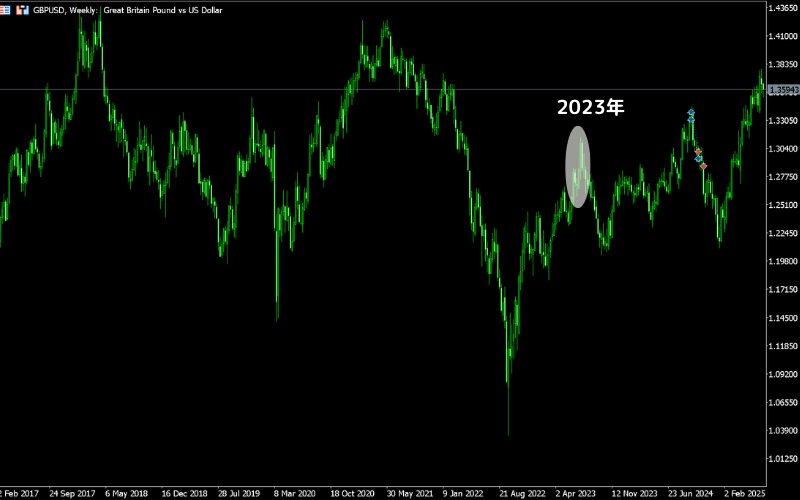
GBP/USD is the most important currency pair for gauging sterling strength. When trading UK100, closely monitor GBPUSD movements -- when the pound weakens, UK100 tends to find support; when the pound strengthens, the index may face headwinds.
4. Commodity Prices
UK100 is highly sensitive to commodity prices. The energy sector (Shell, BP) and mining sector (Rio Tinto, BHP, Anglo American) together account for approximately 15% of the index weight. When crude oil and metal prices rise, these stocks typically benefit, pushing UK100 higher; price declines have the opposite effect.
5. Global Market Sentiment and Geopolitics
As a highly internationalized index, UK100 is sensitive to global risk events:
-
Fed policy and US equity movements transmit sentiment effects to global stock markets
-
Chinese economic data influences commodity demand expectations, indirectly affecting mining and energy stocks
-
UK-EU trade relations continue to influence market confidence
Use Titan FX's Economic Calendar and UK Economic Indicators page to track the release times and market expectations of these key data points in real time.
Index Comparison and Trading Strategies
UK100 vs GER40 vs EUSTX50
| Item | UK100 (FTSE 100) | GER40 (DAX 40) | EUSTX50 (Euro Stoxx 50) |
|---|---|---|---|
| Constituent Scope | ~100 large-cap companies on the LSE | 40 companies on the Frankfurt Stock Exchange | 50 blue-chip stocks from 11 eurozone countries |
| Sector Characteristics | Financials + Energy + Healthcare dominant; highly internationalized | Industrials + Automotive + Technology dominant | Multi-country, multi-sector diversified |
| Currency Sensitivity | GBP weakness is bullish (overseas revenue 70%+) | EUR weakness is bullish (export-oriented) | EUR-denominated; currency impact is more diversified |
| Commodity Sensitivity | High (significant energy + mining weight) | Moderate | Relatively low |
| Volatility | Medium | Medium-High | Medium |
| Trading Session Advantage | Highest liquidity during the London session | Highest liquidity during the European session | Highest liquidity during the European session |
| Titan FX Symbol | UK100 | GER40 | EUSTX50 |
Key Trading Strategy Considerations
-
Sterling inverse play: The inverse relationship between UK100 and the pound is a unique trading signal. When GBPUSD drops significantly, watch for long opportunities in UK100; the reverse also applies
-
Commodity correlation: Crude oil and metal price trends have a significant impact on UK100. Rising oil prices are generally bullish for UK100 (large energy stock weight), but may also create pressure on other sectors through inflation
-
Central bank policy driver: BoE interest rate decisions are a key catalyst for UK100 short-term volatility. A rate hold or a smaller-than-expected rate hike is generally bullish for the index
-
London session trading: UK100 has the highest liquidity and tightest spreads during the London Stock Exchange trading hours, making it the optimal window for intraday trading
How to Trade UK100 on Titan FX
On the Titan FX platform, the FTSE 100 Index is traded under the symbol UK100, available on both MT4 and MT5 platforms via CFD (Contract for Difference) with leverage up to 500:1. You can also trade using WebTrader directly in your browser.
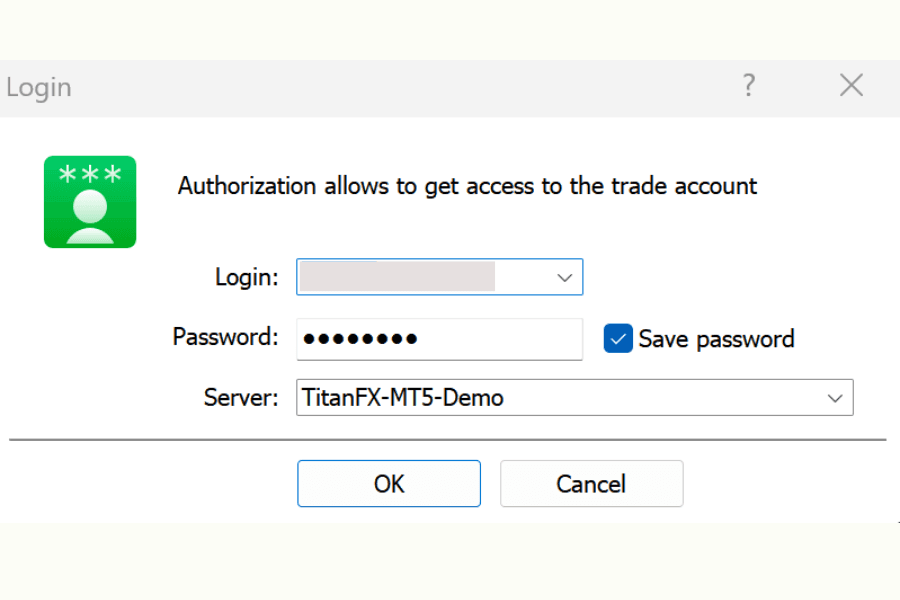
Step 1: Log In to Your Trading Account
Open a Titan FX trading account (Zero Standard or Zero Blade), complete your deposit, then download the MT4 or MT5 platform and log in with your credentials.
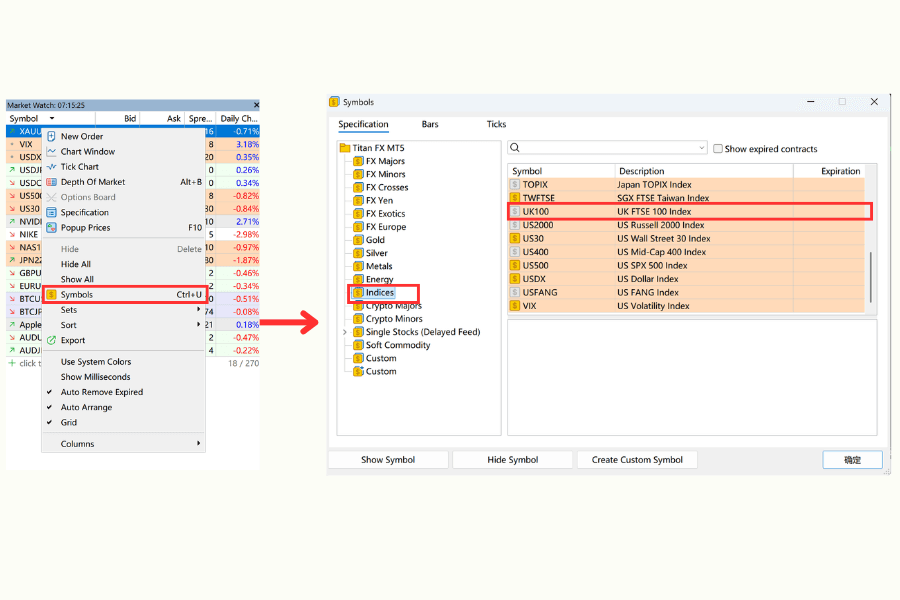
Step 2: Add UK100 to Market Watch
Right-click in the Market Watch window, select "Symbols," expand the "Indices" category, find UK100 (UK 100 Index), and double-click to add it to your quote list.
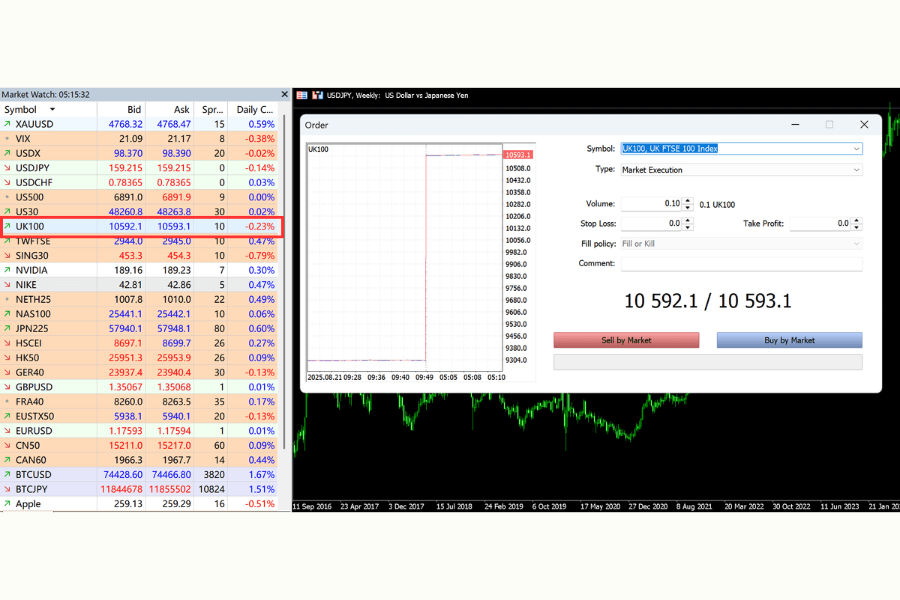
Step 3: Place a Trade
Double-click the UK100 quote or open a chart to access the order window. Enter your lot size (minimum 0.01 lots), select Buy or Sell, set your stop loss and take profit, and execute the trade.
Titan FX offers a free demo account, allowing you to familiarize yourself with UK100 trading procedures and platform operations in a risk-free environment.
Trading Hours
UK100 CFD trading hours cover the London, US, and Asian sessions:
| Time Zone | Standard Time (GMT+2) | Daylight Saving Time (GMT+3) |
|---|---|---|
| MT4/MT5 Server | 01:02-23:59 (Mon 01:05 open, Fri 23:00 close) | 01:02-23:59 (Mon 01:05 open, Fri 23:00 close) |
| Eastern Time (ET) | 19:02-17:59 | 19:02-17:59 |
| Taiwan / Hong Kong / Beijing (GMT+8) | 07:02-05:59 next day | 06:02-04:59 next day |
| Japan (GMT+9) | 08:02-06:59 next day | 07:02-05:59 next day |
UK100 CFD trading hours are significantly longer than the London Stock Exchange's regular trading session, covering the US and Asian sessions to allow traders to react to global events in real time.
Titan FX Analysis Tools
Titan FX provides a range of analysis tools to help traders assess UK100's technical outlook:
- Support and Resistance: Identify key UK100 price levels to assess breakout or reversal potential
- Order Book (Position Information): Observe other traders' pending order distribution and long/short ratios
- Trend Analysis: Determine whether UK100 is in an uptrend, downtrend, or consolidation phase
- RSI Analysis: Identify overbought or oversold conditions to support reversal timing decisions
- Volatility Heatmap: Understand UK100's volatility patterns across different trading sessions
- Percentage Change Ranking: Compare UK100's real-time performance against other indices
- Swap Calendar: Check UK100 overnight financing rates
- Dividend Calendar: Track the impact of constituent ex-dividend dates on CFD accounts
- Margin Calculator: Calculate required margin and appropriate position sizing
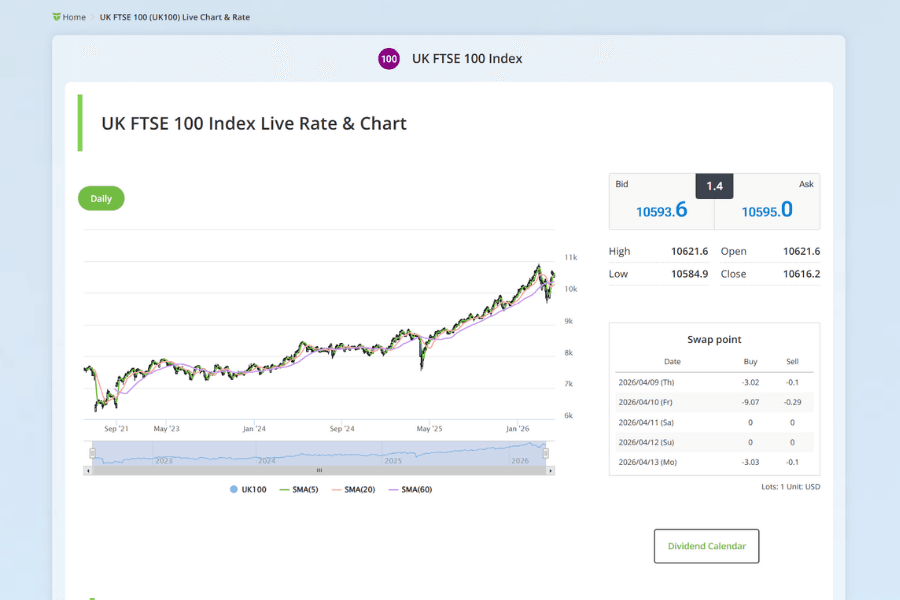
For the latest trading conditions and spreads, please refer to the official page.
For the latest trading conditions and live prices, see the UK100 instrument page.
Start Trading the UK100 Index
Trade UK100 CFDs with Titan FX and enjoy up to 500:1 leverage, tight spreads, and the flexibility to go long or short. Both Zero Standard and Zero Blade accounts support index CFD trading (Zero Micro accounts do not support index CFDs).
FAQ
Why does the FTSE 100 sometimes have more than 100 constituents?
This is because some companies have dual share class structures, such as issuing different classes of ordinary shares. Each class of shares is treated as a separate constituent, so the actual number of constituents may slightly exceed 100. However, the index's name and fundamental positioning remain centered on approximately 100 large-cap companies.
Does UK100 truly reflect the UK economy?
Over 70% of UK100 constituent revenues are generated outside the UK, so the index's performance reflects not only the domestic UK economy but is also strongly influenced by global economic trends. By contrast, the FTSE 250 Index, whose constituents are primarily focused on UK domestic operations, more directly reflects the UK's domestic economy. When trading UK100, it is important to monitor both UK domestic data and international market developments.
How do UK100 CFD trading hours differ from the London Stock Exchange trading hours?
UK100 CFD trading hours are significantly longer than the London Stock Exchange's regular trading session (GMT 08:00-16:30). CFD trading covers nearly around the clock, including Asian and US sessions, allowing traders to respond to global events in real time. However, be aware that liquidity is lower and spreads may widen during LSE off-hours.
Summary
The FTSE 100 Index (UK100) is one of Europe's most important equity benchmarks, bringing together global leading companies from the financial, energy, healthcare, and industrial sectors. Its highly international character makes UK100 not only an indicator of the UK economy but also an important weathervane for global economic trends.
Understanding the inverse relationship between the sterling exchange rate and UK100, tracking the Bank of England's monetary policy direction, monitoring commodity price movements, and applying technical analysis tools to time entries and exits form the fundamental framework for trading UK100.
Use Titan FX's UK100 live quotes and charts page to stay on top of market developments, and refer to the German DAX 40 Index (GER40) Trading Guide and the Euro Stoxx 50 Index (EUSTX50) Trading Guide to learn more about trading strategies for European market indices.