

What Is the EURO STOXX 50 (EUSTX50)? Components, Features & Trading Strategies
EUSTX50 tracks the performance of the eurozone's largest blue-chip stocks, covering 50 leading companies across financials, industrials, consumer goods, energy, and more. From ASML and LVMH to TotalEnergies, these constituents represent the backbone of the European economy.
For CFD traders, EUSTX50's sector diversity and strong correlation with European Central Bank (ECB) policy offer trading opportunities that differ significantly from U.S. equity indices. Whether tracking the progress of eurozone economic recovery or capturing short-term swings around ECB rate decisions, EUSTX50 is an essential instrument for gaining exposure to European markets. This article covers the index composition, price drivers, and practical trading strategies for EUSTX50.
What Is the Euro Stoxx 50 Index (EUSTX50)?
The Euro Stoxx 50 Index (EURO STOXX 50) is compiled by STOXX Ltd and serves as the eurozone's most representative blue-chip index, tracking the 50 largest publicly listed companies from 11 eurozone countries. Calculated using a free-float market-cap weighted methodology, it was officially launched on February 26, 1998, denominated in euros, and serves as the benchmark indicator for overall eurozone equity market performance.
| Item | Details |
|---|---|
| Official Name | EURO STOXX 50 Index |
| Trading Symbol | EUSTX50 (CFD) / SX5E (Cash Index) / EU50 |
| Year Established | 1998 (base date backdated to December 31, 1991, base value 1,000 points) |
| Number of Constituents | 50 |
| Weighting Method | Free-Float Market-Cap Weighted |
| Countries Covered | France, Germany, Netherlands, Spain, Italy, and 6 other eurozone nations |
| Denomination Currency | Euro (EUR) |
| Rebalancing | Annual reconstitution in September |
Unlike single-country indices such as the German DAX 40 (GER40), EUSTX50 spans multiple eurozone countries, providing broader geographical diversification. Compared to the S&P 500 (US500), EUSTX50 has a more balanced sector distribution, with significantly higher weightings in financials and industrials relative to the tech-dominated U.S. index.
Components and Sector Breakdown
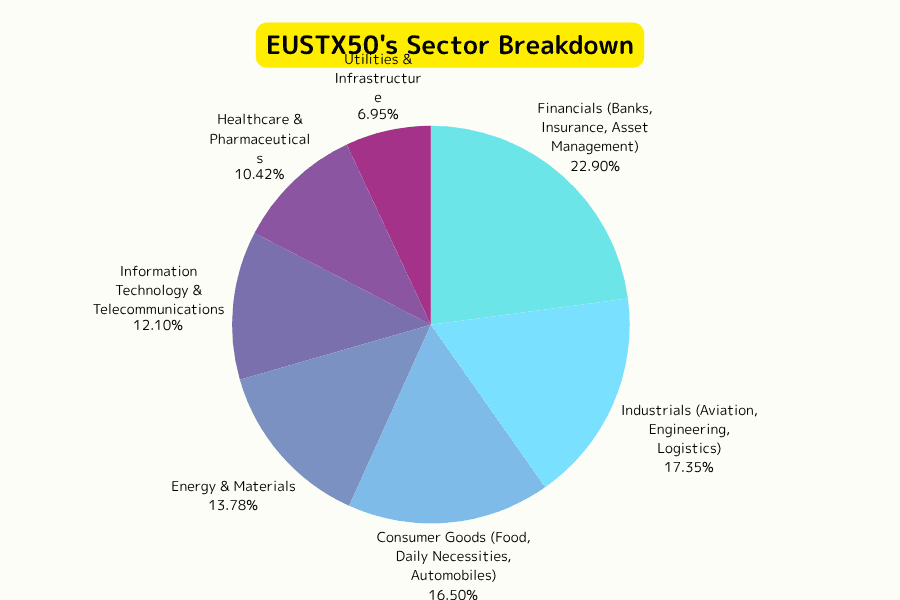
EUSTX50's sector distribution is highly diversified -- this is its biggest differentiator from the tech-concentrated U.S. equity indices. Below is the major sector breakdown:
| Sector | Weight (approx.) | Key Companies |
|---|---|---|
| Financials | ~22.9% | BNP Paribas, Allianz, Banco Santander, AXA |
| Industrials | ~17.4% | Airbus, Siemens, DHL Group, Schneider Electric |
| Consumer Discretionary | ~16.5% | LVMH, Unilever, Volkswagen, Kering |
| Energy | ~13.8% | TotalEnergies, Enel, ENI |
| Information Technology / Telecom | ~12.1% | ASML, SAP, Nokia, Deutsche Telekom |
| Healthcare | ~10.4% | Sanofi, Novo Nordisk, Bayer |
| Utilities | ~7.0% | Iberdrola, ENGIE |
Financials carry the highest weighting (approximately 23%), meaning ECB interest rate policy has a particularly direct impact on EUSTX50. Meanwhile, ASML (the world's sole supplier of advanced semiconductor lithography equipment) and LVMH (the world's largest luxury goods group) are the individual constituents with the greatest influence on the index.
By country, France and Germany together account for over 60% of the index weight, with the Netherlands (ASML, ING), Spain (Santander, Iberdrola), and Italy (Enel, Intesa) also holding significant shares.
Key Factors That Move the Price
Macroeconomic Environment
EUSTX50 is highly sensitive to eurozone economic data. The following indicators are worth monitoring closely:
-
Eurozone GDP Growth Rate: Economic expansion supports corporate earnings expectations and directly drives the index higher
-
HICP (Harmonised Index of Consumer Prices): The eurozone's core inflation indicator, directly influencing the ECB's interest rate policy direction
-
Unemployment Rate: Reflects labor market health, affecting consumer spending and corporate revenue expectations
-
PMI (Purchasing Managers' Index): Manufacturing and services PMIs are leading indicators for gauging economic momentum, with a significant impact on short-term price action
Sector and Company-Level Factors
- Semiconductor cycle: As the world's sole supplier of advanced lithography equipment, ASML's order outlook and capacity plans directly influence the technology sector's performance
- Luxury goods and consumer confidence: Revenue at luxury giants like LVMH and Kering is heavily dependent on Asian (particularly Chinese) consumer demand, with China's economic recovery or slowdown reflected in share prices
- Banking profitability: Eurozone bank net interest margins fluctuate with ECB rate changes -- rising rates expand bank profits, while rate cuts compress margins
- Energy costs: Energy stocks such as TotalEnergies and Enel are influenced by international oil and natural gas prices, with energy price volatility also indirectly affecting overall corporate costs
Geopolitical Factors
- EU political developments: European Parliament elections, national election outcomes, and EU fiscal policy negotiations can all trigger market volatility
- U.S.-EU trade relations: Tariff policy changes directly impact export-oriented companies such as Airbus and automotive manufacturers
- Russia-Ukraine conflict: Energy supply security, sanctions measures, and geopolitical risk premiums continue to affect European market risk appetite
Monetary Policy
The European Central Bank (ECB) interest rate decision is one of the most important single factors influencing EUSTX50.
- Rate cuts / easing: Lower corporate borrowing costs, push up equity valuations, and support EUSTX50
- Rate hikes / tightening: Raise funding costs and suppress valuations, but benefit bank net interest margins
- Asset Purchase Programme (APP) / Quantitative Tightening: Directly affects market liquidity and risk appetite
Currency Factors
The EUR/USD exchange rate has an indirect but important influence on EUSTX50. A weaker euro benefits export-oriented companies (Airbus, LVMH, etc.) as overseas revenues increase when converted back to euros. However, excessive euro weakness may also signal underlying weakness in eurozone economic fundamentals.
Use Titan FX's Economic Indicators Calendar to track all the important eurozone economic data releases and market expectations in real time.
Advantages and Risks
Advantages
-
High sector diversification: Covers financials, industrials, consumer goods, energy, technology, and healthcare, allowing downside risk in any single sector to be partially offset by others
-
Geographical diversification: Constituents are drawn from 11 eurozone countries, spreading single-country economic and political risk
-
Eurozone economic representation: The 50 constituents account for a significant share of eurozone equity market free-float capitalization, making it an efficient tool for gauging overall European equity performance
-
Deep liquidity: EUSTX50 futures are among the most actively traded equity index futures globally, and the CFD market is equally active, enabling smooth entries and exits
-
Dividend yield: European blue-chip stocks generally have higher payout ratios, and EUSTX50's overall dividend yield typically exceeds that of major U.S. indices
Risks
-
Market volatility: Geopolitical conflicts, ECB policy shifts, or global risk events can trigger sharp swings
-
Intra-eurozone economic divergence: Economic performance in Germany and France may differ significantly from southern European countries, and fiscal issues in certain member states could weigh on the overall index
-
Currency risk: For traders not denominated in euros, euro exchange rate fluctuations add an extra layer of impact on actual profit and loss
-
Interest rate policy sensitivity: With a high share of financial stocks, the index reacts sharply to ECB policy shifts
-
Geopolitical risk: Europe sits within a complex geopolitical environment, where regional conflicts, energy security concerns, and trade tensions can cause sharp short-term volatility
Trading Strategies
Technical Analysis Tools (Titan FX Tools)
Titan FX provides a range of analytical tools to help traders assess EUSTX50's technical conditions:
- Support & Resistance: Identify key EUSTX50 price levels and assess the likelihood of breakouts or bounces
- Order Book (Position Information): Observe the distribution of pending orders and long/short ratios among market participants
- Trend Analysis: Determine whether EUSTX50 is currently in an uptrend, downtrend, or range-bound phase
- RSI Analysis: Identify overbought or oversold conditions to help time potential reversals
- Volatility Heatmap: Understand EUSTX50's volatility patterns across different trading sessions
- Percentage Change Ranking: Compare EUSTX50's real-time gains and losses against other indices
Specific Trading Approaches: Trend, Breakout, Event-Driven
Trend Trading
When the ECB's policy direction is clear (e.g., a sustained rate-cutting cycle or a hold), EUSTX50 tends to form medium-term trends lasting weeks to months. Use daily or 4-hour chart moving averages to confirm direction, enter on pullbacks to key support levels or moving averages, and hold with the trend.
Breakout Trading
EUSTX50 often consolidates in a narrow range ahead of ECB rate decisions or major economic data releases. When price breaks above or below the consolidation range on volume, it typically triggers a rapid directional move. Confirming with volume and RSI helps filter out false breakout signals.
Event-Driven Trading
ECB rate decisions, eurozone GDP and HICP inflation data, and earnings releases from heavyweight constituents such as ASML and LVMH can all trigger significant single-day moves in EUSTX50. When trading around events, consider reducing your standard position size by at least half and setting wider stop-loss distances.
How to Trade EUSTX50 on Titan FX
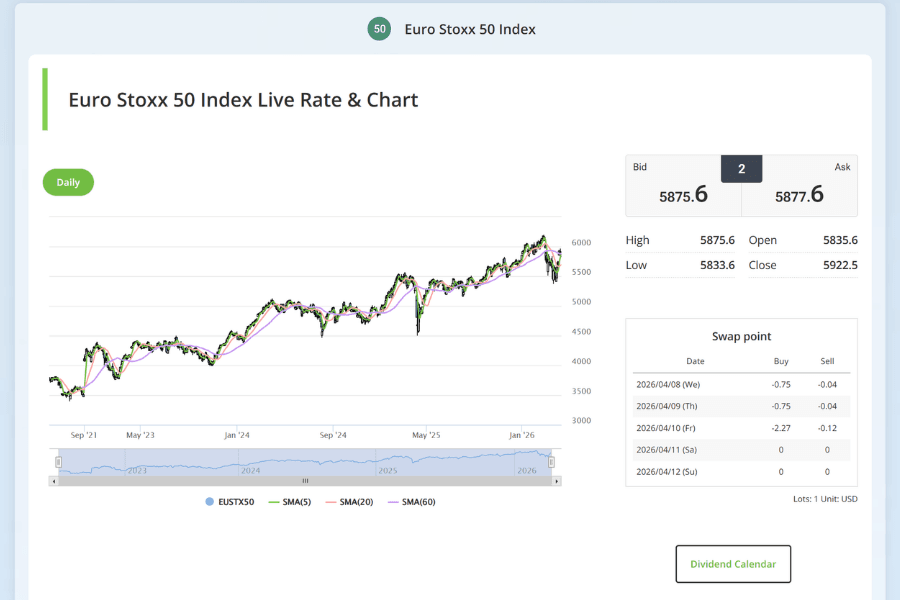
On the Titan FX platform, the Euro Stoxx 50 Index is traded as a CFD (Contract for Difference) under the symbol EUSTX50. You can also trade directly from your browser using WebTrader.
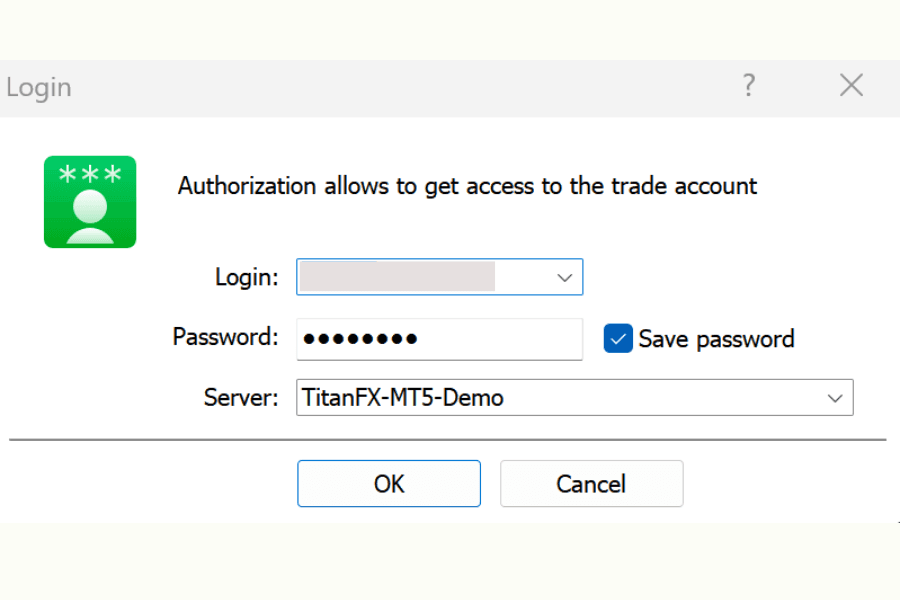
Step 1: Log In to Your Trading Account
Open a Titan FX trading account (Zero Standard or Zero Blade), complete your deposit, then download the MT4 or MT5 platform and log in with your credentials.
Step 2: Add EUSTX50 to Your Watchlist
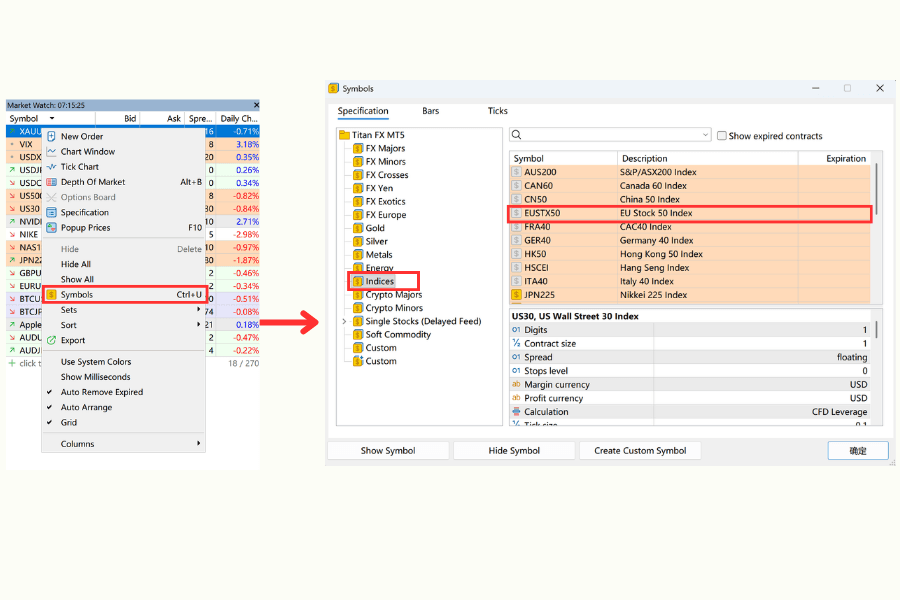
Right-click in the Market Watch window and select "Symbols." Expand the "Indices" category, find EUSTX50, and double-click to add it to your watchlist.
Step 3: Place Your Trade
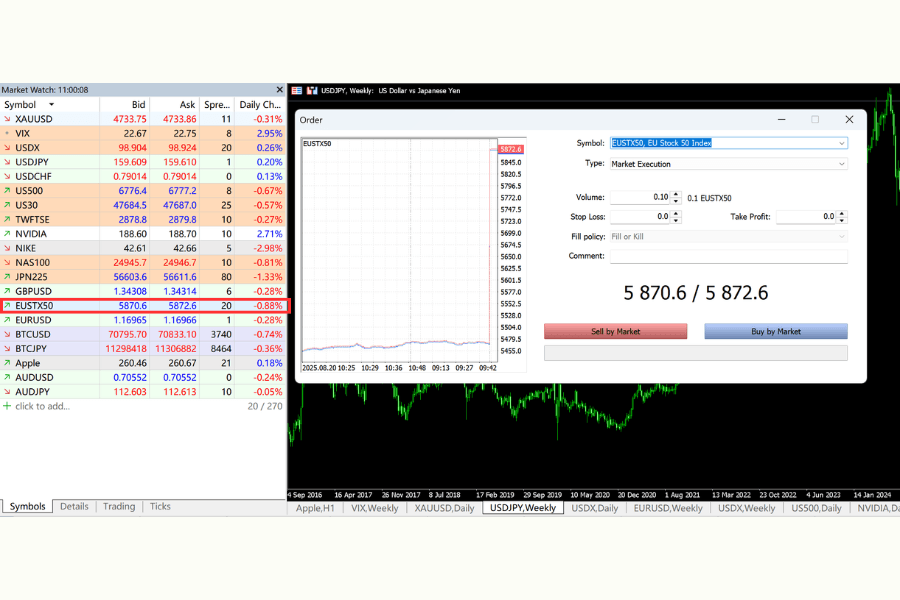
Double-click the EUSTX50 quote or open the chart to access the order window. Enter your lot size (minimum 0.1 lots), select buy or sell, set your stop loss and take profit levels, and execute the trade.
Trading Hours (MT4/MT5 Server Time GMT+3):
| Session | Winter Time (GMT+2) | Summer Time (GMT+3) |
|---|---|---|
| Main Trading Session | 09:00 - 23:00 | 09:00 - 23:00 |
| Eastern Time (Summer) | — | 02:00 AM - 04:00 PM |
For the latest trading conditions and spreads, see the official page.
Start Trading the EUSTX50 Index
Trade EUSTX50 CFDs on Titan FX with up to 500:1 leverage, tight spreads, and the flexibility to go long or short. Zero Standard and Zero Blade accounts support index CFD trading (Zero Micro accounts do not support index CFDs).
Key Considerations for New Traders
Leverage and Risk Management
Titan FX offers up to 500:1 leverage (Zero Standard / Zero Blade accounts). EUSTX50's average daily range is moderate to relatively high among European equity indices, making risk management critical when trading with high leverage:
- Keep per-trade risk within 1-2% of account equity
- Given the potential for gaps around major events (ECB decisions, geopolitical conflicts), avoid setting stop losses too tight
- Use Titan FX's Margin Calculator to determine required margin and appropriate position sizes
European Trading Session Characteristics
EUSTX50's primary liquidity is concentrated during the European trading session (approximately 2:00 AM - 5:00 PM Eastern Time during summer). Outside this session, spreads may widen and liquidity decreases. New traders are advised to focus on European session hours and avoid periods of thin liquidity.
ECB Rate Decision Volatility
The ECB interest rate decision takes place eight times per year and is the most important recurring event for EUSTX50. Beyond the rate change itself, the ECB President's press conference language and economic forecast revisions can trigger sharp price moves. The period around the decision carries the highest concentration of volatility, and less experienced traders may want to consider stepping aside temporarily.
Swap Rates and Dividend Adjustments
Holding EUSTX50 CFD positions overnight incurs swap charges. You can check the latest rates on the Swap Calendar. Additionally, when constituent stocks go ex-dividend, your account receives a dividend adjustment -- long positions are credited and short positions are debited.
Frequently Asked Questions
What is the difference between the Euro Stoxx 50 Index (EUSTX50) and the German DAX 40 (GER40)?
EUSTX50 covers 50 blue-chip stocks from 11 eurozone countries, offering broader geographical diversification. GER40 focuses exclusively on Germany's 40 largest listed companies. GER40 has a higher weighting in industrials and automotive, while EUSTX50 has a more pronounced weighting in financials and energy. For traders looking to gain exposure across the entire eurozone, EUSTX50 is the more comprehensive choice.
What is the difference between the Euro Stoxx 50 Index (EUSTX50) and the S&P 500?
EUSTX50 has a more balanced sector distribution with higher weightings in traditional sectors such as financials, industrials, and energy. US500, by contrast, is dominated by technology stocks. When ECB and Fed monetary policies diverge, the two indices may move in notably different directions, creating hedging or arbitrage opportunities for traders.
What are the trading hours for EUSTX50 CFDs?
EUSTX50 CFDs are available for trading on Titan FX from 09:00 to 23:00 (MT4/MT5 server time GMT+3), which corresponds to approximately 2:00 AM to 4:00 PM Eastern Time during summer. The most significant price action occurs after the European market opens through the first half of the U.S. session, when liquidity and volatility peak. For detailed information, see the Titan FX Index CFD Trading Conditions page.
What fees should I be aware of when trading EUSTX50?
The main costs of CFD trading include the spread (bid-ask difference), overnight swap charges, and potentially commissions. EUSTX50 spread levels and specific trading conditions can be found on the Titan FX website. Overnight positions incur swap charges, which can be checked on the Swap Calendar. Index CFDs also involve dividend adjustments -- when constituent stocks go ex-dividend, your account is credited or debited accordingly.
What technical indicators are useful for trading the Euro Stoxx 50 Index?
Commonly used technical indicators include moving averages (trend direction), RSI (overbought/oversold identification), Bollinger Bands (volatility measurement), and MACD (momentum confirmation). Titan FX's Trend Analysis and RSI Analysis tools provide real-time views of EUSTX50's technical conditions.
Summary
EUSTX50 is a core barometer of the eurozone economy, bringing together leading companies from financials, industrials, luxury goods, energy, and technology. Its balanced sector profile gives traders a risk diversification advantage that differs from U.S. equity indices, while its strong correlation with ECB policy creates abundant event-driven trading opportunities.
Understanding the ECB's policy direction, tracking key eurozone economic indicators, monitoring major constituents like ASML and LVMH, and combining these insights with technical analysis tools to time entries and exits form the fundamental framework for trading EUSTX50.
Use Titan FX's EUSTX50 real-time price chart page to stay on top of market developments and apply this article's analytical framework to your trading.