

Guppy Multiple Moving Average (GMMA):Basics & Application
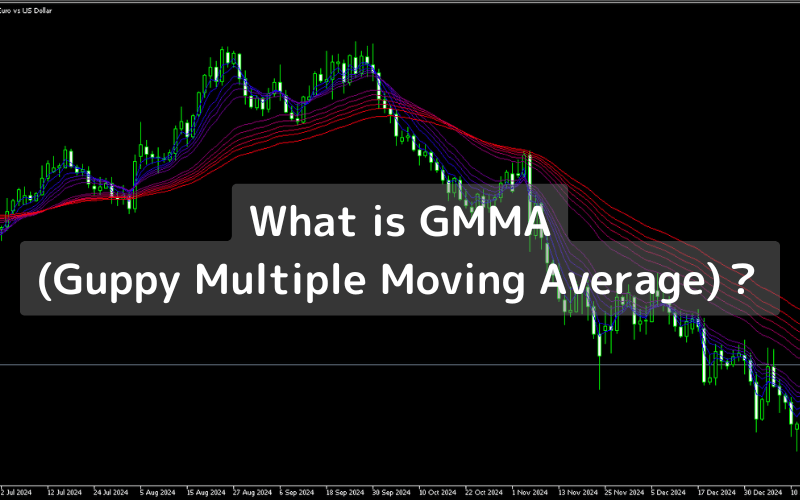
GMMA (Guppy Multiple Moving Average) is a trend indicator created by Daryl Guppy that plots 12 EMAs in short-term and long-term groups to reveal trend direction and strength.
In a trending market, a single moving average rarely tells the whole story — short-term sentiment and long-term money flow often pull in different directions. GMMA closes that gap by bundling several moving averages into one view, making a trend's direction, momentum, and turning points much easier to read and harder to mistake for short-term noise. This guide walks through the core idea, how to read the ribbons, and how to set GMMA up on MT4 and MT5.
- What GMMA is: a 12-EMA trend indicator created by Daryl Guppy
- Short vs long: 6 short EMAs (3-15) vs 6 long EMAs (30-60)
- 3 read methods: ribbon order, width contraction/expansion, group interaction
- Best market: strong in trends, false signals in ranges
- Use it well: confirm with RSI/MACD, backtest parameters per asset
1. What is GMMA (Guppy Multiple Moving Average)?
GMMA stands for "Guppy Multiple Moving Average," created by Australian trader Daryl Guppy.
The term "Guppy Multiple Moving Average" can be broken down as follows:
| Term | Meaning |
|---|---|
| Guppy | Refers to the tool's creator, Daryl Guppy, a well-known Australian trader. |
| Multiple | Represents "multiple" or "many," indicating an analysis tool that includes several moving averages. |
| Moving Average | A technical indicator used to smooth out price fluctuations and analyze market trends. |
GMMA combines 12 exponential moving averages (EMAs) from both short-term and long-term periods to analyze market trend direction and strength. The short-term lines reflect the market sentiment of short-term traders, while the long-term lines represent the trend expectations of long-term investors.
2. Interpreting GMMA
1. Dividing the Moving Averages into Short-Term and Long-Term Groups
GMMA consists of 12 EMAs. These are generally categorized into short-term and long-term groups:
| Type | EMA Periods | Function |
|---|---|---|
| Short-Term | 3, 5, 8, 10, 12, 15 | Reflects the market behavior and sentiment of short-term traders. It reacts quickly to price changes. |
| Long-Term | 30, 35, 40, 45, 50, 60 | Represents the trend expectations of long-term investors, providing a stable reflection of the trend. |
This categorization helps traders observe the interaction between short- and long-term trends, enabling them to better understand the market's overall condition.
2. Determining the Trend Based on the Order of the Moving Averages
The arrangement of moving averages is an important indicator for identifying the direction of the market trend. When the moving averages are arranged in a specific order, this phenomenon is called "Perfect Order", indicating a strong and persistent trend.
2.1 Uptrend
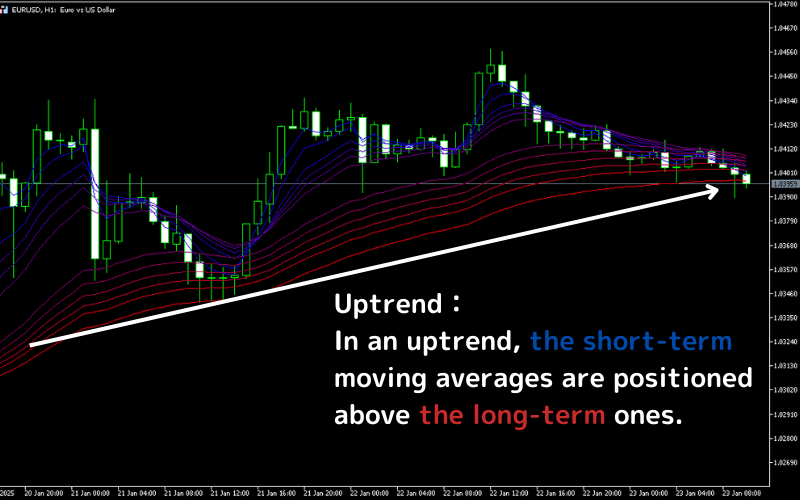
In an uptrend, the short-term moving averages are positioned above the long-term ones. The short-term lines will react first to price increases, quickly rising, while the long-term lines follow, forming an upward trend.
2.2 Downtrend
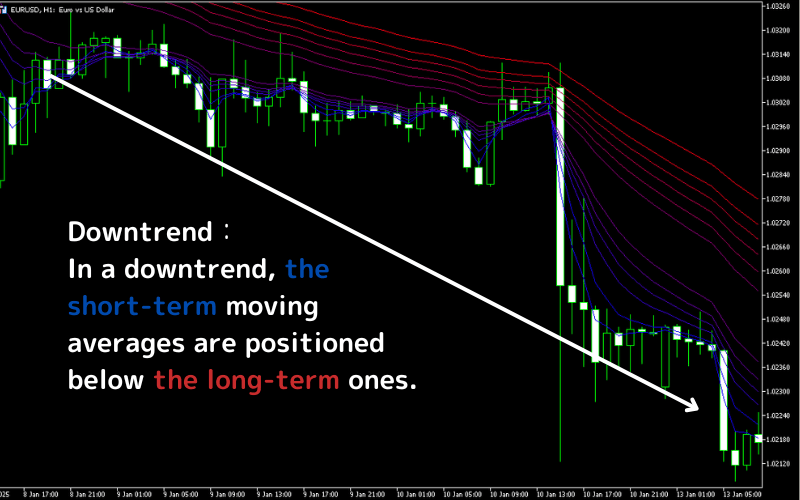
In a downtrend, the short-term moving averages are positioned below the long-term ones. The short-term lines will react first to price declines, falling before the long-term lines, forming a downward trend.
3. Using the Width Between the Moving Averages to Judge Trend Strength
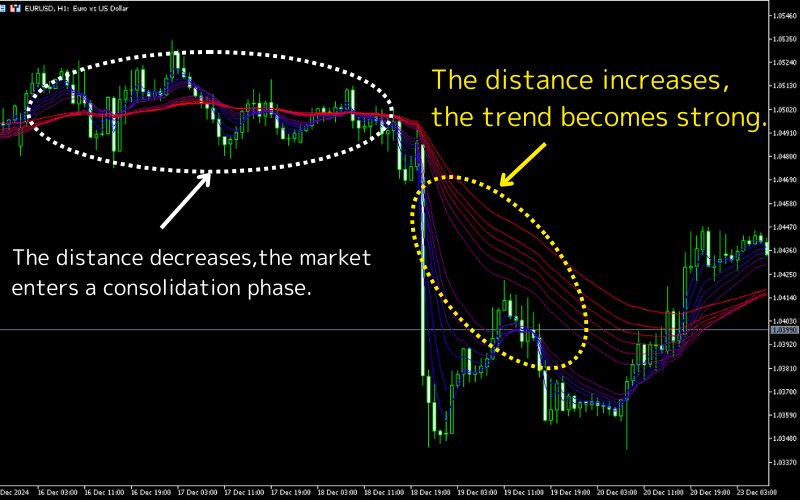
The width between the short-term and long-term moving averages reflects the strength of the trend:
| State | Characteristic | Market Signal |
|---|---|---|
| Narrowing | The distance between short-term and long-term lines decreases | The trend weakens or the market enters a consolidation phase. |
| Widening | The distance between short-term and long-term lines increases | The trend is strong and may continue for a while. |
3. Setting Up GMMA on MT4 and MT5
GMMA is not a built-in feature in MT4 or MT5. To use GMMA, you need to install a custom indicator. Titan FX offers a free Titan_GMMA indicator, which helps traders efficiently analyze market trends.
The installation of custom indicators on Titan FX is easy. Below are links to tutorials for installing and using GMMA:
| Content | Link |
|---|---|
| GMMA (Titan_GMMA) Usage Guide | Click to view Titan_GMMA usage guide |
| MT4 Custom Indicator Installation (Windows) | Click to view MT4 installation guide |
| MT5 Custom Indicator Installation (Windows) | Click to view MT5 installation guide |
| Overview of Titan FX Free Custom Indicators | Click to view all Titan FX custom indicators |
These tutorials will help you quickly install and set up the indicator, making the most of Titan FX's diverse tools to enhance your trading efficiency and accuracy.
4. Key Considerations When Using GMMA
While GMMA is a powerful tool for market analysis, it has specific use cases and limitations. Here are some important points to keep in mind when using GMMA:
1. Suitable for Trending Markets, Not Consolidating Markets
GMMA works well in trending markets, clearly identifying trend direction and strength. However, in consolidating markets, where prices lack clear direction, short-term and long-term lines may frequently cross, leading to false signals and increasing the chance of trading errors. Therefore, traders should confirm that the market is in a trending phase before using GMMA.
2. Avoid Over-Reliance on a Single Indicator
Although GMMA is a strong technical tool, relying solely on it for trading decisions can be risky. Traders should use GMMA in combination with other indicators (such as RSI, MACD, or Bollinger Bands) to confirm trend signals. Additionally, integrating fundamental analysis can further enhance the accuracy of the strategy and prevent the limitations of relying on a single indicator.
3. Misuse of Parameters Can Lead to Incorrect Judgments
GMMA's effectiveness depends on correctly setting parameters, such as the period of short-term and long-term moving averages. If the parameters do not align with market conditions or the trading strategy, the signals may be skewed, leading to poor decisions. Traders are advised to adjust the parameters according to their trading style (e.g., short-term or long-term) and test them using historical data to ensure they align with their strategy.
5. GMMA FAQs
Q1. How is GMMA different from a single EMA or SMA?
A single EMA or SMA shows the trend for one time period only. GMMA combines multiple short-term and long-term averages at once, giving a fuller picture of market structure and trend strength. See §2.
Q2. Which timeframes suit GMMA best?
GMMA works on any timeframe, but the 15-minute chart and above is recommended to filter out short-term noise for clearer signals.
Q3. How should I use GMMA in a ranging market?
In a range, pair GMMA with tools like Bollinger Bands or ADX to confirm the consolidation zone, or wait for a trend breakout before entering to avoid false short-term signals. See §4.
Q4. Can GMMA be applied to assets other than forex?
Yes. GMMA suits any trending market — stocks, indices, futures, and gold — though you should fine-tune parameters to each asset's volatility. See §4.
Q5. How should I set a stop-loss when using GMMA?
A common approach is to place the stop based on long-term-average support/resistance, or at the low/high of the most recent consolidation range.
6. Conclusion: Combining GMMA with Titan FX to Enhance Trading Performance
GMMA (Guppy Multiple Moving Average) is an effective technical analysis tool, especially in trending markets. By combining short-term and long-term moving averages, GMMA helps traders capture market movements more accurately.
With Titan FX's free Titan_GMMA indicator, traders can seamlessly integrate this tool with MT4 and MT5 platforms, improving their trend analysis and trading efficiency. In a stable trading environment, managing risks and achieving consistent profits becomes easier. Choose Titan FX and make your trading more competitive!
Further Reading
- Moving Average (MA) explained
- Exponential Moving Average (EMA)
- Granville's 8 Rules
- What is MACD?
- Titan_GMMA indicator guide
Titan FX Trading Strategy Lab. We produce investor-education content covering forex, commodities (crude oil, precious metals, agricultural goods), stock indices, U.S. equities, and digital assets.
Primary Sources (by Category)
- Indicator creator: Daryl Guppy, Trading with the Guppy Multiple Moving Average and related works — the original GMMA source
- Titan FX official: Titan_GMMA indicator, Technical analysis