

Microsoft (MSFT) Investing Guide: Overview, Drivers, and Trading
Among US technology stocks, Microsoft (MSFT) has long been seen as a name that combines "stability" with "growth." Unlike some tech companies that depend heavily on a single product or short-term theme, it has spent years cultivating the enterprise market and built a complete ecosystem spanning operating systems, cloud services, and enterprise software.
As cloud and artificial intelligence become the core of enterprise digital transformation, Microsoft has returned to the market's focus in recent years. For beginners, the key to understanding Microsoft is not just share-price moves but why it keeps its competitiveness across different tech cycles.
This article systematically organizes Microsoft's investment points — from company positioning, share-price history, and the core factors affecting valuation, to practical ways to invest and trade — to help you judge whether MSFT belongs in your US-stock portfolio.
- Cloud + software + AI platform: Microsoft (MSFT) spans Windows, Office 365, Azure, LinkedIn, and Xbox, with enterprise customers at its core.
- Stability and growth combined: Enterprise subscriptions deliver predictable cash flow, while Azure cloud and AI drive medium- to long-term growth.
- Core share-price drivers: Azure growth, subscription stability, AI/OpenAI integration progress, PC and device cycles, and the macro capex environment.
- Growth engines: Copilot making AI a default feature, Azure becoming AI infrastructure, OpenAI shortening commercialization, and structural security demand.
- How to trade: Via stocks, ETFs, or CFDs for two-way (long/short) exposure; Titan FX offers MSFT US-stock CFDs with up to 20x leverage.
- 1. Microsoft Company Overview: Positioning, Products, and Business Map
- 2. Microsoft Share-Price History: From PC Era to Cloud and AI
- 3. Core Drivers of Microsoft's Share Price: Cloud, AI, and Enterprise Demand
- 4. Microsoft's Long-Term Growth Engines: Deepening AI and Enterprise Services
- 5. How to Trade Microsoft (MSFT) US-Stock CFDs: Steps and Tools
- 6. Frequently Asked Questions (FAQ)
- 7. Conclusion: Microsoft's Role in a Portfolio
1. Microsoft Company Overview: Positioning, Products, and Business Map
Microsoft (ticker: MSFT) was founded in 1975 by Bill Gates and Paul Allen, first establishing its industry standing in the PC era with the Windows operating system and Office software. As the PC market matured, Microsoft did not stay a traditional software company but kept adjusting its direction, gradually transforming into a cloud and platform-type tech company centered on enterprise customers.
Under current CEO Satya Nadella, Microsoft clearly focused on enterprise services, subscription software, and cloud infrastructure, successfully building a revenue structure more stable than any single product and laying the foundation for later AI expansion.
Positioning: An Enterprise Cloud and Software Platform
Unlike most consumer-focused tech companies, Microsoft's main advantage comes from enterprise and organizational customers. Its products are deeply integrated into companies' daily operating workflows, with high switching costs, allowing Microsoft to build long-term, sticky customer relationships.
This enterprise-grade positioning keeps Microsoft's revenue relatively stable through economic cycles and market volatility, making it one of the defensive large-cap tech stocks in investors' eyes.
Core Product Ecosystem and Platform Roles
Microsoft's enterprise and consumer ecosystem is formed by several product lines that support one another rather than operating in isolation:
| Platform / Service | Core Positioning | Role in the Overall Ecosystem |
|---|---|---|
| Windows | OS platform | The base environment for enterprise and personal PCs worldwide |
| Office 365 | Subscription productivity tools | A stable cash-flow source that deeply binds enterprise users |
| Azure | Cloud computing platform | Core infrastructure for cloud services and AI computing |
| Professional social platform | Talent, enterprise data, and business services | |
| Xbox / gaming | Gaming and content ecosystem | An extension of cloud, subscription, and content services |
These products share account systems, cloud architecture, and enterprise customer relationships, letting Microsoft cross-sell across services and improve overall efficiency and user stickiness.
Role in the AI Era: Platform Integrator and Infrastructure Supplier
Amid rapid AI development, Microsoft's strategy is not single-point applications but embedding AI into existing platforms. Through its partnership with OpenAI, Microsoft holds both advanced model capability and Azure cloud compute, and integrates Copilot into Office, Windows, and enterprise services.
This "cloud + software + AI" integration makes Microsoft an infrastructure and platform integrator in the AI era, rather than a mere app developer — an important source of its long-term competitiveness.
Overall, Microsoft has transformed from an early PC software company into a large tech platform combining cloud, enterprise services, and AI; this business structure and positioning are the core foundation of its long-term investment value.
2. Microsoft Share-Price History: From PC-Era Champion to AI Infrastructure Core
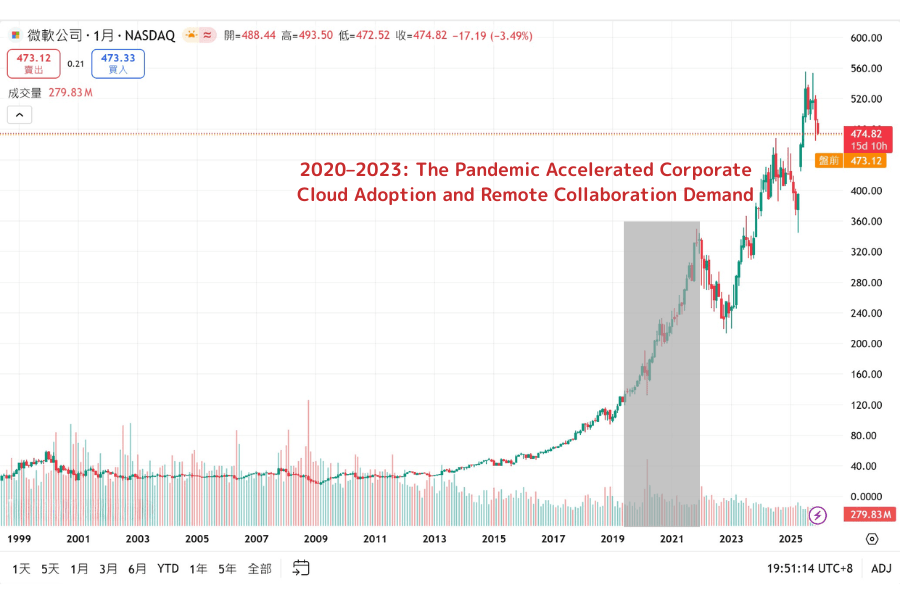
Microsoft's share-price path clearly reflects the transformation of its business model and market positioning.
From 2000 to 2013, as the PC market matured and Windows and Office growth slowed, Microsoft's share price traded in a range for a long stretch, with the market cautious about its future.
After Satya Nadella became CEO in 2014, the company fully pushed cloud-first and mobile-first strategies, Azure grew rapidly, and subscription software gradually replaced one-time licenses. The market began to re-rate Microsoft's long-term value, and the share price entered a structural uptrend.
From 2020 to 2023, the pandemic accelerated enterprise cloud migration and remote-collaboration demand. Azure and Office 365 kept strong growth, and Microsoft became one of the few tech companies that could expand steadily in an uncertain environment.
After 2023, generative AI became the new narrative core. As Copilot commercialization and AI-infrastructure investment expanded, the market saw Microsoft as a key infrastructure provider of the AI era, and the share price regained valuation support.
3. Core Drivers of Microsoft's Share Price: Cloud, AI, and Enterprise Demand
Driver 1: Azure Cloud Revenue Growth Rate
Azure is Microsoft's most core growth engine, and its revenue growth rate directly affects how the market judges the company's long-term cash flow and valuation. Enterprise cloud migration, data-analysis demand, and the compute load for AI training and inference all drive Azure's continued expansion.
As long as Azure maintains steady growth, the market usually grants Microsoft higher confidence and a higher rating.
Driver 2: Stability of Enterprise Subscriptions and Commercial Demand
Enterprise subscription services such as Office 365 and Dynamics give Microsoft a highly predictable revenue source. These products are deeply embedded in daily workflows with high switching costs, so even during a slowdown companies still need to run core IT and productivity tools.
This stable cash-flow structure is one of the key reasons Microsoft's share price is relatively resilient.
Driver 3: AI Integration Progress and OpenAI Partnership Benefits
The results of Copilot and the OpenAI partnership are an important basis for the market to assess whether Microsoft has next-stage growth potential. Investors focus not only on the AI technology itself but on whether these features convert into paid upgrades, improve enterprise efficiency, and actually show up in revenue and profit.
When AI commercialization goes smoothly, it usually brings the share price an extra valuation premium.
Driver 4: The PC and Device Business Cycle
Windows licensing and Surface devices are still highly correlated with the global PC market and are a more volatile business. Although their share of total revenue has clearly declined, they can still affect short-term results when demand falls.
Driver 5: Long-Term Extensibility of the Gaming and Content Business
The Xbox and Activision Blizzard acquisitions give Microsoft a more complete footprint in gaming and content. This business contributes little to profit in the short term, but under the integration of cloud, subscription, and content services it is viewed as a strategic investment with long-term synergy.
Driver 6: The Macro Market and Enterprise Capex Environment
Interest-rate levels, exchange-rate moves, and corporate IT capex budgets still affect the valuation baseline for tech stocks overall. Even with a stable business model, Microsoft cannot be fully immune to share-price swings driven by macro changes.
Overall, changes in Microsoft's share price are usually the result of several factors acting together, with Azure growth and AI commercialization progress remaining the core metrics the market watches most.
4. Microsoft's Growth Engines: An AI-Driven Next Decade
Growth Axis: AI Becomes a Default Feature of Enterprise Software
The key to Microsoft's growth over the next decade is not whether it adopts AI but whether AI becomes the standard configuration of enterprise software. Through Copilot, Microsoft embeds AI deeply into Office, Windows, and enterprise services, letting users use AI naturally within existing workflows rather than learning a new tool.
This integration raises willingness to pay and increases the likelihood of long-term enterprise renewals.
Cloud Role Upgrade: Azure From Service Platform to AI Infrastructure
Azure is not just a cloud computing platform but is gradually transforming into core infrastructure for AI training and inference. As enterprises adopt generative-AI applications, demand for compute resources, data processing, and security rises in tandem, and Azure's role in the enterprise market keeps deepening.
This kind of demand is structural growth, with an impact cycle measured in years rather than a single quarter.
Long-Term Significance of the OpenAI Partnership: Shortening Time to Commercialization
The value of Microsoft's partnership with OpenAI lies not only in technological leadership but in the ability to quickly commercialize model capability. Through its existing enterprise customer base, Microsoft can package AI features directly into enterprise services, shortening the time from technical breakthrough to revenue contribution.
This is also an important reason the market sees Microsoft as an AI platform company.
Extending New Use Cases: Gaming, Content, and Productivity
In gaming and content, AI can improve content-production efficiency and game-development processes and form new use cases with cloud streaming and subscription services. Such changes may not show up clearly in profit in the short term, but they help strengthen the stickiness of the overall ecosystem.
Structural Demand for Security Services
As cloud and AI applications spread, enterprise demand for security and compliance rises in tandem. Microsoft Security combines the cloud platform with enterprise software and is becoming a necessary service in enterprise IT architecture, bringing the company another potential long-term growth curve.
5. How to Trade Microsoft (MSFT) US-Stock CFDs: Steps and Tools
Investors can choose different ways to participate in Microsoft's (MSFT) market moves based on their strategy, risk tolerance, and capital. Among them, CFDs (contracts for difference) — with features such as two-way (long/short) trading and flexible leverage — have become a common tool for trading the swings of large-cap tech stocks.
The table below summarizes common ways to invest in MSFT and who they suit:
| Method | Key Features | Suitable For |
|---|---|---|
| Buy MSFT shares directly | Participate in long-term growth and capital appreciation | Long-term investors |
| ETF / index allocation | Diversify single-stock risk via tech or large-cap ETFs | Medium-term allocators |
| Contracts for difference (CFDs) | Leverage and long/short; highly flexible | Those focused on volatility and strategic trading |
Trading Steps: How to Trade Microsoft CFDs at Titan FX
To participate in Microsoft's two-way moves with a lower barrier, CFDs (contracts for difference) offer a relatively flexible approach, especially suited to investors who watch earnings, cloud and AI news, or shifts in market sentiment.
Titan FX's US-stock CFDs offer up to 20x leverage, letting investors participate in MSFT's price rises or falls with less capital. Here are the basic steps:
| Process | Description |
|---|---|
| Step 1: Register an account | Go to the Titan FX account-opening page, enter your basic details and complete verification to activate your trading account. |
| Step 2: Make a deposit | Log in to the Titan FX Client Cabinet and deposit via credit card, e-wallet, or bank transfer following the prompts. |
| Step 3: Download the MT5 platform | Microsoft US-stock CFDs are traded on MT5. Titan FX offers MT5 for Windows, Mac, iOS, Android, and Web. |
| Step 4: Start trading Microsoft CFDs | Launch MT5, log in, search for and add Microsoft in Market Watch, then choose Buy (long) or Sell (short) to place an order. |
Trading Microsoft via CFDs lets you participate in price moves without holding the underlying shares, but be mindful that leverage magnifies both gains and losses — pair it with clear capital management and a stop-loss strategy.
Free Trading Tools from Titan FX
To help investors track the rhythm of US stocks more effectively, Titan FX offers several practical tools to use alongside analysis:
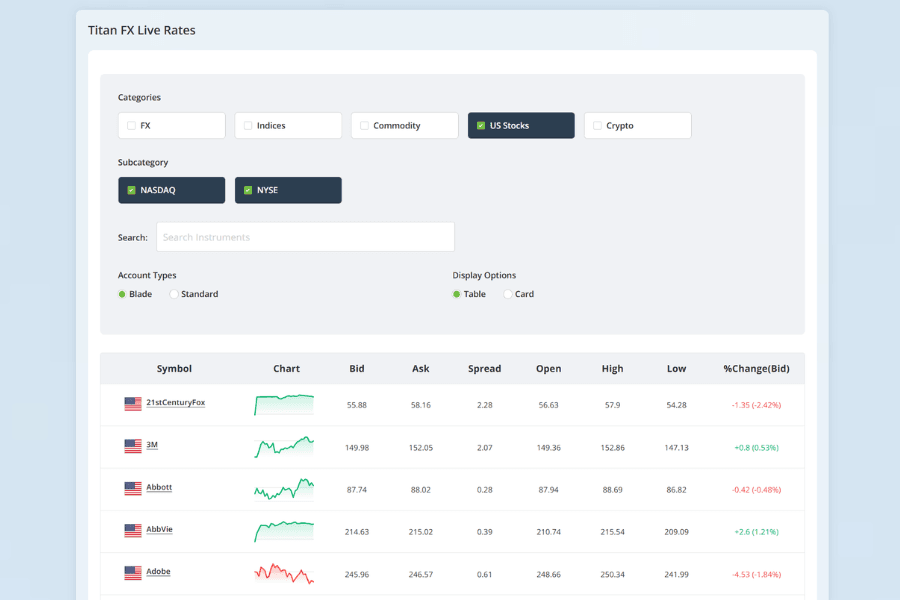
Live Rate
Live Rate provides the latest Bid/Ask, spread, intraday highs and lows, and a mini trend chart — a basic market-data source for short-term trading and strategy statistics.
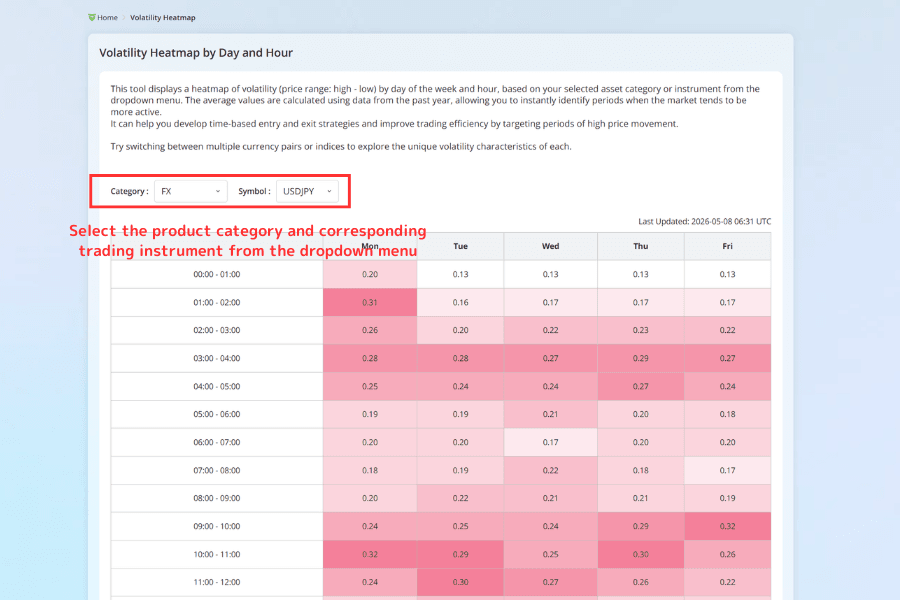
Volatility Heatmap
The Volatility Heatmap uses historical data to show how strongly an instrument moves at different times of day, helping you pick more suitable trading windows.
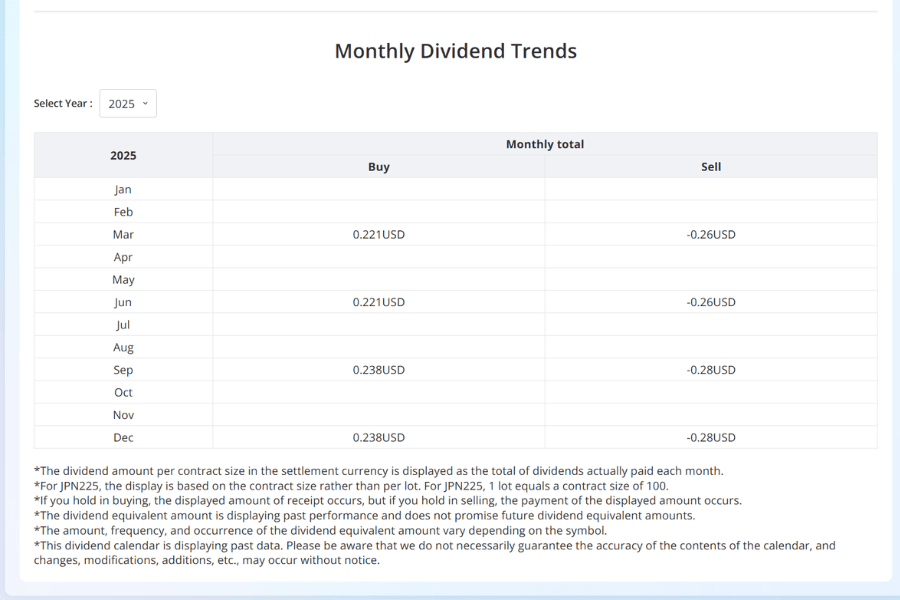
Dividend Calendar
View daily and monthly dividend records for US-stock companies in one place, including the actual dividend amounts at buy/sell, helping you track payout timing, compare yields, or plan a dividend strategy.
Trade MSFT CFDs with Titan FX
Titan FX offers Microsoft (MSFT) stock CFDs with up to 20:1 leverage, tight spreads, and the flexibility to go long or short without owning the shares.
6. Frequently Asked Questions (FAQ)
Q1. What are Microsoft's main risks?
Intensifying cloud-market competition, rising AI-related investment costs, regulatory and antitrust pressure, and the chance that enterprise IT spending turns conservative as the economy slows are all risk sources to watch when investing in Microsoft.
Q2. Is Microsoft a growth stock or a defensive tech stock?
Microsoft has both growth and defensive traits. Cloud and AI provide medium- to long-term growth momentum, while enterprise subscriptions and stable cash flow make it relatively resilient in volatile markets — positioning it between growth and defensive tech stocks.
Q3. Which financial metrics should you watch when investing in Microsoft?
For beginners, prioritize Azure's growth trend, changes in overall revenue and operating margin, and the renewal and growth of enterprise subscription services — these usually offer more reference value than a single quarter's profit.
Q4. Is MSFT better for long-term holding or swing trading?
If you are positive on the long-term development of cloud and AI, Microsoft suits a medium- to long-term holding. If you prefer short-term trading, you need to closely watch earnings, cloud-growth data, and shifts in market sentiment, and manage risk well.
Q5. How important is Azure to Microsoft's share price?
Azure is Microsoft's most core growth engine, and its revenue growth rate directly affects how the market judges the company's long-term cash flow and valuation. Enterprise cloud migration, data analysis, and AI compute demand all drive Azure's expansion, and as long as growth stays steady, the market usually rates MSFT highly.
Q6. Can you trade Microsoft (MSFT) at Titan FX?
Yes. Titan FX offers US-stock CFDs on Microsoft (MSFT) and other US stocks, with up to 20x leverage, two-way (long/short) trading, and no need to hold the underlying shares. US-stock CFDs are traded on the MT5 platform; understand MSFT's volatility and manage stop-losses and capital before trading.
7. Conclusion: Microsoft's Role in a Portfolio
Microsoft is not a typical high-volatility theme stock but a tech-platform company built on enterprise demand. Its core competitiveness comes from stable enterprise-subscription cash flow, the scale of its cloud infrastructure, and steadily deepening AI integration.
For investors, MSFT suits a core holding for medium- to long-term tech allocation rather than a short-term speculative target. Its share-price performance often reflects the enterprise IT investment cycle, cloud penetration, and AI commercialization progress, rather than a single event or short-term news.
If your goal is to balance growth and relative stability within the tech sector, Microsoft remains one of the most representative core choices in the US market. The key is not chasing short-term highs but understanding its business model and industry position, and placing it within an allocation ratio that fits you.
Further Reading
- What Is a CFD (Contract for Difference)?
- What Are Technology Stocks?
- What Is the Business Cycle?
- How to Install MT5
Titan FX Research. Investor-education content covering forex (FX), commodities (oil, precious metals, agricultural products), stock indices, US equities, and crypto assets across global markets.
Primary Sources by Category
- Official data and disclosures: Microsoft Corporation investor relations (10-K annual and 10-Q quarterly reports); U.S. SEC EDGAR filings
- Industry and research: cloud-computing, enterprise-software, and AI market research; major investment-bank tech-sector analysis
- Market data: Titan FX live quotes and US-stock CFD prices; US equity market analysis from major financial media