

Netflix (NFLX) Investing Guide: Price History, Risks, and Growth
Now that streaming has become a mainstream form of entertainment, Netflix (NFLX) is no longer just "a platform for watching shows" but a major company deeply influencing the global film-and-TV industry and capital markets. From the pioneer of the subscription model to a maturing company that in recent years has shifted toward profit and cash flow, every strategic change at Netflix has swayed investors' views on the future of streaming.
This article starts from the business model, share-price history, key drivers, and competitive advantages to help you fully understand how Netflix's positioning has shifted across market phases, and explains how beginner investors can participate in its market performance via stocks, ETFs, or CFDs — helping you build a clearer basis for judgment among information-heavy tech stocks.
- Streaming subscription leader: Netflix (NFLX) was the earliest to fully move entertainment to online subscriptions, sitting between a media company and a data-driven tech platform.
- Business model: A monthly subscription delivers stable, predictable revenue; the key is user retention and viewing stickiness, not any single title's box office.
- Valuation logic shift: From "fast subscriber growth" to "profit quality and free cash flow"; since 2023, account-sharing controls and ad plans have improved the revenue mix.
- Core drivers: Subscriber quality, content investment efficiency, the ad-subscription plan, free-cash-flow sustainability, and competition and market saturation.
- How to trade: Via stocks, ETFs, or CFDs for two-way (long/short) exposure; Titan FX offers NFLX US-stock CFDs with up to 20x leverage.
- 1. What Is Netflix? The Streaming Leader's Business Model
- 2. Netflix Share-Price History: Subscriber Growth and Shifting Expectations
- 3. Core Drivers of Netflix's Share Price: Subscribers, Content, and Profit Quality
- 4. Netflix's Competitive Advantages and Long-Term Growth Drivers
- 5. How to Trade Netflix (NFLX) US-Stock CFDs: Steps and Tools
- 6. Frequently Asked Questions (FAQ)
- 7. Conclusion: Netflix's Investment Value and Allocation Role
1. What Is Netflix? The Streaming Leader's Business Model
Netflix (ticker: NFLX) is one of the world's most representative streaming platforms and the company that most successfully moved film-and-TV entertainment fully to online subscriptions. For investors, Netflix's value comes not just from content itself but from how it combines technology, data, and the entertainment industry to build a scalable business model.
In the US market, Netflix is often seen as the bellwether of the streaming industry, and its strategy changes and operating results frequently serve as a key reference for observing the entire video-entertainment industry.
Background: From DVD Rentals to a Global Streaming Platform
Netflix did not start as a tech company but entered the market with a mail DVD-rental service. As internet bandwidth improved and streaming technology matured, the company gradually shifted its focus to online video and ultimately transformed fully into a streaming platform.
This transformation changed not only Netflix's operating model but also reshaped global film-and-TV consumption, moving viewers from watching TV at set times to watching content anytime, anywhere — laying the groundwork for the spread of subscription streaming.
Business Core: Stable Income from the Subscription Model
Netflix's core business model is a monthly subscription: users pay a fixed fee for unlimited viewing of platform content. This lets the company build a relatively stable and predictable revenue structure and reduces reliance on any single title's box office or on ad-market swings.
For management, the key metrics are no longer a single title's short-term performance but overall subscriber retention and viewing stickiness, which also shapes thinking on content investment and strategy.
Industry Positioning: Between a Media Company and a Tech Platform
Compared with traditional media companies, Netflix is closer to a data-centric tech platform. By analyzing users' viewing behavior, dwell time, and content preferences, it feeds those insights back into title selection and production direction, making content investment closer to actual demand.
This data-driven approach lets Netflix quickly push localized content in different markets while amplifying global distribution — an important reason it can sustain competitiveness over the long term.
2. Netflix Share-Price History: Subscriber Growth and Shifting Expectations
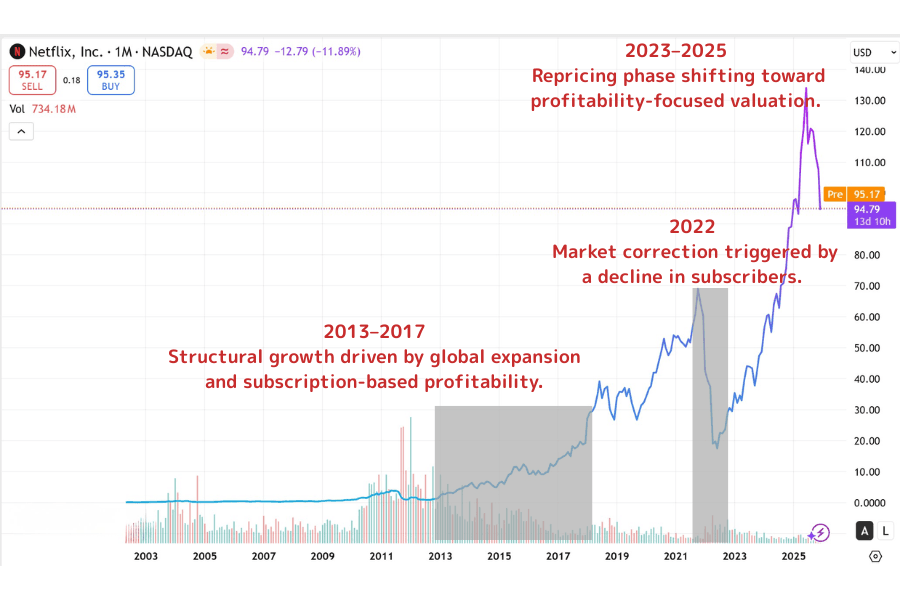
Netflix is a single listed company, and its long-term share-price trend is highly correlated with the maturing of its subscription model. From early rapid growth, to market re-pricing, to the recent profit-oriented shift, the share-price changes actually reflect how the market re-evaluated Netflix's growth logic.
Below we reorganize the more representative phases along the actual price path.
2013–2017: Structural Rise from Global Expansion and the Subscription Dividend
From 2013, Netflix accelerated its international rollout, and the streaming model began replicating quickly outside the US. Subscriber numbers grew steadily, and with the market strongly buying the narrative that "subscriptions disrupt traditional media," the share price entered a clear long-term uptrend.
The valuation core in this phase was continued user-base expansion and untapped global markets, with the market willing to price in future growth ahead of time.
2018–2019: Slowing Growth and a Range-Bound Valuation-Digestion Period
After 2018, Netflix's user growth gradually slowed while content spending kept rising, and the market began focusing on cash-flow pressure and intensifying competition. Although overall operations were still growing, the share price turned to high-level consolidation.
This period reflected the market shifting from "expectations of rapid growth" to re-evaluating "whether it has long-term profitability."
2020–2021: Short-Term Acceleration from the Pandemic Dividend
During the pandemic, demand for at-home entertainment surged, Netflix subscribers grew beyond expectations, the market reinforced its growth narrative, and the share price rose rapidly again.
However, this rally had clear special-event factors and did not come entirely from a structural change in the business model itself.
2022: A Confidence Correction from Falling Subscribers
As the pandemic dividend faded and subscribers fell for the first time, the market's doubts about Netflix's growth ceiling surfaced fully. The valuation logic shifted rapidly from growth-first to strict scrutiny of profitability and cost structure, and the share price corrected sharply.
This phase's decline was essentially a shift in market narrative, not the result of a single operating event.
2023–2025: A Re-Pricing Phase Toward Profit Orientation
From 2023, Netflix improved its user mix and revenue quality through account-sharing controls and ad-subscription plans, and free cash flow improved markedly. The market's positioning gradually shifted from a "pure growth company" to a "mature platform with cash-flow capability."
As of 2025, the valuation focus is no longer a single quarter's subscriber change but long-term profit stability, content-investment efficiency, and operating discipline.
Overall, Netflix's share-price path reflects a complete cycle of the subscription model — from rapid expansion, to valuation digestion, to profit maturity — rather than linear growth along a single path.
3. Core Drivers of Netflix's Share Price: Subscribers, Content, and Profit Quality
As the streaming market gradually matures, Netflix's share-price valuation logic has clearly changed. The market's focus is no longer just "whether users are growing fast" but whether the subscription model can keep converting into stable, predictable profit and cash flow in a competitive environment.
The following factors are the core observation points affecting Netflix's share price in recent years.
Driver 1: The Quality and Structure of Global Subscriber Growth
Subscriber numbers are still the most intuitive operating metric, but the market no longer simply chases total growth and pays more attention to the source and structure of growth. Retention in mature markets, monetization in emerging markets, and the actual paid-conversion rate after account-sharing controls have all become important valuation bases.
In other words, the "quality" of subscribers has gradually replaced "speed" as the key to the share-price reaction.
Driver 2: Content Investment Efficiency and Global Hit-Making Ability
Netflix invests heavily in original content each year, but the market's evaluation focus has long shifted from "how much it spends" to "whether the investment is effective." Whether it can keep producing globally appealing hits and extend content's viewing lifecycle is the core indicator of content-strategy success.
When content can deliver results across multiple markets at once, the return on unit investment rises significantly, which positively affects both the profit structure and valuation.
Driver 3: The Ad-Subscription Plan's Effect on the Revenue Mix
Launching an ad-supported subscription tier means Netflix no longer relies solely on subscription-fee income but begins introducing ad monetization. This reduces reliance on premium plans and offers price-sensitive users a new option.
For the market, the significance of the ad plan is improving overall revenue flexibility rather than a short-term boost to subscriber numbers — an important signal of the valuation logic maturing.
Driver 4: The Sustainability of Profitability and Free Cash Flow
In recent years Netflix has clearly placed its strategic focus on improving profitability and free cash flow, reducing reliance on external financing. When free cash flow turns positive and stabilizes, the market's view of the company shifts from a high-growth company to a mature platform with operating discipline.
This shift has a decisive impact on long-term valuation.
Driver 5: The Competitive Environment and Streaming-Market Saturation
The streaming market is intensely competitive, and user-growth room in most mature markets is relatively limited. Whether Netflix can maintain content differentiation, brand stickiness, and cost control as competitors increase will directly affect its long-term growth expectations.
When a market enters saturation, who can profit steadily often matters more than who grows fastest.
Overall, the core driver of Netflix's share price has shifted from a single growth story to a comprehensive assessment of business-model maturity and profit quality. This change also brings it closer to a media-tech company with long-term operating value.
4. Netflix's Competitive Advantages and Long-Term Growth Drivers
As streaming competition intensifies, the key to Netflix keeping its industry lead is not a single hit but multiple structural advantages built up over time. These advantages give it room to keep adjusting and extending even in an industry where growth momentum is slowing.
Advantage 1: Global Production and Localization Integration
Netflix can produce content for global and local markets simultaneously, releasing internationally appealing works while also making local content tailored to each region's culture and language. This "produce local, distribute global" model lets a single title amplify value across markets and improves overall content-investment efficiency.
Compared with competitors focused on a single market, this global-scale content integration is one of Netflix's hardest-to-replicate core assets.
Advantage 2: A Data-Centric Content Decision Mechanism
Long-accumulated viewing-behavior data lets Netflix grasp user preferences more precisely, adjusting everything from title selection and content length to recommendation ranking based on actual behavior. This data-driven process helps reduce the randomness of content investment and raise the odds of producing hits.
For investors, this means content spending is not just a cost but an investment process that can be continually optimized.
Advantage 3: Long-Term Growth Flexibility from the Ad Tier
The ad-subscription plan means Netflix no longer relies on a single payment model and further opens up flexibility in price tiers and user mix. For price-sensitive users, the low-cost plan lowers the barrier to entry; for the platform, it creates the possibility of ad monetization.
As ad technology and delivery efficiency improve, this could become an important medium- to long-term growth engine rather than a short-term tweak.
Advantage 4: Better Cost Control and a Shift in Cash-Flow Structure
As the content library matures, Netflix's content-investment strategy is shifting from rapid expansion to managing efficiency and payback. When new content keeps driving viewing while overall investment growth becomes more rational, the cash-flow structure can move closer to that of a stable company.
This shift shows Netflix moving from a "heavy-investment growth period" toward a stage that emphasizes profit quality and financial discipline.
Overall, Netflix's competitive advantages are not a single breakthrough but jointly supported by global scale, data capability, business-model flexibility, and a shift in financial structure. These factors form the basis for it to keep adjusting and extending growth in the streaming industry.
5. How to Trade Netflix (NFLX) US-Stock CFDs: Steps and Tools
Investors can choose different ways to participate in Netflix's (NFLX) market performance based on their goals, risk tolerance, and trading horizon. Since Netflix is a relatively high-volatility growth tech stock, CFDs (contracts for difference) — with features such as two-way (long/short) trading and flexible leverage — have become a common tool for trading streaming-media stocks.
The table below summarizes common ways to invest in NFLX and who they suit:
| Method | Key Features | Suitable For |
|---|---|---|
| Buy NFLX shares directly | Participate in Netflix's long-term growth and earnings | Medium- to long-term investors |
| ETF / sector allocation | Diversify single-company risk via tech or communications ETFs | Those who prefer diversification |
| Contracts for difference (CFDs) | Leverage and long/short; highly flexible | Short-term and strategic traders |
Trading Steps: How to Trade Netflix CFDs at Titan FX
To participate in Netflix's two-way moves with a lower barrier, CFDs (contracts for difference) offer a flexible approach, especially suited to investors who watch earnings, subscriber changes, content-strategy shifts, or turns in market sentiment.
Titan FX offers US-stock CFD trading with up to 20x leverage, letting investors participate in NFLX's price rises or falls with less capital. Here are the basic steps:
| Process | Description |
|---|---|
| Step 1: Register an account | Go to the Titan FX account-opening page, enter your basic details and complete verification to activate your trading account. |
| Step 2: Make a deposit | Log in to the Titan FX Client Cabinet and deposit via credit card, e-wallet, or bank transfer following the prompts. |
| Step 3: Download the MT5 platform | Netflix US-stock CFDs are traded on MT5. Titan FX offers MT5 for Windows, Mac, iOS, Android, and Web. |
| Step 4: Start trading Netflix CFDs | Launch MT5, log in, search for and add Netflix in Market Watch, then choose Buy (long) or Sell (short) to place an order. |
Trading Netflix via CFDs lets you participate in price moves without holding the underlying shares, but be mindful that leverage can magnify gains and losses. In practice, pair it with clear capital-management principles and a stop-loss strategy to reduce the risk from market volatility.
Free Trading Tools from Titan FX
To help investors track the rhythm of US stocks more effectively, Titan FX offers several practical tools to use alongside analysis:
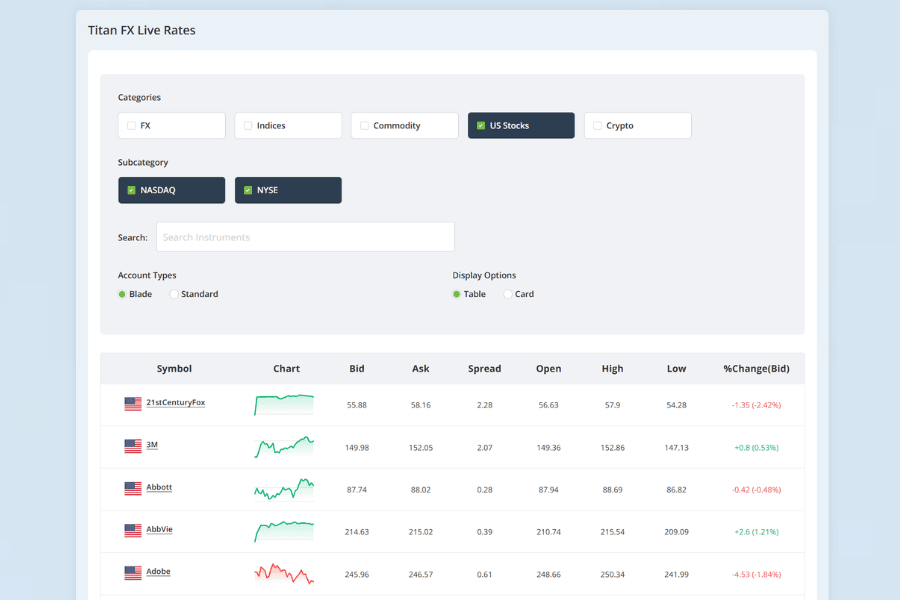
Live Rate
Live Rate provides the latest Bid/Ask, spread, intraday highs and lows, and a mini trend chart — a basic market-data source for short-term trading and strategy statistics.
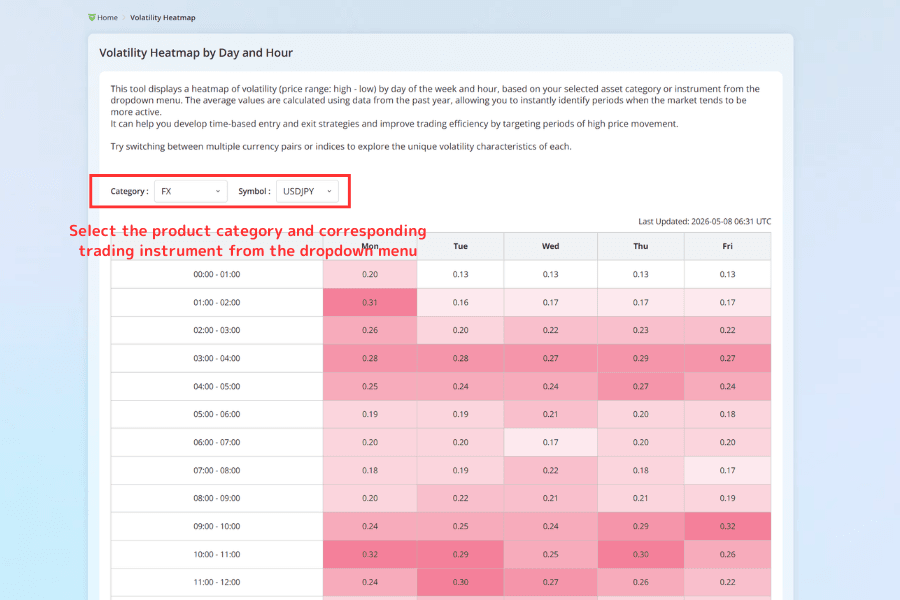
Volatility Heatmap
The Volatility Heatmap uses historical data to show how strongly an instrument moves at different times of day, helping you pick more suitable trading windows.
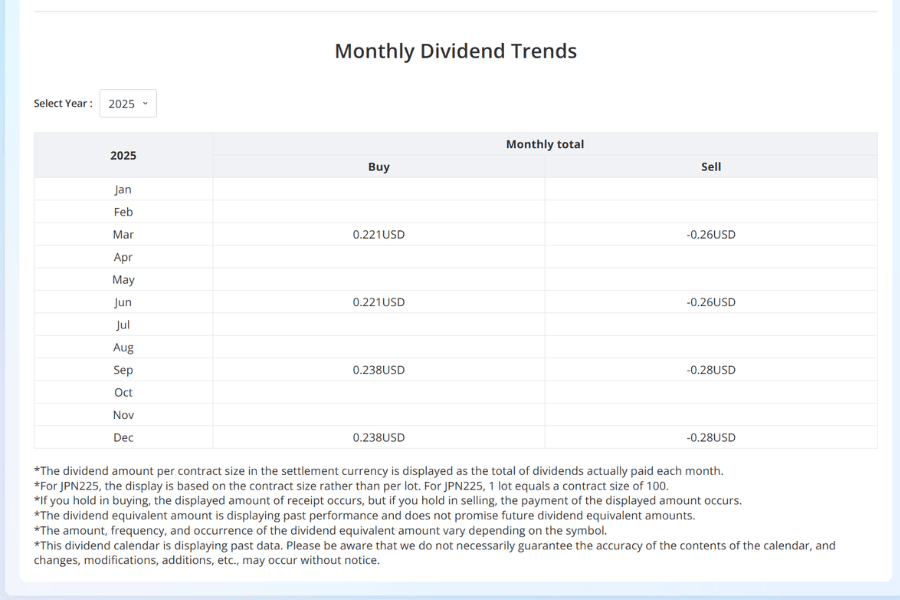
Dividend Calendar
View daily and monthly dividend records for US-stock companies in one place, including the actual dividend amounts at buy/sell, helping you track payout timing, compare yields, or plan a dividend strategy.
Trade NFLX CFDs with Titan FX
Titan FX offers Netflix (NFLX) stock CFDs with up to 20:1 leverage, tight spreads, and the flexibility to go long or short without owning the shares.
6. Frequently Asked Questions (FAQ)
Q1. Is it too late to invest in Netflix now?
Netflix has moved from a rapid-growth period into a mature stage, but that does not mean it has lost investment value. The market's valuation focus has shifted to profitability and cash-flow stability, which can actually make risk easier to assess for beginners who prefer a more predictable operating model.
Q2. Which metrics should beginners look at first when investing in Netflix?
Rather than only looking at subscriber numbers as in the early days, it is now more worthwhile to watch operating margin, free cash flow, and content-spending trends — these reflect whether the company can be self-sustaining over the long term.
Q3. How does Netflix differ from other streaming platforms?
Netflix's advantages lie in global scale, accumulated original content, and data-driven decision-making. Although competitors have increased, most platforms still struggle to compete head-on on content efficiency and international coverage.
Q4. Does investing in Netflix require a high capital threshold?
Not necessarily. Buying shares directly depends on the share price and your allocation; via ETFs or CFDs you can participate with relatively small capital. But the risk structures of different tools vary widely, so beginners should prioritize a method they understand.
Q5. Which news most easily affects Netflix's share price?
The market usually reacts most clearly to earnings releases, subscriber changes, content-strategy shifts, and revisions to profit expectations. Compared with short-term news, long-term investing should focus on whether the strategic direction is consistent and durable.
Q6. What are common mistakes beginners make investing in Netflix?
Common mistakes include chasing highs purely on hit content or short-term positives, ignoring the overall market environment, and not setting an investment horizon and risk range in advance. For beginners, knowing "why you invest" often matters more than "when to enter."
7. Conclusion: Netflix's Investment Value and Allocation Role
Taken together, Netflix has clearly passed its early rapid-expansion stage and entered a maturity centered on profit quality, cash-flow stability, and operating discipline. This means its investment logic no longer relies solely on explosive subscriber growth but is closer to a media-tech company that can generate cash flow over the long term.
For investors, Netflix is less suited as a target for concentrated single-name bets and better as one part of an allocation across tech and content. Long-term investors can watch whether its profit structure keeps improving, while short-term or strategic investors can trade around earnings, subscriber changes, and shifts in market sentiment. Whichever approach you take, understanding that Netflix's business model has turned toward maturity is a key premise for assessing risk and return.
Further Reading
- What Is a CFD (Contract for Difference)?
- What Are Technology Stocks?
- What Is Leverage in Trading?
- How to Install MT5
Titan FX Research. Investor-education content covering forex (FX), commodities (oil, precious metals, agricultural products), stock indices, US equities, and crypto assets across global markets.
Primary Sources by Category
- Official data and disclosures: Netflix, Inc. investor relations (10-K annual and 10-Q quarterly reports); U.S. SEC EDGAR filings
- Industry and research: streaming-media and digital-entertainment market research; major investment-bank tech-sector analysis
- Market data: Titan FX live quotes and US-stock CFD prices; US equity market analysis from major financial media