

NVIDIA (NVDA) Stock Analysis: The AI-Era Tech Giant and the Compute Revolution
As the whole world talks about AI, one of the biggest winners is clearly NVIDIA, the supplier of "compute." But behind the staggering rally, how far can NVDA's growth run, and what risks lie beneath?
This article analyzes NVIDIA across company background, share-price trends, key drivers, growth engines, and investment risks, and explains how to trade it via U.S. stocks or CFDs.
- The compute kingpin of AI: NVIDIA's (NVDA) GPUs are the core hardware for AI model training and data centers, with over 80% high-end GPU share.
- The CUDA moat: Its integrated software-hardware CUDA ecosystem locks in 5M+ developers, forming a hard-to-shake technology barrier.
- Share-price drivers: AI and data-center demand (70%+ of revenue), the TSMC supply chain, earnings margins, competition (AMD/TPU), and valuation and rates.
- Main risks: A high valuation, intensifying competition, US-China high-end GPU export controls, and concentrated reliance on TSMC.
- How to trade: Via stocks, ETFs, or CFDs for two-way (long/short) exposure; Titan FX offers NVDA US-stock CFDs with up to 20x leverage.
1. NVIDIA Company Overview
NVIDIA Corporation is a core company in global artificial intelligence and high-performance computing, co-founded in 1993 by Jensen Huang, Chris Malachowsky, and Curtis Priem, with headquarters in Santa Clara, California.
The company initially focused on developing graphics processing units (GPUs) for the PC and gaming markets. With the rise of AI, data centers, and autonomous driving, NVIDIA gradually extended its GPU technology to deep learning and compute acceleration, successfully transforming into a key supplier of AI chips and cloud computing.
Core Businesses
-
Gaming and graphics (GeForce series): Long holding a leading position in the global gaming-GPU market, the foundation of the company's early rise.
-
Data center and AI chips (H100, B200 series): Providing compute for global AI model training and cloud servers, now the company's main revenue source.
-
Autonomous driving and edge computing (DRIVE platform): By integrating GPUs and AI modules, NVIDIA has built an important footprint in smart vehicles and industrial applications.
Company Positioning
NVIDIA is not just a GPU maker but a provider of an integrated software-hardware AI platform.
Its CUDA software ecosystem lets developers build models and accelerate computing directly on the GPU architecture, forming a strong technology barrier and market power.
Market Position
As of 2024, NVIDIA's market cap surpassed $1 trillion, placing it among the world's top tech giants alongside Apple, Microsoft, and Amazon.
In the AI and data-center chip market, NVIDIA holds over 80% of the high-end GPU share and is currently an irreplaceable core supplier for AI training and inference.
With its technological innovation and market control, NVIDIA has grown from a single hardware company into an infrastructure leader driving the AI economy.
2. NVIDIA Share-Price History
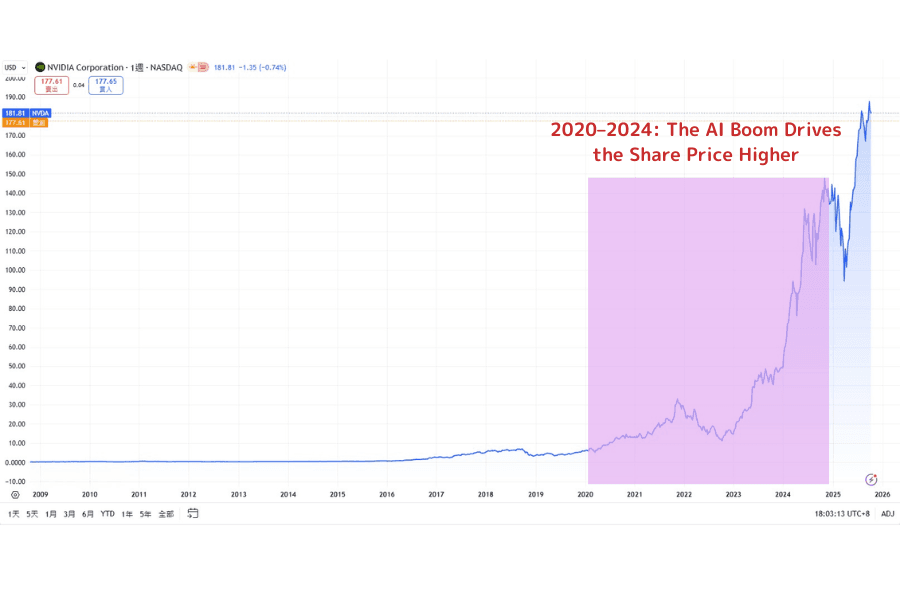
NVIDIA (ticker NVDA) is one of the most representative tech stocks of the 2020s, and its moves have taken off almost in sync with the artificial intelligence (AI) boom.
From under $30 in 2015 to over $1,000 (pre-split price) in 2025, NVIDIA's share price soared more than thirtyfold in a decade, becoming a legendary case in the investing world.
Behind this remarkable rally is not just the growth of the semiconductor industry but the rise of the AI and cloud-computing era.
Phase-by-Phase Review
Phase 1, 2010–2019: From Gaming Giant to the AI-Positioning Period
In this phase, NVIDIA cemented its GPU dominance in gaming with GeForce graphics cards and extended GPUs into science and machine learning via the CUDA platform.
The rise of esports, image processing, and cloud gaming drove steady revenue growth, while its footprint in data centers and deep-learning applications began to take hold, preparing for the future AI boom.
Phase 2, 2020–2024: The AI Boom Drives the Share Price Higher
With the rise of generative AI and large language models (LLMs), global demand for high-performance compute chips surged.
NVIDIA's H100 GPU became the hardware of choice for major tech companies (such as OpenAI, Microsoft, Google, and Amazon) deploying AI servers. Its data-center revenue grew several-fold in just four years, driving the share price to repeated record highs.
From 2023, NVIDIA stock was officially seen as a bellwether of the AI boom, widely regarded by investors as "the TSMC of the AI era."
Phase 3, 2025: High-Level Consolidation and Valuation Correction
After entering 2025, NVIDIA's share price saw a technical correction following a long rally.
Main reasons included:
- A tight global GPU supply chain and limited TSMC capacity;
- Tighter US export controls on China;
- Rising profit-taking pressure on high-valuation tech stocks.
Even so, NVIDIA maintained strong fundamentals, with AI-server and data-center demand steadily supporting its long-term growth momentum.
Many investors believe that while NVIDIA's valuation is high in the short term, it still has structural growth potential over the long term.
3. Key Drivers of NVIDIA's Share Price
NVIDIA's share-price swings are not determined by earnings alone but are the result of multiple market, industry, and policy variables interacting.
The table below outlines the main drivers of NVIDIA's share price, with each key aspect analyzed further below.
| Factor Category | Core Content | Effect on Share Price |
|---|---|---|
| AI and data-center demand | LLM training, cloud computing, AI infrastructure build-out | Lifts revenue and profitability |
| Supply chain and capacity | TSMC fabrication, chip export limits, production bottlenecks | Tight supply amplifies short-term swings |
| Earnings and profitability | Gross margin, revenue growth, guidance | Strong results drive valuation upgrades |
| Competitive landscape | Challenges from AMD, Intel, Google TPU, etc. | Affects share and profit margins long term |
| Valuation and rate environment | High P/E and monetary-policy changes | High valuations invite correction pressure |
AI and Data-Center Demand
AI is the biggest engine driving NVIDIA's share price.
Since 2022, tech giants such as OpenAI, Google, Meta, and Amazon have bought NVIDIA chips in large volumes to train generative-AI models and deploy cloud servers.
The data-center business now contributes over 70% of total revenue, becoming the core momentum leading growth.
As AI models keep expanding and global corporate digital transformation accelerates, demand for NVIDIA's GPUs and networking chips still has long-term upside.
Supply Chain and Capacity Issues
NVIDIA's advanced-process chips are mainly fabricated by TSMC.
If TSMC faces capacity bottlenecks, equipment shortages, or geopolitical risks (such as US-China tech friction), it would affect shipments of flagship products like the H100 and B200.
In addition, US high-end GPU export controls on China forced NVIDIA to adjust its product mix and launch compliant alternative models (such as the H20).
These changes affect the short-term sales pace, but in the medium to long term they help consolidate its global technology lead.
Earnings and the Competitive Environment
NVIDIA has long maintained a gross margin above 70%, showing strong pricing power and a dominant technology position in AI chips.
However, competitors such as AMD's MI300 series, Intel's Gaudi chips, and Google's TPU are accelerating their push into the AI market.
If competitors keep improving performance or cutting prices, it could pressure NVIDIA's share and profit structure over the medium to long term.
Valuation and Market Environment
In a high-rate, tightening environment, tech stocks generally face valuation pressure.
NVIDIA's P/E ratio is far above the market average, meaning investors place high hopes on its growth potential.
If future revenue growth slows or market expectations run too high, it could trigger short-term outflows and a price correction.
Still, as long as AI investment keeps expanding and global compute demand holds up, NVIDIA's long-term growth story remains attractive.
4. NVIDIA's Growth Engines: The Core Force of the AI Era
Amid the AI wave, NVIDIA, with its deep technology and complete ecosystem, has become the leader of global AI infrastructure.
It not only makes high-performance GPUs but has built a complete platform spanning software, hardware, and cloud services, making it hard for competitors to shake its market position.
Technological Advantage
NVIDIA's biggest competitive barrier comes from the CUDA platform ecosystem.
This is a computing architecture combining hardware and software that lets developers build and optimize AI models on NVIDIA GPUs at minimal cost.
Since its launch in 2006, CUDA has attracted over 5 million developers and supports thousands of deep-learning frameworks (such as TensorFlow, PyTorch, and JAX).
This network effect creates a software lock-in effect for NVIDIA, so even if companies want to move to another chip platform, they must pay a very high cost.
Its high-end GPUs, such as the A100, H100, and the latest B200 series, excel at training large language models (LLMs) and generative AI. Compared with traditional CPUs, computing speed can rise tens of times with better energy efficiency.
Application Scenarios
AI Cloud Training and Inference
NVIDIA's GPUs have become the core equipment for OpenAI, Google, Amazon, Anthropic, and others training AI models.
H100 chips are widely deployed in data centers to power generative-AI systems such as ChatGPT, Claude, and Gemini.
Autonomous Driving and Edge Computing
Through the DRIVE platform, NVIDIA extends AI technology to smart transport and autonomous driving. The platform integrates sensor processing, image recognition, and real-time decision algorithms and has been adopted by several automakers.
Research and Medical Applications
NVIDIA's GPUs play a key role in molecular simulation, climate modeling, and medical image processing. Its DGX systems are used by top research institutions worldwide for supercomputing and scientific research, accelerating AI breakthroughs.
5. Main Ways to Invest in NVIDIA Stock
Investors can choose different ways to participate in NVIDIA's (NVDA) share-price moves based on risk tolerance and trading style.
| Method | Key Features | Suitable For |
|---|---|---|
| Buy NVDA shares directly | Capture price growth and dividends | Long-term investors |
| ETF / ETN investing | Track AI or semiconductor indices, diversify risk | Medium-term allocators |
| Contracts for difference (CFDs) | Two-way trading, flexible leverage | Short-term traders |
| Thematic funds | Indirect NVDA weighting, lower volatility | Conservative investors |
For investors with a long-term growth view, holding NVDA shares directly remains the most core way to participate in the AI boom.
To trade market moves flexibly, you can use CFDs: open a Titan FX trading account, and after funding it, you can trade NVIDIA CFD contracts on the MT5 platform.
Titan FX supports US-stock CFD trading with up to 20x leverage and allows two-way trading to help you capture gains from volatility.
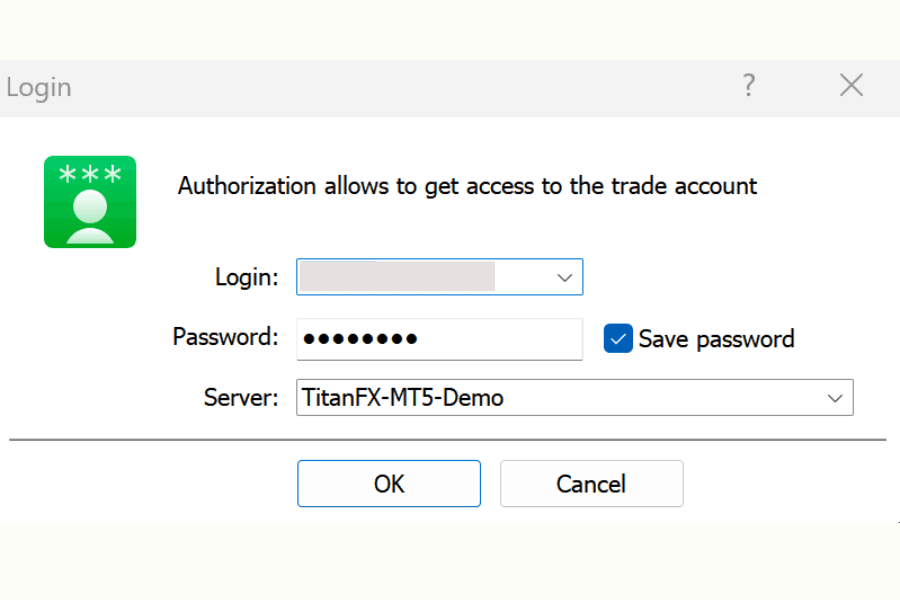
Titan FX Account Registration GuideStep 1: Log in to your trading account
Download the MT5 platform and log in with your ID and password.
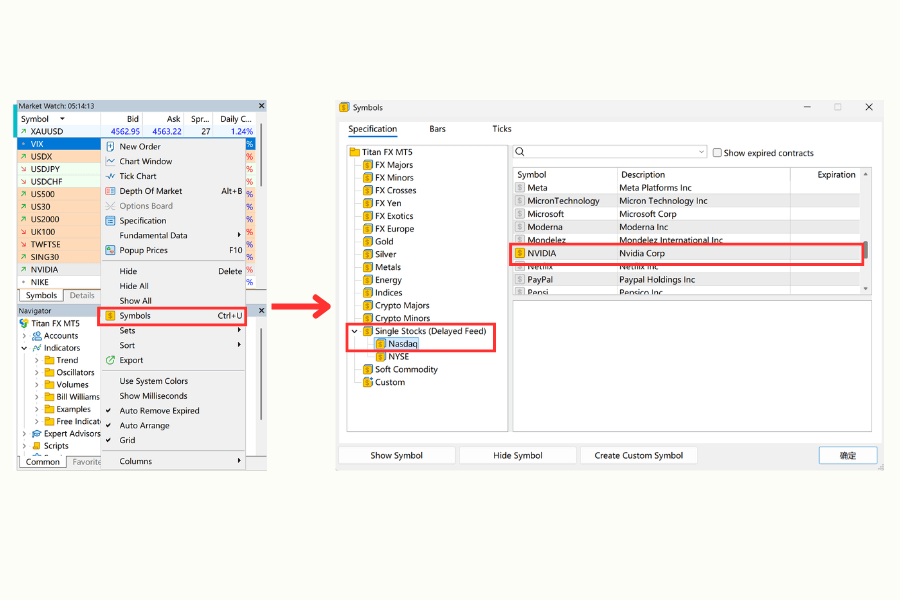
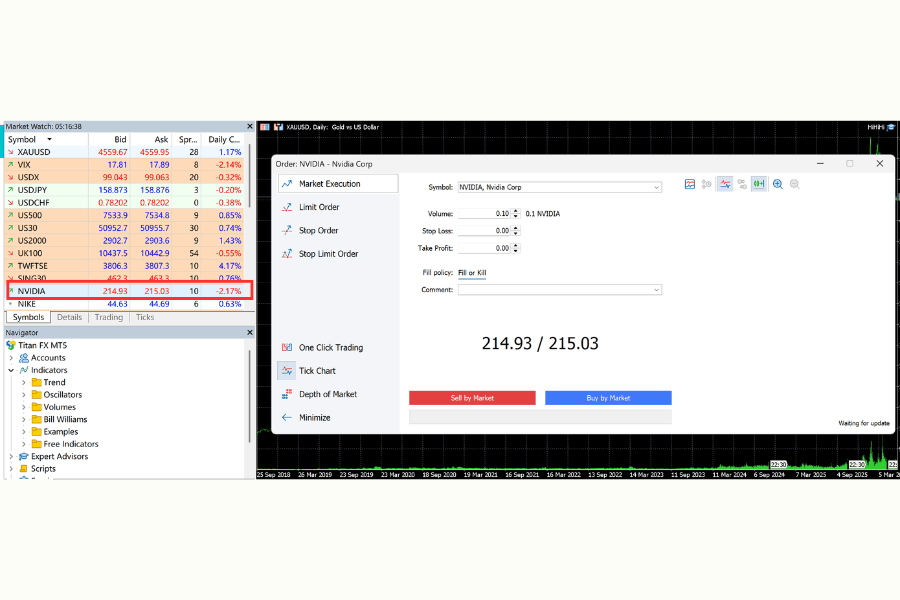
Step 2: Add the NVIDIA quote
In the "Market Watch" window, right-click and select "Symbols," expand "Single Stocks (Delayed Feed)," and select "Nasdaq." Double-click "NVIDIA" to add it to your quote list.
Step 3: Start trading
Double-click the NVIDIA quote or open a chart, enter the order screen, input the lot size, choose buy or sell, and you can trade the NVIDIA CFD.
Free Trading Tools from Titan FX (Custom Indicators and EAs)
Titan FX is committed to giving traders cutting-edge support, including free tools such as custom indicators and EAs (automated trading programs), designed to improve traders' efficiency and strategy precision.
Custom indicators help traders analyze market trends more accurately and spot potential trading opportunities.
EAs automatically execute predefined strategies, avoiding emotional interference and ensuring each trade is executed precisely.
Through these free tools, Titan FX helps you gain an edge in competitive financial markets and improve your trading performance.
All Custom Indicators EA Program Ranking6. Investment Risks and Challenges
Although NVIDIA is seen as the biggest winner of the AI era, its share price also carries significant volatility and potential risks. Investors should fully assess the following uncertainties before entering.
Risk 1: Valuation Too High
NVIDIA's P/E has long exceeded the semiconductor-industry average, with the market extremely optimistic about its growth. If earnings miss expectations or AI-market growth slows, the share price could face clear correction pressure.
Risk 2: Intensifying Competition
AMD, Intel, and Google TPU keep launching high-performance AI chips, challenging NVIDIA's market dominance. If product innovation or R&D pace slows, its long-term competitive edge would weaken.
Risk 3: Policy and Export Controls
US export controls targeting China affect part of NVIDIA's Asia-Pacific sales. Tighter policy could limit shipments and revenue-growth room and add market uncertainty.
Risk 4: Supply-Chain Dependence
NVIDIA's high-end chips are mainly fabricated by TSMC, a high concentration of supply. If TSMC's capacity is insufficient or geopolitical tensions escalate, it would directly affect shipments and delivery.
Overall, NVIDIA has long-term growth potential, but high valuation, supply chain, and policy risks could all be the main challenges for its short-term share price.
Trade NVDA CFDs with Titan FX
Titan FX offers NVIDIA (NVDA) stock CFDs with up to 20:1 leverage, tight spreads, and the flexibility to go long or short without owning the shares.
7. Frequently Asked Questions (FAQ)
Q1. Why can NVIDIA's share price keep hitting record highs?
The main reason is the surge in AI-chip demand. As tech giants such as OpenAI, Google, and Meta expand data-center investment, NVIDIA's H100 and B200 GPUs have become core equipment for AI model training, driving revenue and profit up together.
Q2. Is it still worth buying NVDA now?
Fundamentally, the company is still in a high-growth phase, but its valuation is clearly high. For long-term investing, you can take a "phased entry" approach; for short-term trading, watch for correction risk.
Q3. What is the difference between NVIDIA and AMD?
NVIDIA's biggest advantage lies in software-hardware integration and the CUDA ecosystem, with high developer stickiness and large switching costs. AMD wins on cost-performance and an open architecture, gradually gaining share, but still lags in AI software support and data-center penetration.
Q4. Will NVIDIA be affected by US-China tech friction?
Yes. US export controls on the China market limit some high-end GPU sales, dampening revenue growth in the short term. However, NVIDIA is actively developing "downgraded" chips to comply with export rules and maintain market share.
Q5. Why can NVIDIA maintain high margins and a technology monopoly?
The key lies in the CUDA software-hardware ecosystem and the technology lead of its high-end GPUs. Since its 2006 launch, CUDA has attracted over 5 million developers and supports mainstream deep-learning frameworks like TensorFlow and PyTorch, creating a software lock-in effect; the performance edge of the A100, H100, and B200 in large-model training lets NVIDIA sustain a gross margin above 70%.
Q6. Can you trade NVIDIA (NVDA) at Titan FX?
Yes. Titan FX offers US-stock CFDs on NVIDIA (NVDA) and other US stocks, with up to 20x leverage, two-way (long/short) trading, and no need to hold the underlying shares. US-stock CFDs are traded on the MT5 platform; understand NVDA's volatility and manage stop-losses and capital before trading.
8. Conclusion
NVIDIA is not just a chip company but the "cornerstone of compute" in the AI era.
Its technology and products are deeply embedded in core fields such as AI model training, cloud computing, and autonomous driving, accelerating the evolution of the global tech ecosystem.
The share-price surge is not accidental but capital markets pricing in, ahead of time, future compute demand and the value of AI infrastructure.
However, facing a high valuation and industry competition, investors still need to stay cautious.
Only by grasping long-term trends, diversifying risk, and understanding NVIDIA's strategic role across the entire tech chain can you truly seize the opportunities of this "AI golden age."
Further Reading
- What Is a CFD (Contract for Difference)?
- What Is the P/E Ratio?
- What Are Technology Stocks?
- What Is Leverage in Trading?
Titan FX Research. Investor-education content covering forex (FX), commodities (oil, precious metals, agricultural products), stock indices, US equities, and crypto assets across global markets.
Primary Sources by Category
- Official data and disclosures: NVIDIA Corporation investor relations (10-K annual and 10-Q quarterly reports); U.S. SEC EDGAR filings
- Industry and research: semiconductor, AI-chip, and data-center market research; major investment-bank tech-sector analysis
- Market data: Titan FX live quotes and US-stock CFD prices; US equity market analysis from major financial media