
 Home
Home- Investment Guide: Strategies for Stocks, Forex, and Metals
- What Is an Economic Moat? Buffett's Concept and 5 Moats
Economic Moat
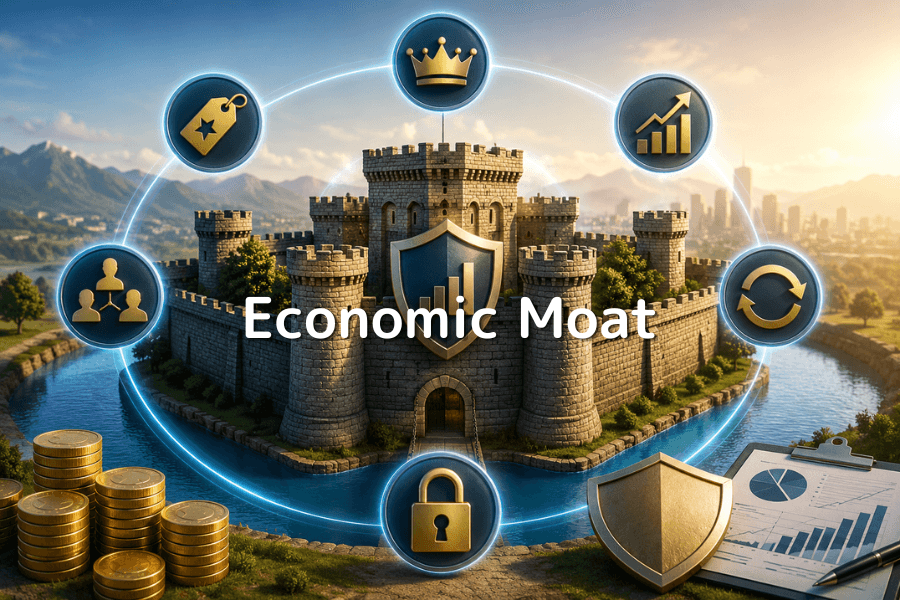
The concept became widely known through its long use and promotion by the value-investing great Warren Buffett, and is often used to assess whether a company can sustain its competitiveness and generate excess returns over time. Companies with strong moats tend to hold relatively stable profitability through industry competition, economic cycles, and market shifts, making the moat one of the core metrics many long-term investors watch.
This article covers the definition and importance of moats, the five common moat types, how to judge whether a company has a moat, and the difference between a moat and a competitive advantage—helping investors build a more complete framework for analyzing corporate competitiveness.
- A moat is a company's key defense for sustaining long-term advantage and profitability.
- The five common moats are brand, cost advantage, network effect, switching cost, and intangible assets.
- Some durable companies hold several moats at once, forming stronger barriers.
- Investors can gauge moat strength with gross margin, ROIC, market share, and free cash flow.
- A moat stresses long-term durability, unlike a short-term competitive advantage.
- A moat helps judge long-term competitiveness but must be paired with valuation, growth, and risk.
1. What Is an Economic Moat? The Advantage Buffett Values Most
An economic moat is a company's ability to sustain a competitive advantage over the long term, protect its profitability, and reduce rivals' ability to erode its market position.
The concept became widely known through its long use and promotion by the value-investing great Warren Buffett, and takes its inspiration from the moat around a medieval castle. The deeper and wider a company's moat, the harder it is for rivals to steal its market and profits through price wars, product imitation, or capital investment.
In business, a moat can come from brand power, cost advantages, network effects, switching costs, or patented technology. If these advantages last, they usually help a company hold a relatively stable market position in a competitive environment and generate profitability better than peers.
Why moats matter for long-term investing
A company's short-term revenue growth or profit surge does not necessarily last for years. What long-term investors truly value is whether a company can keep generating cash flow and maintaining competitiveness in the future.
A company without a moat can lose its edge to intensifying competition, technological change, or shifting consumer habits, even if it once had a hit product or a market lead.
Conversely, companies with strong moats tend to sustain high gross margins, a stable return on capital, and healthy free cash flow, making them frequent objects of long-term study for value investors.
Still, a moat does not mean a stock is worth buying. Investors must judge alongside valuation, growth, financial risk, and industry change to assess a company's long-term investment value more completely.
2. What Types Are There? The Five Economic Moats at a Glance
The sources of a company's competitive advantage vary—some rely on brand power, others on technology, scale, network effects, or customer stickiness. To judge a company's long-term competitiveness, you first need to understand the main types of moats.
The economic moats commonly seen today fall into five types: the brand moat, the cost-advantage moat, the network-effect moat, the switching-cost moat, and the intangible-asset moat.
Type 1: Brand Moat
A brand moat comes from the trust, loyalty, and repeat purchases consumers build over time.
When a brand is highly recognizable and brings lasting pricing power, a company can more easily maintain high gross margins. Even when cheaper alternatives appear, consumers may keep buying out of brand trust, product experience, or emotional attachment. Well-known global beverage brands, luxury brands, and some tech brands may have a brand moat.
Note that brand awareness does not equal a brand moat. Only when a brand delivers lasting pricing power, customer loyalty, or repeat purchases does it come closer to a true brand moat.
Type 2: Cost Advantage Moat
A cost advantage means a company can provide products or services at a lower cost than rivals and keep better profitability in a price war.
This usually comes from economies of scale, supply-chain management, production efficiency, procurement advantages, or automation. As competition intensifies, companies with a cost advantage are more likely to hold profitability and stay competitive even in price wars.
In some industries, a limited market size and the efficient scale of incumbents make it hard for new entrants to join at a reasonable cost, further strengthening incumbents' position.
Type 3: Network Effect Moat
A network effect means that the more users there are, the higher the product's or service's value becomes for each user.
This moat is common in social platforms, payment systems, e-commerce, and software ecosystems. Once a platform accumulates many users, merchants, or developers, new rivals often struggle to shift users away quickly, making a lead easier to build.
However, a large user base does not necessarily mean a strong network effect. You still need to see whether users add value for one another and whether rivals find the ecosystem hard to replicate.
Type 4: Switching Cost Moat
A switching cost is the cost a customer must bear to change products or services.
It can arise from learning time, data migration, system integration, contractual constraints, or operational risk. Enterprise software, cloud services, financial systems, and some industrial equipment often carry high switching costs, so customer retention tends to be high.
When switching would cause operational disruption, staff retraining, or system rebuilding, customers may not switch easily even when a cheaper alternative appears.
Type 5: Intangible Asset Moat
An intangible-asset moat comes mainly from patents, trademarks, licenses, technical barriers, databases, or regulatory protection.
For example, a pharmaceutical company's patented drugs, an exchange license, a franchise right, or key technology can limit rivals' entry and help a company sustain a long-term advantage.
However, patent and license protection often has a time limit or regulatory constraints, so investors should watch for patent expiry, substitute technologies, and risks from policy or regulatory change.
Comparison: The five moat types at a glance
| Moat type | Core source | What to watch | Common industries |
|---|---|---|---|
| Brand moat | Brand recognition and customer loyalty | Pricing power, brand premium, repeat purchases | Consumer goods, luxury, some tech |
| Cost-advantage moat | Economies of scale and efficiency | Cost control, gross margin, expense ratio | Retail, manufacturing, semiconductors |
| Network-effect moat | User scale lifting value | Active users, ecosystem size, retention | Social platforms, payments, e-commerce |
| Switching-cost moat | High cost for customers to switch | Retention, renewal, churn | Enterprise software, cloud, financial systems |
| Intangible-asset moat | Patents, licenses, regulatory protection | Patent life, entry barriers, regulatory change | Pharma, infrastructure, financial services |
In practice, some durable companies hold several moats at once—for example, a firm may have a brand advantage, a network effect, and switching costs together. When multiple advantages reinforce one another, a company is more likely to sustain long-term profitability and market leadership.
3. How to Judge Whether a Company Has a Moat: Four Indicators
Although a moat is a concept of business advantage, it usually shows up in a company's financial performance, market position, and customer stickiness.
Rather than relying only on brand impressions or short-term price action, investors can use a few key indicators to gauge whether a company's moat is solid enough.
Indicator 1: Is the gross margin persistently above peers?
Gross margin reflects a company's pricing power, cost advantage, and product competitiveness.
If a company has maintained a gross margin above the peer average for years, it usually suggests its brand, technology, product differentiation, or market position has some barrier. A steadily falling gross margin may signal intensifying competition, declining pricing power, or a weakening moat.
Still, a high gross margin does not necessarily mean a moat. You need to confirm the high margin can last and turn into stable profit and cash flow.
Indicator 2: Does ROIC stay high over the long term?
ROIC (return on invested capital) is an important gauge of how efficiently a company uses capital.
Companies with a moat tend to keep generating high returns from their existing advantages without constantly pouring in large amounts of capital to sustain growth. A ROIC persistently above the industry average often points to a stronger advantage.
Still, ROIC should be judged alongside industry characteristics, capital intensity, and growth stage. Capital needs vary widely by industry, so a single number cannot compare all companies.
Indicator 3: Is market share stable?
Market share reflects a company's competitive position in an industry.
If a company holds its lead for years, or even keeps expanding share, it usually shows its product, brand, channels, or business model have some barrier. Conversely, steadily losing share may mean the moat is being challenged.
Still, rising share is not always good. If a company gains share through steep price cuts or sacrificed profit, watch it alongside gross margin, operating margin, and free cash flow.
Indicator 4: Is free cash flow growing steadily?
Free cash flow is the cash a company can truly use freely after maintaining operations and necessary capital spending.
Companies with a moat tend to generate cash steadily and put it toward R&D, expansion, acquisitions, debt repayment, or shareholder returns. Long-term stable free cash flow is often an important reference for a company's competitiveness and earnings quality.
Still, free cash flow can be affected by economic cycles, capex cycles, or one-off factors, so watch the long-term trend rather than a single year.
Core indicators for judging a moat
| Indicator | What to watch | What it means |
|---|---|---|
| Gross margin | Persistently above peers? | Pricing power and cost advantage |
| ROIC | Consistently above industry average? | Capital efficiency and advantage |
| Market share | Stable or rising? | Market position and barriers |
| Free cash flow | Growing steadily? | Earnings quality and flexibility |
Note that a single indicator is not enough to prove a moat. Investors should combine financial data, industry structure, business model, and competitive advantage for a more accurate judgment of a company's long-term value.
4. Moat vs. Competitive Advantage: A Quick Comparison
A moat and a competitive advantage are often conflated, but they are not entirely the same.
A competitive advantage is a lead a company has over peers at some stage—technological innovation, cost control, product differentiation, or marketing. A moat is the structural barrier that lets those advantages last and keeps protecting the company's profitability.
Put simply, a competitive advantage can be a short-term lead, while a moat stresses whether that advantage can last for years, is hard for rivals to copy, and keeps converting into profitability and cash flow.
Moat vs. competitive advantage comparison
| Item | Moat | Competitive advantage |
|---|---|---|
| Duration | Long term | Short to medium term |
| Hard to copy | Usually high | Not necessarily |
| Core purpose | Protect long-term profitability | Build a market lead |
| Common sources | Brand, network effect, switching cost, patents, cost advantage | New products, price strategy, tech lead, marketing |
| Analysis focus | Durability and defensibility | Growth and short-term competitiveness |
Key point: a competitive advantage is not always a moat
Some companies grow fast on a hit product, a short-term market opening, or technological innovation, but if rivals can easily copy it, that advantage may not last.
So when analyzing a company, beyond growth speed and market buzz, investors should assess whether it has a moat that can defend its market position, sustain pricing power, and keep generating cash flow over the long term.
In other words, the point of a moat is not "having an advantage now" but "whether that advantage can last for years and is not easily eroded by rivals."
5. Economic Moat FAQ
Q1. Can a moat disappear?
Yes. A moat is not permanent. Industry change, technological innovation, shifting consumer habits, regulatory adjustments, or management missteps can all gradually narrow a company's moat, or even erase it.
A company that once had a strong brand, channel, or technology advantage can still be replaced by new rivals if it fails to keep up with market change. Investors should regularly track a company's competitive position, financials, and industry change rather than relying on a past record.
Q2. Do tech companies always have a moat?
Not necessarily. Tech companies may lead in technology, but technology itself may not last. If rivals can quickly copy it or launch substitutes, a tech lead does not necessarily form a true moat.
Tech companies with a real moat usually also have barriers such as network effects, an ecosystem, high switching costs, a huge user base, a data advantage, or brand trust. High growth does not necessarily mean a moat; you still need to see whether the advantage is durable.
Q3. Does the management team count as a moat?
An excellent management team can lift a company's competitiveness and help build or strengthen a moat, but it is usually not regarded as a solid moat in itself.
The reason is that managers can retire, leave, or be replaced, so on their own they can hardly form a durable, long-term barrier. A truly solid moat usually comes from structural factors such as brand, patents, network effects, switching costs, cost advantages, or regulatory barriers.
Q4. Is a moat the same as brand power?
Not exactly. Brand power is one type of moat, but not all moats come from a brand.
Some companies with low brand awareness still build strong barriers through patented technology, cost advantages, network effects, switching costs, or regulatory barriers. Conversely, some highly recognized brands are not necessarily strong brand moats if they cannot deliver pricing power, customer loyalty, or repeat purchases.
Q5. Which type of moat does Buffett value most?
Buffett has long favored companies with brand advantages, pricing power, stable cash flow, and a high return on capital. Such companies usually have strong barriers and can sustain profitability over a longer period, fitting the long-term compounding that value investing seeks.
That said, Buffett does not look at just one type of moat; he values more whether a company can sustain its advantage over the long term—and whether it can be bought at a reasonable price. For investors, a moat is only part of analyzing a company's value; judge it alongside valuation, margin of safety, and risk control.
6. Summary
A moat is an important tool for judging a company's long-term competitiveness. Companies with a moat tend to sustain profitability and hold stronger defenses through competition, economic cycles, and industry change.
When analyzing a moat, don't look only at brand awareness, short-term growth, or a single financial metric; combine business model, industry structure, competitive landscape, and long-term financials. Gross margin, operating margin, ROIC, market share, and free cash flow are all important references for a moat's strength.
For beginner investors, a moat helps screen for companies with long-term competitiveness, but it must be analyzed alongside valuation, growth, financial risk, and risk control.
Only by buying companies with a wide moat, sound financials, and clear long-term competitiveness at a reasonable price can you better improve the stability of long-term returns. Still, a moat does not guarantee investment success, and investors should keep tracking a company's fundamentals and the changing market environment.
Further Reading
Titan FX Trading Strategy Lab. We produce investor-education content covering forex, commodities (crude oil, precious metals, agricultural goods), stock indices, US equities, and digital assets.
Primary Sources (by category)
- Concepts & books: Warren Buffett — Berkshire Hathaway shareholder letters; Pat Dorsey, The Little Book That Builds Wealth — a classic on moat investing
- Company analysis & metrics: Morningstar — Economic Moat rating methodology; general frameworks for competitiveness analysis using ROIC, gross margin, and free cash flow
- Investor education: Investor-education materials from financial authorities — company analysis and valuation