

ETF (Exchange-Traded Fund)
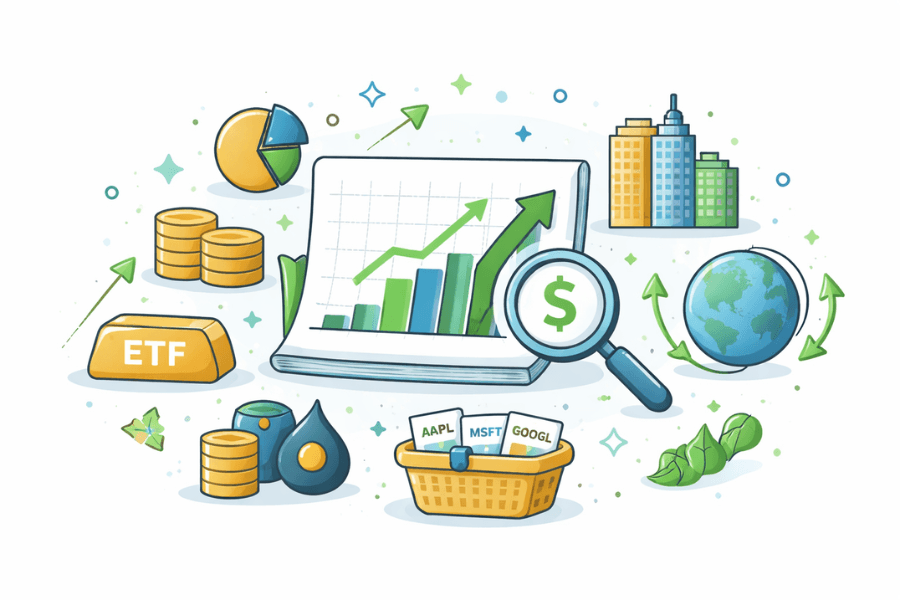
New investors in U.S. equities tend to run into the same problems: picking stocks is hard, there's no time to dig into fundamentals, and single-stock volatility is uncomfortable. ETFs (exchange-traded funds) help on all three fronts. One ETF lets you hold a basket of stocks at once and ride the broader market without picking individual names.
ETFs have become one of the most important tools in global investing. As passive investing has gone mainstream, more and more investors run their asset allocation through ETFs.
This article introduces the basics of ETFs, common types, the upsides and risks, the differences from stocks and mutual funds, and briefly compares ETFs with CFDs as another way to access markets.
- Definition: An ETF (Exchange-Traded Fund) is a fund product listed on an exchange that tracks a specific index; it trades intraday like a stock
- Common types: index ETFs (S&P 500 / Nasdaq 100), sector ETFs, bond ETFs, commodity ETFs (gold, oil, etc.)
- Main upsides: diversification, low expense ratios, intraday liquidity, portfolio transparency
- Main risks: broad market drawdown, tracking error, sector-concentration risk
- ETF vs CFD: ETFs suit long-term allocation (you actually own the shares); CFDs suit short-term trading and hedging (no underlying ownership, with leverage and two-way trading)
1. What Is an ETF? Definition and Mechanics
ETF stands for Exchange-Traded Fund. It's a fund product listed on a stock exchange — you can buy and sell it intraday, the same way you trade a stock.
Most ETFs track a specific market index, for example the S&P 500 or the Nasdaq 100. Buying one share of such an ETF is effectively holding a slice of the basket of companies in that index.
How it works
The ETF issuer allocates its assets across the index components and weights so that the fund closely tracks the index. This passive, index-based approach typically keeps management costs low and reduces the risk that subjective stock-picking goes wrong.
Trading mechanics
ETFs trade on an exchange, so the workflow is essentially the same as trading stocks: you place orders through your brokerage during exchange hours and see live quotes in real time.
Market makers provide liquidity, and the creation/redemption mechanism keeps the ETF's market price close to its net asset value (NAV). This is why ETFs generally trade smoothly and offer good liquidity.
2. Types of ETFs
The ETF universe is broad — different ETFs cover different asset classes or sectors. Investors choose products that fit their goals and risk tolerance.
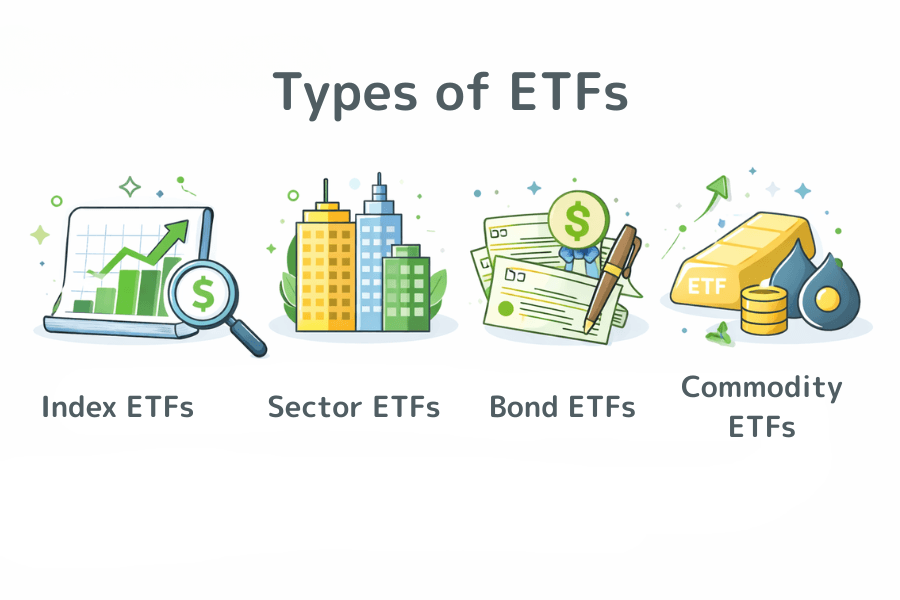
Index ETFs
The most common type. Track broad indices such as the S&P 500, the Nasdaq 100, or the Dow Jones Industrial Average. Often used for long-term investing and asset allocation, letting investors participate in the whole market at once.
Sector ETFs
Focus on a specific industry — technology, financials, healthcare, or energy. Investors get sector-level exposure without picking individual companies.
Bond ETFs
Hold government or corporate bonds. Volatility is usually lower than for equity ETFs, so they're often used to diversify risk or dampen overall portfolio volatility.
Commodity ETFs
Track the prices of gold, silver, crude oil, and similar commodities, letting investors gain commodity exposure without holding the physical asset or futures.
3. Upsides and Risks of ETF Investing
ETFs draw attention worldwide largely because of how their structure and trading work. But every investment carries risk, and it's worth understanding the trade-offs before allocating.
Main upsides and risks of ETFs
| Type | Description |
|---|---|
| Diversification reduces single-stock risk | ETFs typically hold many companies, spreading the portfolio. Single-stock moves have a smaller impact on the whole position. |
| Lower expense ratios | Passive strategies cost less than active funds, and that difference compounds over time. |
| Flexible trading | Intraday trading lets investors adjust positions as the market moves. |
| Transparency | Holdings are disclosed regularly, so investors can see exactly what the fund owns. |
| Market-drawdown risk | Because the ETF tracks an index, when the broad market falls, the ETF falls with it. |
| Tracking error | In practice the ETF's return can drift from the index — this gap is called tracking error. |
| Sector-concentration risk | Sector or thematic ETFs are more exposed when that sector swings sharply. |
4. ETF vs. Stock vs. Mutual Fund: A Side-by-Side
ETFs, stocks, and mutual funds are all common investment tools, but they differ in structure, trading method, and management style. Understanding the contrast helps you pick the right product.
A stock represents ownership of a single company, and the investor judges the firm's growth potential. A mutual fund is actively managed by a fund manager — investors hand their capital over to a professional team. An ETF sits between the two: it tracks an index to build the portfolio, combining diversification with intraday flexibility.
| Tool | ETF | Stock | Mutual Fund |
|---|---|---|---|
| What it invests in | A basket of stocks or assets | A single company | A mix of multiple assets |
| Trading | Intraday on exchange | Intraday on exchange | Once-a-day NAV |
| Diversification | High | Low | High |
| Management | Passive index tracking | DIY stock picking | Actively managed |
| Fees | Lower | None | Higher |
| Entry barrier | One share | One share | Per fund rules |
5. ETFs vs CFDs: Two Different Ways to Access Markets
Beyond buying ETFs (exchange-traded funds) through a brokerage account, some traders use CFDs (contracts for difference) instead. A CFD is a financial derivative — you trade the asset's price movement without actually owning the underlying.
The defining feature of a CFD is capital flexibility. You don't have to pay the full asset value; a margin deposit lets you open a position. CFDs also support two-way trading, so you can short to look for opportunities in a falling market, or hedge existing positions to reduce portfolio volatility.
ETF vs CFD: a detailed comparison
| Compare | ETF | CFD |
|---|---|---|
| Ownership | Actual fund shares; eligible for dividends | No physical asset — trades price movement only |
| Direction | Mainly buy-and-hold (long) | Two-way (long or short) |
| Leverage | Usually none; full payment required | Uses leverage; margin amplifies capital efficiency |
| Capital required | Full asset value | Margin trading — a portion of the position size |
| Main costs | Commission, taxes, expense ratio | Spread, swap (overnight interest) |
| Tax handling | May incur dividend tax and capital-gains tax | Depends on trader's jurisdiction and rules |
| Trading hours | Limited to exchange hours | Longer hours; some markets near 24-hour |
| Use case | Long-term allocation, retirement | Short-term trading, spot hedging, capital efficiency |
The two tools serve different needs: ETFs fit long-term investing and allocation, while CFDs are more useful for short-term trading, hedging, or improving capital efficiency.
6. Trading CFDs with Titan FX
Before trading CFDs live, a demo account is a sensible way for beginners to get familiar with how markets behave and build discipline. With a demo account you experience live quotes, the order workflow, and basic risk control without putting real money at risk.
Titan FX offers a free demo account in a real market environment, alongside a stable platform and a range of trading conditions that have drawn traders globally.
Why traders choose Titan FX for CFDs
| Strength | Description |
|---|---|
| High leverage | Up to 1,000x on Standard and Blade accounts; up to 2,000x on Micro accounts (conditions apply) — flexible capital efficiency. |
| Tight spreads | Competitive spreads, e.g. EUR/USD as low as ~0.2 pips, helping reduce trading cost. |
| Fast execution | Efficient order execution that helps reduce slippage in volatile windows. |
| Advanced platforms | MT4 and MT5, with a full technical analysis and automated-trading stack. |
| Free tools | Technical indicators and the EA ranking to refine strategies. |
| Multi-language support | English, Chinese, and Japanese customer support. |
| Education | FX basics, daily market reports, and strategy content. |
| Flexible funding | Multiple deposit methods with a minimum of USD 1. |
| Zero-cut policy | Protection against negative balances in extreme market conditions. |
Free trading tools (custom indicators and EAs)
Titan FX also provides free custom technical indicators and EAs (expert advisors) to support market analysis and trading efficiency.
Custom indicators help traders read price action and technical signals more clearly, while EAs execute trades automatically according to preset strategies — reducing the impact of emotion on decisions.
Together these tools help traders analyse and execute more efficiently.
Titan FX Account-Opening Guide All Custom Indicators7. Frequently Asked Questions (FAQ)
Q1. What's the difference between an ETF and an index fund?
Both are passive index-tracking vehicles, but the trading mechanism differs. ETFs list on an exchange and trade intraday like stocks with live quotes. Index funds in traditional mutual-fund form trade once a day at the NAV. ETFs suit investors who want intraday flexibility; for steady long-term contributions, the two are often very close in effect.
Q2. How does ETF dividend distribution work?
Equity-index ETFs collect dividends from the underlying holdings and pay them to ETF holders on a schedule (quarterly, semi-annual, or annual) according to the fund's policy. Bond ETFs distribute received interest income on a schedule. Check the prospectus and the issuer's website for the specific frequency and the relevant payout ratio.
Q3. Are leveraged and inverse ETFs suitable for long-term holding?
Generally no. Leveraged (2x, 3x) and inverse ETFs are designed to deliver a daily multiple of the underlying index. Over time, the compounding (Volatility Decay) effect can pull the cumulative return well away from the simple "multiple of the index move." These products are more appropriate for short-term trading or hedging — beginners should be cautious about long-term allocation.
Q4. Where does ETF "tracking error" come from?
Main sources include: (1) the expense ratio and trading costs; (2) cash dividends that aren't reinvested instantly; (3) bid-ask costs during index rebalances; (4) holdings of illiquid constituents that can't be matched precisely to the weights; (5) currency moves for ETFs that track foreign indices. Low-cost, high-liquidity mega ETFs (such as SPY, VOO, or VTI) typically have smaller tracking error.
Q5. How are taxes different between local ETFs and U.S. ETFs?
Tax treatment varies by the investor's country of residence and account type. U.S. ETFs typically face a 30% U.S. dividend-withholding tax for non-U.S. investors (subject to tax-treaty reductions), while capital gains are taxed under the investor's local rules. Local-listed ETFs follow that jurisdiction's tax rules. For specifics, check the local tax rules and account type, or consult a tax professional before placing orders.
8. Conclusion
For many investors, ETFs are a core tool for entering the U.S. equity market. Low cost and high diversification let you participate in long-term market growth without endless single-stock research or trading.
For traders who want to engage more flexibly with market volatility, CFDs offer another route. With CFDs, you can take part in price movements of indices, commodities, or other assets without holding the underlying.
Whether you allocate long-term with ETFs or trade and hedge short-term with CFDs, sound risk control and trading discipline are the foundation that lets either approach work over time.
Further Reading
- What Is the Dividend Payout Ratio?
- What Is a CFD?
- What Is an FX Spread?
- What Is Swap (Overnight Interest)?
- FX Hedging Strategy
Titan FX Research Hub — investor education across foreign exchange (FX), commodities (oil, precious metals, agriculture), stock indices, U.S. equities, and crypto assets.
Primary Sources (by category)
- Markets and exchanges: NYSE, Nasdaq; prospectuses from major ETF issuers such as SPDR, Vanguard, and iShares
- Index and fund data: S&P Global Indices, Nasdaq Index, statistics from the Investment Company Institute (ICI)
- Academic and fund-management basics: general public knowledge on ETF structure, passive investing, and tracking error