
 Home
Home- Investment Guide: Strategies for Stocks, Forex, and Metals
- Trading Psychology Guide: Biases, FOMO, and Mindset
Trading Psychology
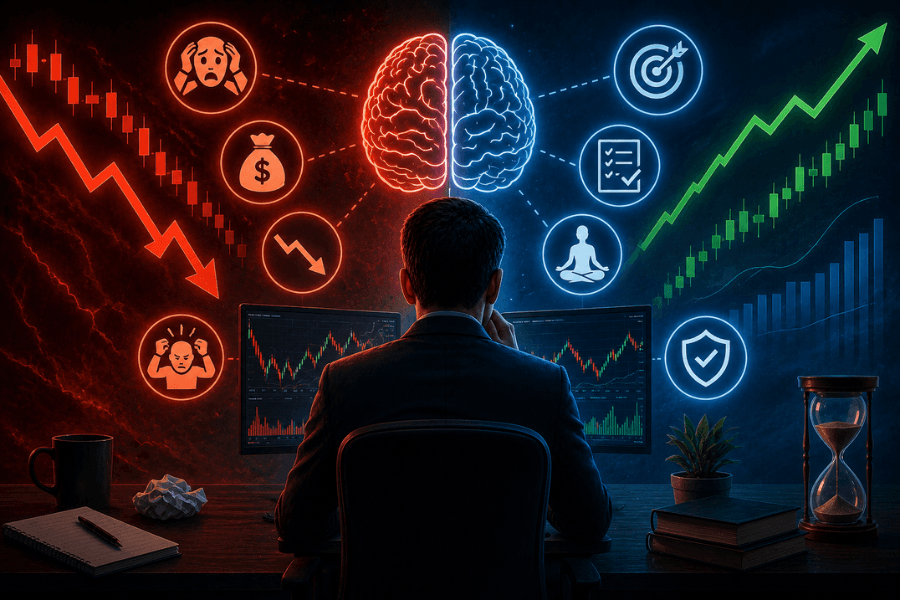
Why do we "know what to do but fail to do it"? You have a trading plan, yet at the crucial moment emotions take over—and that is exactly the core problem trading psychology addresses.
In forex, stocks, and other markets, an investor's state of mind often decides the outcome more than technical or fundamental analysis. Many beginners have a good strategy yet keep losing because they can't control fear, greed, or impulse.
This article covers the basic definition of trading psychology, common biases, the influence of fear and greed, how to build a stable mindset, and practical emotion-management techniques—helping investors improve their mindset and long-term results.
- Quickly grasp the core idea and importance of trading psychology.
- Spot the most common biases and emotional traps in trading.
- Learn to build a stable trading mindset and rational thinking.
- Know practical emotion-management tools and how to build discipline.
- Improve long-term mindset and avoid common emotional decisions.
1. What Is Trading Psychology? Core Concepts for Beginners
Trading psychology is the study of the various mental activities, emotional reactions, and decision-making behaviors investors experience while trading.
Even with the same strategy, different investors often end up with very different results. The biggest difference between a professional and a beginner is usually not technical-analysis skill but whether they can manage their own emotions and cognitive biases.
In a highly uncertain market, emotions directly change how investors judge risk. When prices surge, people overestimate their ability and chase highs; when prices drop, they panic and dump at lows. These emotional swings often keep a good trading plan from being carried out.
That's why successful traders take discipline very seriously. They don't try to be right every time; they focus on executing their system steadily over the long term. A strong mindset helps you stay rational through both losing and winning streaks—and that is the real key to long-term profitability.
2. The Most Common Biases and Emotional Traps
The instinctive reactions the human brain evolved often clash with the logic of successful trading. Recognizing these common biases and emotional traps is the first step to improving your mindset.
Loss aversion
Research shows the pain of a loss is about twice as strong as the pleasure of an equivalent gain. So investors are unwilling to cut a small loss, hoping for a rebound, and turn a small loss into a big one; yet when in profit they rush to lock it in, closing too early and missing a larger move. The result is a pattern of many small gains wiped out by one big loss.
Overconfidence
After a winning streak, traders tend to overestimate their forecasting ability and think "this time it will definitely go up." This loosens risk control—adding to positions freely, ignoring stop signals—and gives back much of the earlier profit in a single big pullback.
Fear of missing out (FOMO)
FOMO is the strong anxiety of missing an opportunity. When the market surges and others are profiting, investors feel the urge that "if I don't get in now, it'll be too late," blindly chase the high, and become the ones left holding at the top.
Revenge trading
After a big loss, many rush to "win it back," lose their reason, and enter frequently while enlarging positions. This emotion-driven, impulsive trading usually leads to even more severe consecutive losses, forming a vicious cycle.
Anchoring
Traders over-rely on a specific price (such as their own entry cost), overlook that the market has fundamentally changed, and stubbornly wait for the price to return to where it "should" be before selling—sinking ever deeper.
Confirmation bias
Traders tend to focus only on information that supports their existing view and ignore contrary evidence. For example, after turning bullish on an instrument, they chase only good news and downplay warning signs, leading to overconfidence and a failure to adapt to changing markets. Deliberately reviewing the opposing view and scenario is an effective way to counter confirmation bias.
3. How to Build a Stable Trading Mindset
A professional trading mindset can't be built overnight; it takes deliberate mental training to develop gradually.
Cultivate probabilistic thinking
Successful traders don't weigh the win or loss of a single trade too heavily; they see trading as a series of probabilistic events. As long as your strategy has a positive expected value over the long run, a single loss is just a normal "cost of doing business." This thinking greatly reduces emotional swings, so you no longer get overly excited or discouraged by one trade's outcome.
Accept market uncertainty
Markets are inherently uncertain, and no one can predict moves with 100% accuracy. Once you truly accept this, you naturally value risk control and stop-loss discipline rather than trying to "be right every time." This keeps you calm in sudden moves and less swayed by short-term price swings.
Separate self-worth from profit and loss
Many beginners tie the account number to their self-worth—feeling great when in profit and self-critical when in loss. Professionals treat trading as a job, and profit or loss as just a data outcome, not a judgment of personal ability. Keeping this objective mindset makes decisions more rational and free of emotional interference.
4. Practical Tools: Executing Discipline and Handling Stress
Beyond mental training, using external tools to constrain behavior is the most effective way to shore up psychological weaknesses.
Tactic 1: Write a trading plan
Before the market opens, write down entry conditions, stop-loss levels, and take-profit targets in advance. When the move starts, just execute the plan—no in-session improvisation. This hands decision-making from the emotional limbic system back to the rational prefrontal cortex.
Tactic 2: Keep a trading journal
Beyond recording buy and sell prices, it's more important to record your mood at the moment of the order in a trading journal. Reviewing the journal reveals patterns in the emotions under which you make mistakes, so you can correct those behavior patterns specifically.
Tactic 3: Use indicators for objective judgment
When emotions run high, return to objective data and tool support. Titan FX offers many free custom technical indicators and EAs (automated trading programs) that help traders observe the market more clearly and execute trades by pre-set rules, greatly reducing the influence of subjective emotion.
With these tools, investors can build a more systematic analysis process and make trading behavior more rational and consistent.
All Custom Indicators5. Trading Psychology FAQ
Q1. Is mindset innate, or can it be trained?
Mindset can be trained through discipline and real experience. By repeating small live trades to let the brain adapt to the physical reactions volatility triggers, and combining that with proper education in probability, any investor can develop a steady trading mindset.
Q2. How do I overcome the hesitation and pain of cutting a loss?
Automate the stop-loss. Set a system stop at the same time as entry and let the software enforce discipline. Also, shrink the risk per trade (for example, 1% of total account assets); when the loss stays within a bearable range, the psychological pressure eases greatly.
Comparing five stop-loss methods and how to choose
Q3. I get very anxious watching profits give back. What can I do?
This usually stems from lacking a clear trailing take-profit strategy. You can take profit in tranches, or raise the stop as the price advances (a trailing stop), so you lock in part of the profit and can hold the rest with more confidence.
Q4. Does demo trading help improve mindset?
Demo trading helps you get familiar with a strategy, but since no real money is involved, it can't fully reproduce the pressure of live trading. Once you're comfortable with the operations, move to live trading with micro lots or small amounts to build stress tolerance step by step.
6. Summary
Trading psychology reminds us that long-term success often depends not on technique or news but on whether you can manage your own fear, greed, and various cognitive biases. Loss aversion, overconfidence, FOMO, revenge trading, anchoring, and confirmation bias are all common traps that keep a good strategy from being carried out.
The real key is to treat trading as a series of probabilistic events, accept market uncertainty, and constrain behavior with external tools such as a written plan, a trading journal, and automated stops. When every decision rests on discipline, your mindset gradually becomes the foundation of your long-term, stable profitability.
Further Reading
- What Is Herd Mentality?
- What Is Sunk Cost?
- What Is the Concorde Effect?
- What Is the Chicken Game?
- What Is a Trading Journal?
Titan FX Trading Strategy Lab. We produce investor-education content covering forex, commodities (crude oil, precious metals, agricultural goods), stock indices, US equities, and digital assets.
Primary Sources (by category)
- Behavioral finance & psychology: Kahneman, D. & Tversky, A. (1979) "Prospect Theory", Econometrica — loss aversion; Kahneman, D. Thinking, Fast and Slow — a classic on cognitive bias
- Trading psychology & practice: General practical guides on trading discipline, journaling, and emotion management; the Fear & Greed Index
- Investor education: FINRA / U.S. Securities and Exchange Commission (SEC) Investor.gov — investor education on behavioral bias and risk management