

Herd Mentality
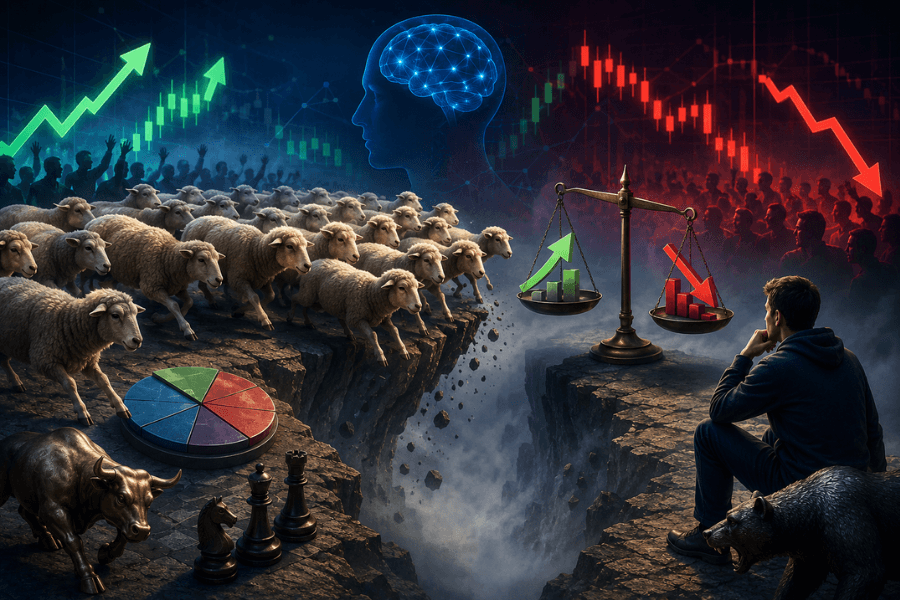
"Everyone's buying, so it must be fine." In both bull runs and panics, our judgment is often pulled along by those around us. Herd mentality is the psychological phenomenon that explains investors' tendency to go along with the majority.
This herding is very common in financial markets. Especially when information is skewed or emotions run high, people are easily swayed by nearby investors or community opinion, leading to collective buying into rallies or selling into declines. Many market bubbles and crashes are closely tied to herd mentality.
This article covers the basic definition and psychology of herd mentality, why it forms, common cases in financial markets, its negative impact on performance, and how beginners can overcome it and build an independent investing framework—helping investors sharpen their rational decision-making.
- Grasp the definition and psychology of herd mentality.
- Understand why it forms in investment markets.
- Recognize its common patterns and real cases.
- See how it erodes personal investment performance.
- Learn practical tactics to think independently.
- 1. What Is Herd Mentality? Definition and Psychology
- 2. How Does Herd Mentality Form? Why Investors Follow
- 3. Common Cases of Herd Mentality in Markets
- 4. How Herd Mentality Hurts Investment Performance
- 5. How to Overcome It: Building an Independent Framework
- 6. FAQ: Questions on Herd Mentality
- 7. Summary
1. What Is Herd Mentality? Definition and Psychology
The term herd mentality comes from a biological observation: when the lead sheep leaps off a cliff, the sheep behind tend to follow without thinking, even into danger. In finance, herd mentality refers to the psychological tendency for investors to follow the majority when making decisions, rather than reaching an independent judgment based on their own rational analysis.
This conformity is rooted in human instinct. Faced with uncertainty, people tend to assume "what everyone is doing must be right," making collective action likely. In financial markets, this effect is often amplified, driving prices away from fundamentals.
2. How Does Herd Mentality Form? Why Investors Follow
Conformity in financial markets is no accident—it is the result of several psychological and environmental factors intertwined.
Cause 1: Fear of missing out (FOMO)
When peers or investors on social media are all talking about a hot instrument and making gains, an investor feels intense anxiety.
This fear of being left out of a money-making opportunity often drives investors to enter blindly at the moment the market is hottest and risk is greatest.
Cause 2: A diluted sense of personal responsibility
Group decisions carry the illusion of shared responsibility.
When investors misjudge on their own, they feel a sharp sense of failure; but if they lose alongside everyone else, they tend to feel psychologically that "it's the environment's fault." This subconscious tendency to ease guilt turns blind following into a safe harbor.
Cause 3: Social media and filter bubbles
In today's investing environment, messaging-app groups and social platforms reinforce echo chambers.
When a group is filled with one-directional market sentiment, opposing views are quickly drowned out, creating a powerful collective momentum that amplifies herd mentality to the extreme.
3. Common Cases of Herd Mentality in Markets
Looking back at financial history, many disastrous market upheavals are closely tied to collective irrational behavior. These cases show how out of control the market can get when herd mentality takes over.
Case 1: The dot-com bubble
In the late 1990s, any company with ".com" in its name drew a rush of investors, regardless of its ability to make a profit. This blind following pushed tech-stock prices up and, when the bubble burst in 2000, caused huge losses for investors worldwide.
Case 2: The crypto and meme-stock frenzy
In recent years, collective buying launched from community forums has been a modern microcosm of herd mentality. Many beginner investors put in money without understanding a token's mechanics or a company's fundamentals, driven only by the buzz and surging prices—and faced very high loss risk when the heat faded.
4. How Herd Mentality Hurts Investment Performance
Blind conformity usually runs counter to sound investing principles and does significant damage to long-term wealth building.
Harm 1: Repeatedly buying high and selling low
The herd shows up at a stage when prices have already been pushed up. When investors enter because "everyone is buying," it is usually at an expensive high; and when they exit as the market panics and everyone dumps, they often sell at a relative low. This cycle steadily erodes principal.
Harm 2: Overly concentrated allocation
Herd mentality channels money into a single hot area. When a portfolio is all popular theme stocks, its allocation loses diversity, and the moment a structural turn hits that area, the whole portfolio faces a devastating drawdown.
Harm 3: Loss of core competitiveness
Successful investing relies on deep research and independent insight. Investors who get used to following gradually give up the process of studying business value, leaving them short of conviction when markets swing and unable to execute a long-term value plan.
5. How to Overcome It: Building an Independent Framework
To stay calm amid the crowd's frenzy, you need to build a line of defense from both mindset and system.
Tactic 1: Stick to fundamentals and intrinsic value
Build a clear standard for valuing assets.
Before buying anything, require yourself to write down at least three reasons based on financial data or industry trends—not "because everyone is buying." Focus on the business's own earning power, not the market's price swings.
Tactic 2: Set and follow a disciplined plan
Set your stop-loss and take-profit levels during a calm period.
When the market enters a frenzied phase, act according to the pre-set plan rather than being swayed by the emotion of the moment. Automated trading or regular fixed-amount investing is also an effective way to reduce human interference.
Tactic 3: Cultivate contrarian thinking
When market sentiment is extremely one-sided, practice considering the opposite possibility.
The core of the famous adage "be greedy when others are fearful, and fearful when others are greedy" is precisely about resisting herd mentality. Regularly reviewing information from the other side of the market helps you assess risk more fully.
6. FAQ: Questions on Herd Mentality
Q1. Isn't it fine to follow the market trend?
Trend following is an effective strategy, but the difference between herd mentality and trend following lies in the logic. Trend followers have clear entry/exit rules and risk controls, whereas an investor under herd mentality acts on psychological pressure and imitation, lacking real control over risk.
Q2. How can I tell whether I'm currently in a herd?
You can watch several signals: whether market volume has swelled abnormally in a short time, whether news and social platforms show overwhelmingly one-sided (bullish or bearish) coverage, and whether the asset's valuation has far exceeded its historical average.
Q3. When are beginners most likely to fall into herd mentality?
Usually in the late stage of a bull market, or in the early days of a new technology or concept. Because beginners lack experience with market cycles, they are easily drawn in by the illusion of high returns and enter alongside the crowd.
Q4. Does cutting back on investment forums help?
Keeping a moderate distance from overly emotional spaces can effectively reduce anxiety. It's better to switch to reading professional financial reports, company filings, or classic books on behavioral finance, strengthening your judgment from the level of knowledge.
7. Summary
The danger of herd mentality is that it makes "going with the crowd" feel safe while actually pushing money in when prices are highest and risk is greatest, and forcing sales at the lows during panics. Most market bubbles and crashes are products of this collective irrationality.
The key to resisting it is not predicting the crowd but building your own framework: sticking to fundamentals and intrinsic value, following a disciplined plan, and cultivating contrarian thinking. When every decision rests on independent logic, you are far less likely to be swept along by market emotion—and far more able to stay clear-headed when others are greedy.
Further Reading
- What Is the Concorde Effect (Sunk Cost)?
- What Is the Chicken Game?
- What Is a Black Swan Event?
- What Is Trend Following?
- What Are Financial Markets?
Titan FX Trading Strategy Lab. We produce investor-education content covering forex, commodities (crude oil, precious metals, agricultural goods), stock indices, US equities, and digital assets.
Primary Sources (by category)
- Behavioral finance & academic: Shiller, R. J. Irrational Exuberance (2000) — crowd psychology and asset bubbles; Banerjee, A. V. (1992) "A Simple Model of Herd Behavior", Quarterly Journal of Economics
- Markets & cases: The dot-com bubble (2000) and collective buying of meme stocks and crypto — flagship examples of herd mentality
- Investor education: U.S. Securities and Exchange Commission (SEC) Investor.gov — investor materials on behavioral biases and risk management