

Black Swan Event
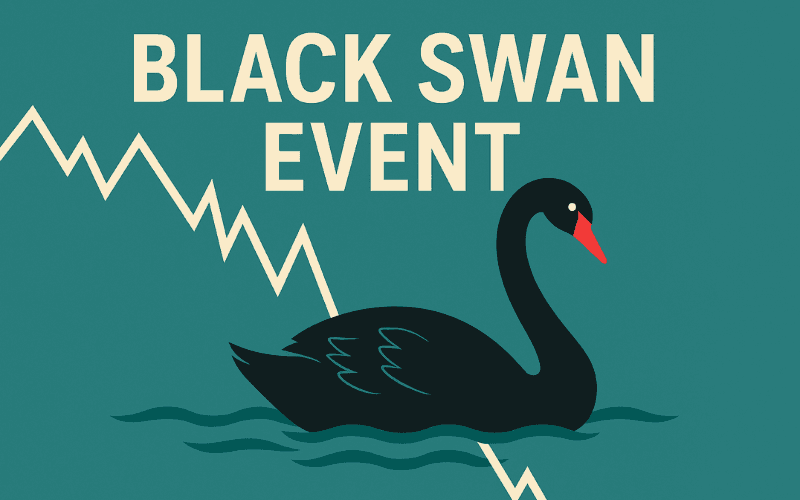
A black swan event is an extremely rare, hard-to-predict occurrence that delivers a massive shock to markets and is rationalised only in hindsight.
In financial markets, investors typically rely on past experience, historical data, and quantitative models to forecast future moves. Yet the events that truly upend markets and trigger violent dislocations are rarely the foreseeable ones — they are the sudden, unpredictable shocks. In risk-management terminology, these are called Black Swan Events.
These rare but consequential events can rewrite market structure and participant behaviour within days, sometimes hours. From the subprime mortgage crisis to global pandemics, Black Swans repeatedly remind us that risk is not only born from known uncertainty — it can also emerge from the unknowns we never imagined.
This guide unpacks the definition, characteristics, and historical cases of Black Swan Events, then analyses their concrete impact on markets and traders, helping Titan FX clients build more resilient risk awareness and response capability.
- Definition: An extremely rare event with severe impact that is rationalised only after the fact. Systematised by Nassim Nicholas Taleb in his 2007 book The Black Swan.
- Three traits: ① unpredictability (outside the normal distribution), ② massive impact (markets, industries, policy), ③ retrospective rationalisation (hindsight bias).
- Three canonical cases: 2008 Global Financial Crisis (Lehman collapse), 2015 Swiss franc cap removal (CHF up 30% in a day), 2020 COVID-19 (worldwide circuit breakers).
- Market effects: Price gaps, liquidity drought, wider spreads/slippage, leverage cascades, sentiment whiplash.
- Survival principles: Risk management first, keep capital reserves, discipline over strategy, treat each crisis as a system review.
1. What is a Black Swan Event?
In investment markets we usually rely on historical data and technical indicators to anticipate the future and grasp risk. Yet some events fall completely outside expectation, break market regularities, and inflict massive shocks. These sudden, consequential events are termed "Black Swan Events".
The concept comes from author and former hedge-fund manager Nassim Nicholas Taleb. In his 2007 book The Black Swan: The Impact of the Highly Improbable, he identified three defining traits: extreme rarity, severe impact, and retrospective explanation. In short, unpredictable in advance, devastating in effect.
The 2008 financial crisis, the Swiss National Bank's surprise removal of its EUR/CHF floor in 2015, and the 2020 COVID-19 pandemic are all textbook Black Swans. Each rocked global stock indices and forex markets and rendered countless trading strategies useless overnight.
Unlike day-to-day price movement, a Black Swan's destructive power lies in being fast, large, and unwarned. That is precisely why every trader needs to understand them — it is the first step in disciplined risk management.
2. The Three Traits of a Black Swan
Black Swans are hard to handle because they don't fit traditional risk-assessment frameworks. According to Taleb, they share three explicit traits.
Trait 1: Unpredictable
The first hallmark is that almost no one foresees them.
This is not an information shortage — it's that the event itself sits outside the realm of imagination. Market models and forecasting tools effectively stop working in such conditions.
Trait 2: Massive Impact
Once they happen, Black Swan events reshape markets, industries, and even societies.
Beyond mere price corrections, they can redirect capital flows, rewrite policy, and topple major institutions.
Trait 3: Rationalised After the Fact
Most ironically, after the event there is always someone "replaying history" and pointing to signals that supposedly foretold the crisis.
This is hindsight bias. We are not actually predicting the future — we are habitually constructing post-hoc narratives that make everything look explainable.
3. Famous Black Swan Events in History
While Black Swans are intrinsically unpredictable, history offers several textbook cases that caught entire markets off guard.
The 2008 Global Financial Crisis
The global financial storm triggered by the U.S. subprime mortgage crisis is the most representative modern Black Swan. The collapse of Lehman Brothers and the freeze in credit markets sent global equities into a tailspin and embedded "risk is everywhere" into the core mindset of investors.
The 2015 Swiss Franc Shock
Without prior notice, the Swiss National Bank (SNB) removed its EUR / CHF floor, sending the franc up more than 30% in a matter of minutes. Countless FX traders and institutions absorbed severe losses, and several brokers were forced into insolvency. The episode highlighted the unpredictability of policy risk.
The 2020 COVID-19 Pandemic
The global outbreak threatened lives and directly disrupted supply chains and consumer behaviour. Equity markets posted historic single-day declines, and unprecedented policy intervention followed — including emergency monetary easing and large-scale fiscal stimulus.
4. How Black Swans Affect Financial Markets
When a Black Swan strikes, markets almost always react violently and uncontrollably. The impact extends beyond price volatility to the stability of the entire financial system.
For investors and traders, understanding these chain reactions is non-negotiable for risk management.
Effect 1: Sudden Asset-Price Collapses or Spikes
A Black Swan triggers panic volatility within minutes.
Equities, FX, commodities, and even crypto can all see sweeping price moves.
Traditional technical analysis and forecasting models often fail to provide useful guidance, because sentiment overwhelms fundamentals and technicals.
Effect 2: Liquidity Drought and Severe Slippage
Once panic sets in, liquidity evaporates rapidly.
Bids and offers vanish; spreads widen and slippage worsens, multiplying execution risk.
This is especially dangerous for leveraged traders — stop-losses may not fill at the expected level, or may be skipped entirely.
Effect 3: Amplified Leverage Risk
Black Swans are particularly lethal for highly leveraged positions.
Whether in FX, CFDs, or other derivative markets, a sharp adverse price move evaporates margin, triggering forced liquidation, expanded losses, and potentially negative balances.
For institutions, leverage cascades can ripple through the entire financial system.
Effect 4: Sentiment Whiplash
A Black Swan is as much a psychological event as an economic one.
In short order, markets swing from optimism to panic and from "buy the dip" to "sell everything." That sentiment shift further amplifies price moves and can drive irrational behaviour.
5. Preparing for and Learning from Black Swan Risk
Black Swans cannot be predicted, but they can be prepared for. Mature traders focus on staying alive rather than catching every opportunity. The following principles help protect you in extreme conditions and turn each crisis into a learning resource.
Risk Management Comes First
When a Black Swan hits, the first to fall are those who neglected risk control. Setting stop-losses, sizing positions sensibly, and avoiding excessive leverage — these conservative-looking actions are exactly what keep you standing through the storm.
Keep Capital Management Flexible
Don't let a single trade or single market dominate your capital. Reserves are what prevent margin calls when conditions deteriorate, and what enable contrarian repositioning when the moment is right.
Composure Beats Strategy
When markets panic, traders are easily pulled into emotional decisions. Whether you can preserve discipline and judgement is what separates professionals from amateurs.
Each Crisis Is Nutrition
Every Black Swan is an opportunity to audit your trading system and psychological resilience. Reviewing afterwards — where was preparation thin, where was reaction too slow — strengthens you for the next storm.
Frequently Asked Questions (FAQ)
Q1. Can Black Swan events be predicted?
By definition, Black Swans are unpredictable. However, investors can prepare for tail risks through diversification, hedging strategies, and position size limits to mitigate their impact.
Q2. What is the difference between a Black Swan and a Gray Rhino?
A Black Swan is an unpredictable, high-impact event. A Gray Rhino refers to a highly probable but neglected risk, such as debt crises or geopolitical tensions that are visible but ignored.
Q3. How can individual investors best prepare for Black Swan events?
Portfolio diversification, stop-loss orders, controlled leverage, and maintaining a cash reserve are fundamental. The goal is not to predict the event but to survive it financially.
6. Conclusion: Prepare for the Unpredictable
Black Swans remind us that market uncertainty is greater than imagination allows. Rather than trying to predict every shock, focus on building enough defence: sound capital management, a clear risk framework, and the composure to deal with volatility calmly.
Further Reading
- What is a Financial Crisis?
- Greater Fool Theory
- Ponzi Scheme — How It Works
- Forex Trading Basics
- What is Leverage?
- The 2% Risk Rule
The financial markets research team at Titan FX. We produce educational content across a broad range of instruments, including forex (FX), commodities (crude oil, precious metals, agricultural products), equity indices, U.S. stocks, and crypto assets.
Primary Sources (by category)
- Theoretical foundation: Taleb, N. N. (2007) The Black Swan: The Impact of the Highly Improbable, Random House
- 2008 GFC: Federal Reserve Bank of St. Louis (FRED) — Lehman collapse timeline and S&P 500 trajectory; Bank for International Settlements (BIS) Annual Report 2009
- 2015 SNB shock: Swiss National Bank — official statement of 15 January 2015 (CHF/EUR 1.20 floor removed); BIS Triennial Survey 2016 — post-event FX liquidity analysis
- 2020 COVID-19 shock: WHO COVID-19 announcement timeline; CBOE VIX index historical data (closing high of 82.69 on 16 March 2020); U.S. Federal Reserve emergency rate cut to 0–0.25% on 15 March 2020