

Concorde Effect
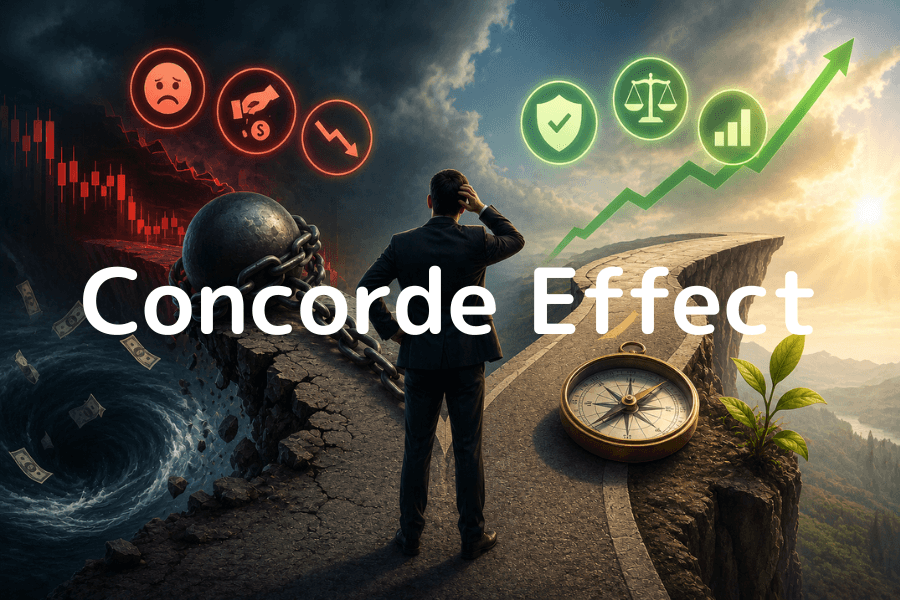
"We've come too far to quit now." Whether in investing or in work, almost everyone has felt this at least once—and it has a name: the Concorde Effect.
This phenomenon, also called the sunk cost fallacy, is extremely common in investment markets. Many investors refuse to accept a loss because they have "already put in too much," and some even keep adding to the position, ultimately causing far greater losses.
This article covers the basic definition and causes of the Concorde Effect, how it commonly appears in investment markets, its negative impact on decisions, and how beginners can avoid it effectively—helping investors build a more rational approach to risk management.
- Grasp the Concorde Effect and sunk cost fallacy quickly.
- Understand why we resist cutting losses and keep adding.
- Spot the pattern across stocks, forex, and crypto.
- See how it wrecks stop-loss discipline and returns.
- Learn practical tactics to avoid emotional averaging down.
1. What Is the Concorde Effect? The Basics of the Sunk Cost Fallacy
The Concorde Effect is the psychological tendency to keep pouring in more resources because of costs already sunk in the past, refusing to stop even when there is objectively no reasonable prospect of return.
The concept comes from the "Concorde" supersonic airliner jointly developed by the United Kingdom and France. At the time, the project's operating costs were clearly out of line with market demand, but because both governments had already committed enormous funds and political capital, they chose to press on rather than cut their losses in time.
In economics, this behavior is closely tied to the sunk cost fallacy.
A sunk cost is a cost that has already been paid and cannot be recovered—for example:
- Capital already committed and unrecoverable
- Research time already spent
- Trading costs already paid
- Effort spent maintaining the position
A rational investment decision should focus on future risk and reward, not on what has already been lost. Yet the human mind finds it very hard to truly ignore existing costs, which is why we fall into the Concorde Effect.
2. Why Do We Fall Into It? The Psychology Explained
The human brain evolved many protective mechanisms, but in fast-moving financial markets these instinctive reactions often turn into deadly cognitive biases.
Cause 1: Powerful loss aversion
Prospect theory in behavioral economics suggests the pain of a loss is roughly twice as strong as the pleasure of an equivalent gain.
When a trade goes into the red, as long as you do not sell, you can keep treating it psychologically as a "paper loss." The moment you decisively cut the loss, it becomes a formal admission of failure—and to escape that pain, the brain strongly pushes the investor to keep holding.
Cause 2: Fear of admitting mistakes and self-justification
Cutting a loss means admitting your earlier judgment was wrong, which many investors find hard to accept.
To protect their self-image and avoid cognitive dissonance, investors unconsciously seek out information that favors their position—and may even add to it—trying to prove their original decision was right.
Cause 3: An emotional bond with sunk costs
The more money, time, and effort we put into an investment, the more emotional attachment we tend to form.
Even when the market trend has clearly changed, we are unwilling to let go, thinking "I've already put in this much, I can't stop now." This is the core psychological mechanism of the Concorde Effect.
3. How the Concorde Effect Shows Up in Markets
When investors fall into the Concorde Effect, several typical behavior patterns usually appear. These often turn a once-manageable loss into an unrecoverable one.
Form 1: Averaging down into a losing position
After a price drops, investors are unwilling to accept the loss and exit; instead, they keep adding to lower their average cost. This is the most common form of the Concorde Effect. Many think "it would be a waste to sell now; if it falls more, it's cheaper," and so they buy more as it falls, ultimately concentrating too much risk in a single position. See more on averaging down.
Form 2: Revenge buying under high leverage
In high-leverage markets such as futures and forex, after a major loss investors often feel a strong urge to "win it back," enlarging positions to trade against the trend. This emotion-driven revenge trading frequently causes even more severe consecutive losses in a short time.
Form 3: Long-term holding of a clearly failed investment
Whether stocks, funds, or crypto, even after fundamentals have deteriorated and the trend has clearly weakened, investors tend to hold on and refuse to accept the loss because of the money and effort already spent. This "hold to the bitter end" behavior is the most typical market picture of the Concorde Effect.
4. How to Avoid It: Practical Tactics for Beginners
To survive in financial markets, you must learn to fight your own instincts. With systematic tools and rational thinking, you can build an effective barrier that insulates decisions from emotion.
Tactic 1: Set clear stop-loss conditions before entering
Before opening any position, first decide the maximum loss you can bear and set a stop-loss immediately. Treat the stop-loss as part of the trading plan, not an afterthought. This greatly reduces emotional interference and returns decisions to reason.
Tactic 2: Review from a zero base regularly
When a position shows a loss, try setting aside the costs already invested and ask yourself: "If I held cash right now and saw this instrument for the first time, would I buy at this price?" If the answer is no, you should exit decisively. This zero-based thinking helps you break free from the grip of sunk costs.
Tactic 3: Focus on future expected value, not past inputs
Professional traders care only about "from this moment on, is this investment's future return worth continuing to hold." The money already spent is an unchangeable fact and should not affect the current decision. Regularly reassessing the future potential of each position helps you adjust in time and avoid wasting resources on instruments that have lost their edge.
Tactic 4: Strictly enforce position-sizing limits
Limiting how much any single asset or trade takes up of your total capital (for example, no more than 10%) effectively prevents emotional adding. Even if your judgment is wrong, it will not deal a fatal blow to the whole account.
Building these practical tactics helps investors gradually escape the Concorde Effect and return their decisions to reason and long-term value.
5. FAQ: Questions on the Concorde Effect and Investor Psychology
Q1. How do I tell the Concorde Effect apart from genuine long-term value investing?
The key is whether the asset's core value and fundamentals have changed.
Long-term value investing patiently waits for price to return, on the premise that the intrinsic value is unchanged. The Concorde Effect, by contrast, is holding on blindly purely because you cannot bear the earlier loss, even though the fundamentals or trend have already turned worse. Their starting points are fundamentally different.
Q2. Why can't I press the close button even when I know I should cut the loss?
This is an "execution barrier" in behavioral finance. When the loss exceeds your psychological threshold, the brain slips into numbness or avoidance.
The fix is to shrink the initial risk on each trade. As long as every loss stays within a range that barely stings, you can cut it decisively with no psychological burden.
Q3. How can I train myself to let go of sunk costs?
Keep a trading journal for deliberate practice. Each time you finish a stop-loss, record in detail that although you lost money, you regained freedom in capital allocation and valuable time.
When you come to see a stop-loss as an active optimization—cutting the weak and keeping the strong—rather than a passive failure, you gradually make peace with sunk costs.
Q4. Does the Concorde Effect get worse in team or family investing?
Group decisions often amplify the Concorde Effect. Because shared responsibility and mutual approval are at play, no one wants to be the first to admit failure.
In such cases, introducing an objective, quantitative third-party review, or having an independent risk manager strictly enforce system settings, is an effective way to break groupthink.
6. Summary
The essence of the Concorde Effect is letting "how much I have already put in" override the judgment of "whether it is still worth continuing." Averaging down again and again, revenge buying, or clinging to a clearly weakening position all share the same reluctance to let go of sunk costs.
A truly rational decision looks only at an investment's expected value from this point forward, not at what has already been spent. By setting a stop-loss before entering, reviewing positions from a zero base regularly, and strictly capping the capital in any single position, you can gradually break free of the Concorde Effect—turning each exit into an active optimization rather than a passive failure.
Further Reading
- What Is Averaging Down?
- What Is Forced Liquidation (Loss-Cut)?
- What Is the Chicken Game?
- What Is a Black Swan Event?
- What Are Financial Markets?
Titan FX Trading Strategy Lab. We produce investor-education content covering forex, commodities (crude oil, precious metals, agricultural goods), stock indices, US equities, and digital assets.
Primary Sources (by category)
- Behavioral economics & academic: Kahneman, D. & Tversky, A. (1979) "Prospect Theory", Econometrica — the theoretical basis of loss aversion; Arkes, H. & Blumer, C. (1985) "The Psychology of Sunk Cost", Organizational Behavior and Human Decision Processes
- Case & history: The UK-France "Concorde" supersonic airliner project — the origin of the term "Concorde Effect"
- Investor education: U.S. Securities and Exchange Commission (SEC) Investor.gov — investor materials on behavioral biases and risk management