

Sunk Cost
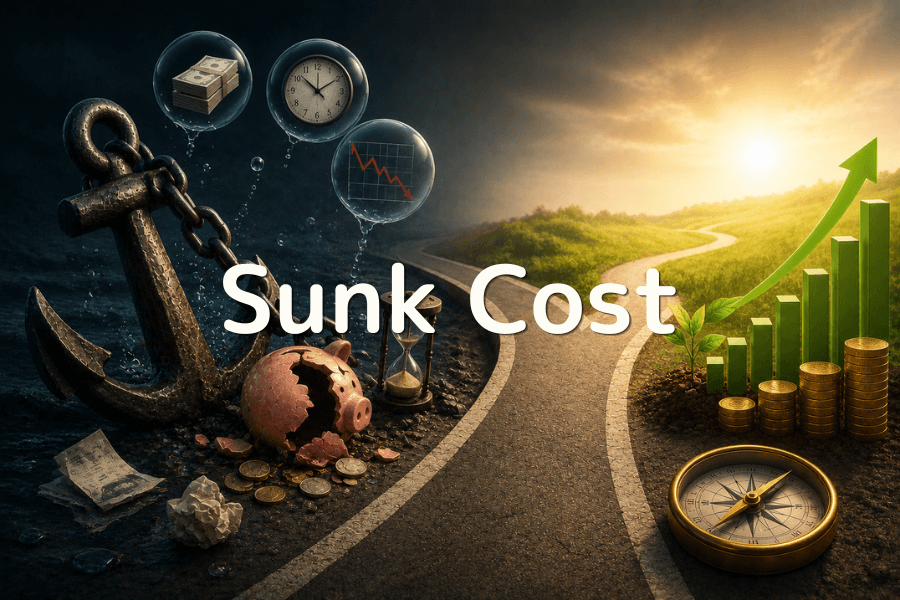
"I've already lost this much, so I can't sell now." If you have felt this while investing, it may be a sign that your judgment is anchored to a sunk cost.
In investment decisions, many people cling to their original choice because of these unchangeable past inputs, even when continuing is likely to bring greater losses. This is known as the sunk cost fallacy—a common psychological trap in behavioral finance.
This article covers the basic definition of sunk cost, how it differs from marginal cost and opportunity cost, the psychology that makes investors vulnerable to it, common ways it shows up in markets, and how beginners can avoid it—helping investors make more rational decisions.
- Grasp the definition of sunk cost in behavioral finance.
- Tell sunk cost apart from marginal and opportunity cost.
- Recognize the psychology behind the sunk cost fallacy.
- Spot common sunk-cost traps across markets.
- Learn practical tactics to avoid emotional holding.
1. What Is Sunk Cost? Sunk vs. Marginal vs. Opportunity Cost
A sunk cost is a cost that has already been incurred and cannot be recovered—for example, a loss already taken, or the time and effort already invested.
The table below contrasts three commonly confused cost concepts:
| Cost type | Definition | Should it affect future decisions? | Investing example |
|---|---|---|---|
| Sunk cost | A cost already paid and unrecoverable | No | An entry price already at a loss; fees paid |
| Marginal cost | The added cost of taking one more unit of action | Yes | The capital needed to add to the position now |
| Opportunity cost | The forgone return of the best alternative you gave up | Yes | Locking funds in a losing stock and missing other opportunities |
Understanding the difference helps you decide more rationally. A sunk cost can no longer be changed; what truly matters is whether the future marginal cost is worth paying and how large the opportunity cost will be.
What is the sunk cost fallacy?
When investors keep clinging irrationally because of sunk costs already incurred, the result is the sunk cost fallacy. This is also the core psychological basis of the Concorde Effect. Many investors know a position has no future prospects yet sink deeper because "I've lost this much, I can't sell now."
2. Why Are Investors So Vulnerable to Sunk Cost?
Sunk costs are hard to ignore, mainly because of several instinctive reactions of the human brain. These make it hard to choose rationally when facing a loss that has already occurred.
Cause 1: The instinct of loss aversion
People are far more sensitive to losses than to the pleasure of an equivalent gain.
When an investment shows a loss, choosing to cut the loss means accepting the fact of a "real loss," whereas holding on lets the brain treat the loss as "not yet realized" for the time being.
This tendency to avoid real pain leads many investors to take on greater risk rather than accept a loss early.
Cause 2: Self-image and cognitive dissonance
Admitting a sunk cost means admitting your earlier decision was wrong, which bruises your self-esteem.
To ease this discomfort, investors tend to rationalize—looking only at information that supports holding, or telling themselves "just a little longer and it will turn around."
Cause 3: Emotional investment and attachment to sunk costs
The more money you put in, the more time you spend researching, and the more emotion you invest, the more attachment you form to that investment.
Even when objective data shows the trend has turned, investors think "I can't let my earlier effort go to waste" and keep holding or adding.
Cause 4: Excessive fixation on breaking even
Many people focus on "getting back to the original entry price" rather than assessing future value. This "I have to at least break even" obsession often causes investors to overlook the fact that the market has changed fundamentally.
3. Common Sunk-Cost Fallacy Traps in Markets
In real trading, the sunk cost fallacy rarely appears in a crude form; it usually disguises itself as various plausible-sounding excuses that quietly erode your capital.
Trap 1: Bottomless, strategy-free averaging down
When an asset's fundamentals have deteriorated fundamentally and the market is in a structural downtrend, many people cannot bear to cut because they have already lost a significant amount.
The most common mistake here is to keep buying to lower the average cost. This averaging down without risk control tends to concentrate risk in a single position, and once the market hits extreme conditions, the whole account faces a forced liquidation.
Trap 2: Clinging to high-fee, underperforming assets
Some investors bought financial products with high subscription fees or management costs in the past.
Even after the product persistently lags the market index, or the environment has changed, they refuse to redeem because of the "I'd lose out if I don't earn back the fees" mindset.
This attachment to past spending instead keeps their capital stuck in inefficient assets for the long term.
Trap 3: Revenge over-sizing in high-leverage markets
In high-leverage margin markets such as forex and futures, the destructive power of sunk cost is magnified many times over.
After a trade suffers a large loss, a strong urge to win it back arises.
To recover the margin just lost, investors blindly enlarge positions for high-risk counter-trend trades. This emotional trading, triggered by sunk costs, is a leading cause of accounts blowing up in a very short time.
4. How to Avoid the Sunk-Cost Trap: Practical Tactics
The key to avoiding the influence of sunk cost is to shift your attention from "how much I've already put in" to "whether it's still worth continuing."
Tactic 1: Build the habit of zero-based thinking
When a position shows a loss, try to ignore the costs already invested and ask yourself: "If I held cash right now and were seeing this instrument for the first time, would I buy at the current price?" If the answer is no, you should consider exiting. This helps you shed the psychological baggage of past inputs and focus on future value.
Tactic 2: Set clear exit rules in advance
Before opening any position, write down the stop-loss condition and the maximum loss you can bear, and enforce them strictly. Treat the stop-loss as an inseparable part of the trading plan, not a flexible clause you adjust by mood. This upfront constraint effectively reduces emotional interference at the critical moment.
Tactic 3: Reassess future expected value regularly
Review your positions periodically and ask: "From now on, are this investment's future risk and potential reward still reasonable?" If the fundamentals or trend have clearly changed, adjust or exit decisively rather than clinging on because of what you have already put in.
Tactic 4: Strictly control single-asset allocation
Limiting how much any single instrument takes up of total capital (for example, no more than 10%) prevents sunk-cost-driven over-adding at the source. Even if one investment is misjudged, it will not deal too big a blow to the whole account, always leaving you room to reallocate.
Through these practical methods, investors can gradually reduce the influence of sunk cost on decisions, making each allocation more rational and future-focused.
5. FAQ: Questions on Sunk Cost and Investor Psychology
Q1. How is a sunk cost different from normal long-term holding?
Normal long-term holding rests on the asset still having future value, whereas a sunk cost is holding on because you are unwilling to accept a loss that has already occurred.
Q2. How can I tell whether I'm being influenced by sunk cost?
If your reason for holding is mainly "I've already put in this much" rather than "there is still a reasonable future return," you are likely already being influenced.
Q3. Besides money, do time and effort count as sunk costs too?
Yes. Non-monetary resources are also part of sunk cost. Many investors spend hundreds of hours poring over financial reports and tracking forums for a single stock, and this large investment of effort creates an even deeper emotional bond.
Yet in the face of objective price action, these efforts do not increase the odds of the asset rising. Learning to let go of invested time matters just as much.
Q4. Is a stop-loss the best way to avoid sunk cost?
Yes. Setting a stop-loss rule in advance and enforcing it strictly effectively cuts off the influence of past costs on future decisions.
6. Summary
A sunk cost is a cost already paid that cannot be recovered, and a rational decision should ignore it and look only at future risk and reward. Unlike marginal cost and opportunity cost, a sunk cost should not affect future decisions—drawing that line is the starting point.
Even so, loss aversion, self-justification, and the hope of breaking even lead people to be dragged along by sunk costs—averaging down, holding underwater positions, and revenge trading. Practicing four things—zero-based thinking, setting exit rules in advance, reassessing future expected value regularly, and capping single-asset weight—lets you decide based on the future rather than the past. For more on the behavioral side, see the Concorde Effect.
Further Reading
- What Is the Concorde Effect?
- What Is Herd Mentality?
- What Is the Chicken Game?
- What Is a Black Swan Event?
- What Is Stop Loss?
Titan FX Trading Strategy Lab. We produce investor-education content covering forex, commodities (crude oil, precious metals, agricultural goods), stock indices, US equities, and digital assets.
Primary Sources (by category)
- Behavioral economics & academic: Arkes, H. & Blumer, C. (1985) "The Psychology of Sunk Cost", Organizational Behavior and Human Decision Processes; Kahneman, D. & Tversky, A. (1979) "Prospect Theory", Econometrica — the theory of loss aversion
- Concept & textbook: Definitions of sunk cost and opportunity cost in standard economics textbooks (e.g., Mankiw, Principles of Economics)
- Investor education: U.S. Securities and Exchange Commission (SEC) Investor.gov — investor materials on behavioral biases and risk management