

Averaging Down
Averaging down is a strategy of adding to a losing position in the same direction to lower the average entry price, so the market needs only a smaller rebound to break even. It can amplify profits if price recovers — but it equally magnifies losses and margin risk if the trend continues, making it a double-edged tool that beginners should use with caution.
Because it adds to a position that is already underwater, averaging down demands strict risk control. This article walks through its definition, calculation, three advantages, three drawbacks, the situations it suits, key precautions, and frequently asked questions, so you can judge rationally whether to use it.
- Definition: add to a same-direction position while at a loss to lower the average cost (total cost ÷ total size)
- Core logic: move the break-even point lower and shorten the wait to recover
- Three advantages: lower average price, amplified profit on rebound, more psychological flexibility
- Three drawbacks: magnified losses, margin drain leading to forced liquidation, added psychological pressure
- Best timing: long-term trend intact and the pullback is temporary (confirm with RSI/MACD/support)
- Vs dollar-cost averaging: averaging down is discretionary; DCA is mechanical and lower-risk
1. What Is Averaging Down?
Let’s start by explaining the meaning and origin of Averaging Down.
Meaning of Averaging Down
Averaging Down is a common strategy in forex trading.
It refers to adding new positions when the market price moves against your existing position, aiming to reduce the average entry price (average cost).
By lowering the average entry price, traders can potentially achieve higher profits if the market rebounds as anticipated.
However, if the market continues moving in the opposite direction, losses will increase, so forex beginners must exercise extreme caution.
Origin of Averaging Down
The term "Averaging Down" comes from the concept of equalizing losses by reducing the overall cost.
In actual trading, however, the purpose of Averaging Down is not just to mitigate losses but often to aim for profit as the market recovers.
2. How to Calculate the Average Entry Price in Averaging Down
Averaging Down is designed to lower the average entry price of open positions, but how exactly is it calculated? Let’s illustrate with an example.
The calculation formula is as follows:
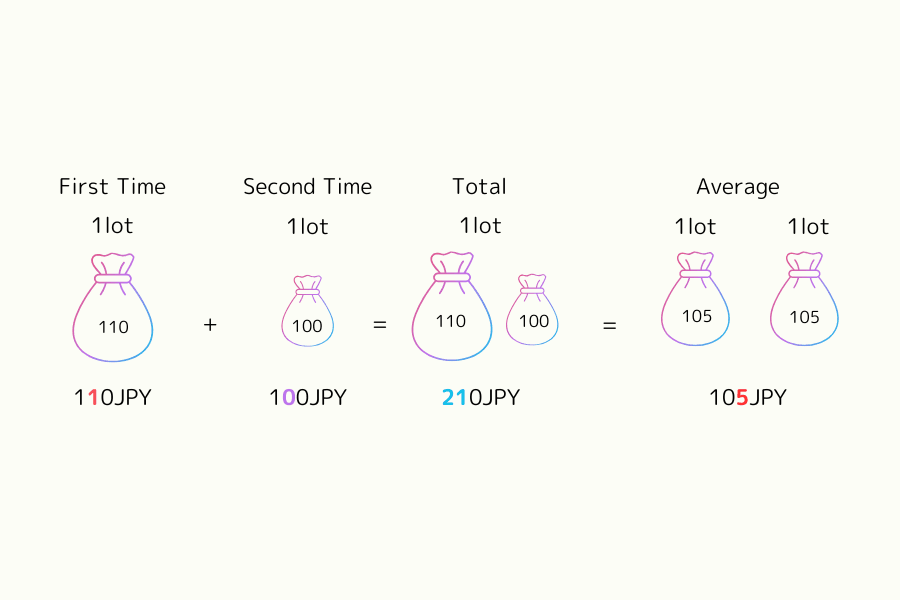
Average Entry Price = Total Transaction Value ÷ Total Number of Positions
For example, let’s take USD/JPY:
- Suppose you buy 1 lot at 110 yen.
- Later, the price drops to 100 yen, and you buy another 1 lot.
Using the formula:
(110 + 100) ÷ 2 lots = 105 yen
Therefore, the average entry price is 105 yen.
Although the original position was purchased at 110 yen, by averaging down with an additional purchase at 100 yen, the average entry price becomes 105 yen for the 2 lots.
As long as the price rises above 105 yen, the positions can be closed at a profit.
3. Advantages of Averaging Down
The main benefits of averaging down include three key points:
- 1.Reduces the Average Entry Price
- 2.Opportunity to Minimize Losses
- 3.Potential for Greater Profits
1. Reduces the Average Entry Price
As previously mentioned, averaging down helps reduce the average entry price.
When the average price decreases, the breakeven point also lowers. If you anticipate a market rebound, this can be an effective strategy to recover losses faster.
2. Opportunity to Minimize Losses
After averaging down, the reduced average price gives traders an opportunity to minimize their losses.
For example, without averaging down, the price would need to return to the initial entry level of 110 yen to offset unrealized losses.
However, by averaging down at 100 yen, the breakeven point drops to 105 yen.
This shortens the waiting time for a market rebound, making it one of the key advantages of averaging down.
3. Potential for Greater Profits
Averaging down not only lowers the average price but also increases the position size.
By purchasing at lower prices, if the market rises, the profits will be larger compared to holding the original position.
For instance:
-
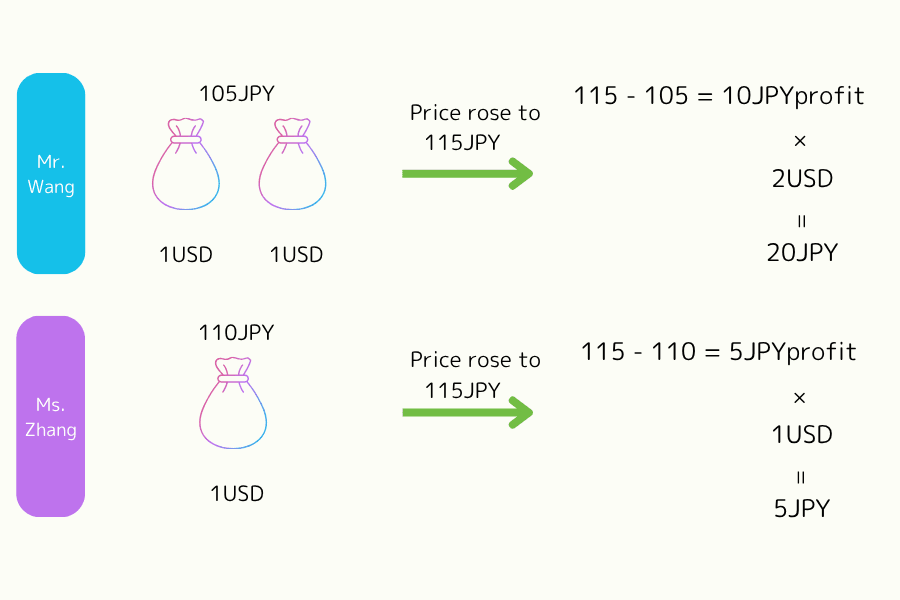
Mr. Wang and Ms. Zhang both initially buy 1 USD at 110 yen.
-
When the price drops to 100 yen, only Mr. Wang purchases another 1 USD.
-
If the price later rises to 115 yen, and both exit their positions:
-
Mr. Wang’s total profit: 20 yen.
-
Ms. Zhang’s total profit: 5 yen.
This example demonstrates how properly executed averaging down can lead to greater profits when the market moves in your favor.
4. Disadvantages of Averaging Down
The main drawbacks of averaging down include three key points:
- 1.Potential for Greater Losses
- 2.Reduced Margin Balance and Increased Risk of Forced Liquidation
- 3.Increased Psychological Pressure
1. Potential for Greater Losses
While averaging down can increase profits if successful, it can also amplify losses if the market continues to move against you.
For example:
-
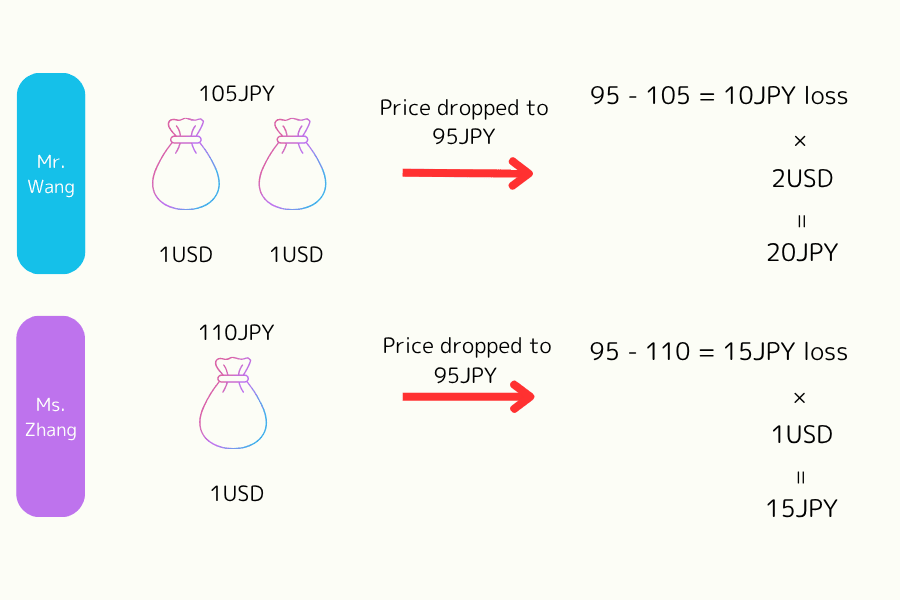
Mr. Wang and Ms. Zhang both initially buy 1 USD at 110 yen.
-
When the price drops to 100 yen, Mr. Wang averages down by buying another 1 USD.
-
However, if the price continues to fall to 95 yen, and both are forced to close their positions:
-
Mr. Wang’s total loss: 20 yen.
-
Ms. Zhang’s total loss: 15 yen.
By averaging down, Mr. Wang’s loss increases by 5 yen, representing a 33% greater loss compared to Ms. Zhang, who did not average down.
This highlights the risk of larger losses when averaging down fails.
2. Reduced Margin Balance and Increased Risk of Forced Liquidation
Averaging down increases position size, which also raises the margin requirements. If the market continues to move unfavorably, the margin balance will decrease.
If the margin level falls too low, traders face the risk of forced liquidation. Proper risk management and strict control of available capital are essential when averaging down.
3. Increased Psychological Pressure
Averaging down involves adding positions during a losing trade, making it an inherently high-risk strategy.
Before the market reverses, unrealized losses may continue to grow, placing significant psychological pressure on traders.
This emotional strain can affect daily life and decision-making. Therefore, caution and a disciplined mindset are critical when using the averaging down strategy.
5. Best Situations to Use Averaging Down
Here are the scenarios where averaging down can be effectively applied:
- 1.When a Price Reversal is Judged to Be Temporary
- 2.When You Want to Quickly Eliminate Unrealized Losses
1. When a Price Reversal is Judged to Be Temporary
Averaging down is most suitable when you believe that the current adverse price movement is temporary.
For example, if the long-term trend is upward, short-term fluctuations may cause temporary declines. However, the overall direction remains upward.
In such a case, when prices experience a short-term drop, averaging down can be considered.
Example:
- Suppose the long-term trend is upward, and you buy 1 position at 105 yen.
- If the price temporarily falls to 95 yen, you buy 1 more position.
- The average price is now reduced to 100 yen.
Once the price returns to the long-term upward trend and exceeds 100 yen, you can close the position with a profit.
Key to Timing:
- Analyze whether economic data releases, speeches by policymakers, or technical factors could signal a turning point in the decline.
- Check for important support levels or use technical indicators to assess the opportunity.
2. When You Want to Quickly Eliminate Unrealized Losses
Averaging down is also useful when you want to quickly offset unrealized losses.
If you do not average down, you would need to wait for the price to return to the original entry price to recover the losses.
Holding onto a losing position for an extended period can create significant psychological stress for traders.
By averaging down, the average price is lowered, increasing the chance of exiting the position sooner as the price recovers.
6. Key Points to Consider When Averaging Down
Averaging down is inherently a risky strategy, and traders must keep the following points in mind:
- 1.Strictly Manage Your Capital
- 2.Use Averaging Down Strategically
- 3.Cut Losses Immediately if They Exceed Your Risk Tolerance
1. Strictly Manage Your Capital
Before averaging down, it’s essential to carefully control your margin balance and maintenance ratio.
Proper capital management allows you to systematically increase positions while reducing the risk of forced liquidation.
However, it’s important to note that holding losing positions will temporarily tie up capital, which is an unavoidable drawback.
2. Use Averaging Down Strategically
Averaging down is effective if you have a clear plan in place, such as:
- When to add positions
- When to cut losses
Strategic averaging down requires a predefined stop-loss plan, mental preparation, and control over the risks of forced liquidation.
The key to a successful strategy lies in the ability to predict price trends through technical analysis.
3. Cut Losses Immediately if They Exceed Your Risk Tolerance
When losses exceed your acceptable range, you must cut your losses immediately to protect your capital.
Decide on clear stop-loss rules in advance, such as:
- Based on a specific loss amount: “Close the position if losses reach XXX.”
- Based on price movements: “Exit if the price moves XXX points against the position.”
Avoid the mistake of continuously adding positions in the hope of a market rebound, as this can magnify losses.
The key to profitability is “small losses, big gains”. Mastering loss control is the first step to achieving consistent, large profits.
7. Frequently Asked Questions (FAQ)
Q1: What is the opposite of averaging down?
The direct opposite is averaging up (scaling into a winning position as price rises to raise the average price). In a broader sense, the opposite is cutting losses, since a stop-loss locks in the loss instead of adding to the position.
Q2: Is averaging down suitable for beginners?
Generally not. It adds to losing positions and can magnify losses and margin pressure. Beginners should first set stop-loss rules and a cap on add-ons, and practice in a demo account.
Q3: How does averaging down differ from dollar-cost averaging (DCA)?
Both involve staged entries, but the logic differs: DCA invests a fixed amount on a fixed schedule (mechanical, lower-risk, for long-term investing), while averaging down is discretionary, triggered by an unrealized loss, and concentrates risk in a falling position.
Q4: What kind of trader is averaging down suited to?
Traders with strict capital management, ample free margin, solid forex experience to read trends and technicals, and the discipline to cut losses if the thesis breaks. Beginners should build experience and risk management first.
Q5: How does averaging down relate to the Kelly criterion?
The Kelly criterion sizes positions from win rate and odds. Applied to averaging down, each add-on should be re-sized from the updated probability and odds rather than blindly doubling down; Martingale-style doubling violates Kelly and easily leads to a blow-up.
8. Summary
Averaging down is a strategy with both potential and risk in forex trading. By lowering the average entry price, a trader can earn more on a rebound and clear an unrealized loss faster. However, if the market keeps moving against the position, averaging down can magnify losses, raise the risk of forced liquidation, and add psychological pressure.
It suits situations where a pullback is judged temporary or you want to clear an unrealized loss quickly — but only with strict capital management and a clear stop-loss plan. Beginners should practice in a demo account and master technical analysis and risk management first. Used sensibly alongside sound risk controls such as the 2% rule and the Kelly criterion, averaging down can improve execution efficiency while pursuing steadier returns.
Further Reading
- Forex Trading Basics
- What is Stop Loss?
- What is Kelly Criterion?
- What is Volatility?
- The 2% Risk Rule
Titan FX Trading Strategy Lab. We produce investor-education content covering forex, commodities (crude oil, precious metals, agricultural goods), stock indices, U.S. equities, and digital assets.
Primary Sources (by category)
- Historical origin: Edo-period Dojima Rice Exchange (the world's earliest organized futures market, 1730) — origin of "nanpin" (averaging-down) terminology
- Proverb: "Heta na nanpin, sukanpin" — classic Japanese investing maxim warning against poor averaging-down
- Mathematical foundations: Kelly, J. L. (1956) "A New Interpretation of Information Rate", Bell System Technical Journal — Kelly Criterion application to averaging-down position sizing
- Academic analysis: Statman, M. (2014) "Behavioral Finance: Finance with Normal People", Borsa Istanbul Review — behavioral-finance perspective on averaging-down