
 Home
Home- Investment Guide: Strategies for Stocks, Forex, and Metals
- What Are Segregated Accounts? Mechanism & Verification
What Are Segregated Accounts? Mechanism, Verification & Titan FX Case
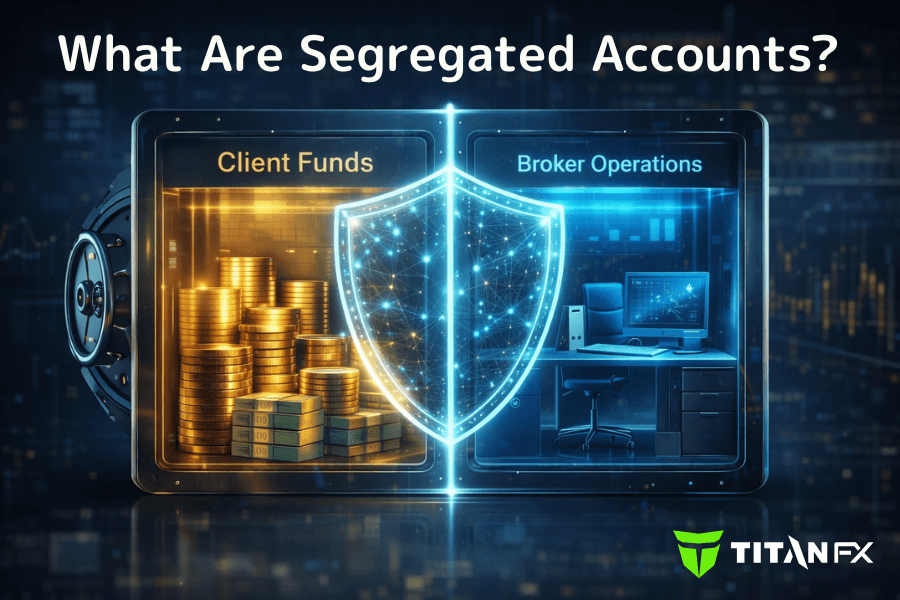
A segregated account is a client-fund account kept separate from an FX or CFD broker's operating money. It helps keep ownership and traceability clear if the broker faces operational stress, but it is not a capital guarantee, deposit insurance, or protection against trading losses.
This article explains what segregated accounts protect, what they do not protect, how the deposit-to-withdrawal flow works, and how they differ from trust accounts, compensation funds, and platform-level margin settings. It also reviews Titan FX's fund-segregation framework and third-party dispute-resolution arrangements.
- What segregated accounts protect and what they do not protect
- How client funds are separated from broker operating capital
- How segregated accounts differ from trust accounts, compensation funds, and isolated margin
- What public documents and deposit-flow details to check before opening an account
- 1. What Are Segregated Accounts?
- 2. How Segregated Accounts Work (Flow and Logic)
- 3. Distinctions from Similar Concepts
- 4. How to Tell if a Broker Actually Uses Segregated Accounts
- 5. FAQ
- 6. Titan FX Case: Segregated Fund Management and Third-Party Protection
- 7. Summary: Fund Safety Is the Foundation of Trading
1. What Are Segregated Accounts?
Segregated accounts are an accounting-and-legal framework FX brokers use to protect client assets. The core purpose is to completely separate client funds from the broker's own operating capital, ruling out the risk of misappropriation or commingling at the institutional level.
Definition: Asset Separation in Physical and Legal Terms
The basic concept is that the broker must open a dedicated account at a third-party bank, where client deposit margin is held. This is not just physical account separation. The law also treats client funds as not part of the broker's balance sheet.
Even if the broker faces distress, bankruptcy, or legal proceedings, funds inside the segregated account still belong to clients and legally cannot be used to settle the firm's debts.
Function: The Protection Boundary
To evaluate risk correctly, traders need to see exactly where segregated accounts protect, and where they do not.
- ▸ What they protect: mainly the ownership safety of the funds. They prevent the broker from using client money for its own operations, salaries, or proprietary investing, so that capital does not vanish because of firm-level operating risk.
- ▸ What they don't protect: they are not a capital guarantee or deposit insurance. Trading P&L, slippage, or losses from extreme market moves are market-risk items and fall outside the segregated-account scope.
In other words, segregated accounts guarantee that "the money is always yours," not that "you won't lose on trades."
2. How Segregated Accounts Work (Flow and Logic)
The most intuitive way to understand segregated accounts is to follow the closed-loop flow of funds from deposit to withdrawal. This flow ensures that every part of the capital is clearly labeled and use-restricted at the bank level.
Step 1: Funds Enter the Segregated Account
When an investor deposits, the funds are transferred directly into a bank account labeled Client Segregated Account. From that moment, funds are clearly marked as client assets at the bank level and separated from the broker's operating capital.
Step 2: Ledger Matching
After funds arrive in the segregated account, the broker records the amount internally, matching the actual bank balance to the investor's trading-account balance. This stage involves only bookkeeping; funds themselves don't move.
Step 3: Capital Controls During Operations
While the investor holds positions or trades, funds in the segregated account remain under usage restriction. Broker salaries, system maintenance, and marketing must be paid from the firm's own operating account; client funds inside segregated accounts cannot be used.
Step 4: Withdrawal Flow Back Out
When an investor requests a withdrawal, the broker follows the established process to move funds out of the same segregated account to the investor's designated bank account. Since the funds stayed in the segregated account throughout, the withdrawal flow has a clean, auditable trail.
Under this continuous-flow design, client funds remain independent at every stage, and their location and use can always be traced. This is exactly the core role segregated accounts play in the fund-safety framework.
3. Distinctions from Similar Concepts
When assessing platform safety, investors often encounter several similar-sounding but distinct terms. Contrasting them with segregated accounts helps clarify the real boundaries of protection.
Segregated Accounts vs Trust Accounts
Segregated accounts center on "restriction on use of funds": the broker retains management authority but cannot spend client funds.
Trust accounts, by contrast, involve stricter legal entrustment, typically placing ownership and management under a trustee (a bank or law firm).
Both improve fund safety, but trust accounts lean toward legal structure, while segregated accounts focus on operational separation and supervisory requirements.
Segregated Accounts vs Investor Protection / Compensation Funds
These two represent "prevention before a problem" vs "remediation after a problem."
Segregated accounts set up separation and control before problems occur, reducing the probability of issues arising.
Investor protection or compensation funds come in after disputes or losses and provide avenues for complaints and compensation, for example, third-party arbitration through the Financial Commission.
The former is preventive, while the latter is remedial. They cannot substitute for each other.
Segregated Accounts vs Platform-Internal Risk Features (e.g., Isolated Margin)
Some platforms offer "isolated margin" or in-account risk settings that modify how risk is calculated across orders. These live at the trading-system layer and are designed to manage trading risk.
Segregated accounts live at the bank and regulatory layer and concern where funds are actually held and who owns them in law. Even with strong in-platform risk controls, if there is no bank-level segregation, legal safety is limited.
4. How to Tell if a Broker Actually Uses Segregated Accounts
The key for investors is whether they can find concrete, verifiable evidence in public information. Reviewing legal documents, the actual deposit flow, and regulatory requirements usually makes a broker's actual practice clear.
Check 1: Do Legal Documents Clearly State Fund Separation?
Review the broker's Client Agreement or Product Disclosure Statement (PDS) and confirm whether they explicitly specify that client funds are managed using Segregated Accounts.
Also check whether the documents specify the tier of the custodian bank, for example, whether it is a top-rated Tier-1 bank.
Check 2: Actual Deposit Account Name and Nature
The receiving-account information shown during deposit is an important tell.
If the account name contains wording like "Client Account," it usually means the deposit goes into a client-dedicated account. Conversely, if the process asks you to wire to a personal account or a third-party account of unclear origin, transparency is lacking and caution is warranted.
Check 3: Specific Regulatory Requirements
Finally, check whether the broker's regulatory license specifically requires client-fund separation.
Some regulators require periodic audits to ensure segregated-account practices stay compliant. The more specific the regulatory requirements, the higher the likelihood of real implementation.
Using these checks, investors can form a grounded view of a broker's fund-management practices before opening an account, rather than relying on marketing language alone.
5. FAQ
Q1: If there's a segregated account, does that mean the platform can't go bankrupt?
Segregated accounts separate client funds from company assets and reduce misappropriation risk, but they do not change the broker's operating condition. If the platform fails, segregated accounts raise the odds that client funds can be identified and returned, but they cannot prevent the failure itself.
Q2: If the bank custodying client funds fails, is the money affected?
That is a banking-system risk, typically subject to the local regulatory framework and bank-protection schemes. If the broker chooses a high-rated custodian bank, that reduces the probability of this type of risk.
Q3: I don't have a big account. Do I really need to care about segregated accounts?
Yes. Segregated accounts protect the legal and accounting ownership of your capital, regardless of account size. For investors trading over the long term or frequently, the stability of fund management often matters more than the cost of any single trade.
Q4: What's the relationship between segregated accounts and a regulator's license?
Most strictly regulated financial institutions, including ASIC-regulated entities, include client-fund segregation in their licensing conditions. Regulators typically verify segregation through periodic audits or filings, so segregation quality reflects the quality of regulation.
6. Titan FX Case: Segregated Fund Management and Third-Party Protection
When you actually choose a platform, the crucial thing is whether the fund-safety framework is implemented in practice, not just named. Titan FX has built a full set of fund protection spanning prevention to remediation, so investors can focus on markets without worrying about fund safety.
Protection 1: Titan FX's Segregated Fund Management
Titan FX strictly implements a client fund segregation system, keeping all client margin completely separate from firm operating capital. These funds are held with top-tier banks to ensure legal independence.
In addition, Titan FX is regulated across multiple jurisdictions to ensure transparency and stability. Across the group, there are four financial licenses covering compliance and operational stability.
| Entity | Regulator | License Number |
|---|---|---|
| Titan FX Limited | Vanuatu Financial Services Commission (VFSC) | 40313 |
| Goliath Trading Limited | Seychelles Financial Services Authority (FSA) | SD138 |
| Titan Markets | Mauritius Financial Services Commission (FSC) | GB20026097 |
| Atlantic Markets Limited | British Virgin Islands FSC (BVIFSC) | 2080481 |
Titan FX is also a member of the Vanuatu Financial Centre Association and the Vanuatu Financial Markets Association, with international compliance standards.
Protection 2: Financial Commission Third-Party Dispute Resolution
Beyond segregation, Titan FX is a member of the Financial Commission, an independent body that specializes in FX and CFD trading disputes. When clients and the broker disagree on execution, withdrawal, or other issues, they can file a complaint for independent review.
If applicable conditions are met, the Financial Commission offers compensation up to EUR 20,000 per client. This is a remediation-stage arrangement that adds an extra protective layer on top of fund safety.
7. Summary: Fund Safety Is the Foundation of Trading
The significance of segregated accounts lies in drawing a clear line of fund-safety for investors. Through separation, client funds maintain legal and accounting independence, reducing the risk of being affected by changes in a broker's operating condition.
For traders, segregated accounts are a foundational protection mechanism that keeps fund ownership and traceability clear across different market environments.
When fund safety becomes a serious criterion in platform selection, trading decisions stand on a more stable base. That's exactly why many traders, as they shift from short-term activity to longer-term market participation, gradually come to treat this as a central concern.
Further Reading
Titan FX's financial market research and analysis team produces investor education content across a wide range of financial instruments, including foreign exchange (FX), commodities (crude oil, precious metals, and agricultural products), stock indices, U.S. equities, and crypto assets.
Primary Sources by Category
- Titan FX official information: Public information on Titan FX regulation, segregated client-fund management, and Financial Commission membership.
- Regulatory and registration information: Vanuatu Financial Services Commission (VFSC), The Financial Commission.
- General client-fund and dispute-resolution materials: Public materials from regulators and industry bodies on client-fund protection and third-party dispute handling.