

What Is Heating Oil? Diesel Link, Futures Specs, Price Drivers and How to Trade

Heating oil prices follow crude oil, but winter demand, diesel demand and refinery output also move them, so heating oil often trades differently from crude. In 2026, heating oil futures rose from about $2 a gallon at the start of the year to about $5.26 in September.
This guide explains what heating oil is, how it relates to diesel, the futures contract specifications, what drives prices and seasonality, how prices have moved over the past five years, and how to trade heating oil with Titan FX.
- Heating oil is a distillate close in composition to diesel. About 3% of U.S. households use it as their main heating fuel, most of them in the Northeast
- The benchmark is NYMEX NY Harbor ULSD futures (HO). One contract is 42,000 gallons, and the contract has followed ultra-low sulfur diesel specifications since 2013
- The main price drivers are crude oil, distillate supply and demand, refinery output, winter weather and diesel demand
- In 2026, lower global refining activity tightened distillate supply, and futures closed at about $5.26 a gallon on September 15
- At Titan FX, the instrument is HeatingOil, classified as a soft commodity with fixed 50:1 leverage
- 1. What Is Heating Oil?
- 2. What Are Heating Oil Futures (HO)? NYMEX Contract Specs
- 3. What Drives Heating Oil Prices?
- 4. Heating Oil Seasonality
- 5. Heating Oil Prices Over the Past Five Years
- 6. Heating Oil vs. Crude Oil vs. Gasoline
- 7. How to Trade Heating Oil CFDs: Titan FX Specs and Margin
- 8. FAQ
- 9. Conclusion
1. What Is Heating Oil?
Heating oil is a distillate produced when crude oil is distilled at a refinery. It is burned in boilers, furnaces and water heaters in homes and commercial buildings. According to U.S. Energy Information Administration (EIA) estimates for 2026, about 3% of U.S. households, or roughly 4.13 million homes, use heating oil as their main heating fuel, and about 3.39 million of them are in the Northeast.
Heating oil vs. diesel
Heating oil and diesel are both distillates with similar composition. The differences lie mainly in use and regulation:
| Heating oil | On-road diesel | |
|---|---|---|
| Main use | Boilers and furnaces for heating | Diesel engines in trucks and buses |
| Peak demand | Winter | Year-round, varying with freight and economic activity |
| U.S. tax treatment | Off-road fuel is dyed red and exempt from road fuel taxes | Road fuel taxes apply |
States in the U.S. Northeast have phased in requirements for ultra-low sulfur heating oil with 15 parts per million of sulfur or less, the same limit as on-road ultra-low sulfur diesel (ULSD). Actual specifications still vary by use, region and regulation.
2. What Are Heating Oil Futures (HO)? NYMEX Contract Specs
Heating oil futures trade on NYMEX, part of CME Group. The contract originally used heating oil as its delivery grade, but starting with the May 2013 contract it switched to ultra-low sulfur diesel specifications and was renamed NY Harbor ULSD. The ticker stayed HO, and the market still calls it "heating oil futures." As a result, the HO price also reflects supply and demand in the diesel market and is not the same as the retail price of residential heating oil.
| Item | Details |
|---|---|
| Exchange | New York Mercantile Exchange (NYMEX, CME Group) |
| Ticker | HO |
| Contract size | 42,000 gallons (1,000 barrels) |
| Price quotation | U.S. dollars per gallon |
| Delivery | New York Harbor |
Crude oil is priced per barrel, and one barrel is 42 gallons. Multiplying the heating oil price per gallon by 42 converts it to a per-barrel price you can compare with WTI crude. For example, $4.79 a gallon is about $201 a barrel.
3. What Drives Heating Oil Prices?
-
Crude oil prices: heating oil is made from crude, which is its largest cost, so heating oil usually follows crude's broad direction
-
Distillate supply and demand: the EIA's Weekly Petroleum Status Report, released every Wednesday, includes distillate inventories. Low stocks heading into winter, stronger export demand or higher import costs all tighten domestic supply
-
Refinery output and outages: maintenance, hurricanes or accidents that shut refineries directly cut heating oil and diesel supply
-
Winter weather: cold snaps in the U.S. Northeast raise heating demand, while mild winters reduce it
-
Diesel demand: heating oil and diesel prices move together, so freight volumes and the economy affect heating oil through diesel demand
-
Global supply and geopolitics: distillates are traded heavily across borders, and prices react quickly to conflict in major producing regions or export restrictions
4. Heating Oil Seasonality
U.S. residential heating oil use is concentrated from October through March. According to the EIA, residential retail prices tend to rise during this peak-demand period, and cold snaps or winter storms can push them up sharply in the short term.
Futures prices, however, look ahead to expected winter supply and demand. Whether inventories are adequate is often priced in before winter starts, so futures may rise well before the cold arrives. Seasonality is only a tendency; changes in crude prices, geopolitics or refinery supply often matter more.
5. Heating Oil Prices Over the Past Five Years
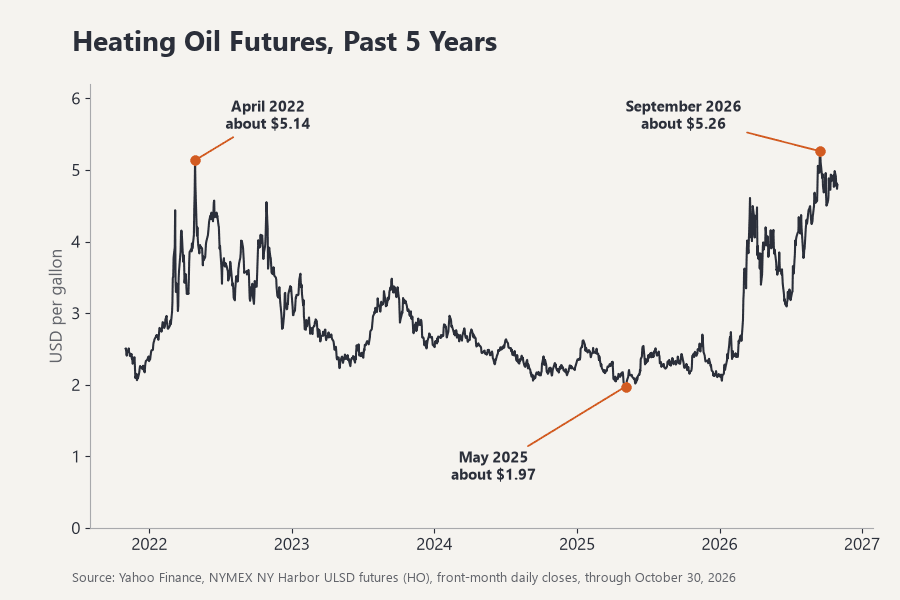
The chart below shows front-month NYMEX heating oil futures daily closes over the past five years.
-
2022: energy prices soared after Russia invaded Ukraine, and heating oil futures closed at about $5.14 a gallon on April 28
-
2023 to 2025: prices eased, closing at about $1.97 on May 5, 2025, the low of the past five years
-
2026: prices surged from March, closing at about $5.26 on September 15, above the 2022 high, and at about $4.79 on October 30
In its October 2026 Winter Fuels Outlook, the EIA said lower global refining activity had reduced output of distillates, including heating oil, and that with costlier imports and export demand, U.S. distillate stocks were low heading into winter. Over the same period, tensions in the Middle East and shipping risks around the Strait of Hormuz added to supply concerns across energy markets. The EIA expects U.S. households that heat mainly with heating oil to spend about 21% more on heating in winter 2026–27 than the previous winter.
6. Heating Oil vs. Crude Oil vs. Gasoline
| Heating oil | Gasoline (RBOB) | WTI crude | |
|---|---|---|---|
| Main use | Heating, diesel fuel | Motor fuel | Refinery feedstock |
| Quotation | USD per gallon | USD per gallon | USD per barrel |
| Peak demand | Winter | Summer driving season | Year-round |
| Main price drivers | Distillate stocks, winter weather, diesel demand | Gasoline stocks, driving demand | Producer policy, global demand |
Refineries turn crude oil into gasoline and distillates. The gap between product prices and crude prices is called the crack spread, and it represents refiners' margins. A wider heating oil crack spread means distillates are strong relative to crude, which can reflect tight product supply, limited refining capacity or rising diesel demand. In 2026, heating oil rose more than crude and its crack spread widened sharply.
RBOB gasoline peaks in summer and heating oil in winter. Both come from crude oil, but their different seasonal demand means their prices often diverge.
7. How to Trade Heating Oil CFDs: Titan FX Specs and Margin
Titan FX offers heating oil as a CFD under the name HeatingOil, classified as a soft commodity alongside cocoa, coffee and corn. Soft commodities are cash-settled CFDs with no physical delivery and no contract months.
| Titan FX HeatingOil (CFD) | NYMEX heating oil futures | |
|---|---|---|
| Contract size | 10,000 | 42,000 gallons |
| Leverage and margin | Fixed 50:1, regardless of your account leverage setting | Set by the exchange and broker |
| Trade size | Minimum 0.1 lot, maximum 20 lots per position | Whole contracts |
| Trading hours | Server time 01:00–23:59 (Friday close 23:55) | Exchange hours |
| Expiry and settlement | No expiry, cash-settled | Contract months, physical delivery |
At Titan FX, HeatingOil can be traded on MT4 and MT5; Micro accounts cannot trade soft commodities. Required margin is calculated as follows:
Formula: Required margin = lots × contract size × market price ÷ 50
Example: trading the minimum 0.1 lot at 4.7900, required margin = 0.1 × 10,000 × 4.7900 ÷ 50 = $95.80
Beyond margin, you pay the spread when you trade, and positions held overnight incur swap. After weekends or major news, prices can also open with a gap from the previous close.
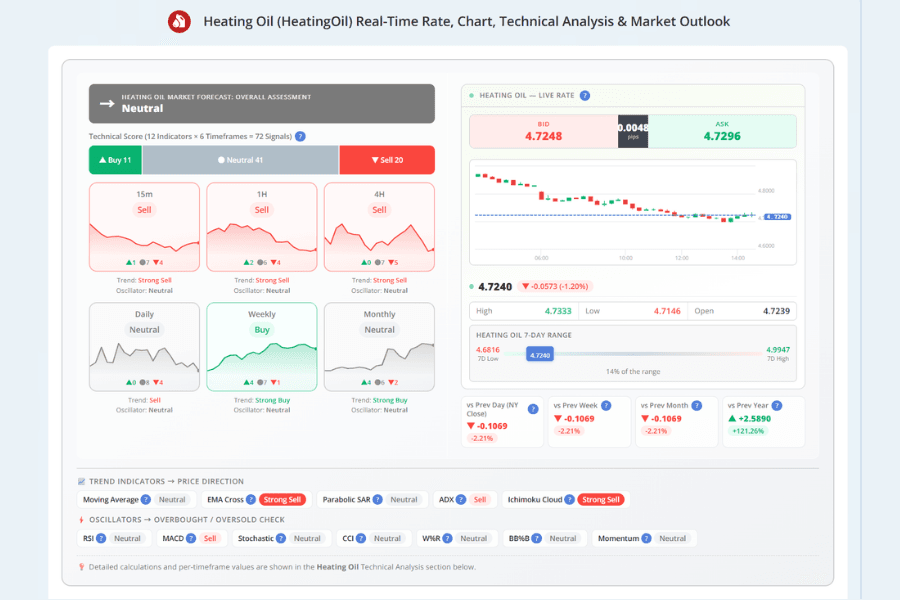
The instrument page shows the live heating oil price, chart, support and resistance, and technical analysis:
8. FAQ
Q1. Is the heating oil futures price the same as the retail price of home heating oil?
No. Futures reflect the New York Harbor wholesale market, while retail prices also include delivery costs and dealer margins. According to the EIA, retail prices tend to be higher in remote areas with higher delivery costs and where there are fewer local suppliers.
Q2. When does the EIA release distillate inventory data?
The EIA releases its Weekly Petroleum Status Report every Wednesday. Its distillate inventory figure covers both diesel and heating oil, and stock levels heading into winter draw particular attention.
Q3. What is the minimum price move in heating oil futures?
The minimum price fluctuation for NYMEX heating oil futures is $0.0001 per gallon. With 42,000 gallons per contract, that equals $4.20 per contract.
Q4. Does Titan FX charge swap on HeatingOil?
Yes. Positions held past rollover incur swap, and positions carried from Friday to Monday are charged three days. The formula is: swap = lots × contract size × long or short swap rate × decimal factor × number of days.
9. Conclusion
Heating oil is a heating fuel in the same distillate family as diesel, and its benchmark is NYMEX NY Harbor ULSD futures. Besides tracking crude oil, its price responds to distillate supply and demand, refinery output, winter weather and diesel demand.
At Titan FX, heating oil trades as HeatingOil in the soft commodities group. When trading it, keep an eye on the EIA's weekly distillate inventories and winter weather forecasts.
Further Reading
Titan FX's financial market research and analysis team produces investor education content across a wide range of financial instruments, including foreign exchange (FX), commodities (crude oil, precious metals, and agricultural products), stock indices, U.S. equities, and crypto assets.
Primary Sources (by Category)
- Official statistics: U.S. Energy Information Administration (EIA) Heating oil explained, Factors affecting heating oil prices, Winter Fuels Outlook (October 2026)
- Exchange materials: CME Group NY Harbor ULSD futures contract specifications and 2013 contract amendment notice
- Titan FX trading conditions: Titan FX soft commodities page and Help Center soft commodity articles
- Market data: Yahoo Finance (NYMEX HO front-month daily closes)