

BOJ
This guide breaks down how the meeting works, the full 2026 schedule, the five post-meeting documents the BOJ publishes, and how each segment of the meeting moves the yen and Japanese equities.
- The BOJ meets eight times a year. Each meeting runs two days and is decided by a nine-member policy board.
- The 2026 schedule has eight meetings. Outlook Report released at the January, April, July, and October sessions.
- Five post-meeting documents matter. Statement, summary of opinions, minutes, governor press conference, and Outlook Report.
- Three triggers move the yen. Policy rate, Outlook Report forecast revisions, and the press-conference tone.
- Track via the Titan FX Economic Calendar. Meeting dates and market expectations are surfaced in one place.
1. What Is the BOJ Monetary Policy Meeting?
The BOJ Monetary Policy Meeting (often abbreviated as the "BOJ meeting") is where the Bank of Japan sets monetary policy. The decisions made there directly shape Japan's policy rate, market liquidity, and ultimately the path of the Japanese yen.
Frequency and structure
- Frequency: 8 times a year, each meeting lasts 2 days.
- Flow: After the meeting concludes, the Governor holds a press conference to explain the decision and take questions from the media.
Members of the Policy Board
The Policy Board has 9 voting members:
| Role | Name (Romaji) |
|---|---|
| Governor | Ueda Kazuo |
| Deputy Governor | Uchida Shinichi |
| Deputy Governor | Himino Ryozo |
| Member | Adachi Seiji |
| Member | Nakamura Toyoaki |
| Member | Noguchi Akira |
| Member | Nakagawa Junko |
| Member | Takata Hajime |
| Member | Tamura Naoki |
Government representatives (the Minister of Finance, the Minister of State for Economic and Fiscal Policy, or their designated officials) may attend but do not hold voting rights.
Meeting objectives
The meeting:
- Sets or adjusts the guideline for money market operations (such as policy-rate targets).
- Determines policy tools (conditions for open market operations).
- Assesses economic and financial conditions and publishes a basic view.
Because BOJ decisions affect the yen exchange rate, Japanese equities, and global capital flows, the meeting is followed closely by traders around the world.
2. The 2026 BOJ Meeting Schedule
The 2026 BOJ Monetary Policy Meetings are scheduled as follows (subject to change — confirm with the BOJ's official site):
| Meeting dates | Outlook Report |
|---|---|
| Jan 22–23 | Released |
| Mar 18–19 | — |
| Apr 27–28 | Released |
| Jun 15–16 | — |
| Jul 30–31 | Released |
| Sep 17–18 | — |
| Oct 29–30 | Released |
| Dec 17–18 | — |
What to watch in 2026
- Direction of the policy rate: The BOJ exited negative rates in 2024 and raised the policy rate to 0.5% in January 2025. In 2026, market attention shifts to the pace of further hikes and the likely terminal rate.
- Outlook Report (4 times): Released at the January, April, July, and October meetings, providing GDP and CPI projections and risk assessments.
- Governor press conference: Held the afternoon of each meeting, often the trigger for short-term yen volatility through supplementary policy signals.
For the latest details see the Bank of Japan official site.
3. The Five Documents Released After Each Meeting
The BOJ publishes five sets of documents on its website after each meeting. Together they reveal the policy decision, member views, and the policy trajectory.
3.1 Statement on Monetary Policy
Contents:
- Adjustments to the guideline for money market operations (policy-rate target).
- Changes to benchmark rates or operating tools.
- Basic view of economic and financial conditions.
Timing:
- Released immediately after the meeting (typically between 12:00 and 15:00).
- A late release often signals a material policy change and the market tends to react in anticipation.
3.2 Summary of Opinions
Contents:
A digest of the major views expressed by members:
- Views on the economic and financial situation.
- Recommendations on monetary policy operations.
- Government representative comments (if any).
Timing:
Released 6 business days after the meeting (typically at 8:50 a.m.) as a bulleted summary.
Note:
Speakers are not identified — only the aggregate views are shown.
3.3 Minutes
Contents:
A detailed record of the meeting, including:
- Reports from BOJ executives on the economy and markets.
- Outlines of the discussion among Policy Board members.
Timing:
Published roughly 2 months after the meeting. This is a retrospective document with limited real-time value to traders.
3.4 Governor Press Conference
Contents:
The Governor elaborates on the statement and answers questions from the press.
Format:
Held the same afternoon as the meeting (typically 15:30 onward). Some platforms (YouTube etc.) provide live coverage or transcripts.
Value:
Fills in the gaps left by the statement and reveals the reasoning and detail behind the policy decision.
3.5 Outlook Report
Contents:
- Released four times a year (January, April, July, October), covering:
- Current economic conditions and forward projections.
- GDP and inflation outlooks.
- Risk analysis.
Importance:
Provides the BOJ's medium-term view and is a key reference for inferring the policy path.
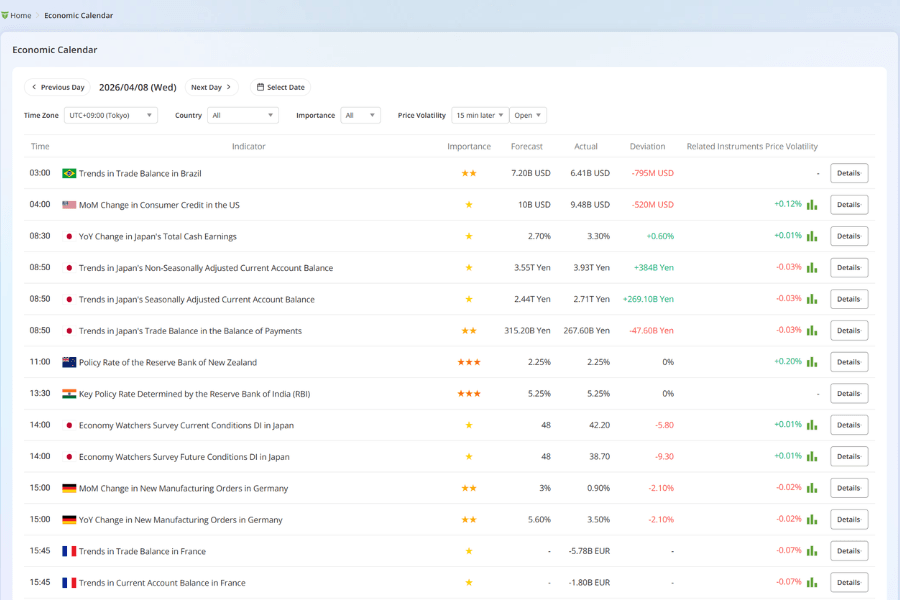
Titan FX provides an economic calendar that lets you filter by country, region, and date so the data and meeting times stay one click away.
4. How BOJ Meetings Move Markets
BOJ meeting decisions move financial markets in several distinct ways:
| Channel | What changes | Typical market reaction |
|---|---|---|
| Policy rate | Rate hike or rate cut | Hike: stronger yen, equities pull back, bond yields rise. Cut: weaker yen, equities rally, bond prices rise. |
| Economic outlook | Outlook Report (GDP, CPI projections) | Upgrade: improved sentiment, equities rally. Downgrade: safe-haven demand, yen tends to strengthen. |
| Money market operations | Liquidity supply and JGB purchase plans | Larger purchases: long-end yields fall, bond prices rise. Tapering: yields rise, liquidity tightens. |
| Yen exchange rate | Monetary policy stance vs. the yen | Continued easing: weaker yen, carry trades expand. Tightening signals: stronger yen, safe-haven demand. |
| Governor press conference | Explanation and Q&A | May release supplementary policy signals and shift market expectations. |
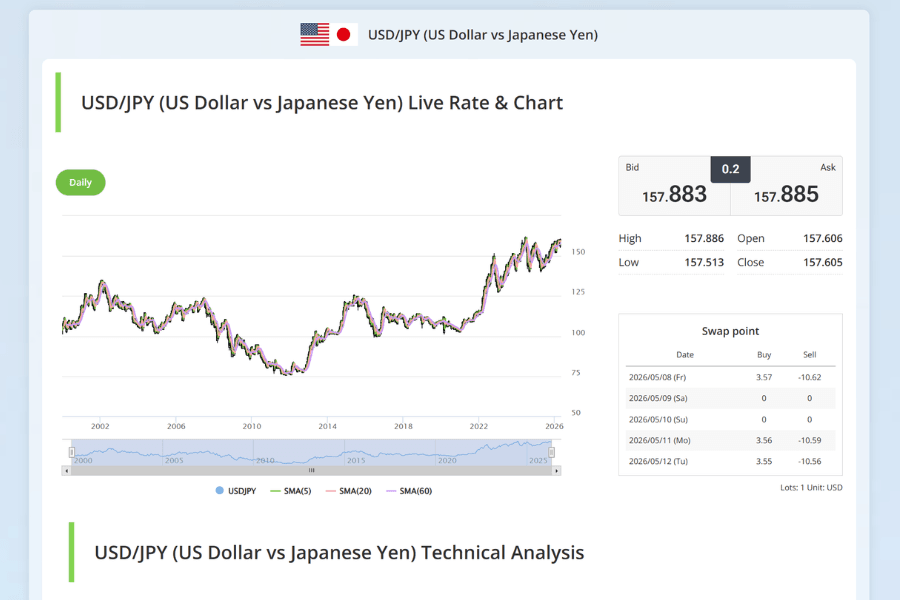
Check the USD/JPY (US Dollar / Japanese Yen) live chart to track yen moves and market volatility in real time.
5. Frequently Asked Questions
Q1. How does the BOJ meeting differ from the Federal Reserve's FOMC?
Both are central bank monetary-policy decision forums, but the size and frequency differ. The BOJ meets 8 times a year for 2 days each, with 9 Policy Board members voting. The Federal Reserve FOMC also meets 8 times a year, but with 12 voting members (7 Governors plus 5 rotating Reserve Bank presidents). The BOJ moves the yen and Japanese markets; the FOMC moves global capital flows through the dollar's reserve role.
Q2. When are BOJ meeting decisions released?
The same afternoon the meeting ends, typically between 12:00 and 15:00 JST, the BOJ publishes the Statement on Monetary Policy, followed by the Governor's press conference. The Summary of Opinions arrives 6 business days later, and the full Minutes appear roughly 2 months later.
Q3. How much does a BOJ meeting move the yen?
A BOJ meeting is one of the single largest events for short-term yen volatility. A rate hike or hawkish tone typically lifts the yen, especially when the market had expected no change. Dovish signals or continued easing push the yen lower. The bigger the gap between the decision and market expectations, the larger the move.
Q4. Is the Governor's press conference more important than the statement itself?
Both have their value. The statement records the decision; the press conference reveals the rationale and the policy trajectory, often containing forward-looking hints (such as a possible additional hike at the next meeting). Markets often react more sensitively to the tone of the press conference than to the wording of the statement.
Q5. How should retail traders track BOJ meetings?
Beforehand: confirm meeting dates and market expectations via the Titan FX Economic Calendar. On the day: watch for the statement around 12:00 JST and the press conference from 15:30 JST. Afterwards: read the Outlook Report (when released) and the Summary of Opinions to track the policy direction.
Titan FX Economic Calendar6. Conclusion
The BOJ Monetary Policy Meeting is the central forum for Japan's monetary policy. Eight meetings a year, two days each, nine Policy Board members deciding policy rates and money market operations — these mechanics define the rhythm of Japan's monetary cycle.
After exiting negative rates in 2024 and lifting the policy rate to 0.5% in January 2025, the key question for 2026 is how fast the BOJ continues to hike and where the terminal rate lands. The Outlook Report (four times a year), the policy rate decision, and the tone of each Governor's press conference together act as the three main triggers for yen volatility.
The five post-meeting documents — Statement, Summary of Opinions, Minutes, Governor Press Conference, and Outlook Report — each serve a different purpose. Reading them together gives the clearest view of where Japan's monetary policy is heading next.
Further Reading
- Japanese Yen (JPY) trading guide
- What is the Nikkei 225 Index?
- USD/JPY (US Dollar / Japanese Yen) live chart
- Titan FX Economic Calendar
- What is the FOMC?
Titan FX Research and Review Team — covering forex (FX), commodities (oil, precious metals, agricultural products), stock indices, US equities, and crypto assets, producing educational content for retail and institutional investors.
Primary Sources by Category
- Official data and regulators: Bank of Japan (BOJ) official site — "Outline of Monetary Policy Meetings" and "Release Schedule"; BOJ "2026 Schedule of Monetary Policy Meetings" publication.
- Market data and liquidity: Bloomberg Markets (JPY coverage), Reuters (BOJ reporting), Bank for International Settlements (BIS) Triennial Central Bank Survey.
- Academic research: Takatoshi Ito, "The Japanese Economy" (chapters on BOJ policy); Ben S. Bernanke et al., "Monetary Policy in a Low Inflation Era".
- Industry and third-party references: Investopedia (Bank of Japan), OANDA Lab "BOJ Monetary Policy Meeting" guides, Titan FX Economic Calendar.