

Stagflation
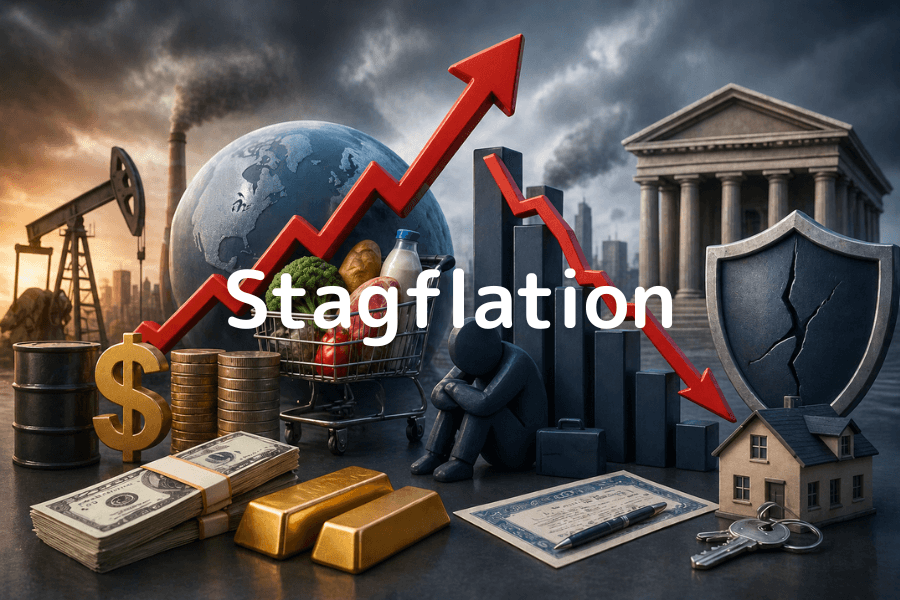
Stagflation is an economic condition where growth stalls and unemployment rises while prices keep climbing.
Normally, a weak economy means falling demand and easing price pressure. Under stagflation, however, supply-chain disruption, surging energy prices, or rising production costs can keep prices rising even as growth slows — producing "low growth, high inflation, high unemployment" all at once.
This article covers the definition of stagflation, its main causes, its impact on equities, bonds, and real estate, and the risk-management points investors should watch.
- Definition and traits: the core of stagflation, its three traits, and how it differs from ordinary inflation or recession
- Causes: how supply shocks and monetary policy combine to trigger it
- Market impact: typical effects on equities, bonds, and real estate
- Allocation: principles for shifting toward defence and value preservation
- Historical lessons: the 1970s case and the key indicators to track
1. What Is Stagflation? Definition and Core Traits
Stagflation is a contradictory economic condition where growth stalls or contracts and unemployment rises while prices keep climbing.
It breaks the traditional inverse relationship between inflation and unemployment, leaving investors facing both falling purchasing power and weak economic activity.
Quick comparison
| Condition | Prices (CPI) | Growth (GDP) | Unemployment | How it feels |
|---|---|---|---|---|
| Healthy inflation | Mild rise | Strong growth | Falling | Income outpaces prices |
| Recession | Slowing/falling | Negative growth | Rising fast | Job fears but cheap prices |
| Stagflation | Surging | Stalled/shrinking | Stuck high | Worst: dear prices, no jobs |
Core traits
Trait 1: Prices keep rising Even with weak demand, cost pressures push prices up — typically supply-driven inflation.
Trait 2: Growth stalls GDP growth slows sharply or turns negative, and overall industrial activity weakens.
Trait 3: Unemployment stays high Firms cut staff under both rising costs and falling demand, keeping the labour market weak.
2. Why Does It Happen? Cause Analysis
Stagflation usually arises when a supply-side shock meets an unsuitable policy setting. When supply is constrained while liquidity is too loose, rising prices and a stalling economy can occur together.
Cause 1: Supply-side shocks
When energy, raw materials, or key supply chains are disrupted, production costs jump. Spikes in oil, gas, or food prices directly raise transport and manufacturing costs.
Firms raise prices under cost pressure, but limited consumer purchasing power suppresses demand, forming a "prices up, output down" structure.
Cause 2: Monetary policy and liquidity build-up
When monetary policy is too loose, excess liquidity can push prices up even with weak fundamentals. If a supply bottleneck appears at the same time, price pressure persists.
Purchasing power falls while growth fails to keep pace — the classic setup for stagflation.
Cause 3: Structural and productivity stagnation
Where productivity fails to improve over the long run, firms struggle to cut costs through technology or scale, so an external shock more easily pushes the economy into high cost and low growth.
Such structural issues tend to prolong stagflation and make it harder to solve with short-term policy.
How to identify it
Watch three indicators: CPI keeps rising, GDP growth slows or turns negative, and unemployment rises. All three together is a clear warning signal.
3. Impact on Investment Markets
Under stagflation, inflation pressure and slowing growth occur together, so traditional asset allocation struggles to work. Rising funding costs and deteriorating profits often pressure stocks and bonds at once.
Equities
Firms face the double pressure of higher input costs and weaker demand, compressing profits. Expectations turn cautious and valuations are revised down. Cyclical sectors such as manufacturing and growth stocks tend to be more volatile here.
Bonds
Rising inflation erodes the real return of fixed-income assets. When expected inflation exceeds bond yields, bond prices fall. If central banks hike to curb inflation, yields rise further, pressuring prices.
Real estate
Property has some inflation resistance, but the high-rate environment during stagflation raises mortgage costs and dampens buying demand. With stagnant incomes, transaction volume and price momentum are usually constrained.
Case: 1970s U.S. stagflation
The 1970s is the classic historical case. The 1973 first oil crisis, with the OPEC embargo, drove international oil prices sharply higher in a short time. U.S. official data show inflation briefly exceeding 12% in 1974, unemployment near 9%, and clearly slowing growth.
The 1979 second oil crisis hit markets again; supply disruption from the Iranian Revolution pushed energy prices up and worsened inflation.
The Federal Reserve then faced a dilemma: hiking would cool the economy further, while staying loose would let inflation run. Ultimately, under Chairman Paul Volcker, the policy rate was raised to nearly 20%.
This tightening curbed inflation but also triggered a severe recession in the early 1980s. The lesson: under stagflation, a single asset class struggles to hedge both inflation and recession, so diversification and risk control matter more.
4. Strategy: Asset Allocation Under Stagflation
Facing stagflation, allocation logic must shift from chasing growth to defence and value preservation. The key is to find assets that hold value under rising prices or can pass costs through.
Inflation-resilient assets
Gold and commodities tend to do relatively better in such periods. Gold, a safe-haven asset not dependent on any government's credit, shows its value-preservation property when fiat purchasing power falls. Energy and base metals, themselves drivers of inflation, can act as a hedge.
Defensive leaders
Choose leaders in licensed industries or staples with strong pricing power. Even when they raise prices, demand does not vanish, so they better withstand margin compression.
Cash-flow management
In extreme volatility, keeping some cash or short-term, highly liquid assets is important. When panic drives assets into oversold territory, only investors holding cash can reposition selectively.
5. Frequently Asked Questions (FAQ)
Q1. What is the real impact of stagflation on ordinary investors?
Wage growth usually trails price rises, the real purchasing power of savings falls, and job opportunities shrink. Portfolios are prone to a simultaneous stock-bond sell-off, so a more defensive allocation should be set early.
Q2. Can a central bank solve stagflation by cutting rates?
A rate cut may stimulate the economy but push inflation higher, while a rate hike curbs inflation but can worsen stagnation. Central banks face a dilemma; solutions usually need supply-side improvement and long-term structural adjustment.
Q3. Which indicators should investors watch most?
Focus on whether CPI keeps rising, whether GDP growth stalls, and whether unemployment rises at the same time. All three deteriorating together is a clear warning.
Q4. How long does stagflation usually last?
There is no fixed cycle; it depends on whether supply shocks ease and policy is suitable. The 1970s episode lasted roughly a decade, and structural productivity problems tend to prolong it, making short-term fixes difficult.
Q5. Why is gold often seen as a stagflation hedge?
Gold does not depend on any government's credit, so it tends to hold value when high inflation erodes fiat purchasing power, and its lower correlation with stocks and bonds aids diversification. Still, gold itself fluctuates and profit is not guaranteed.
6. Conclusion
Stagflation is rare but far-reaching, defined by rising prices, stalled growth, and rising unemployment occurring together. It puts central banks and governments in a policy dilemma and makes financial markets bear inflation and recession pressure at once.
When watching it, look beyond CPI to GDP, unemployment, energy prices, wage growth, and corporate earnings together. If high inflation is supply-driven while growth slows simultaneously, market risk usually rises markedly.
For investors, understanding the source of each asset's risk matters: equities can be hit by earnings downgrades, bonds by inflation and rate hikes, and real estate by rising rates and falling purchasing power.
Understanding the causes and market impact of stagflation helps build a more complete macro framework rather than judging direction from a single asset or data point.
Further Reading
- What Is Inflation?
- What Is the CPI?
- What Is GDP?
- What Is the Unemployment Rate?
- What Is Monetary Policy?
Titan FX Research Hub — investor education across foreign exchange, commodities (oil, precious metals, agriculture), stock indices, U.S. equities, and crypto assets.
Primary Sources (by category)
- Macro economy and indicators: public statistics from the U.S. Bureau of Labor Statistics and Department of Commerce (general CPI/GDP/unemployment concepts); the 1970s oil crises and stagflation history
- Monetary policy: public materials from central banks (general knowledge on monetary policy and rate hikes/cuts)
- Market impact and allocation: general educational material on risk management and diversification; Titan FX platform public information