

CNH(Offshore Renminbi)
CNH (offshore renminbi) is the Chinese yuan traded outside mainland China—mainly in Hong Kong—with a market-driven exchange rate that moves separately from the onshore yuan (CNY).
The offshore renminbi (CNH) stands as one of the most significant milestones in China's push to internationalize its currency. Since its launch in Hong Kong in 2010, CNH has expanded the use of the renminbi in global trade and investment, providing a market-driven exchange rate mechanism that serves as a key barometer for China's economic outlook and policy expectations.
This article covers the full scope of offshore renminbi, from its historical origins and comparison with onshore renminbi to the factors driving its exchange rate, its evolving role in global markets, and practical ways to trade it.
- The history and economic foundation behind the creation of CNH
- How CNH (offshore) differs from CNY (onshore) in regulation, pricing, and market behavior
- Four key factors that move the CNH exchange rate
- The international standing of CNH within global foreign exchange reserves
- Currency characteristics and practical trading methods for CNH
1. History and Economic Foundation of Offshore Renminbi
The offshore renminbi (CNH), denoted by the currency symbol "¥," is the form of the Chinese renminbi traded outside mainland China. It was first introduced in Hong Kong in 2010 as a pivotal step in China's strategy to internationalize its currency. The primary goal was to meet growing international demand for renminbi-denominated settlement and investment while allowing the currency to move toward global use without fully opening the capital account.
Unlike the onshore renminbi (CNY) used within mainland China, CNH operates under a floating exchange rate regime. Its price is determined by market supply and demand, free from the People's Bank of China's (PBOC) daily fixing rate and the strict trading band that constrains CNY. This structural difference makes CNH generally more volatile than its onshore counterpart.
China's rapid economic expansion from the early 2000s onward, marked by surging trade volumes and outbound investment, created tangible demand for renminbi-based settlement. The Belt and Road Initiative, launched in the 2010s, further broadened the scope of CNH by fostering cross-border cooperation with partners across Asia, Africa, and the Middle East.
Today, CNH has established mature trading and clearing infrastructure in major international financial centers including Hong Kong, Singapore, and London, positioning it as one of the world's most prominent emerging-market currencies.
2. Differences Between CNH (Offshore) and CNY (Onshore)
CNH and CNY are fundamentally the same currency, but because they are traded in different jurisdictions under different regulatory frameworks, they diverge meaningfully in how exchange rates form, who participates in the market, and how policy affects pricing. Understanding these differences is essential for forex traders and cross-border investors.
The table below compares CNH and CNY across five dimensions:
| Dimension | Onshore Renminbi (CNY) | Offshore Renminbi (CNH) |
|---|---|---|
| Trading venue | Mainland China only (e.g., Shanghai) | Hong Kong, Singapore, London, and other offshore markets |
| Exchange rate mechanism | Guided by PBOC's daily fixing rate; limited fluctuation band | Fully market-determined; more elastic |
| Primary use case | Domestic payments, investment, and trade settlement | International trade, outbound investment, offshore financial transactions |
| Liquidity scope | Confined to China's financial system | Freely circulated across global markets |
| Policy influence | Directly constrained by China's monetary and capital controls | Influenced by Chinese fundamentals but reflects international market sentiment more strongly |
Overall, CNH functions as a leading indicator for gauging the renminbi's international market standing, policy expectations, and capital flows, thanks to its market-based pricing and offshore accessibility. CNY, by contrast, tracks the PBOC's official monetary policy direction more closely. Although the two rates trend together over time, short-term divergences can be significant and are commonly exploited in arbitrage strategies and hedging programs.
3. Key Factors Affecting the CNH Exchange Rate
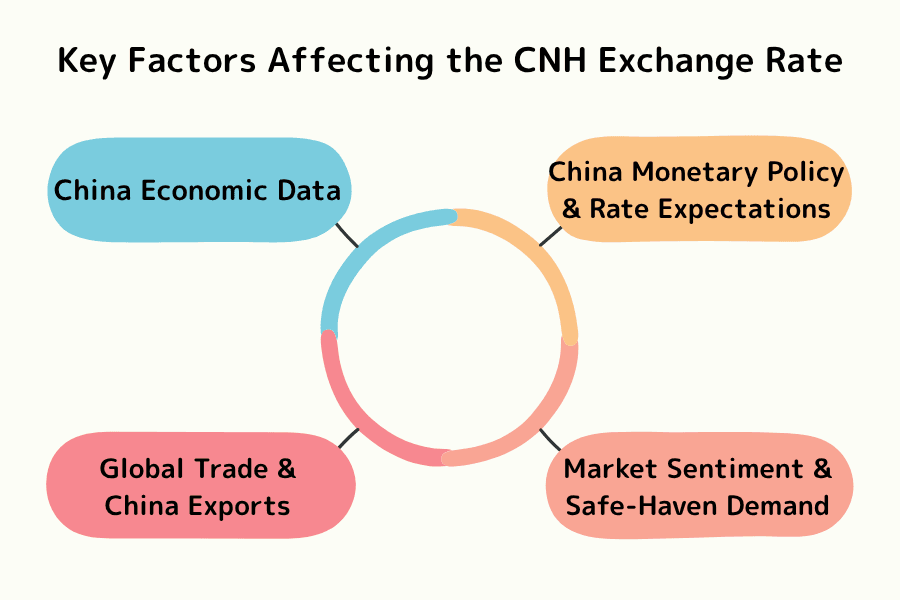
The CNH exchange rate is determined by market supply and demand, but it remains deeply influenced by Chinese economic conditions and the broader global financial environment. The following four factors are the primary drivers of CNH volatility, and traders should monitor them closely.
Factor 1: Chinese Economic Fundamentals
Despite being an offshore currency, CNH remains highly sensitive to mainland China's economic performance. Key indicators such as GDP growth, the consumer price index (CPI), trade surplus, and foreign exchange reserves directly shape international confidence in the renminbi. When China reports economic growth above market expectations, capital inflows tend to increase, pushing CNH higher.
Factor 2: Chinese Monetary Policy and Interest Rate Expectations
Although CNH is not directly controlled by the PBOC, the central bank's interest rate decisions and policy signals are major variables in offshore renminbi movements. If markets anticipate monetary easing, such as reserve requirement ratio cuts or interest rate reductions, capital outflows may accelerate, putting downward pressure on CNH. Conversely, rate hikes can attract capital back, supporting the exchange rate.
Factor 3: Global Trade Environment and Chinese Export Performance
As one of the world's largest exporters, China's trade dynamics have a profound impact on CNH. Shifts in U.S.-China trade relations, tariff policies, and supply chain risks all alter foreign investor expectations for renminbi assets. When global trade conditions are stable and external demand is strong, renminbi demand increases and CNH tends to appreciate.
Factor 4: International Financial Sentiment and Safe-Haven Demand
CNH reflects a composite assessment of China's macroeconomic environment and global risk appetite. When geopolitical risks escalate or financial market volatility rises, safe-haven flows into the U.S. dollar or gold can weigh on CNH. Conversely, when global sentiment turns optimistic, increased risk appetite for Chinese assets tends to support CNH appreciation.
View the global economic calendar for upcoming data releases
4. Economic Foundation and International Status
While CNH is traded offshore, its value is firmly rooted in mainland China's economic performance and the country's evolving role in international markets. The following economic indicators and financial positions form the fundamental backbone of CNH movements.
Core Economic Indicators for CNH
The data points below play a critical role in shaping market expectations for CNH strength or weakness:
| Indicator | Description | Potential Impact on CNH |
|---|---|---|
| GDP growth rate | Reflects China's overall economic vitality | Accelerating growth boosts confidence and pushes CNH higher |
| Trade balance | Measures surplus from export-oriented economy | Wider surplus strengthens foreign exchange inflows and CNH demand |
| Inflation rate (CPI) | Gauges real purchasing power of the renminbi | Controlled inflation supports exchange rate stability |
| Foreign exchange reserves | Total foreign currency assets held by the government | Rising reserves demonstrate financial stability, boosting CNH credibility |
| Foreign direct investment (FDI) | International capital inflows | Higher FDI increases renminbi settlement demand, supporting CNH |
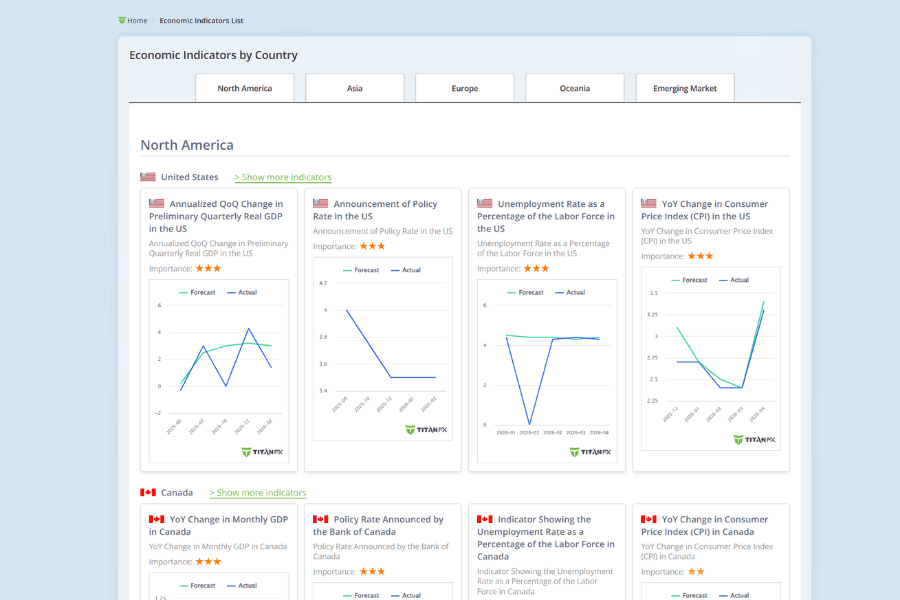
Free Economic Indicator Tools from Titan FX
Titan FX offers free economic data for major economies including the United States, Europe, Japan, and China. You can search by release date, country, and importance level.
The Global Market Role of CNH
As the flagship vehicle for renminbi internationalization, CNH occupies several important positions in the global financial system:
Role 1: Cross-Border Trade Settlement Currency
CNH is gradually replacing a portion of U.S. dollar settlement in Belt and Road partner countries and across the broader Asian trade network. Its flexible, market-based pricing makes it an effective instrument for two-way trade and investment flows, and it is widely adopted in energy, machinery, and manufacturing sectors that trade heavily with China.
Role 2: Growing Participation in Foreign Exchange Markets
According to BIS data, CNH's share of global foreign exchange turnover has been rising steadily and now approaches 2%. The USD/CNH pair sees its most active trading during the Hong Kong and London market sessions, reflecting CNH's increasing liquidity and international participation.
Role 3: Rising Status as a Reserve Currency
According to IMF data for Q1 2025, the renminbi accounts for 2.12% of global official foreign exchange reserves. Although the IMF report labels this as "CNY," the figures actually encompass total renminbi assets, including both onshore (CNY) and offshore (CNH) holdings. This reflects a growing willingness among central banks to include the renminbi in their reserve allocations. While the share remains far below the U.S. dollar and euro, the long-term growth trajectory is noteworthy.
| Currency | Reserve Amount (USD billions) | Share |
|---|---|---|
| U.S. Dollar (USD) | 6,720.31 | 57.74% |
| Euro (EUR) | 2,334.62 | 20.06% |
| British Pound (GBP) | 603.70 | 5.19% |
| Japanese Yen (JPY) | 599.10 | 5.15% |
| Other currencies | 573.42 | 4.93% |
| Canadian Dollar (CAD) | 306.13 | 2.63% |
| Chinese Renminbi (CNY) | 246.31 | 2.12% |
| Australian Dollar (AUD) | 167.74 | 1.44% |
| Swiss Franc (CHF) | 88.39 | 0.76% |
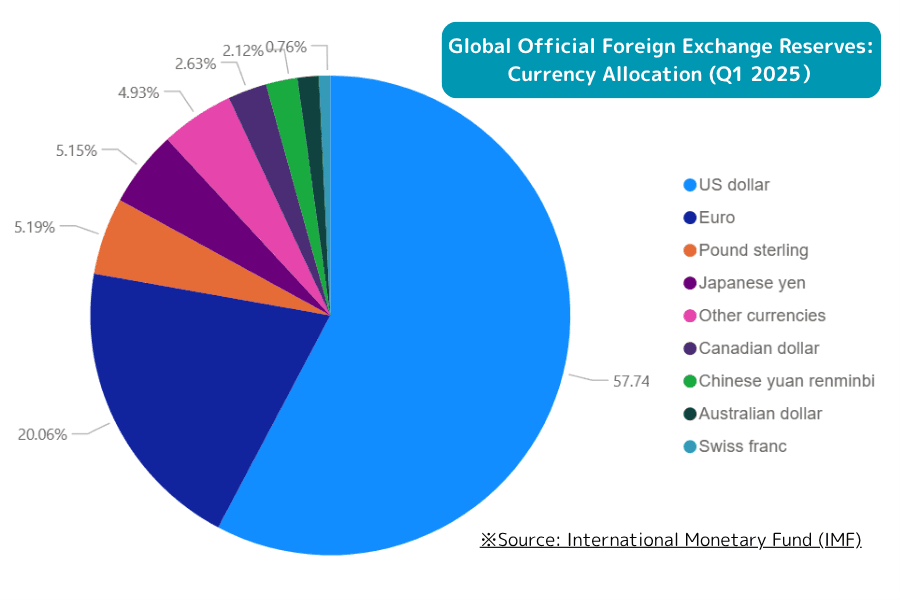
Note on IMF COFER methodology: The IMF's COFER statistics use "CNY" as the label, but the underlying data covers total renminbi assets, including both onshore (CNY) and offshore (CNH) holdings. The IMF does not distinguish between the two and reports them jointly under "Renminbi."
Role 4: Expanding Platform for Investment Products
The offshore renminbi market has developed a diverse range of financial instruments, including renminbi-denominated bonds (commonly known as "dim sum bonds"), CNH forwards, and interest rate swaps. These tools provide international institutions and sovereign wealth funds with diversified allocation channels, strengthening CNH's functionality and recognition in global investment markets.
5. Currency Characteristics Overview
As the internationalized form of the renminbi, CNH exhibits characteristics distinct from its onshore counterpart. These traits shape its risk profile and trading appeal in global capital markets:
Characteristic 1: High Degree of Marketization
CNH is not subject to the PBOC's daily fixing rate. Its exchange rate is determined purely by market supply and demand, reflecting international confidence in China's economy and policies. As a result, CNH volatility is generally higher than that of CNY.
Characteristic 2: Open Capital Flows
As an offshore currency, CNH is not subject to China's capital account restrictions and can move freely across borders. This openness attracts institutional capital seeking renminbi asset exposure.
Characteristic 3: Dual-Driver Dynamics (Policy and Market)
Although market-priced, CNH remains highly responsive to Chinese economic policy and major events. This creates a dynamic where policy expectations and market sentiment operate as parallel drivers, often pulling in different directions.
Characteristic 4: Arbitrage and Spread Trading Potential
CNH and CNY rates can diverge in the short term, creating space for arbitrage. Additionally, the interest rate differential between CNH and other currencies can form carry trade opportunities, such as CNH/JPY positions.
Characteristic 5: Multi-Functional and Evolving Role
CNH serves settlement, investment, and reserve functions simultaneously. As China's economic integration with the world deepens, CNH's financial role will continue to expand, potentially developing into a more liquid regional reserve currency.
6. How to Trade CNH

The most common way to trade CNH is through forex margin trading. This approach uses leverage, allowing traders to control larger positions with a relatively small amount of capital.
Forex margin trading also supports two-way positioning, meaning traders can go long or short depending on market conditions.
The forex market operates 24 hours a day, five days a week, making it one of the most liquid and flexible markets in the world. It accommodates a wide range of trading strategies and risk profiles.
Related reading: Forex Trading Basics
Titan FX offers leverage of up to 1:1000.
Trading Forex with Titan FX: Step-by-Step
Step 1: Open an Account
Opening a Titan FX account is fast and straightforward, with no requirement to submit identity documents or proof of address upfront. Titan FX offers Standard and Blade account types. Traders can select their preferred account type during registration.
Titan FX Account Opening GuideStep 2: Fund Your Account
After registration, you can deposit funds into your account. Titan FX supports multiple deposit methods, with credit card deposits being the fastest option. Funds typically arrive instantly.
Credit Card Deposit GuideStep 3: Download the Trading Platform (MT4/MT5)
Titan FX provides both MT4 and MT5 trading platforms. Both are available for Windows, Mac, iOS (iPhone/iPad), and Android.
MT5 Download and Login Guide MT4 Download and Login GuideStep 4: Select a Currency Pair
Titan FX offers approximately 60 currency pairs. The most commonly traded pair involving CNH is USD/CNH (U.S. Dollar / Offshore Renminbi).
View All Currency PairsStep 5: Place a Trade
Once logged in to MT4 or MT5, select your instrument and execute a buy or sell order.
MT5 Order Guide MT4 Order GuideFree Trading Tools from Titan FX (Custom Indicators and EAs)
Titan FX provides free custom indicators and Expert Advisors (EAs) designed to enhance trading efficiency and strategy precision.
Custom indicators help traders analyze market trends more accurately and identify potential trading opportunities. EAs automate predefined trading strategies, removing emotional bias and ensuring consistent execution.
These free tools give traders an edge in competitive financial markets and can meaningfully improve trading performance.
All Custom Indicators EA Trading Program Rankings7. FAQ
Q1: What is the practical trading difference between CNH and CNY?
Although CNH and CNY represent the same underlying currency, CNH is driven by international capital flows and market supply-demand dynamics, making its price more responsive. This sensitivity is particularly evident during major economic or geopolitical events. For forex traders, CNH pricing offers a more accurate reflection of global market expectations regarding China's economy and policies.
Q2: What are the potential risks of trading CNH in the offshore market?
Without direct PBOC intervention, the offshore market can experience sharp short-term volatility in CNH. During politically sensitive periods, such as U.S.-China trade negotiations or major policy meetings, rumors and headline risk can amplify liquidity risk and slippage. Traders should prioritize risk management and always use stop-loss orders.
Q3: Does CNH function as a safe-haven currency?
Compared to traditional safe-haven currencies like the Japanese yen or Swiss franc, CNH's safe-haven properties are still developing. However, when China maintains stable trade relationships with major economies, some institutional investors include CNH in diversified currency portfolios as a regional risk-balancing tool. This approach is especially practical for participants in Asian markets.
Q4: What trading strategies are commonly used in the offshore renminbi market?
Beyond basic long and short positions, carry trades and spread trades that exploit the CNH-CNY price differential are popular among institutional investors. Some traders also use event-driven strategies, positioning ahead of PBOC interest rate decisions to capture the impact on CNH.
8. Summary
The offshore renminbi (CNH) is not only a landmark achievement in China's financial liberalization but also an increasingly important bridge connecting China's economy with global markets. From its independent market-pricing mechanism and institutional differences from CNY to its exchange rate dynamics driven by both Chinese policy and international sentiment, CNH has demonstrated a high degree of marketization and flexibility.
As the global economy continues to shift toward multipolarity and regional cooperation deepens, CNH's international influence is poised to grow further. Whether for businesses settling cross-border trade or investors participating in forex markets, understanding CNH's institutional characteristics and market behavior is essential for more accurately tracking renminbi trends and identifying risk-reward opportunities.
CNH is more than just the renminbi's offshore mirror. It is a financial window through which to observe China's economy, policy direction, and interactions with the rest of the world.
Further Reading
- Forex Trading Basics
- What Is FOMC? How Monetary Policy Affects Exchange Rates
- U.S. Economic Indicators
- USD/CNH Instrument Page
Titan FX's financial market research and analysis team produces investor education content across a wide range of financial instruments, including foreign exchange (FX), commodities (crude oil, precious metals, and agricultural products), stock indices, U.S. equities, and crypto assets.
Primary Sources by Category
- International organizations and central bank data: IMF COFER (Currency Composition of Official Foreign Exchange Reserves), BIS Triennial Central Bank Survey of Foreign Exchange and OTC Derivatives Markets, People's Bank of China (PBOC) policy announcements
- Economic indicators and trade data: National Bureau of Statistics of China (GDP, CPI), General Administration of Customs of China (trade statistics), State Administration of Foreign Exchange (SAFE, reserves and capital flows)
- Market and trading information: Titan FX official website (trading conditions and platforms), Hong Kong Monetary Authority (HKMA, CNH clearing mechanism)