

Deflation
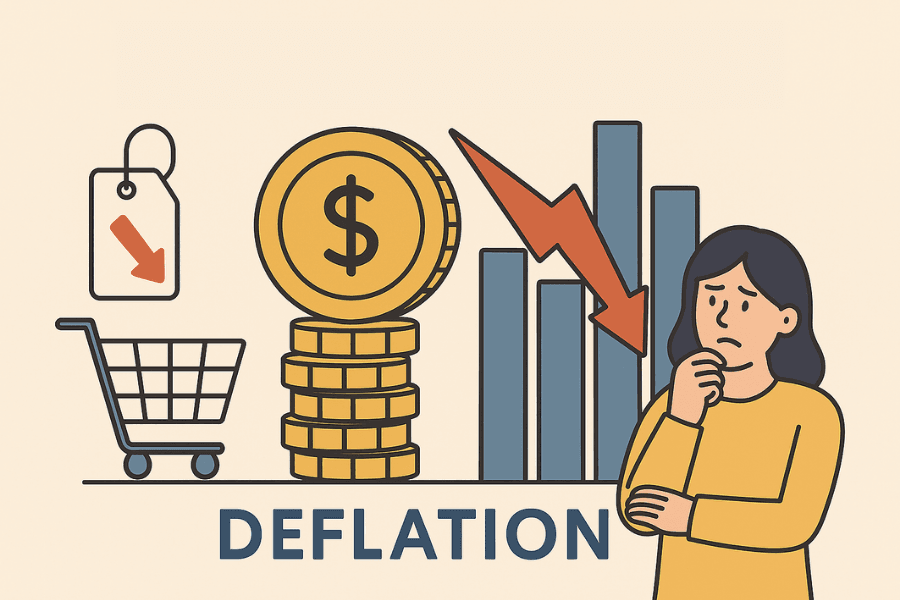
This guide covers the definition of deflation, how it differs from disinflation, the key metrics used to measure it, its causes and effects, the policy tools governments deploy in response, and answers to frequently asked questions.
- The definition of deflation and its core characteristics
- How deflation differs from disinflation
- How CPI, Core CPI, and PCE are used to identify deflationary conditions
- The demand-side, supply-side, and monetary causes of deflation
- Short-term benefits versus long-term economic risks
- Monetary and fiscal policy tools used to combat deflation
1. What Is Deflation? Definition and Core Concepts
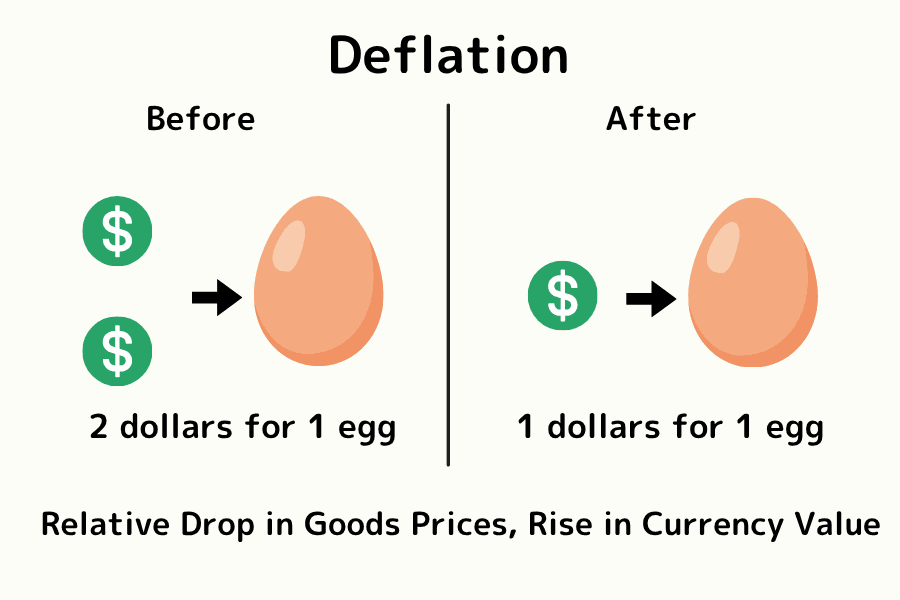
Deflation refers to a sustained decrease in the overall price level of an economy. When the inflation rate falls below 0% and remains there, the economy is generally considered to be in a deflationary state. Purchasing power rises because each unit of currency can buy more goods and services than before.
It is important to distinguish deflation from ordinary short-term price fluctuations. Deflation involves a persistent, economy-wide decline in the prices of goods and services -- not just a drop in one sector or a single commodity.
Key characteristics of deflation include:
- Rising purchasing power: the same amount of money buys more goods and services
- Broad-based price declines affecting consumer goods, wages, and asset values
- Often a signal of economic weakness, typically appearing during recessions or periods of subdued demand
In the short run, falling prices may benefit consumers. Over the longer term, however, deflation tends to suppress business investment and consumer spending, acting as a drag on overall economic growth.
2. Deflation vs Disinflation
In macroeconomics, "deflation" and "disinflation" are frequently confused, yet they describe fundamentally different conditions. Understanding the distinction is essential for sound investment decisions and policy analysis.
The critical difference lies in whether the inflation rate crosses below zero:
- Deflation: prices are falling, and the inflation rate is negative
- Disinflation: prices are still rising, but the rate of increase is slowing down; inflation remains positive
| Factor | Deflation | Disinflation |
|---|---|---|
| Definition | Inflation rate below zero; overall prices falling | Inflation rate declining but still positive; prices still rising |
| Economic context | Typically seen during demand collapses or financial crises | Common when central bank tightening is taking effect |
| Historical examples | 1930s U.S. Great Depression; Japan's Lost Decade (1990s) | Early 1980s U.S., when inflation fell from 14.6% |
| Impact on consumers | Delayed spending; purchasing power rises but economic output shrinks | Easing price pressures; real income improvements |
| Economic implications | Often accompanied by recession and rising unemployment | Generally viewed as a return toward equilibrium |
In short, disinflation represents a deceleration of inflation and is often the intended result of central bank policy. Deflation, by contrast, means prices are falling outright and is typically associated with economic crisis or prolonged stagnation, carrying far greater potential for economic harm.
3. Measuring Deflation: CPI, Core CPI, and PCE
Determining whether an economy has entered deflation requires official price indexes. The three most widely used measures are the Consumer Price Index (CPI), Core CPI, and the Personal Consumption Expenditures Price Index (PCE).
Consumer Price Index (CPI)
CPI tracks the average change in prices paid by consumers for a basket of goods and services -- including food, transportation, housing, and healthcare. It is the most commonly cited inflation and deflation gauge. When the year-over-year CPI turns negative on a sustained basis, the economy is generally regarded as being in deflation.
Core CPI
Core CPI excludes food and energy, both of which are subject to large short-term price swings, providing a clearer view of the underlying price trend. Central banks tend to give greater weight to Core CPI when setting monetary policy.
Personal Consumption Expenditures Price Index (PCE)
The Federal Reserve considers PCE its preferred inflation measure. PCE covers a broader range of expenditures than CPI and adjusts for shifts in consumer behavior. When PCE registers negative readings over an extended period, it similarly signals deflationary pressure.
Measurement Controversies
- Duration thresholds: some economists define deflation as two consecutive quarters of negative CPI, while others require a longer period
- Regional differences: countries use different baskets and calculation methods, which can lead to varying deflation determinations
- Complementary indicators: relying on CPI alone can be misleading; examining Core CPI and PCE together provides a more comprehensive picture
The fundamental criterion for deflation is whether the price level is falling on a sustained basis. However, the choice of indicator and definition affects when and how individual countries recognize deflation and respond with policy measures.
4. Causes of Deflation
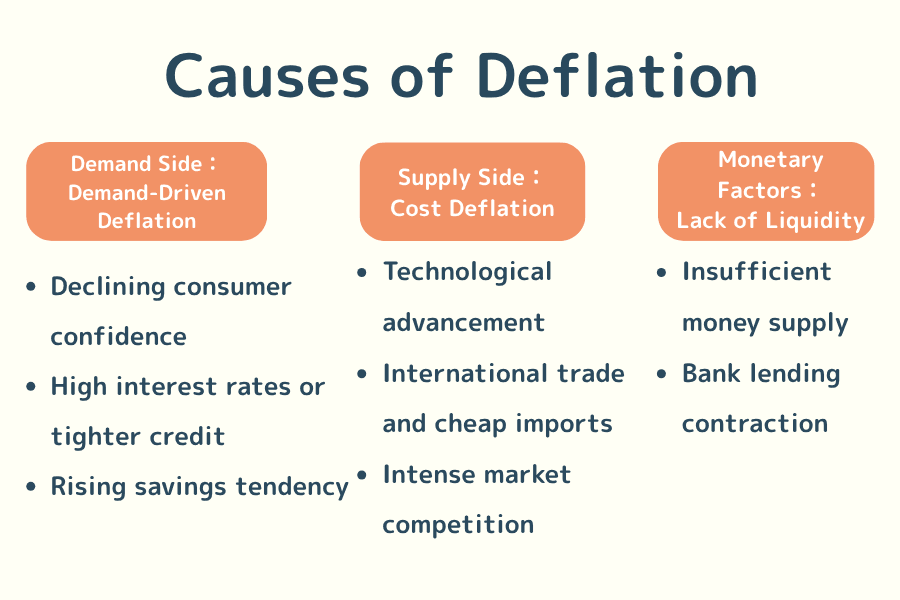
Deflation is rarely the product of a single cause. It arises from a combination of economic pressures that can be grouped into three broad categories: demand-side deflation, supply-side deflation, and monetary factors.
Demand Side: Demand-Pull Deflation
When aggregate demand falls, goods and services go unsold and businesses cut prices to stimulate sales, eventually pushing the general price level lower.
- Declining consumer confidence: during economic downturns or rising unemployment, households postpone spending
- High interest rates or credit tightening: increased borrowing costs reduce business investment and household expenditure
- Rising savings preference: uncertainty about the future encourages people to save rather than spend
Example: during the 2008 Global Financial Crisis, a sharp drop in demand produced deflationary pressure in the United States and across Europe.
Supply Side: Cost-Push Deflation
When supply expands sharply or production costs fall, downward pressure on prices intensifies.
- Technological advances: productivity gains lead to oversupply
- International trade and cheap imports: an influx of lower-priced foreign goods forces domestic producers to cut prices to remain competitive
- Intense market competition: firms competing for market share drive prices progressively lower
Example: in 1990s Japan, excess manufacturing capacity combined with intensifying international competition contributed to a prolonged period of depressed prices.
Monetary Factors: Insufficient Liquidity
An inadequate money supply raises the value of each currency unit, putting downward pressure on prices.
- Tight money supply: the central bank fails to provide sufficient liquidity to the economy
- Bank lending contraction: credit tightening prevents capital from flowing into the market, amplifying deflationary forces
Example: during the 1930s U.S. Great Depression, widespread bank failures and a contraction in credit drained cash from the economy, causing prices to plunge.
In practice, demand weakness, supply gluts, and a restrictive monetary environment frequently coexist and reinforce one another, making deflation harder to reverse once it takes hold.
5. Effects of Deflation: Short-Term Benefits and Long-Term Risks
While deflation can temporarily boost purchasing power, its long-term negative consequences typically far outweigh any short-term gains.
Benefits
Benefit 1: Increased Purchasing Power
Falling prices mean consumers can buy more goods and services for the same amount of money, reducing the cost of living. When food or energy prices drop, household budgets receive immediate relief.
Benefit 2: Rising Real Value of Cash and Fixed Income
Individuals who hold cash or rely on fixed wages, pensions, or annuities see their real purchasing power increase. They can maintain or even improve their standard of living without earning more in nominal terms. This effect is especially pronounced for savers.
Risks
Risk 1: Deferred Consumption and Weak Demand
If consumers expect prices to fall further, they delay purchases. Retail and durable-goods sectors are particularly hard hit by this behavior.
Risk 2: Shrinking Corporate Profits and Rising Unemployment
As revenues decline, businesses are forced to cut prices, compressing margins. Over time, firms respond by reducing headcount or cutting wages, which pushes unemployment higher.
Risk 3: Increasing Real Debt Burden
The nominal value of debt does not fall with prices, so its real burden grows. Households and businesses face heavier repayment obligations, raising the risk of defaults and bankruptcies.
Risk 4: Falling Asset Prices (Asset Deflation)
Real estate and equity prices tend to decline during deflation, eroding household and corporate net worth. As the wealth effect disappears, consumption and investment weaken further.
Risk 5: Rising Real Interest Rates
Even if nominal interest rates remain unchanged, falling prices push real interest rates higher. This makes borrowing more expensive in real terms, discouraging capital expenditure and consumer credit.
Risk 6: Reduced Investment and the Deflationary Spiral
Faced with weak demand and tightening finances, businesses cut investment. Lower investment leads to stagnant capacity, suppressing employment and incomes. This self-reinforcing negative loop is known as a deflationary spiral and can trap an economy in a prolonged contraction.
On balance, while deflation may briefly increase the purchasing power of money, its longer-term impact can lead to broad economic contraction and significantly delay recovery.
6. Government Responses to Deflation
When deflation sets in, governments and central banks typically deploy monetary policy and fiscal policy simultaneously to combat weak demand and prevent the economy from deteriorating further.
Monetary Policy
-
Lowering the policy rate: cutting interest rates reduces borrowing costs for businesses and households, encouraging investment and consumption
-
Quantitative easing (QE): the central bank purchases government bonds or asset-backed securities on a large scale, injecting liquidity into the financial system and expanding the money supply Example: The Bank of Japan launched QE in 2001, establishing it as a key tool against entrenched deflation.
-
Reducing reserve requirements: relaxing the amount of reserves banks must hold frees up capital for lending, increasing the flow of credit into the economy
-
Forward guidance: the central bank publicly commits to maintaining low rates or accommodative policy for an extended period, shaping market expectations and investment behavior
Fiscal Policy
-
Expanding public works and government spending: infrastructure projects and social welfare outlays directly stimulate demand and support the labor market Example: during the Great Depression, the United States implemented the New Deal, dramatically scaling up public works programs.
-
Tax cuts: reducing the tax burden on businesses and households increases disposable income, stimulating consumption and investment
-
Subsidies and direct transfers: targeted support for lower-income households or specific industries provides a short-term boost to market purchasing power
Combined Effect
Monetary policy can quickly increase market liquidity, but if confidence is deeply impaired, monetary easing alone may not be enough. Fiscal policy is typically needed alongside it to directly lift aggregate demand and prevent the deflationary spiral from intensifying.
7. FAQ
Q1 What is the difference between deflation and inflation?
Inflation is a sustained rise in the general price level, eroding the purchasing power of money. Deflation is the opposite: a sustained decline in prices that increases purchasing power. Inflation is often associated with an overheating economy, while deflation tends to appear during recessions or periods of weak demand.
| Factor | Inflation | Deflation |
|---|---|---|
| Price trend | Sustained increase | Sustained decrease |
| Purchasing power | Falls -- the same money buys less | Rises -- the same money buys more |
| Economic signal | May indicate strong demand or supply shortages | Typically reflects insufficient demand or weak investment |
| Consumer impact | Higher living costs; erosion of savings value | Short-term gains, but long-term deferred spending |
| Debtor impact | Real debt burden lightens as currency depreciates | Real debt burden grows as currency appreciates |
Q2 Who benefits from deflation?
In the short term, those holding large cash reserves or receiving fixed incomes may benefit because their money's purchasing power rises. Over the long run, however, deflation depresses corporate profits and raises unemployment, trapping the broader economy in a vicious cycle that ultimately harms most participants.
Q3 Is disinflation better than deflation?
Yes. Disinflation means the rate of price increases is slowing, but prices are still rising. This is often the intended outcome of central bank tightening and generally indicates a healthy economic adjustment. Deflation, on the other hand, involves outright price declines and economic contraction, making it considerably more damaging.
Q4 How can you tell whether the economy is experiencing disinflation or deflation?
Monitor the Consumer Price Index (CPI) and Core CPI. If CPI remains positive but the rate of increase is falling, the economy is in disinflation. If CPI turns negative and continues to decline, the economy has entered deflation.
Q5 How does deflation affect stock and real estate markets?
In a deflationary environment, corporate earnings decline and valuations compress, so equity markets tend to weaken. Real estate prices may also fall, shrinking household wealth and reinforcing the downward pressure on consumption and investment.
Q6 How should investors approach asset allocation during deflation?
The following are general considerations, not investment advice:
- Maintain liquid assets: cash and money-market funds preserve purchasing power and provide flexibility during uncertainty
- Allocate to safe-haven assets: government bonds and high-grade corporate bonds tend to appreciate as interest rates decline
- Favor defensive equities: companies in consumer staples, healthcare, and utilities tend to be more resilient in downturns
- Reduce leverage and debt: deflation increases the real burden of debt, so paying down liabilities early can lower overall risk
8. Summary
Deflation is a sustained decline in the general price level accompanied by rising purchasing power. Its effects are two-sided: in the short term, consumers enjoy lower prices, but over the longer term, deflation can suppress demand, increase the real burden of debt, and trigger a deflationary spiral -- a self-reinforcing contraction that is difficult to escape.
Disinflation, by contrast, refers to a slowing rate of price increases and does not involve falling prices. It is generally seen as a natural part of the economic cycle, whereas deflation is closely linked to financial crises and deep recessions.
To prevent deflation from becoming entrenched, governments and central banks combine monetary policy tools -- interest rate cuts, quantitative easing, and forward guidance -- with fiscal measures such as public investment, tax reductions, and direct transfers to bolster demand and halt the downward spiral. For investors, a deflationary environment calls for higher liquidity, lower leverage, and allocations to safe-haven assets and defensive equities to manage risk.
Deflation is an economic phenomenon that warrants serious attention. A clear understanding of its definition, causes, and policy responses is valuable not only for interpreting macroeconomic trends but also for making more informed decisions in portfolio management and financial planning.
Further Reading
- What Is the FOMC? Role and Impact on Financial Markets
- FX Basics: How Foreign Exchange Trading Works
- What Is CPI? Understanding the Consumer Price Index
- What Is Inflation? Definition, Causes, and Effects
The financial markets research team at Titan FX. We produce educational content across a broad range of instruments, including forex (FX), commodities (crude oil, precious metals, agricultural products), equity indices, U.S. stocks, and crypto assets.
Primary Sources by Category
- Price statistics and inflation data: U.S. Bureau of Labor Statistics (BLS) -- Consumer Price Index; U.S. Bureau of Economic Analysis (BEA) -- Personal Consumption Expenditures Price Index
- Central banks and monetary policy: Board of Governors of the Federal Reserve System; Bank of Japan -- Monetary Policy Statements
- Economic history and macroeconomic analysis: International Monetary Fund (IMF) -- World Economic Outlook; National Bureau of Economic Research (NBER)