

Futures Trading
Futures trading is the buying and selling of a specific asset through a standardized, exchange-listed contract at a fixed price for delivery on a set future date. Both parties are obliged to settle as agreed, positions are held on margin with leverage, and the market supports two-way trading (long or short) — making futures a widely used tool for hedging and speculation, while also carrying high risks such as margin calls, price gaps, and loss of principal.
From gold and crude oil to stock indices and agricultural products, the futures market spans an exceptionally wide range of assets and sits at the heart of how institutions and corporations manage price risk and discover fair value. Its blend of high leverage and two-way trading makes it highly capital-efficient — but also a market where both potential reward and risk are amplified, so trading without first understanding its mechanics can lead to heavy losses.
In this article, we will delve into the basic definition, operation mechanism, features, and risks of futures trading to help you fully understand the futures market.
- Futures essence: An exchange-traded financial derivative — a standardized contract to buy or sell an asset at a fixed price on a specific future date
- Core features: Price lock / leverage (margin) / two-way trading / fixed expiry
- vs. CFD: Futures are exchange-listed, contracts are standardized, physical delivery is possible; CFDs are OTC and cash-settlement only
- Main risks: Capital loss / price gaps / margin calls and forced liquidation / liquidity shortfalls
Titan FX does not offer futures trading. This article is for general educational purposes about futures markets.
1. What is Futures Trading?
Definition
Futures trading is a financial derivative that allows both parties to agree to buy or sell an asset at a fixed price on a specific future date. The core of this trading lies in "locking in the price" in advance, meaning that no matter how the market price fluctuates, both parties must settle the transaction at the agreed price.
Unlike spot trading, futures trading does not require holding the actual asset or paying the full price at the time of the transaction. This allows investors to "short sell" assets they do not own, thus profiting from price declines.
Additionally, futures trading is often used as a risk management tool. For instance, producers or consumers can use futures contracts to lock in future prices, avoiding risks due to market price fluctuations. This feature makes futures trading an important hedging tool in financial markets.
Types of Futures Trading
Futures trading can involve various underlying assets, including:
- Stock indices (e.g., S&P 500 futures, Nasdaq 100 futures, Nikkei 225 futures)
- Bonds (e.g., US Treasury futures, German government bond futures, UK long-term bond futures)
- Commodities (e.g., crude oil, gasoline, soybeans, corn)
- Precious metals (e.g., gold futures, silver futures, platinum futures, palladium futures)
- Interest rates (e.g., LIBOR futures, Eurodollar futures)
Futures Trading Mechanism
The basic process of futures trading can be broken down into the following steps:
1. Agreement to Trade
At the start of a futures trade, both parties agree on the asset, the price, the quantity, and the delivery date. This agreement represents a commitment to complete the trade under these conditions at a future time.
2. Delivery or Closing
There are two ways to settle futures contracts:
Delivery: Upon the contract’s expiration, the transaction is completed at the agreed price, and both parties deliver the actual asset.
Closing: Before the futures contract expires, investors may opt to close their position by executing the opposite transaction (e.g., buying back the same quantity of contracts sold initially), settling the price difference, and avoiding actual delivery.
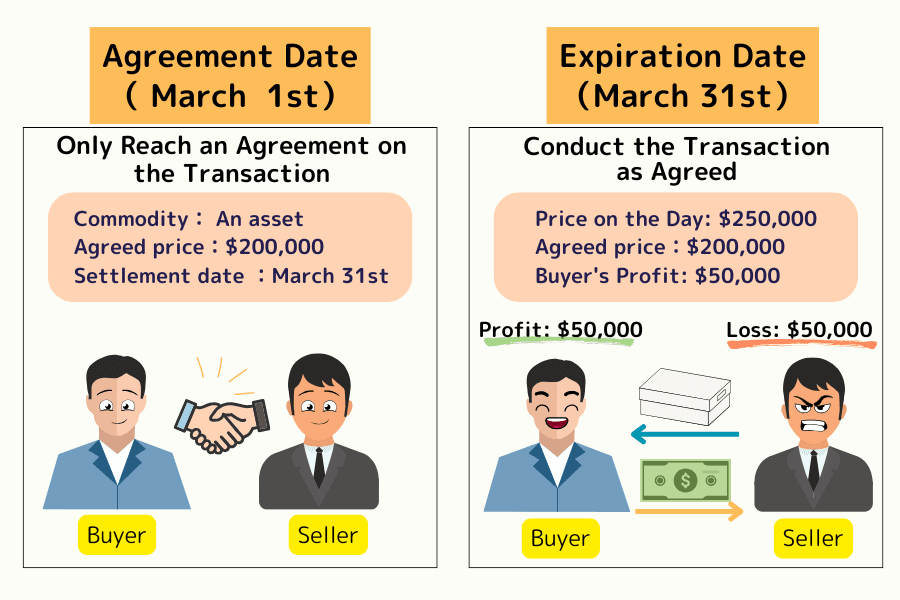
When discussing futures trading, it’s important to note that on the trading day, only the agreement is made, and the following elements are agreed upon:
- • The underlying asset (the asset being traded)
- • Agreed price
- • Transaction quantity
- • Settlement date (expiry date)
When the agreed expiration date arrives, both parties perform the buy/sell operations as initially agreed.
For example, let’s say the asset’s price on the trading day is $250,000.
However, since the contract is agreed at $200,000, the buyer can purchase it at $200,000.
By buying an asset worth $250,000 at $200,000, the buyer’s profit is $50,000.
Conversely, if the asset’s price drops before the expiration date, the buyer will incur a loss.
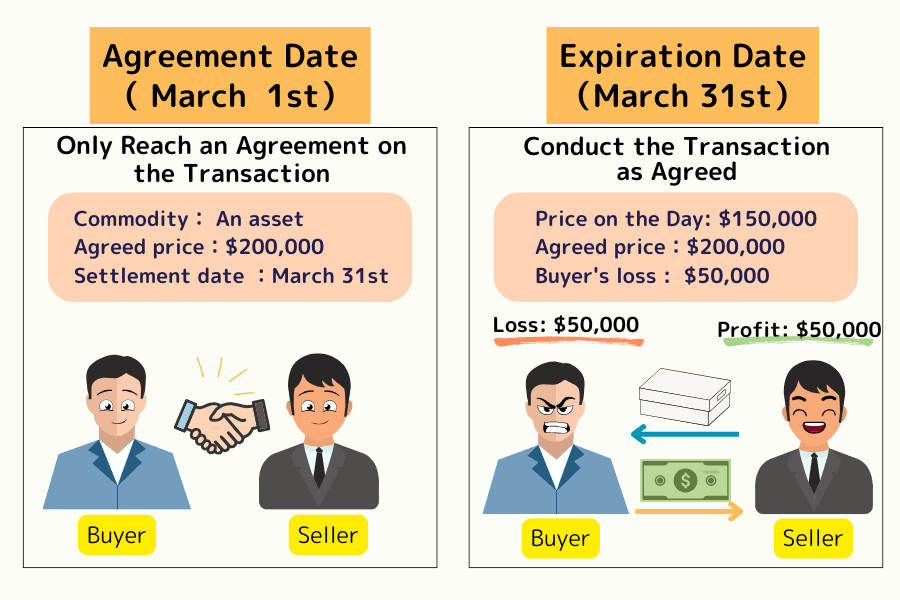
This is how things would work on the expiry date (maturity), but before the agreed expiry date, reverse transactions (selling or buying back) can also be conducted.
2. Differences Between Futures Trading and CFD Trading
| Feature | Futures Trading | CFD Trading |
|---|---|---|
| Nature of Trade | Standardized contracts traded on exchanges | Non-standardized contracts traded over-the-counter (OTC) via brokers |
| Underlying Assets | Primarily commodities, stock indices, bonds, interest rates | Broader range, including stocks, indices, forex, commodities, cryptocurrencies |
| Settlement Method | Physical delivery or cash settlement | Only cash settlement, no physical delivery |
| Trading Hours | Fixed trading hours determined by exchanges | Nearly 24-hour trading (depending on the market) |
| Leverage | Fixed leverage ratio determined by exchanges | Flexible leverage provided by brokers, usually higher |
| Margin Requirements | Higher margin, must meet exchange regulations | Lower margin, more flexible |
| Fees and Costs | Includes exchange fees, broker commissions, etc. | Mainly spreads and overnight financing costs, with a more complex cost structure |
| Suitable for | Professional investors or institutional investors, requiring in-depth market knowledge | Suitable for all types of investors, especially short-term traders |
| Contract Expiry | Fixed expiry date, must be closed or settled before expiry | No fixed expiry date, can hold long-term (but requires paying overnight financing costs) |
Futures trading is more suitable for those seeking hedging (such as businesses locking in prices) or professional investors familiar with the futures market. It is standardized and transparent.
CFD trading is more flexible, suitable for retail investors seeking high leverage and short-term speculation, but carries higher risk and depends on the broker's reliability.
Further Reading: What is CFD (Contract for Difference)?
3. Features of Futures Trading
1. Short Selling
One of the main advantages of futures trading is its short selling feature. When investors expect asset prices to fall, they can sell futures contracts without owning the underlying asset. This allows investors to profit during bear markets.
2. Cash Settlement
Most futures trades are settled in cash. In other words, futures contracts typically don’t require physical delivery of the asset. Instead, the price difference is paid or received. For instance, if the futures price rises, the buyer pays the difference; if the price drops, the seller pays the difference.
3. Fixed Trading Duration
Unlike long-term stock investments, futures trading has a clear time frame. During the trading period, buying and selling can occur at any time, but once the period ends, the trade is automatically settled, and the profit/loss is determined.
4. Margin System
In futures trading, investors only need to deposit a margin, a fraction of the total contract value, to control a larger position. This leverage effect amplifies both potential profits and risks. Example of Leverage: If the margin is $50,000, an investor can control a futures contract worth $500,000, resulting in a 10x leverage.
4. Risks of Futures Trading
1. Principal at Risk
Futures trading does not guarantee the safety of the principal. Due to the unpredictable nature of market price fluctuations, investors may lose their entire investment.
2. High Leverage Risk
Because futures trading often uses leverage, even small market price movements can significantly magnify losses, potentially exceeding the initial margin. Therefore, futures trading carries high risk.
3. Systemic Risk
Futures trading relies on electronic trading platforms and exchange systems. A system failure could disrupt normal trading and prevent investors from executing trades or settlements in a timely manner.
4. Margin Calls
In futures trading, if market fluctuations lead to insufficient margin, investors will need to deposit additional funds to maintain the validity of their positions. If they fail to meet the margin call in time, their positions may be forcibly closed, resulting in losses.
5. Frequently Asked Questions (FAQ)
Q1. How does futures trading differ from spot FX?
The biggest differences lie in the underlying instrument and settlement mechanism:
- Futures trading uses standardized derivatives contracts with an explicit expiry; some commodity contracts can require physical delivery.
- Spot FX has no contract expiry — it is an immediate currency exchange operation, settled on the books.
Futures are mostly listed on exchanges, while FX is largely traded OTC, so the rule sets and cost structures also diverge.
Q2. Can you sell-then-buy in futures the way you do with CFDs?
Yes. Futures markets natively support two-way trading — you can short without holding the underlying. Open a sell position when you expect prices to fall, then buy back at a lower price to close. The shorting logic mirrors a CFD short, but CFDs are non-standardized contracts so execution and oversight differ.
Q3. Can MT4/MT5 trade real futures?
MT4 and MT5 technically support futures contracts, but whether you can actually trade them depends on what your broker offers. Most retail brokers (including Titan FX) provide CFD-style products rather than exchange-regulated futures.
If a platform shows tickers like "US30" or "Oil" without an explicit expiry date, those are typically CFD mirror products — not traditional futures.
Q4. Will I take physical delivery from a futures trade?
Not necessarily. Physical delivery only happens at expiry on contracts that were not closed beforehand, and only on certain commodity futures (agricultural products, metals, etc.). The vast majority of investors close their positions before expiry to avoid the delivery process.
Financial futures — equity indices, interest rates, most currency pairs — are settled in cash and never involve physical asset transfer.
Q5. Is futures trading suitable for beginners?
Futures trading is high risk, highly leveraged, and demands a solid understanding of contract specifications and margining. Brand-new traders should not jump straight in. Build a foundation in market mechanics and risk management first, then progress through demo platforms or small positions.
If you want a lower-friction derivatives entry point, consider CFDs, ETFs, or options before stepping up to exchange-listed futures.
6. Conclusion
Futures trading is a financial derivative that allows both parties to agree to buy or sell an asset at a fixed price on a specific future date. The core of this trading lies in "locking in the price" in advance, meaning that both parties must settle the transaction at the agreed price, regardless of how the market price moves.
Futures trading encompasses various types, including stock indices, bonds, and commodities. Its operations involve agreements, delivery or closing positions, and investors can choose to settle through delivery or close positions before expiration to settle the price difference.
Compared to CFD trading, futures trading involves standardized contracts traded on exchanges with fixed expiry dates, and offers physical delivery or cash settlement. It has lower leverage and higher transparency, making it suitable for professional investors. CFD trading, on the other hand, is a non-standardized contract, has no expiry date, and offers flexible leverage. It’s more suited for short-term traders but relies on brokers.
In summary, futures trading is a complex and high-risk financial instrument suitable for investors with deep market knowledge and the ability to handle significant risks. By mastering the basics of futures trading and risk management strategies, investors can uncover more opportunities in the futures market while effectively mitigating potential risks.
Further Reading
- What Is CFD (Contract for Difference)?
- Forex Leverage Explained
- Forex Hedging
- Loss Cut (Forced Liquidation)
- Price Gaps in Candlestick Charts
The Titan FX Financial Markets Research and Analysis Team. Covering forex (FX), commodities (crude oil, precious metals, agricultural products), stock indices, US equities, and crypto assets, the team produces educational content for investors across a broad range of financial instruments.
Primary Sources (by category)
- Regulators & exchanges: CME Group, ICE Futures, CFTC, U.S. SEC
- Education & research: CFA Institute, Investopedia: Futures Contract, Wikipedia: Futures contract
- Academic & industry: John C. Hull, Options, Futures, and Other Derivatives; Robert A. Strong, Derivatives: An Introduction
- Media & research: Bloomberg, Reuters, Wall Street Journal futures-market coverage