

Matthew Effect
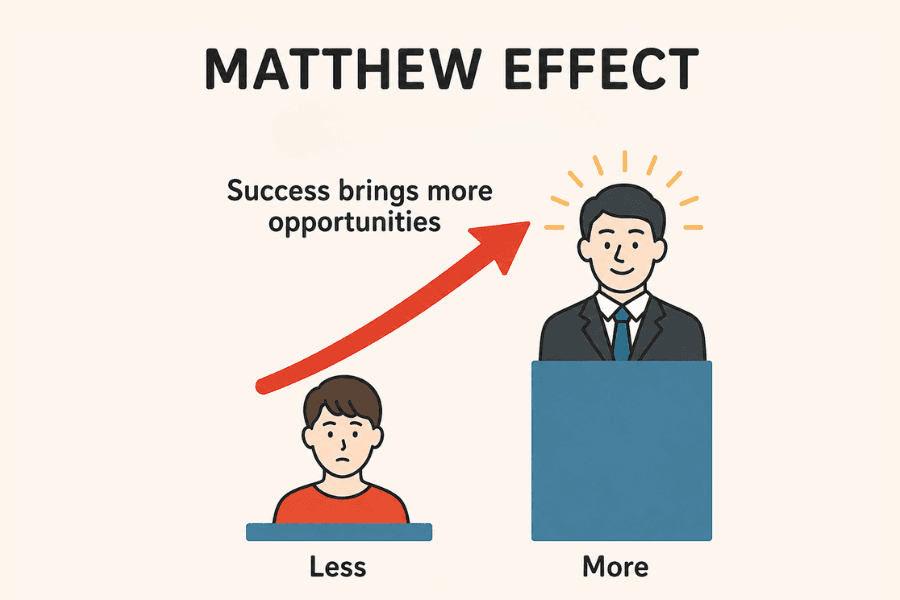
The Matthew effect is the phenomenon of cumulative advantage: early success attracts more opportunities, resources, and recognition, so the successful keep pulling ahead.
In workplaces, academia, and even investment markets, we keep seeing the same pattern. Once a few people taste success, opportunities, resources, and reputation roll toward them like a snowball; meanwhile, many others keep grinding without ever getting their break. This is not coincidence — it is a structural social phenomenon known as the Matthew Effect.
- The Matthew Effect, coined by sociologist Robert K. Merton in 1968, describes a cumulative-advantage mechanism: successful people stay successful, while those who fall behind find it harder to recover.
- It shows up most clearly in three arenas — workplace promotion, corporate hiring, and financial markets — producing a "resources → talent → results → re-expansion" loop.
- Its counterpart is the Marko Effect, which spreads resources to overlooked potential. The two are complements, not opposites.
- In FX and equity markets, the Matthew Effect shows up as gaps in capital scale, information speed, and access to advanced tools (algos / EAs).
- Retail investors can start their own positive loop by sizing positions small, enforcing risk rules, and stacking repeatable small wins.
1. What Is the Matthew Effect?
The Matthew Effect is a social-science concept describing how "the successful tend to become more successful, while the unsuccessful find it harder to recover." The name comes from a verse in the Gospel of Matthew (25:29):
"For unto every one that hath shall be given, and he shall have abundance: but from him that hath not shall be taken away even that which he hath."
In 1968, sociologist Robert K. Merton used this verse to explain reputation accumulation in academia. Well-known scholars more easily attract funding, collaboration, and awards, while lesser-known peers with comparable results are routinely overlooked. The concept was later extended to education, business, social relationships, and financial markets.
Its core logic is cumulative advantage: when early small successes are recognised and amplified, they kick off a positive feedback loop that compounds. Those who do not capture early opportunities tend to be pushed to the margin.
2. Real-World Examples in Work and Business
The Matthew Effect is common in workplaces and corporate life. The following three angles explain how it operates and why it matters.
2.1. Results Lead to More Opportunities: From Performance to Promotion
In an organisation, an employee who excels on a project tends to be assigned more responsibility and higher-stakes work. Those additional opportunities then become the stage on which they accumulate visibility and credentials. For example, a new hire who proposes a smart process improvement in year one may be tapped for the core team next quarter and ultimately enter the promotion pipeline.
This "one success unlocks the next" positive loop is a textbook instance of the Matthew Effect. The flip side is that employees who do not get noticed early — even capable ones — may end up sidelined and lose motivation and retention.
2.2. Well-Known Companies Attract Better Talent
The same logic applies at the corporate level. Established brands and large firms, by virtue of existing resources and market position, attract higher-quality applicants. Those hires further raise performance and brand visibility, locking in a "resources → talent → results → re-expansion" loop. Smaller and less-visible startups, by contrast, often face hiring difficulties and resource constraints.
The pattern shows that in environments where resources are unevenly distributed, the strong grow stronger and the weak find it harder to break out.
2.3. The Matthew Effect in the Global Financial System
The Matthew Effect is also vivid in the international financial system. A handful of reserve currencies led by the U.S. dollar — backed by deep liquidity, complete settlement networks, and low trust costs — continually attract cross-border transactions and reserve allocations. Emerging-market currencies, even when fundamentals improve, struggle to displace the incumbent order. This "strong currency gets stronger" pattern is precisely what bodies like G20 and G7 have repeatedly debated.
3. Strengths and Challenges of the Matthew Effect
The Matthew Effect has clear upsides. From an organisational standpoint, concentrating resources on high performers delivers results faster and strengthens competitive position. Time and budget are finite, so betting on those who "look most likely to succeed" is rational. Successful examples also generate trust and support, creating a positive atmosphere across the firm.
But this approach has side effects. The most common is "opportunity concentration": employees who work equally hard but are not spotted early remain on the periphery, systematically overlooked. The inequality is not from malice — it is a natural consequence of how the system is wired. Over time, overlooked employees lose motivation and may exit.
Another risk is over-reliance on a small number of key performers. When team success rests on a few star employees, their departure or failure can cause a sudden collapse. Such environments also bury employees with potential but weaker self-promotion, lowering long-term innovation capacity.
In short, the Matthew Effect is efficient, but it tends to make the strong stronger and the weak weaker. If this asymmetry is not detected and corrected, it can ultimately slow the organisation's overall development.
4. Matthew Effect vs Marko Effect: Two Mindsets Compared
The Matthew Effect describes the world we observe: those who perform better get noticed and get more resources, and so they keep succeeding. Yet behind this logic there is another voice — the Marko Effect.
The Marko Effect argues for spreading resources and opportunities outward, especially to those who have not yet been spotted but carry real potential. Everyone may flourish given the right timing and conditions; if an organisation only bets on already-successful individuals, it risks missing silent contributors.
The Marko Effect does not reject performance — it asks that fairness and long-term development sit alongside efficiency. In practice it shows up as open proposal channels, rotation programmes that ignore tenure, and refusing to concentrate every opportunity on a small group.
Which is better? There is no absolute answer; the optimal strategy depends on the situation. The table below summarises the differences:
| Dimension | Matthew Effect | Marko Effect |
|---|---|---|
| Core idea | The successful keep succeeding | Anyone may be worth discovering |
| Resource allocation | Concentrated on high performers | Spread to the overlooked |
| Organisational culture | Elite-driven, competitive | Inclusive, potential-aware |
| Strengths | Efficient, clear outcomes | Higher engagement, better morale |
| Risks | Ignores fairness, over-relies on few | Higher execution cost, slower payoff |
| Best context | Fast growth, performance push | Team formation, cultural shift, early-stage |
In reality, many organisations blend the two: leaning toward the Matthew Effect (resource concentration) during core-business pushes, and toward the Marko Effect (resource diffusion) during talent development and culture change. The balance lets a firm capture outcomes while not missing the quieter sources of capability.
5. Practical Application in Investment Markets
The Matthew Effect exists in trading and investment markets too — arguably more vividly than elsewhere.
5.1. Successful Traders Stay Successful
Successful traders in FX and equity markets typically enjoy these advantages:
- More capital to deploy across a wider basket, with better risk diversification through cycles.
- Faster access to market information (paid pro platforms, dedicated trading desks).
- Access to advanced tools such as algorithmic trading and EAs (automated programmes).
- With enough historical data, exposure to ETFs, CFDs for hedging, and other diversified strategies.
A well-capitalised FX trader can carry larger position swings, so when a high-probability setup appears, they can scale up — turning a single edge into a return that dwarfs typical retail outcomes. Their record then attracts followers and copy-traders, and may earn invitations to teach or advise, layering reputation on top of resources.
5.2. The Matthew Effect Challenge for Retail Investors
Conversely, a beginner who loses in their first months sees capital shrink, confidence erode, and the ability to refine strategy or trading psychology weaken — sometimes to the point of exit. This is "the weak getting weaker": losers find it harder to recover, while winners keep accumulating resources, trust, and influence.
5.3. How a Retail Investor Can Kick Off Their Own Positive Loop
The key is not a one-shot windfall but building repeatable small wins:
- Keep early positions small — accumulate live data with the minimum size so one mistake cannot end the journey.
- Enforce risk management — set explicit stops and position caps on every trade, preserving capital for the next opportunity.
- Keep a trading journal — treat it like a KPI dashboard, reviewing win-rate, average P/L ratio, and max drawdown.
- Focus on a small market set — start in the most liquid markets (G20 majors) and only expand to harder instruments later.
As small wins compound, a retail investor builds a "performance → confidence → deployment → more performance" loop. That is the Matthew Effect applied to oneself in a healthy way.
6. FAQ
Q1. Are the Matthew Effect and "winner-take-all" the same thing?
Similar but not identical. Winner-take-all focuses on extreme concentration of outcomes (the top 1% taking 90% of profit). The Matthew Effect focuses on the accumulation mechanism — how early advantages self-reinforce. Winner-take-all is one long-run consequence of the Matthew Effect.
Q2. Is the Matthew Effect always bad news for retail investors?
No. The same mechanism works in your favour once you build a stable trading record and risk-management process. Each small win compounds into better conditions for the next decision. The retail strategy is simple: do not let early losses destroy long-term compounding.
Q3. Where does the Matthew Effect appear most often in FX?
In three layers: capital scale, information speed, and tool access. Large institutions have Bloomberg terminals, low-latency servers, and quant teams that react instantly to G7 central-bank policy shifts. Retail investors close the gap by trading smaller, enforcing strict risk rules, and choosing transparent broker environments.
Q4. How do the Matthew and Marko Effects coexist in corporate practice?
Mature organisations switch by context: lean Matthew (concentrate resources) during core-business pushes and KPI sprints; lean Marko (spread resources) during new-business incubation, talent development, and culture transitions. The two are not either/or.
Q5. What can a retail investor do to avoid getting "trapped" by the Matthew Effect?
Three directions: (1) Set strict position caps and stops so a single loss does not force you out. (2) Keep learning and logging so each experience feeds the next decision. (3) Choose a transparent, compliant, execution-reliable trading environment, so structural disadvantages do not compound against you.
7. Conclusion
Success is not only a function of effort — it is also shaped by visibility and how resources flow. The Matthew Effect reminds us that inequality in society and organisations often accumulates rather than appears overnight. The Marko Effect offers a complementary path: letting more people participate. For individuals and firms alike, balancing efficiency and fairness is what makes long-term progress possible. For retail investors, kicking off your own small Matthew loop is more worthwhile than chasing a single windfall.
Further Reading
The financial markets research team at Titan FX. We produce educational content across a broad range of instruments, including forex (FX), commodities (crude oil, precious metals, agricultural products), equity indices, U.S. stocks, and crypto assets.
Primary Sources by Category
- Academic literature: Robert K. Merton (1968), "The Matthew Effect in Science", Science 159 (3810)
- Sociology classics: public research on cumulative advantage
- Financial-system background: G20 Information Centre, G7 Information Centre, Bank for International Settlements (BIS) public materials