

G7 (Group of Seven)
The G7 (Group of Seven) is one of the most influential coordination platforms among advanced economies in the world. It brings together the United States, Japan, Germany, the United Kingdom, France, Italy, and Canada — countries that not only lead the global financial system but also sit at the centre of technology, energy, and international security.
For investors, the G7's policy tone and the direction of cooperation it signals are key inputs for reading the global economic environment, the rate cycle, supply-chain shifts, and geopolitical risk.
This article walks through, in a structured way, the G7's origins, composition, core functions, and impact on financial markets — helping beginners and investors track the policy pulse and sharpen their reading of global markets.
- Position: G7 (Group of Seven) — U.S., Japan, Germany, U.K., France, Italy, Canada — the most influential coordination platform among advanced economies
- Origin: France hosted a G6 in 1975; Canada joined in 1976 to form the G7. Russia was admitted to make the G8 in 1998 but had its participation suspended after the 2014 Crimea annexation
- Scale: Together about 40% of global GDP, nearly one-third of global trade, and the main source of global R&D and defence spending
- Three-layer operation: Leaders' Summit (May-July) / Ministerial Meetings / Working Groups and Policy Research
- Areas of influence: international taxation, technology security, supply-chain reshaping, energy and climate governance, AI and cyber-security — i.e. global rule-making
1. Origins and Background
The G7's formation traces back to the heavy economic turbulence of the 1970s.
The 1973 oil crisis sent international oil prices sharply higher, inflation accelerated, and growth stalled, ushering in what came to be known as "stagflation." Existing multilateral mechanisms (IMF, OECD) were not nimble enough at policy coordination, and major economies clearly needed a smaller, more action-oriented cooperation platform.
Against that backdrop, in 1975 France invited the United States, the United Kingdom, Germany, Italy, and Japan to hold an informal leaders' meeting, forming the G6. The next year (1976) Canada joined, and the group was formally expanded to the G7.
Russia later joined in 1998, making it the G8, but its participation was suspended after the 2014 Crimea annexation. Since then, the group has reverted to its original G7 composition.
The G7 exists in order to:
- ▸let the major advanced economies coordinate fiscal, monetary, and energy policy more quickly
- ▸collectively confront cross-border challenges such as financial crises and geopolitical change
- ▸speed up and align policy decision-making through direct leader dialogue
Backed by its members' dominant position in the global economy and technology, the G7 quickly grew from a small consultative platform into a core circle of international political-economic governance — and continues to shape global market direction and the international policy framework.
Summit format and timing
The G7's core operation centres on the "Leaders' Summit," with the rotating presidency setting the agenda and inviting member leaders. The summit is highly flexible and informal, designed so the major advanced economies can swiftly exchange views and align policy direction.
The G7 Summit typically takes place between May and July, with the exact timing set by the host. In addition to the leaders' summit, multiple ministerial meetings — finance, foreign affairs, energy, and others — run throughout the year.
The table below shows recent G7 summits' hosts and venues — a useful reference for tracking global policy shifts.
| No. | Year | Host | City |
|---|---|---|---|
| 37 | 2011 | France | Deauville |
| 38 | 2012 | U.S. | Camp David |
| 39 | 2013 | U.K. | Lough Erne |
| 40 | 2014 | EU / Belgium | Brussels |
| 41 | 2015 | Germany | Schloss Elmau |
| 42 | 2016 | Japan | Shima |
| 43 | 2017 | Italy | Taormina |
| 44 | 2018 | Canada | La Malbaie |
| 45 | 2019 | France | Biarritz |
| 46 | 2020 | U.S. (planned) | Camp David (in-person summit cancelled) |
| 47 | 2021 | U.K. | Carbis Bay |
| 48 | 2022 | Germany | Schloss Elmau |
| 49 | 2023 | Japan | Hiroshima |
| 50 | 2024 | Italy | Fasano |
| 51 | 2025 | Canada | Kananaskis |
| 52 | 2026 | France | Évian-les-Bains |
Through this annual summit system, the G7 continuously forms a common stance on the global economy, technology governance, energy security, and geopolitics — exerting a lasting influence on international policy and market sentiment.
2. Members and Organisational Structure
The G7 is made up of seven advanced countries with the largest combined economic, technological, and political influence, spanning the major mature economies of North America, Europe, and Asia. Its composition underpins the G7's central role in global governance.
Membership
The G7's formal members are: the United States, Japan, Germany, the United Kingdom, France, Italy, and Canada.
They share several common traits:
- ▸highly industrialised, mature market economies
- ▸major hubs of global financial markets
- ▸significant decision-making influence in international bodies such as the IMF, World Bank, and WTO
- ▸leading positions in technology innovation, military capability, and diplomatic influence
Unlike the G20, the G7 does not include emerging markets, and does not use regional representation. The EU is not a formal member but attends all G7 meetings as a participant.
In aggregate, G7 members account for:
- ▸about 40% of global nominal GDP
- ▸nearly one-third of global trade
- ▸a major share of global R&D and defence spending
So while the G7 is small in membership, it remains one of the most consequential economic-political blocs for actual decision-making globally.
How the G7 operates
The G7 runs as a highly flexible "informal cooperation framework" — no permanent secretariat, no formal treaty. The annually rotating presidency sets the agenda and convenes the meetings.
That design lets the G7 form a policy stance quickly when international conditions shift, avoiding the slower decision cycles that often plague larger multilateral organisations.
The structure works across three interlocking layers:
| Layer | Name | Function | Participants | Notes |
|---|---|---|---|---|
| Layer 1 | Leaders' Summit | Sets the G7's core policy stance; covers global economy, financial stability, geopolitics, energy, and technology | Seven heads of state and government | Top decision-making platform; the post-meeting Leaders' Communiqué is the main output |
| Layer 2 | Ministerial Meetings | Operationalise the summit's direction with policy details (finance, foreign affairs, energy, interior, etc.) | Finance, foreign, energy ministers, and others | The central layer for policy design |
| Layer 3 | Working Groups and Policy Research | Deep work on specific issues — climate, technology, supply chains, the digital economy — with expert recommendations | Technical officials, experts, cross-agency representatives | Research feeds into ministerial meetings and on to summit decisions |
3. Core Functions and Role
The G7's influence comes from its members' leadership in economics, technology, diplomacy, and international rule-making. As the most representative coordination platform among advanced economies, the G7 doesn't only debate economic topics — it also plays a major role in international politics, security, technology governance, and supply-chain reshaping. Its core functions can be read from three angles:
Function 1: Coordinating the policy direction of major advanced economies
The G7's most basic task is to keep its members aligned on key policy areas, especially monetary policy, fiscal stimulus, trade rules, and energy and resource management.
Through summit and ministerial meetings, members can quickly exchange information and align direction during global crises.
For example, during the 2008 financial crisis and the COVID-19 pandemic, the G7 was among the first to coordinate the pace of rate cuts, principles for financial-institution support, and market-stability measures — reducing the risk of policy collisions between countries.
Function 2: Driving international financial and technology governance
On global financial systems and technology policy, the G7 sits at the centre of standard-setting. Its influence shows up in international taxation, banking supervision, technology security, and supply-chain resilience. Examples:
- ▸supporting the OECD-led global minimum corporate tax to stop multinationals from arbitraging tax differences;
- ▸advancing supply-chain security for semiconductors, energy, and critical minerals to reduce dependency on any single region;
- ▸building a common stance on AI, cyber-security, and digital governance that shapes the direction of global tech regulation.
Because most G7 members are major rule-makers in international finance and technology, their policies tend to be treated as important reference points by other countries and firms.
Function 3: A common-stance platform for global political and geopolitical issues
Beyond economics, the G7 has long built consensus on major geopolitical issues — including the war in Ukraine, energy security, the Indo-Pacific, human rights, and supply-chain restructuring.
These joint statements have no legal force, but because of the members' diplomatic and military weight, the G7's positions often shape international opinion and the market's reading of geopolitical risk.
Across these three dimensions, the G7 has grown from an early economic coordination group into a comprehensive decision-making platform covering diplomacy, security, technology, and finance — keeping a high level of influence over global markets and the policy environment.
4. Impact on Global Economy and Financial Markets
The G7's statements and policy positions are widely treated as a barometer for the direction of the global economy.
Because its members occupy leading positions in the global financial system, technology supply chains, and energy markets, the direction of their decisions affects investor sentiment, FX moves, international capital flows, and policy adjustments across countries. The impact divides into two layers: short-term market reaction and medium-to-long-term policy signals.
Impact 1: Short-term market reaction
Around each G7 summit, markets pay close attention to the wording of leaders' statements, policy tone, and whether trend-turning signals come through. Reactions tend to cluster around a few scenarios:
- ▸If a statement emphasises "inflation pressure," "monetary-policy normalisation," or "stronger financial oversight," markets often read it as a tightening signal — the U.S. dollar and safe-haven assets can strengthen, with global equities under near-term pressure.
- ▸Mentions of "economic stimulus," "stronger cooperation," or "maintaining market liquidity" tend to lift risk appetite — equities, commodities, and emerging-market assets can rally together.
- ▸References to "geopolitical risk" or "energy-supply uncertainty" can trigger a risk-off shift — gold, oil, or sovereign bonds may move higher.
These short reactions don't necessarily change the trend, but they have a clear effect on investor sentiment and short-term capital flows.
Impact 2: Medium-to-long-term policy direction
Compared with short-term price action, the deeper market impact of the G7 comes from its policy consensus. Since members tend to be international rule-makers, their stance often hints at medium- to long-term trends, including:
- ▸International taxation and corporate regulation: e.g. supporting the OECD's global minimum corporate-tax rules — directly affecting the operating footprint and earnings model of multinationals.
- ▸Technology security and supply-chain reshaping: restricting tech exports, emphasising semiconductor and critical-material supply security — making the tech sector and geopolitical-tech competition long-term investment themes.
- ▸Energy policy and climate governance: attitudes toward fossil fuels, the energy transition, and carbon emissions — driving valuations and capital flow across traditional energy, renewables, and ESG assets.
- ▸Financial stability and market supervision: positions on crypto regulation, bank capital requirements, and cross-border financial cooperation — often steering the related regulatory trend.
For investors, the G7 is not only a source of geopolitical signals but a key reference for understanding global policy rotation, industry cycles, and capital flow. Reading the G7's policy tone for trend direction often delivers more investment value than chasing short-term moves.
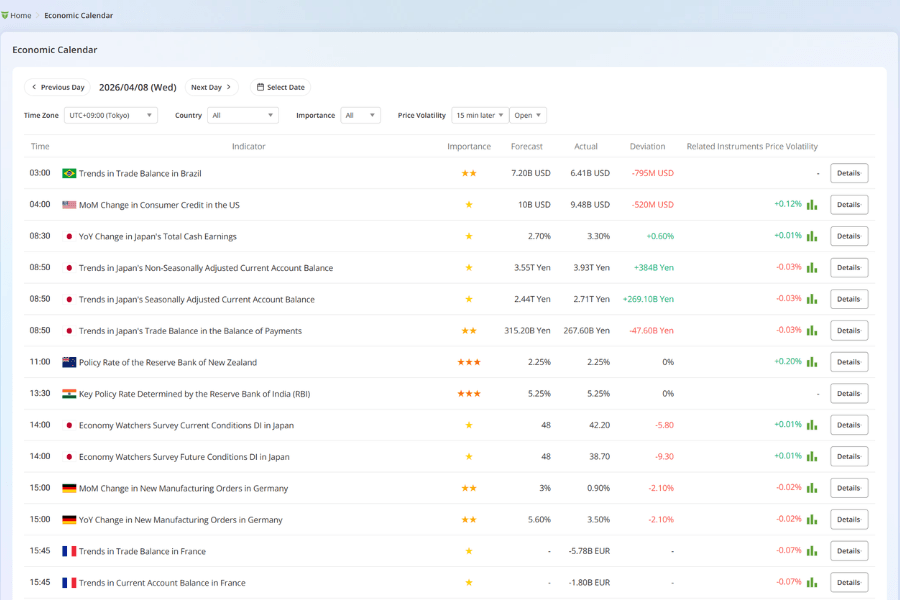
Titan FX offers a free economic calendar, helping you track key events such as GDP, CPI, and the U.S. nonfarm payrolls.
5. Frequently Asked Questions (FAQ)
Q1. What's the main difference between the G7 and the G20?
The G20 includes 19 countries plus the EU (and emerging markets such as China, India, and Brazil), while the G7 is just seven advanced industrial economies. The G7 is more homogeneous and can move faster, but its representation is narrower. The G20 is more inclusive, but consensus is slower. In short: the G7 carries the "common advanced-country stance"; the G20 hosts a North-South economic dialogue.
Q2. Why was Russia excluded from the G8?
The G7 admitted Russia in 1998 to make the G8, with the intent of integrating Russia into the Western political-economic system. After Russia annexed Crimea in 2014, the other members suspended Russia's participation for "disrupting the international order," and the G8 reverted to the G7 framework. This also shows that the G7 is more than an economic coordination platform — it is also a common front of advanced democracies on political stance.
Q3. Why is the EU a "participant" rather than a formal member of the G7?
The EU attends all G7 meetings as a "special participant," represented by the Presidents of the European Council and the European Commission. It has no formal voting rights, but it represents the collective position of around 27 member states, and its practical influence is significant. The design balances "tight coordination among seven countries" with "the broader EU interest."
Q4. How much do G7 leaders' communiqués actually move markets?
The communiqués themselves don't carry legal force, but they convey the common stance of countries that issue major reserve currencies (USD, EUR, JPY, GBP, CAD). The content often filters quickly into FX and commodity markets. Specific positions on "exchange-rate stability," "energy-price caps," or "technology export controls" can see noticeable market moves within 24 hours of the release.
Q5. What's the relationship between the G7 and BRICS?
BRICS (Brazil, Russia, India, China, South Africa, and others) is an emerging-market-led platform that contrasts with the G7, forming an "advanced vs. emerging" bipolar pattern. The two groups often engage with each other in G20 settings — on topics such as international reserve currencies, IMF voting-share reform, and fintech standards. Investors who track the stance gap between G7 and BRICS at the same time can often spot medium-to-long-term shifts in global governance structure earlier.
6. Conclusion
The G7 holds a distinctive place in the global governance architecture. Though its membership consists mainly of advanced economies and does not represent the whole world, its policy-coordination capacity, economic weight, and diplomatic influence keep it central in international economics, financial systems, and technology governance.
For investors, the G7 is not a short-term news flash — it is a policy platform worth following over time. Its consensus often foreshadows the next phase of global capital flow, industry direction, and market-risk sentiment. Understanding the G7 means grasping the core signals of global economic momentum and the policy cycle.
Further Reading
Titan FX Research Hub — investor education across foreign exchange (FX), commodities (oil, precious metals, agriculture), stock indices, U.S. equities, and crypto assets.
Primary Sources (by category)
- Official sources from international bodies: G7 Information Centre, OECD
- Financial institutions and central banks: International Monetary Fund (IMF), Federal Reserve, Bank of Japan (BoJ)
- Academic and institutional design: general public research on coordination mechanisms among advanced economies, the OECD's international tax framework, and supply-chain resilience