

G20 (Group of Twenty)
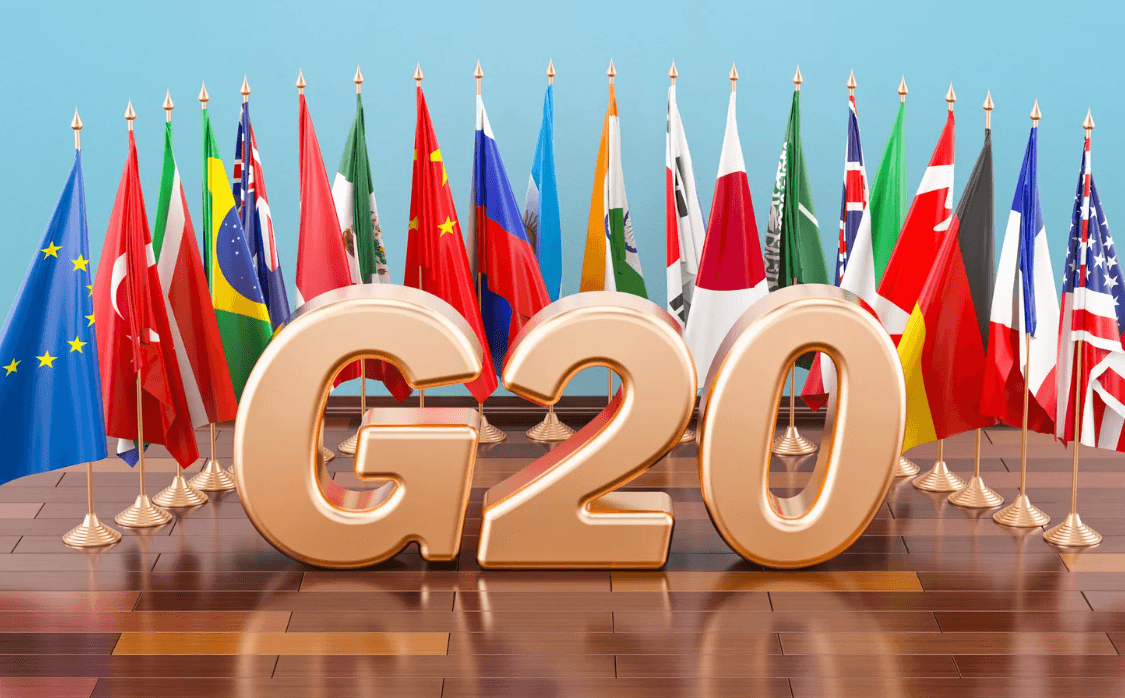
For the general public, the G20 looks like a dialogue at the top of international politics and economics. For investors, it is a barometer that reflects global policy trends and the direction of capital flows.
Each annual summit is both a diplomatic event for national leaders and a key reference point for the market's reading of monetary policy, inflation, and shifts in geo-economic conditions. This article walks through the G20's origins, membership, role, and market impact, giving you a structured view of what the G20 actually means and what investors should take away from it.
- Position: The G20 (Group of Twenty) consists of 19 sovereign countries plus the European Union — the most representative global economic-coordination platform
- Origin: Established in 1999 via a G7 finance ministers' agreement; upgraded to the leaders' summit after the 2008 financial crisis
- Scale: Together about 85% of global GDP, 75% of trade, and two-thirds of population
- Three-layer operation: Leaders' Summit / Finance Track / Engagement Groups (B20, T20, W20, Y20)
- Market impact: The annual Q4 (usually November) summit statement often becomes a short-term catalyst for FX, rates, and commodity prices
1. Origins and Background
The creation of the G20 marks a key turning point — global economics moving from "regional coordination" to "global governance."
It can be traced to the 1997 Asian financial crisis, when markets were highly connected but effective international coordination mechanisms were missing.
The traditional G7 (the United States, Japan, Germany, the United Kingdom, France, Italy, and Canada) was a representative group of advanced economies, but its membership couldn't reflect the rising weight of emerging markets in the world economy.
In 1999, the G7 finance ministers' meeting decided to establish the G20 so that developing countries and emerging markets could participate in international economic policy coordination too.
The G20's purpose is to promote global financial stability, policy coordination, and inclusive growth. It started as a forum for finance ministers and central-bank governors and was officially upgraded to a leaders' summit after the 2008 financial crisis, becoming the most influential global economic-governance platform.
Summit format and timing
The G20 uses a rotating-host system, with a different member hosting the summit each year. It runs on two main tracks:
- ▸Leaders' Summit: heads of state and government meet to discuss global economic and political issues.
- ▸Finance Track (finance ministers and central-bank governors): focuses on monetary policy, financial regulation, and debt issues.
The summit usually takes place in the fourth quarter of each year (often November); the host country sets the theme, and a joint communiqué issued at the end serves as an important reference for global economic policy direction.
The table below lists the host, city, and main themes of G20 summits from 2011 to 2026 — a useful timeline for tracking international policy changes.
| Year | Host | City | Main themes |
|---|---|---|---|
| 2011 | France | Cannes | Euro-debt crisis and global financial stability |
| 2012 | Mexico | Los Cabos | Economic recovery and fiscal reform |
| 2013 | Russia | Saint Petersburg | Jobs and growth, tax cooperation |
| 2014 | Australia | Brisbane | Global growth and infrastructure investment |
| 2015 | Turkey | Antalya | Inclusive growth and financial-regulation reform |
| 2016 | China | Hangzhou | Innovative growth and global governance |
| 2017 | Germany | Hamburg | Connected world and global governance |
| 2018 | Argentina | Buenos Aires | Global trade and sustainable development |
| 2019 | Japan | Osaka | Global governance and technological innovation |
| 2020 | Saudi Arabia | Riyadh (virtual) | 21st-century opportunities and pandemic response |
| 2021 | Italy | Rome | Green transition and digitalisation |
| 2022 | Indonesia | Bali | Energy crisis and food security |
| 2023 | India | New Delhi | Inclusive development and South-South cooperation (African Union admitted as a permanent member) |
| 2024 | Brazil | Rio de Janeiro | Fighting hunger and climate action |
| 2025 | South Africa | Johannesburg | Solidarity, equality, and sustainable development |
| 2026 | United States | Miami (Trump National Doral Miami) | Economic prosperity, secure energy supply, and new technologies |
The evolution of summit themes reflects how the focus of global economics has shifted — from crisis response and regulatory reform to climate finance, digital economy, and inclusive growth.
Through this institutional platform, the G20 has moved from "crisis coordinator" to "stabiliser of global governance," and its discussions shape both national policy direction and the global financial market.
2. Members and Organisational Structure
The G20 is one of the most representative and inclusive cooperation mechanisms in the global economy. Its membership mirrors today's economic landscape and the coexistence of advanced and emerging economies.
Membership
The G20 consists of 19 countries plus the European Union (EU) and the African Union (AU), with international organisations (IMF, World Bank, OECD, the UN, etc.) attending as observers.
The members span five continents and include the world's major economic centres and trading hubs: the United States, China, Japan, Germany, the United Kingdom, France, India, Brazil, Canada, Italy, Mexico, South Korea, Australia, Indonesia, Saudi Arabia, Argentina, South Africa, Russia, and Turkey.
Alongside these 19 countries, two regional organisations sit at the table: the European Union and the African Union. The African Union became a permanent member at the New Delhi summit in September 2023, bringing 55 African states into the group.
Together these economies account for:
- ▸about 85% of global nominal GDP
- ▸about 75% of global trade
- ▸about two-thirds of global population
That scale makes the G20 the core circle of global economic-policy coordination — any consensus or statement tends to have a major influence on international financial markets and policy direction.
Why is it called the "Group of Twenty" when there are not twenty members?
The G20 was never a group of twenty countries. At its founding it was 19 sovereign states plus one regional organisation, the European Union. At the New Delhi summit in September 2023 the African Union joined as a permanent member, so the group now comprises 19 countries plus two regional organisations.
The name has stayed "G20," so the "20" no longer matches the number of members — it is simply the label the group has carried since 1999.
As a collective economy, the EU represents the broader European interest and participates fully in the G20 agenda. This makes the G20 the only economic cooperation platform that combines national and regional organisations, which underpins its inclusiveness and representation in global governance.
Architecture and coordination
The G20 does not run on a permanent secretariat or a formal treaty — it works on an "informal mechanism" basis. This flexible structure lets the G20 react quickly to international changes while preserving the autonomy of individual members.
The work is organised in three layers.
Layer 1: Leaders' Summit
The top decision-making forum. Heads of state and the President of the European Council come together to discuss global economy, trade, financial stability, and emerging topics (climate, digitalisation, etc.).
The Leaders' Declaration issued afterwards is a key reference for reading global policy direction.
Layer 2: Finance Track
Finance ministers and central-bank governors form the technical and execution hub of the G20. Main tasks:
- ▸monetary and fiscal coordination
- ▸financial supervision and market stability
- ▸international tax cooperation and debt transparency
Outcomes here typically get formal adoption at the Leaders' Summit.
Layer 3: Engagement Groups
Another feature of the G20 is its openness. Beyond government-level meetings, there are several engagement groups that let the private sector, academia, and industry contribute, for example:
- ▸B20 (Business): corporate leaders provide private-sector recommendations.
- ▸T20 (Think Tanks): research institutes and academics provide research and policy proposals.
- ▸W20 (Women): focuses on gender equality and inclusion.
- ▸Y20 (Youth): brings young leaders into the conversation on future global issues.
These platforms make the G20 a comprehensive forum that combines government decisions and social participation.
Structural traits: flexible, inclusive, collaborative
Three traits explain why the G20 has continued to function over time:
- ▸Flexibility: not bound by treaty, so it can respond quickly to international shifts.
- ▸Inclusiveness: balances the interests of advanced and emerging economies.
- ▸Collaboration: government and non-government participation run in parallel, supporting multi-layer policy implementation.
This unusual "no permanent body" approach gives the G20 a way to keep bridging and coordinating through turbulence and policy divergence, and it lays the institutional groundwork for subsequent global policy consensus.
3. Core Functions and Role
The G20 is more than a "discussion platform" — it is a hub of global economic governance.
It connects advanced and emerging economies and coordinates national directions on currencies, trade, and financial supervision, helping prevent global imbalances and the spread of financial risk.
Its core functions fall into three areas.
Function 1: Global policy-coordination platform
The G20 is the leading mechanism for policy dialogue and coordination among major economies.
It has played a critical role during crises. During the 2008 financial crisis, G20 members jointly pushed large-scale fiscal stimulus and liquidity support, preventing a deeper global downturn.
Through this cross-border coordination, the G20 balances out potential national-policy conflicts and acts as a "coordination valve" for global stability.
Function 2: Financial stability and institutional reform
On the financial-system side, the G20 is a major driver of international supervisory standards.
It pushed Basel III, stronger bank-capital requirements, greater transparency, and better cross-border supervision of derivatives and capital flows.
It also collaborates closely with the IMF, World Bank, and the Financial Stability Board (FSB) to build cross-border supervision and information-sharing mechanisms that reduce systemic risk.
This anchors the G20 as a "stability pivot" in the international financial architecture.
Function 3: Emerging topics and sustainable development
As global economic topics broaden, G20 discussions have expanded beyond traditional fiscal and monetary policy.
It increasingly takes on climate change, energy transition, the digital economy, inequality, and inclusive growth, reflecting the G20's shift from "crisis-response body" to "long-term governance platform."
Incorporating these themes lets the G20 shape not only market direction but also forward-looking policy design — underscoring its strategic place in the global economic order.
4. Impact on Financial Markets and Investing
G20 summit statements and discussion topics are widely viewed as references for global policy direction and changes in the economic cycle. The agenda — FX, rates, trade, inflation, geopolitics, and more — has a potential effect on global capital flow, investor sentiment, and asset prices.
The impact splits into short-term market reaction and medium-term policy direction.
Impact 1: Real-time market reaction
During the summit, investors and trading desks watch closely for changes in leaders' language, joint statements, and tone.
Small differences in wording often drive immediate reactions:
- Mentions of "monetary tightening" or "rising inflation risk" tend to read as a hawkish signal, pulling equities lower and the U.S. dollar stronger.
- Emphasis on "stimulus," "global cooperation," or "lowering trade barriers" tends to lift risk appetite, with capital flowing into equities and emerging markets.
So summit statements move not only FX and bonds but also commodities such as gold and crude oil in the short term.
Impact 2: Policy coordination and capital flow
Beyond the short term, the G20's consensus signals medium-term policy direction.
For example, agreement on "currency stability" or "debt restructuring" often signals an upcoming shift in global liquidity and risk-asset conditions.
When the focus is "financial supervision" or "fiscal discipline," capital tends to move toward safer assets (USD, Treasuries). When the emphasis lands on "growth stimulus," "the digital economy," or "the green transition," capital tends to rotate back toward emerging markets and tech.
Reading these signals lets investors adjust asset allocation ahead of time.
How investors can read G20 policy signals
For investors, the goal isn't to predict the summit outcome but to use the language and consensus trend to gauge investment direction for the next few quarters. Three observation points:
- ①Direction of monetary and rate policy: are central banks leaning toward maintaining easing, tightening, or staying neutral?
- ②Trade and geopolitical risk: any new signs of protectionism or regional cooperation in the meeting?
- ③Stance on emerging topics: green finance, energy transition, AI governance, international tax coordination — these tend to flag long-term investment trends.
The G20's impact on markets isn't just a one-off jolt; it is a barometer of the global economic pulse.
Treat it as a "policy weathervane" — adjusting medium-term risk preference around the summit's consensus rather than chasing short-term moves is the more useful posture.
5. Frequently Asked Questions (FAQ)
Q1. What is the main difference between the G20 and the G7?
The G7 includes only seven advanced industrial economies (U.S., Japan, Germany, U.K., France, Italy, Canada). The G20 includes 19 countries plus the EU and brings emerging markets into the conversation. In short: G7 is the advanced-country club; G20 is the global-economy general assembly. The G7 is more homogeneous and can move faster on decisions; the G20 is more inclusive but takes more time to reach consensus.
Q2. Are G20 decisions legally binding?
No. The G20 runs as an informal mechanism without a treaty or a permanent secretariat. The leaders' declaration is a political commitment, not a legal document. Because members account for about 85% of global GDP, however, the content of those declarations is typically translated into actual rules through national legislation, central-bank policy, or the standards of bodies like the IMF, FSB, and BCBS.
Q3. Which signals should investors track in G20 meetings?
Four observation points: (1) FX-cooperation clauses (especially mentions of currency stability or pushback on competitive devaluation, which affect USD and safe-haven currencies); (2) monetary-policy tone (tightening vs easing hints); (3) geopolitical language (whether there's a common stance on Russia-Ukraine, the Middle East, or the Indo-Pacific); (4) positions on emerging topics (CBDC, crypto, AI governance, climate finance). Subtle differences in those paragraphs of the communiqué often telegraph medium-term policy direction.
Q4. How does the G20 relate to the BIS, IMF, and FSB?
The G20 is the political decision platform; BIS, IMF, and FSB are technical execution partners. G20 leaders set direction (e.g. "strengthen supervision of systemically important banks"). The FSB then drafts the concrete standards and lists, the BCBS (under BIS) turns them into capital-adequacy rules, and the IMF handles country-level surveillance and rescue. The four together form a "political mandate → technical translation → national implementation" chain in global financial governance.
Q5. Why does the G20 affect emerging markets more than the G7?
Emerging markets (China, India, Brazil, Indonesia, Mexico, South Africa, and others) are G20 members, so they can speak for themselves at the summit. In the G7, emerging markets are usually discussed but not present, so there is no first-hand dialogue. On topics such as emerging-market debt restructuring, cross-border capital flows, or trade frictions, G20 outcomes therefore matter more to EM currencies (INR, BRL, MXN, ZAR, and similar) than G7 outcomes.
6. Conclusion
The G20 marks the entry of global economic coordination into a new era of "multi-polar cooperation." It is not just an emergency forum for crises — it is also a stabilising foundation of the international economic order.
From the 2008 financial crisis to today's energy transition and geopolitical tensions, the G20 has played the role of consensus builder, balancing across policy divergences and competing interests. Its decisions are not binding, but its statements often become the barometer of global policy coordination and market expectations.
In the years ahead, the G20 faces several challenges:
- ▸how to maintain cooperation across digital currencies, green finance, debt management, and the North-South gap
- ▸how to make benefit distribution more inclusive between emerging and advanced economies
- ▸how to turn its policy recommendations into actual action
For investors, the G20 is no longer just an international meeting — it is a key coordinate for understanding global policy tempo, capital flow, and market-risk structure. Reading the G20 well is, in effect, reading the future tempo of the global economy.
Further Reading
Titan FX Research Hub — investor education across foreign exchange (FX), commodities (oil, precious metals, agriculture), stock indices, U.S. equities, and crypto assets.
Primary Sources (by Category)
- Official sources from international bodies: G20 Information Centre, OECD, Financial Stability Board (FSB)
- Financial institutions and central banks: International Monetary Fund (IMF), World Bank, Bank for International Settlements (BIS)
- Academic and institutional design: general public research on global economic-coordination mechanisms and the governance framework spanning emerging and advanced economies