

What Is the Tokyo Stock Price Index (TOPIX)? Constituents & Trading Guide
The Tokyo Stock Price Index (TOPIX) is a market-cap-weighted index covering every company on the Tokyo Stock Exchange's Prime Market — over 2,000 firms — and serves as the core benchmark for the Japanese stock market as a whole. Compared with the price-weighted Nikkei 225 (JPN225), which holds just 225 constituents, TOPIX is far broader and more sensitive to Japan's economic fundamentals and financial stocks, making it a key instrument for CFD traders accessing the Japanese market.
Japan is home to one of the world's largest equity markets, one that has long drawn global capital.
This article starts with how TOPIX is built and calculated, compares it with the Nikkei 225, reviews its main constituents and sector mix, looks at recent moves and price drivers, and lays out practical strategies — and beginner cautions — for trading TOPIX on Titan FX.
- TOPIX is a market-cap-weighted index of every company on the TSE Prime Market
- Broader than the 225-stock, price-weighted Nikkei 225 — closer to the whole economy
- Driven by BoJ policy, the yen, Japanese economic data, and foreign-investor flows
- The TSE reforms since 2022 have spurred a re-rating and better governance
- You can trade TOPIX as a CFD on Titan FX — manage leverage and risk carefully
- 1. What Is the Tokyo Stock Price Index (TOPIX)?
- 2. Key Differences Between TOPIX and Nikkei 225 (JPN225)
- 3. Major Constituents and Sector Breakdown
- 4. Recent Performance (2020–2025)
- 5. Main Price Drivers
- 6. Practical Trading Strategies
- 7. How to Trade TOPIX at Titan FX
- 8. Key Points for Beginners
- 9. Frequently Asked Questions
What Is the Tokyo Stock Price Index (TOPIX)?
The Tokyo Stock Price Index (TOPIX) is a market-cap-weighted index calculated by Japan Exchange Group (JPX). It was launched on January 4, 1968, using the combined market capitalization of all First Section listings on that day as the base value of 100. Following the Tokyo Stock Exchange's market restructuring in April 2022, TOPIX now focuses on the newly established Prime Market, while transitionally retaining certain Standard Market stocks.
| Item | Details |
|---|---|
| Official Name | Tokyo Stock Price Index |
| Ticker | TOPIX (CFD) / TPX (spot index) |
| Launch Year | 1968 (base value = 100) |
| Number of Constituents | Approximately 2,100 (2025) |
| Weighting Method | Free-float market-cap weighted |
| Publisher | Japan Exchange Group (JPX) |
| Leading ETF | TOPIX ETF (1306.T, one of Japan's largest ETFs) |
| Rebalancing | Annual review in October + quarterly adjustments |
How TOPIX Is Calculated
The TOPIX formula is as follows:
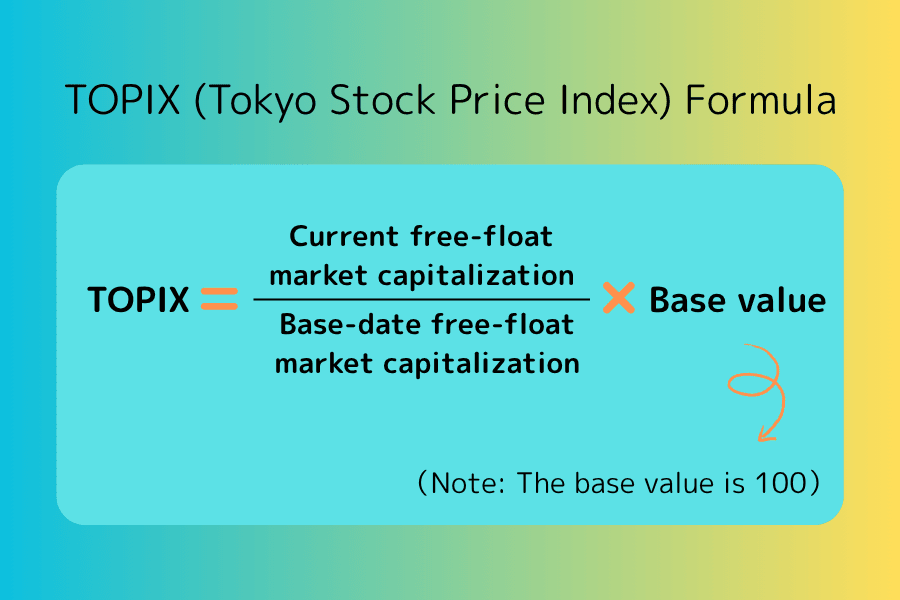
TOPIX = (Current aggregate free-float market cap of constituents / Base market cap) × 100
The index uses a free-float market-cap weighting that counts only shares genuinely available for trading, excluding strategic holdings by major shareholders, government stakes, and similar non-circulating stock. This makes TOPIX a more accurate representation of tradable market value.
In contrast to the price-weighted Nikkei 225 (JPN225), TOPIX's market-cap weighting gives mega-caps like Toyota (market cap roughly 40 trillion yen) a dominant influence on the index, rather than allowing high-priced stocks such as Fast Retailing to steer the benchmark as they do in JPN225.
Key Differences Between TOPIX and Nikkei 225 (JPN225)
TOPIX and JPN225 are both flagship Japanese equity indices, but their structural differences mean they can perform very differently across market environments.
| Comparison | TOPIX | JPN225 (Nikkei 225) |
|---|---|---|
| Number of Constituents | ~2,100 | 225 |
| Weighting Method | Free-float market cap | Price-weighted (stock-price-divisor method) |
| Coverage | All Prime Market listings | 225 names curated by the editorial committee |
| Sector Representation | Balanced across industries | Skewed toward high-priced sectors (semiconductors, retail) |
| Largest Weight | Toyota ~3–4% | Fast Retailing ~10–11% |
| Best For | Observing the Japanese economy as a whole | Tracking large, high-profile blue chips |
| BOJ ETF Purchase Focus | Primary target | Secondary target |
| Titan FX Symbol | TOPIX | JPN225 |
When TOPIX and JPN225 Diverge
- Financial-sector-led rallies: Rising BOJ rate-hike expectations push bank stocks higher → TOPIX outperforms JPN225 (banks carry heavy market-cap weight in TOPIX but low price weight in JPN225).
- Surges in a handful of high-priced names: Single-day spikes in Fast Retailing or Tokyo Electron → JPN225 outperforms TOPIX (price weighting amplifies high-priced stocks).
- Broad-based rebounds: Economy-wide recoveries lift mid- and small-cap names → TOPIX outperforms JPN225 (TOPIX holds many more mid-sized companies).
For traders, monitoring the TOPIX/JPN225 ratio offers a read on whether capital is flowing into value-oriented large caps (bullish for TOPIX) or concentrating in a few growth-oriented, high-priced names (bullish for JPN225).
Major Constituents and Sector Breakdown
Although TOPIX includes more than 2,000 companies, the top ten names still account for roughly 20–25% of total weight and exert meaningful influence on index moves. Below are the leading constituents as of 2025.
| Rank | Company | Code | Industry | Weight (approx.) |
|---|---|---|---|---|
| 1 | Toyota Motor | 7203 | Automobiles | ~3.5% |
| 2 | Mitsubishi UFJ Financial | 8306 | Banking | ~2.5% |
| 3 | Sony Group | 6758 | Electronics / Entertainment | ~2.2% |
| 4 | Hitachi | 6501 | Diversified Electronics | ~2.0% |
| 5 | Keyence | 6861 | Industrial Sensors | ~1.8% |
| 6 | Tokyo Electron | 8035 | Semiconductor Equipment | ~1.7% |
| 7 | Sumitomo Mitsui Financial | 8316 | Banking | ~1.6% |
| 8 | Mitsubishi Corporation | 8058 | Trading House | ~1.5% |
| 9 | Recruit Holdings | 6098 | HR / IT | ~1.4% |
| 10 | Shin-Etsu Chemical | 4063 | Chemicals | ~1.3% |
Unlike NAS100, where the top ten names collectively exceed 50% of index weight, TOPIX's top ten sit around 20%, with far more balanced sector exposure. That means single-company setbacks have a comparatively muted impact on TOPIX, while the index reflects the macro economy much more closely.
Sector Distribution
| Sector | Share (approx.) | Representative Companies |
|---|---|---|
| Electronics / Precision Machinery | ~17% | Sony, Hitachi, Keyence, Tokyo Electron |
| Banking / Financials | ~13% | Mitsubishi UFJ, Sumitomo Mitsui, Mizuho |
| Automobiles / Transport Equipment | ~10% | Toyota, Honda, SUBARU |
| Information / Telecom | ~9% | NTT, SoftBank, Recruit |
| Chemicals / Pharmaceuticals | ~8% | Shin-Etsu Chemical, Takeda, Daiichi Sankyo |
| Trading Houses | ~6% | Mitsubishi Corp., Itochu, Mitsui & Co. |
| Machinery | ~5% | Komatsu, SMC, Fanuc |
| Others (Real Estate, Construction, Food, etc.) | ~32% | Mitsui Fudosan, Daiwa House, Meiji HD |
The distribution highlights Japan's dual pillars of manufacturing and financial services. Notably, the weight of bank stocks in TOPIX is far higher than in JPN225, which makes TOPIX significantly more sensitive to Bank of Japan monetary policy.
Recent Performance (2020–2025)
2020: Pandemic Shock and Recovery (Start 1,721 → End 1,804, +4.8%)
The COVID-19 outbreak triggered a global sell-off in March 2020, dragging TOPIX down to 1,236—a decline of nearly 30%. The BOJ responded by raising its annual ETF purchase cap to 12 trillion yen and rolling out special lending facilities. With global central banks loosening policy in concert, TOPIX recovered through the second half and ended the year up around 4.8%.
2021: Vaccination and Economic Reopening (+10.4%)
Vaccine distribution revived economic reopening expectations, helping exporters benefit from a weaker yen and rebounding global demand. Heavyweights such as Toyota and Sony posted strong gains, pushing TOPIX near the 2,000 level. Although the Omicron variant and supply-chain bottlenecks weighed on sentiment late in the year, TOPIX still closed roughly 10.4% higher.
2022: The Double-Edged Sword of a Weak Yen (-5.1%)
Aggressive Federal Reserve rate hikes widened US–Japan yield differentials, sending USD/JPY briefly above 150. A weaker yen is theoretically good for exporters, but concerns about a global slowdown and imported inflation offset the FX tailwind. TOPIX finished the year about 5.1% lower—still far better than NAS100's -33%—showing the defensive power of broad diversification.
2023: Valuation Rerating Fueled by TSE Reform (+25.1%)
2023 marked a turning point for TOPIX. The Tokyo Stock Exchange issued improvement requests to companies trading below book value (PBR < 1), accelerating large-scale corporate governance reform and shareholder return increases. Warren Buffett's expanded positions in Japan's five largest trading houses attracted additional global capital. Foreign net buying of Japanese equities hit a record high, lifting TOPIX by about 25.1% for the year.
2024: Normalization of BOJ Policy (+15.2%)
In March 2024, the BOJ ended its negative interest rate policy for the first time in 17 years. Bank stocks surged on widening margins and became the main engine of TOPIX's advance. Semiconductor-equipment names also rallied in sync with the global AI investment boom. Despite an early-August plunge driven by the unwinding of yen-carry trades (with a single-day drop exceeding 6%), TOPIX still ended the year up about 15.2%.
2025 YTD: Tariff Shocks and Policy Uncertainty
TOPIX extended its rally into early 2025, briefly setting all-time highs. However, repeated shifts in US tariff policy pressured Japan's auto industry, dragging on heavyweights such as Toyota. At the same time, expectations for further BOJ hikes intertwined with yen strength to amplify market volatility. The deepening of governance reforms and long-term reallocation toward Japan by global investors remain supportive factors.
Main Price Drivers
Bank of Japan Monetary Policy
The BOJ monetary policy meeting is the single most influential factor for TOPIX. The BOJ's normalization process that began in 2024 affects sectors very differently:
- Rate hikes boost banks: Wider net-interest margins directly lift profitability, making Mitsubishi UFJ, Sumitomo Mitsui, and other financials the main drivers of TOPIX gains.
- Rate hikes pressure growth stocks: High-valuation tech and growth names face upward pressure on discount rates.
- BOJ's ETF holdings matter: The BOJ holds roughly 37 trillion yen in ETFs (mainly TOPIX-type). The pace at which it unwinds these positions has meaningful supply-demand implications.
Subtle shifts in wording at the BOJ Governor Kazuo Ueda's regular press conferences and in the BOJ monetary policy meeting minutes can trigger immediate moves in TOPIX.
Yen Exchange Rate
The relationship between USD/JPY and TOPIX is layered:
- Yen depreciation (USD/JPY rising): Favors exporters (autos, electronics) but raises import costs (energy, raw materials).
- Yen appreciation (USD/JPY falling): Squeezes exporter profits but eases imported inflation.
- Rapid FX swings: Regardless of direction, extreme volatility itself adds uncertainty to corporate FX results, typically pressuring TOPIX.
Automakers such as Toyota are especially sensitive to the yen: each one-yen depreciation is estimated to add around 50 billion yen to Toyota's annual operating profit.
Japanese Economic Indicators
The following data points shape market expectations for Japanese corporate earnings:
- National Consumer Price Index (CPI): Key input for the BOJ's rate-hike cadence.
- BOJ Tankan Survey: Quarterly business sentiment survey, a major reference for BOJ decisions.
- Industrial Production: Manufacturing health gauge.
- Unemployment Rate: Signals labor-market tightness.
- Retail Sales: Gauges domestic consumption momentum.
Use Titan FX's Economic Calendar to track release schedules and consensus forecasts in real time.
Global Economy and Geopolitics
- US economy and trade policy: Tariff changes directly affect Japanese auto and semiconductor exports, while US recession risk depresses global risk appetite.
- China's economic conditions: As one of Japan's largest trading partners, a Chinese slowdown materially impacts trading houses, chemicals, and machinery.
- Semiconductor cycle: Constituents like Tokyo Electron and Shin-Etsu Chemical move in tight synchrony with the global semiconductor capex cycle.
- Oil prices: Heavy energy-import dependence means rising oil prices add to corporate costs and weigh on the trade balance.
Corporate Governance Reform and Foreign Flows
TSE reform has steadily pushed Japanese corporates to improve capital efficiency since 2023:
- Companies with PBR < 1 are asked to publish improvement plans, prompting large-scale buybacks and higher payouts.
- Unwinding of cross-shareholdings has increased free-float supply.
- Foreign institutional investors' net buying/selling is a key variable in TOPIX's short- to medium-term trend.
Practical Trading Strategies
Institutional Positioning (CFTC)
The weekly CFTC Commitment of Traders report for Nikkei-related futures records how large speculators are positioned in Japan's equity-index futures. Although the report directly covers Nikkei 225 futures, the high correlation between TOPIX and JPN225 (typically above 0.95) makes the same data useful for gauging overall Japanese equity direction.
- Persistent growth in net long positions signals foreign bullishness on Japan's medium-term outlook.
- A roll-off from extreme net long levels can foreshadow a short-term pullback.
- Combining COT data with yen moves helps identify foreign capital flows.
Technical Analysis Tools (Titan FX Proprietary Tools)
Titan FX offers a suite of tools to help traders read TOPIX technicals:
- Support & Resistance: Confirm key TOPIX levels and judge breakouts or pullbacks.
- Order / Position Info: Observe the distribution of resting orders and long-short ratios.
- Trend Analysis: Determine whether TOPIX is in an uptrend, downtrend, or range.
- RSI Analysis: Identify overbought/oversold conditions to time reversals.
- Volatility Heatmap: Understand TOPIX's volatility profile by trading session.
- Percentage Change Ranking: Compare TOPIX's intraday move against other indices.
Concrete Trading Approaches
BOJ Policy Trading
BOJ monetary policy meetings (eight per year) are TOPIX's most critical scheduled events. Volatility tends to concentrate in the 30–60 minutes following the announcement. Key points:
- Watch yen implied volatility ahead of the meeting; unusually elevated IV argues for smaller positions.
- If a hike exceeds expectations, banks typically lead the rally—look for TOPIX's relative strength.
- If the BOJ holds rates but signals a dovish tone, yen weakness can power an exporter rebound.
TOPIX vs. JPN225 Relative-Value Trades
Use the structural differences between the two indices for pair trades:
- When financials are expected to rally (for example, during a hiking cycle): long TOPIX / short JPN225.
- When a few high-priced tech leaders are expected to lead (for example, on a semiconductor-order surge): long JPN225 / short TOPIX.
- These pair strategies hedge away systemic Japan-equity risk and focus on harvesting structural alpha.
Event-Driven Trading
- Earnings season (typically late January, April, July, and October): TOPIX constituents release results in clusters—watch aggregate earnings growth and guidance revisions.
- Shunto wage negotiations (March): Bigger-than-expected wage hikes → higher inflation expectations → rising BOJ rate-hike odds → bullish for banks.
- Weekly foreign flows data (Thursdays): Multi-week stretches of large net buying tend to confirm trend continuation.
How to Trade TOPIX at Titan FX
On the Titan FX platform, TOPIX trades as a CFD under the ticker TOPIX. You can also trade it directly in your browser via WebTrader.
Step 1: Log In to Your Trading Account
Open a Titan FX trading account (Zero Standard or Zero Blade), complete funding, download MT4 or MT5, and log in with your account number and password.
Step 2: Add TOPIX to Market Watch
Right-click the "Market Watch" window, choose "Symbols," expand "Indices," find TOPIX, and double-click to add it to your watch list.
Step 3: Start Trading
Double-click the TOPIX quote or open its chart to access the order ticket. Enter your lot size (minimum 0.1 lots), select Buy or Sell, set stop-loss and take-profit levels, and place the order.
Trading Hours (MT4/MT5 server time GMT+3):
| Session | Winter (GMT+2) | Summer (GMT+3) |
|---|---|---|
| Main Session | 01:00 – 06:30 | 02:00 – 07:30 |
| Eastern Time (Summer) | — | 19:00 – 00:30 |
TOPIX CFD hours primarily mirror the Tokyo cash session (Tokyo time 9:00–15:30). For the latest trading conditions and spreads, see the official page.
Start Trading TOPIX
Trade TOPIX CFDs at Titan FX with leverage up to 500x, tight spreads, and full long/short flexibility. Zero Standard and Zero Blade accounts both support index CFDs (Zero Micro does not support index CFDs).
Key Points for Beginners
Leverage and Risk Management
Titan FX offers leverage up to 500x on Zero Standard and Zero Blade accounts. Daily TOPIX volatility is typically lower than NAS100, but single-day swings can expand significantly around BOJ meetings or when foreign investors rebalance aggressively.
- Cap per-trade risk at 1–2% of account equity.
- Reduce positions ahead of BOJ meetings to avoid outsized losses from sudden moves.
- Use Titan FX's Margin Calculator to size positions accurately.
TOPIX and the Yen
When trading TOPIX, always monitor USD/JPY. Rapid yen appreciation often coincides with TOPIX weakness (compressed exporter profits), whereas sharp yen depreciation can push TOPIX higher (stronger export competitiveness). For non-JPY accounts, TOPIX CFDs also involve FX conversion P&L.
Japan's Unique Trading Session
TOPIX activity is concentrated in the Tokyo session (roughly Eastern Time 20:00–01:30 in summer), with virtually no overlap with US or European markets. This means:
- Overnight moves in US equities tend to show up as opening gaps on TOPIX at the Tokyo open.
- Major Japanese data prints are usually released at 18:30 or 19:50 Eastern Time, which can trigger sharp moves around the open.
- Trading volumes drop noticeably around the lunch break (Tokyo time 11:30–12:30).
The Impact of BOJ Meetings
BOJ meeting decisions are typically released around Tokyo noon (timing is not fixed), followed by the Governor's press conference, which further shapes market expectations. The yen-carry unwind in early August 2024 demonstrated how an unexpected BOJ move can spark cross-market contagion well beyond Japanese equities.
Frequently Asked Questions
Should I trade TOPIX or Nikkei 225 (JPN225)?
Both have merits. TOPIX covers more than 2,100 names with balanced sector exposure and suits traders looking to play Japan's broad economic recovery. JPN225 contains 225 large-caps with higher volatility and is better for short-term trading tied to specific industries such as semiconductors. When banks are the rally leaders during hiking cycles, TOPIX usually outperforms JPN225.
Are BOJ rate hikes bullish or bearish for TOPIX?
It depends on the pace and size of hikes. Gradual moves (e.g., 25 bps per step) are typically bullish for TOPIX because expanded bank margins more than offset valuation pressure on growth stocks. Sharper or faster hikes, however, can trigger yen-carry unwinds similar to August 2024, causing TOPIX to plunge.
How does the CFTC COT report help with TOPIX trading?
The CFTC report tracks Nikkei 225 futures positioning directly, but because TOPIX and JPN225 correlate extremely tightly, shifts in institutional net exposure in the Nikkei COT data also inform TOPIX's medium-term direction. When institutional net longs roll over from extreme highs, be alert to correction risk.
What are TOPIX CFD trading hours?
TOPIX CFD hours primarily mirror the Tokyo cash session. In summer, they run roughly 19:00–00:30 Eastern Time. Unlike US indices, which have near-24-hour futures, TOPIX's trading window is relatively concentrated. For the latest hours, see the Titan FX Index CFD Conditions page.
What costs should I consider when trading TOPIX?
The main costs of CFD trading include spreads (bid-ask), overnight swaps, and any applicable commissions. For TOPIX spread levels and detailed trading conditions, check the Titan FX website. Overnight positions incur swap charges, which you can monitor via the Swap Calendar. Index CFDs may also involve dividend adjustments, debited or credited to your account when constituents go ex-dividend.
How will TSE reform affect TOPIX over the long term?
The TSE reform launched in 2023 requires companies with PBR below 1.0 to publish capital-efficiency improvement plans, prompting large-scale buybacks, higher dividends, and the unwinding of cross-shareholdings. Over time, these structural changes are expected to narrow Japanese equities' valuation discount and attract greater global allocation—providing durable support for TOPIX.
Summary
TOPIX is the most comprehensive benchmark of Japan's equity market. Its free-float market-cap weighting and 2,000-plus constituents make it the go-to gauge of overall economic health. Compared with JPN225's price-weighted structure, TOPIX more accurately reflects BOJ policy, financial-sector performance, and broad market sentiment.
Mastering the direction of BOJ policy, tracking the yen and corporate earnings, using CFTC positioning for medium-term bias, and combining technical tools to time entries and exits together form the core framework for trading TOPIX.
Leverage Titan FX's TOPIX live quote and chart page to stay on top of the market and apply the framework in this article to real trades.
Further Reading
Titan FX's financial-market research team. We cover a broad set of instruments — foreign exchange, commodities (crude oil, precious metals, agricultural products), equity indices, US equities, and digital assets — producing educational content for investors.
Primary Sources (by Category)
- Official index data: JPX — TOPIX, Japan Exchange Group (JPX)
- Concept & market data: Investopedia — TOPIX, Bank of Japan