

How to Read the Silver Price: Live Quotes, Drivers, and Ways to Invest

Silver occupies an unusual place in global markets. It sits alongside gold in the precious-metals family and behaves like a store of value in times of stress, yet more than half of annual demand comes from industry — electronics, solar panels, electric vehicles, and medical devices. When you follow the silver price, you are effectively tracking two markets at once: the flight-to-safety trade and the industrial cycle.
That split personality has real consequences for investors. Silver can rally hard when haven demand and industrial demand rise together, but it can also fall faster than gold when growth fears take hold. Understanding what is driving the quote on any given day is therefore the first step toward trading or investing in it sensibly.
This guide walks through how the silver price is quoted, where to check it live, the forces that move it, the gold-silver ratio, and how the main investment vehicles compare — so you can go from simply watching a number to acting on it with a clear framework.
- Silver trades as XAG/USD, priced in U.S. dollars per troy ounce.
- It is both a haven asset and a heavily used industrial metal.
- Prices move faster than gold thanks to lower liquidity and industrial demand.
- The gold-silver ratio helps gauge silver's relative value.
- CFDs, ETFs, futures, and physical bars each suit different investors.
1. How to Read the Silver Price: Live Quotes and Basics
The silver price is quoted internationally in U.S. dollars per troy ounce, and the global benchmark is the LBMA Silver Price. This benchmark fix is published twice each trading day — at 10:30 and 15:00 London time — and it feeds directly into the valuation of physical silver, silver futures, and silver ETFs around the world.
Silver belongs to the same precious-metals family as gold, but its industrial side is far more pronounced. It is consumed in large volumes across electronics, solar photovoltaics, automotive electronics, and medical equipment, which means the silver price is pulled by industrial demand and investment demand at the same time.
Because of this dual nature, silver typically swings more violently than gold. Those larger moves are exactly what draw many traders to the market, as sharper price ranges create more opportunities — and more risk — over short time frames.
2. Three Ways to Check the Live Silver Price
Checking the live silver price is the first practical step before you invest. Today there are several reliable ways to pull an up-to-date quote.
Method 1: International Exchange Prices
The core sources are the world's leading precious-metals venues:
- The London Bullion Market Association (LBMA)
- The COMEX division of the CME (New York)
These markets set the global benchmark and are the most authoritative reference point for the silver price.
Method 2: Market-Data Sites, Brokers, and CFD Platforms
Most investors read the live price through financial data services, such as:
- Commodity quote websites
- Brokerage trading platforms
- CFD platforms
Small price differences between platforms are normal and come mostly from liquidity and spread settings. On Titan FX you can view the dollar-denominated silver CFD price in real time and watch the market quote move alongside it, which makes it easy to stay on top of the trend.
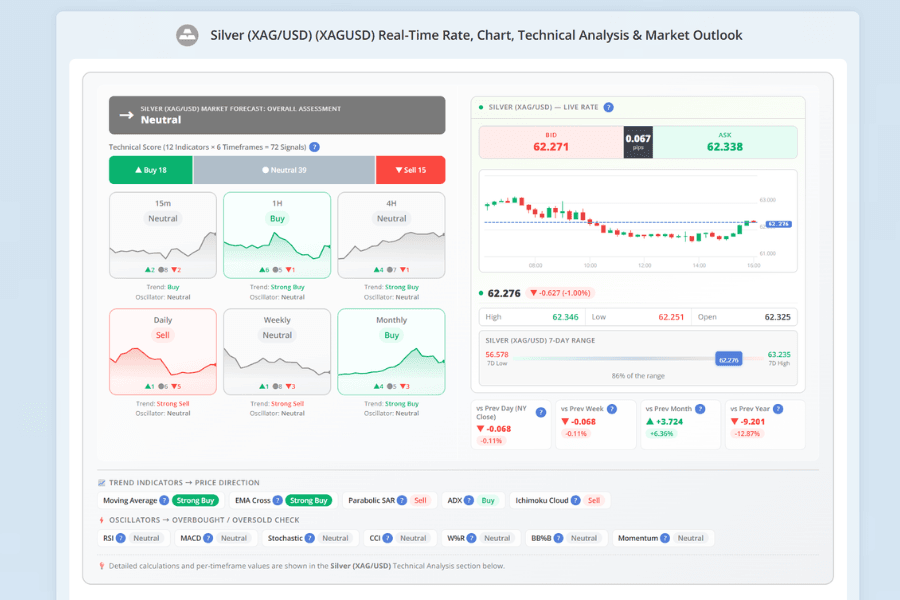
Silver (XAG/USD) live quotes and chart
Method 3: Spot Price vs. Futures Price
The silver price comes in two main forms:
- Spot price: the price for immediate delivery
- Futures price: the price for delivery at a future date
The gap between the two reflects how the market is pricing future supply and demand.
3. What Moves the Silver Price
The silver price is driven by several forces working together. The following are the most important.
Industrial Demand
Silver is used heavily in electronics, solar panels, and electric vehicles. When these industries are expanding, demand for silver rises and prices tend to climb.
Investment and Haven Demand
When the economy looks uncertain or inflation expectations rise, investors treat silver as one of their safe-haven assets, and that flow of money pushes the price up.
The U.S. Dollar and Interest Rates
Because silver is priced in dollars, a stronger dollar usually weighs on the silver price, while a weaker dollar tends to lift it. Higher interest rates also raise the opportunity cost of holding a non-yielding metal like silver.
Supply-Side Factors
Silver mine supply is shaped by mining costs, policy in major producing countries, and labor relations. When the supply side shifts, the price often moves sharply.
The 2026 Silver Surge
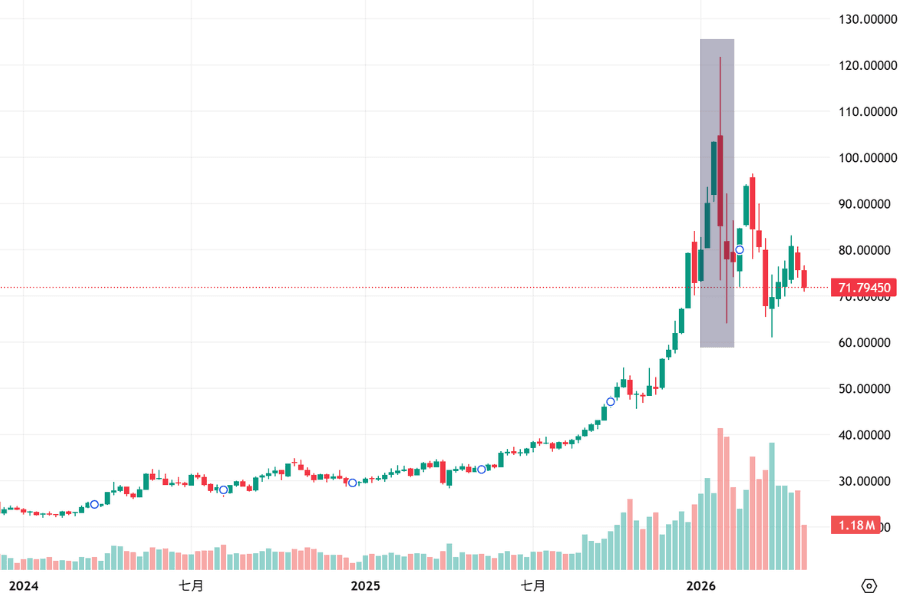
In January 2026, silver saw an extraordinary move, spiking to an all-time high of roughly $121 per ounce on January 29.
The pressure showed up clearly in the physical market. On COMEX, roughly a quarter of registered inventory — about 26%, or some 33.45 million ounces — was withdrawn for physical delivery in a single week in mid-January. That drawdown pushed the market into backwardation, a classic signal of a physical squeeze in which nearby supply is scarcer than deferred supply.
Several forces drove the surge at once. Industrial demand tied to AI computing and clean energy kept expanding, tighter export controls in several key supplier regions constrained the supply side, and central-bank accumulation added to the pull. Together, these shifts reshaped silver's identity — moving it away from a metal valued mainly for its haven appeal and toward a strategic industrial commodity.
4. The Gold-Silver Ratio
The gold-silver ratio is simply the gold price divided by the silver price, and it measures the relative value of the two metals.
Gold-Silver Ratio = Gold Price ÷ Silver Price
If the ratio is 80, it means one ounce of gold costs the same as 80 ounces of silver.
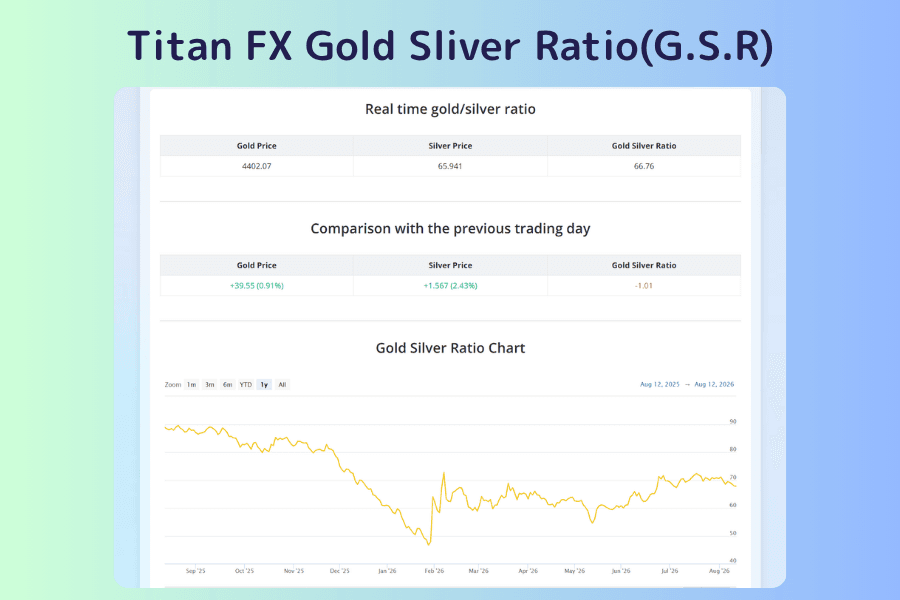
A high ratio suggests silver is relatively cheap compared with gold, while a low ratio suggests silver is relatively expensive. Historically the ratio has spent long stretches between roughly 40 and 80, and many investors use it as one reference point for judging whether silver looks undervalued or overvalued.
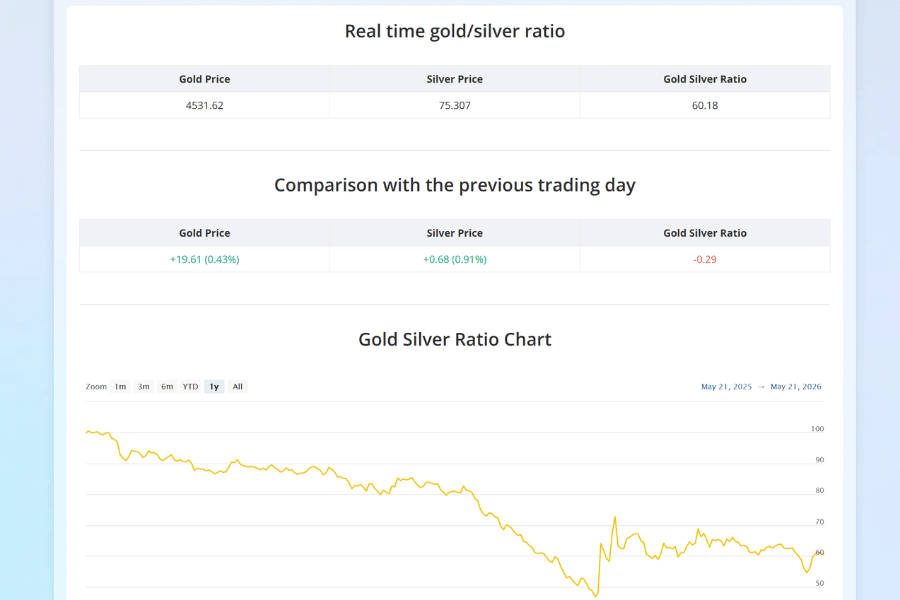
Titan FX gold-silver ratio live price and chart
5. Comparing Ways to Invest in Silver
The main ways to invest in silver are physical silver, silver ETFs, silver futures, and silver CFDs. Each suits a different type of investor.
| Investment Vehicle | Characteristics | Best Suited For |
|---|---|---|
| Physical Silver | Direct ownership, no leverage | Long-term store-of-value investors |
| Silver ETF | High liquidity, easy to trade | General investors |
| Silver Futures | Leveraged, high volatility | Advanced traders |
| CFD | Long or short, highly flexible | Short-term traders |
Silver CFDs (contracts for difference) are now the mainstream way to trade silver online. Titan FX offers a silver CFD (symbol XAG/USD) with two-way trading — you can go long or short — plus leverage and no physical delivery. Traders only need to post a modest margin to gain exposure to a larger position.
Trade Silver CFDs with Titan FX
Titan FX offers silver CFDs (XAG/USD) with up to 500:1 leverage, tight spreads, and the flexibility to go long or short without holding physical silver. Micro accounts: up to 1,000:1.
6. Silver Price FAQ
Q1. Why does silver sometimes fall harder than gold?
Silver has lower market liquidity than gold and a large industrial component. When the market shifts into full risk-off mode ("cash is king") or fears a recession that would stall industrial activity, investors tend to sell silver first, so it can drop more steeply than gold.
Q2. Is now a good time to invest in silver?
There is no universally right or wrong moment. Timing depends on the current economic backdrop, inflation expectations, and the gold-silver ratio, and it should be weighed against your own goals and risk tolerance rather than a single indicator.
Q3. Does a high gold-silver ratio mean silver is undervalued?
A high ratio means silver is cheap relative to gold, which is often read as a possible sign that silver is undervalued. It is only one signal, though, and should be combined with other factors before drawing a conclusion.
Q4. When is silver trading most active?
Silver is usually most active around the U.S. equity market open, when American economic data is released frequently, liquidity is deepest, and price swings are largest. This window is prime time for day traders and short-term traders.
7. Summary
The silver price is a key asset indicator shaped by both industrial demand and financial markets. From reading the live quote, to understanding the core drivers, to using the gold-silver ratio and choosing an investment vehicle, every link in that chain affects the quality of your decisions.
In practice, investors should first build a basic framework of "price source + driving factors + choice of vehicle," then gradually layer in the market environment and their own risk tolerance when deciding how to allocate.
Further Reading
Titan FX Trading Strategy Lab. We produce investor-education content covering forex, commodities (crude oil, precious metals, agricultural goods), stock indices, US equities, and digital assets.
Primary Sources (by category)
- Market & benchmark: LBMA silver price fix; COMEX (New York) silver futures and inventory data
- Industry & supply-demand: General analysis of silver demand from AI/clean-energy industries and supply-side shifts
- Investor education: Investor education from financial regulators on silver investing, the gold-silver ratio, and CFD risk