

Commodities
In the diverse asset universe of modern markets, commodities sit in a unique position—they combine "real-economy fundamentals" with "investable financial value." Commodity prices feed directly into energy supply, industrial production, and food costs, while also shaping inflation, currency moves, and overall portfolio performance.
Access has broadened too. Beyond traditional futures, retail and institutional investors now reach commodities through CFDs (Contracts for Difference), ETFs, and commodity funds, each with its own leverage and liquidity profile.
This guide walks through what commodities are, how they are classified, what moves their prices, and the practical ways traders participate—plus a clear-eyed view of the risk profile.
- The basics of commodities. Substitutability, standardization, and USD-denominated global pricing. Four main groups: energy, metals, agriculture, and livestock.
- Hard vs soft. Extracted resources (metals, energy) versus agricultural/livestock products (grains, coffee, cattle), with very different volatility drivers.
- Six price drivers. Supply-demand fundamentals, business cycle, geopolitics, USD strength, weather and climate, and financial liquidity.
- Main access methods. Physical, futures, ETFs, options, and CFDs—compared by leverage, liquidity, and storage costs.
- Titan FX commodity CFDs. Crude oil (up to 100x), natural gas and gasoline (up to 500x), gold (up to 1,000x; other precious metals 500x), and soft commodities (up to 50x) tradable from a single platform.
1. What Are Commodities? Definition and Concept
Commodities (sometimes called "primary goods" or "raw materials") are products that are traded in bulk, standardized for quality, and substitutable across producers.
They are not finished consumer goods—they are inputs that feed into manufacturing and production. Examples include crude oil, natural gas, gold, copper, wheat, and soybeans. Together they form the operational foundation of the global economy.
Three Defining Characteristics
- Substitutability. A barrel of oil or an ounce of gold of equivalent grade can be exchanged across markets regardless of origin.
- Standardization. Each commodity has clear quality specifications and trading units defined internationally—barrels of oil, troy ounces of gold, bushels of wheat.
- Global pricing. Most commodities trade in US dollars, so prices respond to global supply and demand, the US dollar trend, and geopolitical developments together.
Why Understanding Commodities Matters
Commodities are both production inputs and financial assets. That dual role—real-economy actor and tradable security—makes them important reading for producers, corporates, and investors alike.
High-Level Classification
By underlying source, commodities split into two broad groups:
- Hard commodities. Resources from extraction or refining—metals, energy, minerals. Examples: crude oil, natural gas, copper, aluminum, gold.
- Soft commodities. Products from agriculture and livestock—grains, cotton, coffee, sugar, livestock. Climate and seasonality drive much of the volatility here.
2. Commodity Categories and Representative Names
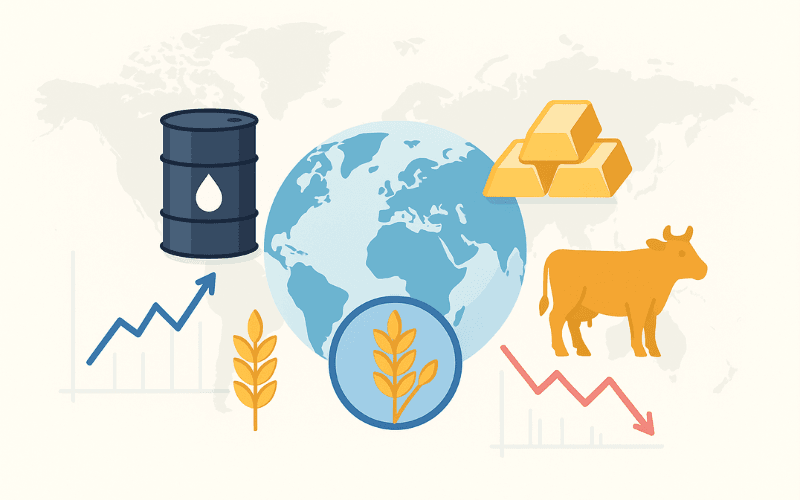
After the basics, the next step is to break commodities into concrete categories. By source and end-use, commodities fall into four groups: energy, metals, agriculture, and livestock/other raw materials.
Energy and metals come from extraction (hard commodities), while agriculture and livestock come from farming and ranching (soft commodities). Each group has its own representative names and its own pattern of how traders and investors actually use it.
A: Energy
Energy commodities are the lifeblood of the global economy and among the most actively traded products in the commodity universe. Their prices feed directly into inflation, transportation costs, and overall economic activity.
- Crude oil. The single largest commodity by trading volume. Key benchmarks include Brent and WTI (West Texas Intermediate). Prices respond not only to supply and demand but also strongly to geopolitics and OPEC/OPEC+ policy.
- Natural gas. Treated as a bridge fuel during the energy transition, demand driven by seasonality and energy policy choices.
- Coal. Receding in developed markets due to decarbonization, but still a meaningful energy source in parts of Asia.
Energy is high-volatility and policy-sensitive, which is why it appears so often in both short-term trading and macro hedging.
B: Metals
Metals straddle industrial and investment use, and are usually split into "precious metals" and "industrial metals."
- Precious metals (gold, silver and others). Store-of-value character, often treated as safe-haven assets. Demand tends to climb in inflation and market-stress regimes.
- Industrial metals (copper, aluminum, zinc, nickel). Closely tied to manufacturing and infrastructure activity—widely cited as a "barometer of the real economy."
For example, copper tends to rally as global growth picks up (more construction and electrification), while gold attracts haven flows when markets sell off or inflation surprises to the upside.
C: Agriculture / Soft Commodities
Agricultural commodities are the most weather- and season-sensitive group. Prices interact closely with weather, food supply chains, and geopolitics.
Common contracts include:
- Grains. Wheat, corn, soybeans—the staples of global food and feed.
- Softs. Coffee, cotton, sugar, cocoa. Heavily influenced by weather and producing-country policy.
- Agricultural futures. Widely used by food companies and traders as a hedging tool against input-cost volatility.
For investors, the agriculture group is volatile but tends to show low correlation with equity and metal markets—useful as a diversification block.
D: Livestock and Other Raw Materials
This group covers live cattle, lean hogs, dairy, natural rubber, and lumber. The aggregate share of trading volume is smaller than energy or metals, but the regional economic relevance is high.
For example, at the Chicago Mercantile Exchange (CME), live-cattle and lean-hog futures remain core hedging tools for the food industry.
Natural rubber and lumber, meanwhile, move closely with the automotive, construction, and furniture industries, and show clear cyclical patterns.
3. What Drives Commodity Prices?
After identifying the categories, the next question is what actually moves the prices. Whether you are looking at crude oil, gold, or wheat, the direction is rarely random—it is the resultant of several economic, policy, and market forces working at once. Below are the six dominant drivers.
Driver 1: Supply-Demand Fundamentals
Supply-demand balance is the foundation of every commodity price.
When supply expands (producer-country output increases) or demand softens (growth slows), prices tend to drop. The reverse—supply shortage or demand surge—lifts prices. When OPEC+ cuts output, global crude supply tightens and oil prices usually respond upward almost immediately.
Driver 2: Global Economy and the Business Cycle
Where the business cycle sits feeds directly into commodity demand.
In expansion phases, industrial activity lifts energy and metal demand and prices follow. In recession phases, manufacturing slows, commodity demand fades, and prices typically pull back. The 2008 financial crisis is a textbook example: copper and crude collapsed in short order.
Driver 3: Geopolitics and Policy Risk
Geopolitical events tend to be the catalysts behind sharp, short-term moves.
Wars, sanctions, trade frictions, and export bans can disrupt supply chains directly. Middle East conflict has repeatedly tightened oil supply concerns and sent prices spiking.
Driver 4: FX and the US Dollar
Because most commodities trade in dollars, the US dollar's trajectory feeds directly into price.
A stronger dollar raises the effective purchase cost for non-USD holders, dampening demand, and commodity prices tend to slip. A weaker dollar does the opposite. This is the structural reason gold and the dollar often show inverse correlation.
Driver 5: Weather and Natural Disasters
For agricultural commodities, weather is the decisive variable.
Droughts, floods, hurricanes, and heat waves damage output and logistics directly. South American drought, for instance, has historically cut soybean harvests and pushed global oilseed prices higher.
Driver 6: Financial Liquidity and Speculation
Modern commodity markets reflect not just physical supply and demand but also financial-flow dynamics.
When investment funds or speculative capital rush in, prices can rise sharply in a short window; when those flows reverse, the correction can be just as sharp. Sentiment and liquidity shifts are major drivers of short-term price action.
4. How to Trade Commodities: Access Methods
There are several practical ways to participate in commodity markets, each with its own risk, leverage, and cost profile. A side-by-side comparison:
| Access Method | Description | Characteristics and Risks | Suited For |
|---|---|---|---|
| Physical purchase | Buy gold bars, silver, physical oil or agricultural products outright | True ownership and store-of-value; storage and insurance costs make short-term trading impractical | Long-term store-of-value investors |
| Futures contracts | Standardized exchange contracts for future delivery | High leverage and volatility; the core tool for professional hedging and dedicated commodity trading | Experienced investors, corporate hedgers |
| Commodity ETFs / funds | Indirect exposure via index trackers or futures baskets | Strong liquidity, easier to handle than futures; no physical storage | Beginners and medium- to long-term investors |
| Options / other derivatives | Participation via the right (not obligation) to trade at a price | Flexible strategies, but require specialist knowledge | Advanced investors |
| CFDs (Contracts for Difference) | Margin-based products that mirror the price change directly | No underlying ownership; go long or short. Leverage is flexible but raises risk | Traders looking for flexible exposure to volatility |
In modern markets, CFDs have become one of the most flexible ways to access commodities. From a single platform you can trade energy, metals, and agricultural products without delivery constraints, and the leverage helps stretch capital efficiency.
5. Which Commodities Does Titan FX Offer?
Titan FX offers commodity CFDs across energy, precious metals, and soft commodities. Traders can go long or short with flexible leverage and no physical-delivery requirement, gaining direct exposure to global price action.
| Category | Instruments | Max Leverage |
|---|---|---|
| Energy | WTI Crude (XTI/USD), Brent Crude (XBR/USD), Natural Gas (XNG/USD), RBOB Gasoline | 500x |
| Precious Metals | Gold (XAU/USD, XAUEUR, XAUAUD, XAUCHF, XAUGBP, XAUJPY), Silver (XAG/USD, XAGEUR, XAGAUD), Platinum (XPT/USD), Palladium (XPD/USD) | 1000x |
| Soft Commodities | Cocoa, Arabica coffee, Robusta coffee, corn, cotton, heating oil, soybeans, white sugar, wheat, live cattle, copper | 50x |
Titan FX combines efficient execution with flexible leverage so traders can participate across energy, metals, and agricultural markets from a single platform.
6. Trading Commodities on Titan FX: Workflow
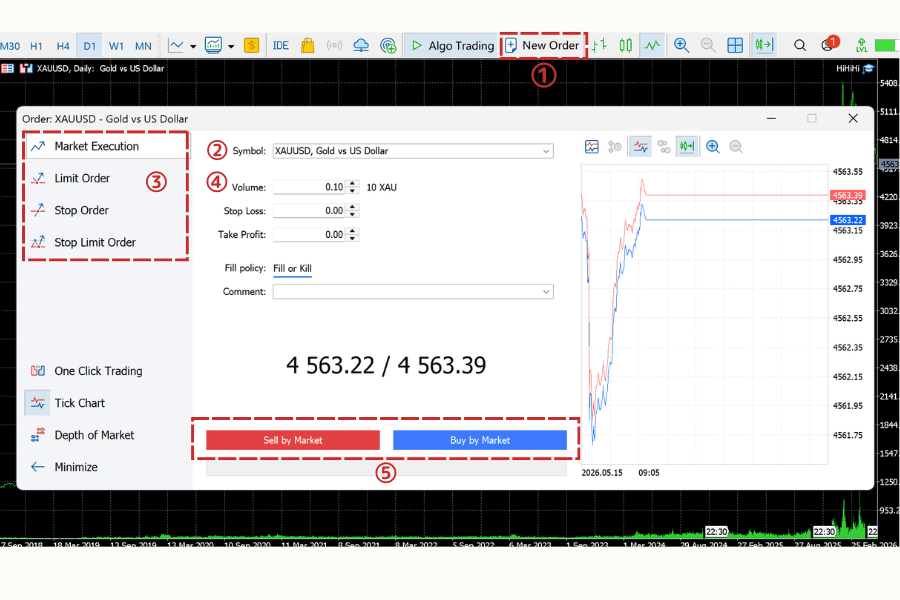
With the Titan FX product list and leverage settings clear, the next piece is the practical workflow.
The path from account opening to first trade is straightforward, and new users can complete the setup quickly.
| Step | Action |
|---|---|
| Step 1: Open an account | Go to the Titan FX account page, register with email and password. Email and SMS verification activates the account. |
| Step 2: Fund the account | Log into the client portal and choose a deposit method (credit card, e-wallet, bank transfer, etc.) and submit. |
| Step 3: Start trading | After funding clears, download and log in to MT4 or MT5. The minimum lot size is 0.01 (micro lot). |
7. FAQ: Commodity Trading
Q1. How are commodities different from FX and equities?
Commodities are anchored in real-economy fundamentals—their prices respond most directly to supply-demand balance, geopolitics, and weather. FX moves on relative currency value; equities move on company-level earnings and valuation multiples. The three asset classes are driven by different forces, which is exactly why combining them works as portfolio diversification.
Q2. Which commodity should a beginner start with?
Gold and WTI crude oil are the standard starting points. Both have deep liquidity, frequent news coverage, and clearer price-to-driver relationships, which makes them educational. From there, traders typically expand into silver, copper, and agricultural names as their grasp of category-specific drivers matures.
Q3. For retail investors, are futures or CFDs more practical?
For most retail traders, CFDs are the more realistic vehicle. Futures contract sizes are large and require expertise in delivery and margin mechanics. CFDs trade in micro lots, offer flexible leverage, and have no delivery exposure. Short-term tactical exposure usually suits CFDs; long-term industrial hedging usually suits futures.
Q4. Are commodities a good inflation hedge?
Often yes, but not universally. Gold has historically rallied in inflation regimes; copper and crude can also lift during inflation acceleration. That said, monetary tightening cycles or growth slowdowns can override the relationship and drag commodities lower. Best treated as one element of an inflation-aware portfolio, not a guaranteed hedge.
Q5. How should I manage risk in commodity trading?
Three layers usually work in combination. Position size: leverage in CFDs amplifies both gains and losses, so capping maximum loss per trade at 1–2% of account equity is a standard discipline. Stop-loss: essential for high-volatility categories such as energy and agricultural products. Diversification: rather than concentrating in one category, spreading across several commodities benefits from the low cross-category correlation.
8. Summary
Commodities form a critical bridge between the real economy and financial markets. They can act as an inflation hedge and a diversifier, but the volatility they bring also makes them demanding to trade.
For investors, understanding the demand-supply logic and price character of each category—and matching that to the right trading method and risk framework—is more important than chasing short-term returns.
Whether you choose ETFs, futures, or CFDs, the consistent ingredient is a clear read on how the market actually works. With that in place, commodities can become a steady, productive allocation in a long-term portfolio.
Open a Titan FX AccountFurther Reading
- Crude oil CFDs (WTI and Brent): basics for traders
- Gold CFD trading basics
- Precious metals primer: gold, silver, platinum, palladium
- CFDs (Contracts for Difference): how they work and their risks
- Futures trading basics: mechanics, expiries, rollover
Titan FX Research and Review Team — covering forex (FX), commodities (oil, precious metals, agricultural products), stock indices, US equities, and crypto assets, producing educational content for retail and institutional investors.
Primary Sources by Category
- Official data and regulators: U.S. Energy Information Administration (EIA); International Energy Agency (IEA); OPEC Monthly Oil Market Report; USDA World Agricultural Supply and Demand Estimates (WASDE); World Gold Council; London Bullion Market Association (LBMA).
- Market data and liquidity: Bloomberg Commodities; Reuters; CME Group; ICE Futures; Shanghai Futures Exchange (SHFE); World Federation of Exchanges (WFE).
- Academic research: Hilary Till and Joseph Eagleeye, "Intelligent Commodity Investing"; Helyette Geman, "Commodities and Commodity Derivatives"; Robert J. Gordon (commodity and macro chapters).
- Industry and third-party references: Investopedia (Commodity); Vanguard Research (commodity exposure); BlackRock iShares (commodity ETFs); Titan FX Research commodity trading guides.