

CME Group
CME Group is one of the most influential derivatives exchanges in the world. With its diversified product offerings, highly efficient electronic trading systems, and rigorous risk management framework, CME Group serves as a premier marketplace for institutional investors, professional traders, and retail participants alike.
This article provides a comprehensive overview of CME Group's history, its four core exchanges, trading platform architecture, technology tools, and practical applications for investors. Use this guide to understand how the world's largest derivatives marketplace shapes global financial markets and informs trading strategy.
- CME Group's role and positioning in global financial markets
- The historical evolution from agricultural exchange to leading derivatives platform
- Key features of the four core exchanges: CME, CBOT, NYMEX, and COMEX
- How CME Globex, CME Direct, and CME ClearPort serve different trading needs
- How the FedWatch Tool helps forecast Federal Reserve interest rate decisions
1. CME Group's Function and Global Role
CME Group is one of the most significant derivatives exchanges in global finance. Its core function is to provide futures and options trading services that enable investors to engage in price discovery and risk management. As a cross-asset trading hub, CME Group offers deep liquidity not only to financial institutions and professional traders, but increasingly to retail investors worldwide.
CME Group's product range spans interest rates, equity indices, foreign exchange, energy, metals, and agricultural commodities. These instruments are tightly linked to global economic conditions, central bank policy, and inflation expectations. Investors use CME products to adjust asset allocations, hedge against price volatility, or take speculative positions.
In practice, CME Group products are embedded in the risk management models of asset management firms around the world. For example, the U.S. 10-Year Treasury Note futures are widely used to hedge interest rate risk, while WTI crude oil futures provide exposure to energy price trends. For Asia-based investors, the Nikkei 225 futures, U.S. Treasury futures, and USD/JPY futures are essential instruments for tracking global market movements.
CME Group also strengthens its international role through technology and data services. Its infrastructure supports 24-hour electronic trading, real-time market data, historical data access, and derivatives research platforms, ensuring high transparency and predictability across all trading activity.
2. History and Evolution of CME Group
CME Group's development reflects the broader trajectory of financial innovation in the United States and the rise of organized derivatives markets worldwide. From its origins as a 19th-century grain exchange, the organization has evolved into the world's leading futures and options trading platform. This transformation spans five major phases.
Phase 1: Origins as an Agricultural Exchange
In 1848, the Chicago Board of Trade (CBOT) was established to facilitate agricultural forward contracts, becoming the world's first organized futures market. This phase laid the groundwork for standardized contracts and margin-based clearing, institutionalizing risk management tools for the first time.
Phase 2: Expansion into Financial Derivatives
Beginning in the 1970s, CME entered the foreign currency and interest rate futures markets. In 1982, it launched the first equity index futures contract based on the S&P 500, marking the transition from commodity-only futures to financial asset coverage.
Phase 3: The Electronic Trading Era
In 1987, CME began developing CME Globex, its electronic trading platform, freeing investors from the constraints of floor trading hours. The 1997 launch of E-mini S&P 500 futures was a landmark product that dramatically improved global trading efficiency and accessibility.
Phase 4: Exchange Mergers and Cross-Asset Integration
Starting in 2007, CME progressively merged with CBOT, NYMEX, and COMEX, forming the unified CME Group brand. This consolidation created a single platform for trading commodities, energy, metals, and financial futures.
Phase 5: New Asset Classes and Sustainable Finance
In recent years, CME Group has actively expanded into ESG and digital asset markets. It launched Bitcoin and Ethereum futures, and partnered with European exchanges such as Eurex to strengthen its presence in cross-border trading and sustainable investment.
CME Group Timeline: Key Milestones
| Year | Event |
|---|---|
| 1848 | Chicago Board of Trade (CBOT) founded as the world's first futures exchange |
| 1865 | First grain futures trade executed; buyer-seller margin clearing system established |
| 1898 | Chicago Butter and Egg Board founded (renamed CME in 1919) |
| 1972 | CME launches financial futures on 7 foreign currencies |
| 1982 | CME introduces the first equity index futures: S&P 500 futures |
| 1987 | Development of CME Globex electronic trading platform begins |
| 1997 | E-mini S&P 500 futures launched as the first small-scale electronic futures |
| 2002 | CME goes public |
| 2007 | CME and CBOT merge to form CME Group |
| 2008 | NYMEX and COMEX integrated into CME Group |
| 2017 | Bitcoin futures trading begins |
| 2020 | Partnership with Eurex to expand European market operations |
| 2021 | Launch of ESG-related derivatives trading |
| 2022 | Ethereum futures launched, expanding cryptocurrency derivatives |
3. The Four Core Exchanges of CME Group
CME Group operates through the integration of four historically significant exchanges, creating a global derivatives trading system that covers multiple asset classes. Each exchange specializes in specific products and markets, providing professional, high-liquidity platforms to support hedging and asset allocation needs worldwide.
CME (Chicago Mercantile Exchange)
CME is the world's largest futures exchange, founded in 1898. Its primary trading products include agricultural commodities, foreign exchange, interest rates, and equity index futures.
CME offers products closely connected to Asian markets, including Nikkei 225 index futures and USD/JPY futures, giving global investors a broad selection. The CME Globex electronic trading system supports nearly 24-hour access to markets worldwide.
CBOT (Chicago Board of Trade)
CBOT is the oldest exchange in the United States, founded in 1848 and originally focused on grain trading.
Today, CBOT remains widely known for agricultural futures such as soybeans and corn, while also offering interest rate futures and equity index futures. As the birthplace of modern futures trading, CBOT holds a pivotal position in global market history.
NYMEX (New York Mercantile Exchange)
NYMEX is the world's largest energy and precious metals futures exchange, founded in 1882. Its major products include crude oil, natural gas, platinum, and palladium.
NYMEX's WTI crude oil futures serve as a critical global benchmark for oil prices and attract investors from every region. The exchange operates on a 24-hour trading cycle.
COMEX (Commodity Exchange Inc.)
COMEX was founded in 1933 and specializes in metal futures, with a particular focus on gold, silver, and copper.
COMEX gold futures are among the most closely watched contracts in the world and occupy a dominant position in global metal markets. Although COMEX is now part of NYMEX, it continues to operate under its own brand, providing highly liquid metal futures trading.
4. Key Features and Trading Platforms
The World's Largest Derivatives Exchange
CME Group is the world's largest derivatives exchange, with annual trading volume worth approximately USD 1 quadrillion. Its products span equity indices, foreign exchange, energy, agricultural commodities, and metals, making it a comprehensive platform for risk management and investment.
Advanced Trading Technology
CME Group leverages cutting-edge technology to deliver multiple electronic trading platforms, ensuring efficient and secure execution.
| Platform | Overview |
|---|---|
| CME Globex | Electronic trading system connecting to global exchanges nearly 24 hours a day |
| CME Direct | Unified management tool for futures, options, and block trades |
| CME ClearPort | Clearing and custody service for cross-asset OTC transactions |
| EBS | Electronic brokerage system for foreign exchange |
| BrokerTec | Fixed-income trading platform |
CME Globex
CME Globex is an electronic trading platform designed for futures and options. Co-developed by Reuters and CME Group, it is now used in over 150 countries. By partnering with major exchanges worldwide, CME Globex enables investors to access global markets on a near-24-hour basis.
CME Direct
CME Direct is a multi-function trading tool that allows users to manage CME Group's futures, options markets, and block trades from a single interface. It is known for fast execution, robust security, and high customizability. Mobile applications for iPhone and Android are also available for on-the-go trading.
CME ClearPort
CME ClearPort is a clearing services platform designed for the global over-the-counter (OTC) market, supporting clearing across different asset classes.
Since its launch in 2002, CME ClearPort has become a vital part of the global financial infrastructure, currently processing approximately 450,000 transactions daily with over 17,000 users, including financial institutions and brokers.
5. The CME FedWatch Tool
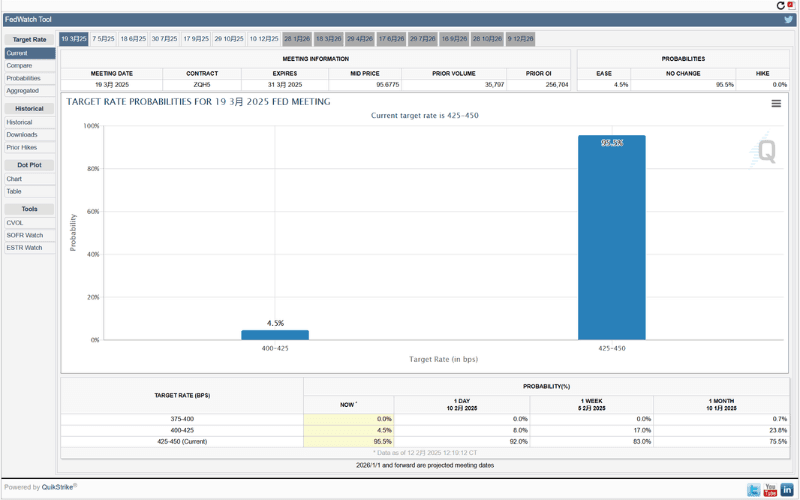
The FedWatch Tool is a proprietary instrument offered by CME Group, designed to forecast changes in the Federal Reserve's (Fed) interest rate policy.
The tool uses data from CME's interest rate futures market to calculate and display the market-implied probability of the Fed raising or lowering rates at upcoming meetings.
Investors use FedWatch to understand how the market is pricing future rate movements, enabling them to adjust trading strategies with particular attention to the impact on FX markets and equities. For analyzing U.S. economic conditions and the direction of monetary policy, FedWatch is an indispensable tool for risk management and investment decision-making.
6. Frequently Asked Questions
Q1: What expiration dates and settlement methods apply to CME Group products?
CME Group futures typically have monthly or quarterly expiration dates, with two settlement methods available: physical delivery and cash settlement. For example, gold futures can be settled by physical delivery, while equity index futures generally use cash settlement. Exact conditions depend on each contract's specifications.
Q2: How can I check margin requirements for CME Group products?
Investors can check initial and maintenance margin requirements in real time on CME Group's official Performance Bond Requirements page. Alternatively, simplified margin quotes are available through most broker platforms.
Q3: What partnerships does CME Group have with other international exchanges such as Eurex or SGX?
CME Group has established mutual clearing links and cross-exchange connectivity agreements with Eurex, SGX, and other exchanges, enabling global product distribution and extended timezone coverage. For example, CME Group's European government bond futures can trade extended hours through Eurex, broadening the participant base.
CME Group operates under the regulatory oversight of the CFTC (Commodity Futures Trading Commission). The Commitments of Traders (COT) reports published by the CFTC are a key resource for understanding positioning trends across CME Group's markets.
7. Conclusion: A Critical Platform for Global Asset Allocation
CME Group stands as the central hub of the global derivatives market, combining powerful trading infrastructure with a diverse product lineup and continuous leadership in financial innovation and risk management. Whether hedging against interest rate fluctuations, positioning for global equity trends, or tracking energy and metals prices, CME Group provides a highly transparent, stable, and liquid trading environment.
For investors worldwide, understanding CME Group's institutional design, technology platforms, and market role is essential for building effective asset allocation strategies and participating in the dynamics of international capital markets.
Further Reading
- What Is FOMC? Understanding Federal Reserve Policy Meetings
- Forex Trading Basics
- What Is the CFTC? Role of the Commodity Futures Trading Commission
- CFTC Commitments of Traders (COT) Report Dashboard
- U.S. Economic Indicators Calendar
Titan FX's financial market research and analysis team produces investor education content across a wide range of financial instruments, including foreign exchange (FX), commodities (crude oil, precious metals, and agricultural products), stock indices, U.S. equities, and crypto assets.
Primary Sources by Category
- Exchanges and market data: CME Group Official Website, CME FedWatch Tool, CME Group Performance Bond / Margin Requirements
- Regulators and oversight: CFTC (Commodity Futures Trading Commission), CME Group Rulebook
- Financial education and history: CME Group Education, Investopedia: CME Group