

Price-Weighted Index
When investing in equities, a stock index reflects the overall market trend better than individual moves.
Among the calculation methods, the price-weighted index is one of the earliest forms of stock index. Its hallmark: the higher a stock's price, the bigger its impact on the index, regardless of market cap. Though largely replaced by market-cap weighting in modern markets, the Dow Jones Industrial Average (DJIA) and Nikkei 225 remain classic indicators watched worldwide.
This article covers the definition, calculation, pros/cons, classic examples, and comparison with other weighting methods, presented neutrally.
- Definition: weighted by stock price - higher price means bigger index impact (cap-independent)
- Formula: price-weighted index = sum of constituent prices / divisor
- Divisor's role: offsets splits, mergers, dividends, constituent changes to keep continuity
- Classic examples: DJIA (since 1896), Nikkei 225, Dow Transportation/Utility averages
- Positioning: distortion-prone, now mostly replaced by cap weighting; useful as an auxiliary lens
1. What Is a Price-Weighted Index?
A price-weighted index is a stock-market index calculated from constituents' "stock price." In this framework, the higher the price, the greater the weight; a low-priced stock has limited impact even with a large market cap.
Unlike the cap-weighted method investors know, price weighting is closer to "summing constituent prices and adjusting by a divisor." It is easily swayed by high-priced stocks and limited in representativeness, but its historical value is very high - the most representative example is the Dow Jones Industrial Average (DJIA), a key U.S. equity barometer since 1896.
Further reading: What Is a Stock Market Index?
2. Calculation and Adjustment Mechanism
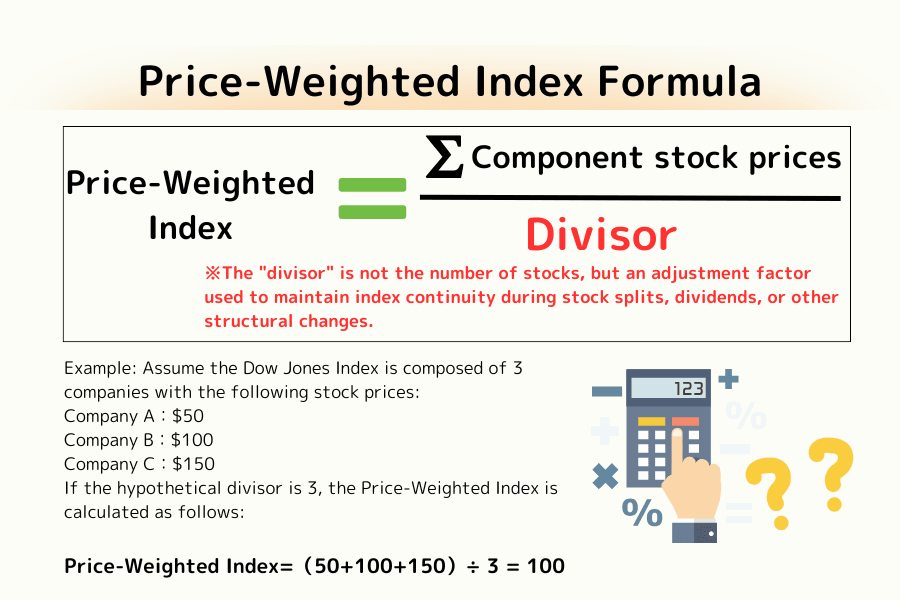
First, the stock price is the price at which an investor buys or sells one share, reflecting company value, supply/demand, and expectations. The core of a price-weighted index is using price as the weight, so higher-priced companies influence the index more.
Basic formula
Here all influence comes from "price itself," not market cap or capital size. The move of a single high-priced stock can clearly affect the whole index.
Role of the divisor
With stock splits, mergers, dividends, or constituent changes, a simple price sum would distort the index. So a divisor is introduced and adjusted to prevent breaks from technical events and keep continuity.
Worked example
Assume three constituents:
| Stock | Price (USD) |
|---|---|
| A | 50 |
| B | 100 |
| C | 150 |
Initial sum 300 USD; with a divisor of 3 the index is 100 points. If B does a "1-for-2" split to 50 USD, the sum falls to 250 USD. To keep continuity the divisor is adjusted to 2.5, so 250 / 2.5 = 100 points and the index is unaffected.
3. Pros and Cons
Intuitive and easy, yet debated in modern markets.
| Item | Pros | Cons |
|---|---|---|
| Method | Just sum prices and divide by the divisor | Cannot reflect real company size or capital weight |
| Responsiveness | Price moves reflect immediately, good for short-term watching | Easily distorted by a single high-priced stock |
| Representativeness | Long history, still has news value | Less representative than cap weighting |
| Application | Useful for watching price moves and sentiment | Not for performance evaluation or fund tracking |
4. Classic Price-Weighted Indices
Modern markets mostly use cap weighting, but several long-standing price-weighted indices still matter.
Dow Jones Industrial Average (DJIA)
The DJIA comprises 30 U.S. blue chips across finance, energy, healthcare, and technology. Being price-weighted, moves in higher-priced firms have a bigger impact on the index.
Nikkei 225
The Nikkei 225 is Japan's representative index of 225 large firms. Also price-weighted, high-priced stocks tend to drive its changes.
Dow Transportation/Utility averages
The Dow Jones Transportation (DJTA) and Utility (DJUA) averages are also price-weighted, reflecting U.S. transport and utility conditions.
5. Price-Weighted vs Cap-Weighted vs Equal-Weighted
Index calculation is not one-size-fits-all; the weighting method affects representativeness and interpretive value.
| Item | Price-weighted | Cap-weighted | Equal-weighted |
|---|---|---|---|
| Weight basis | Stock price | Company market cap | Same for each |
| Representativeness | Skews to high-priced | Reflects capital distribution | Reflects stocks evenly |
| Pros | Simple, long history | Consistent with market structure | Diversified, balanced |
| Cons | Distortion-prone | Large firms dominate | Differs from actual allocation |
6. Investor View: How to Read It
Rarely a benchmark in modern investing, but still an important reference for observing market structure and capital concentration. Because high-priced stocks have clear impact, it tends to reveal capital preference and sector focus - e.g., when pricey tech stocks rise, the DJIA may look strong even if other sectors are flat. So treat a price-weighted index as an auxiliary lens alongside a cap-weighted one; comparing the two helps judge whether the market is leader-driven or broadly rising.
7. Frequently Asked Questions (FAQ)
Q1. What is a price-weighted index?
A price-weighted index uses constituents' stock price as the weight - the higher the price, the bigger the impact on the index, regardless of market cap. Its value is the sum of constituent prices divided by a divisor, so it skews toward high-priced stocks.
Q2. What is the role of the divisor?
With stock splits, mergers, dividends, or constituent changes, a simple price sum would distort the index. Introducing and dynamically adjusting a divisor keeps the index continuous, with no break from corporate actions.
Q3. What are classic price-weighted indices?
The most representative are the Dow Jones Industrial Average (DJIA, since 1896) and the Nikkei 225; the Dow Jones Transportation (DJTA) and Utility (DJUA) averages also belong to the price-weighted family.
Q4. How does price-weighted differ from market-cap-weighted?
Price-weighted uses price and skews to high-priced stocks; market-cap-weighted uses company market value and better reflects capital distribution; equal-weighted gives every constituent the same weight. The three differ in representativeness and interpretive value.
Q5. How should investors view a price-weighted index?
It is rarely a performance benchmark today, but because high-priced stocks have clear impact it reveals capital preference and sector focus. Use it as an auxiliary lens alongside a market-cap index, comparing the two to judge whether the market is leader-driven or broadly rising.
8. Conclusion
A price-weighted index is no longer mainstream but retains some reference value. Because high-priced stocks carry more influence, it shows which sectors or stocks capital concentrates in, making it a useful auxiliary tool for watching sentiment and price change. For investors, understanding how it works helps when reading historical indicators like the DJIA or Nikkei 225, grasping their structural differences and limits. In modern markets, the market-cap-weighted index is the mainstream measure, reflecting economic reality and capital flow more accurately. Overall, the value of a price-weighted index lies in "historical meaning and sentiment observation," not performance evaluation.
Further Reading
- What Is a Stock Market Index?
- What Is a Market-Cap-Weighted Index?
- What Is an Equal-Weighted Index?
- Dow Jones Industrial Average (US30)
- Nikkei 225 (JPN225)
Titan FX's financial market research and analysis team produces investor education content across a wide range of financial instruments, including foreign exchange (FX), commodities (crude oil, precious metals, and agricultural products), stock indices, U.S. equities, and crypto assets.
Primary Sources by Category
- Index-calculation fundamentals: Investopedia / Corporate Finance Institute (Price-Weighted Index); Wikipedia (Price-weighted index)
- Methodology of representative indices: S&P Dow Jones Indices (general DJIA methodology framework); Nikkei Stock Average guidebook (Nikkei Inc.)
- Weighting comparison: general index-theory knowledge on price / market-cap / equal weighting