

CZK(Czech Koruna)
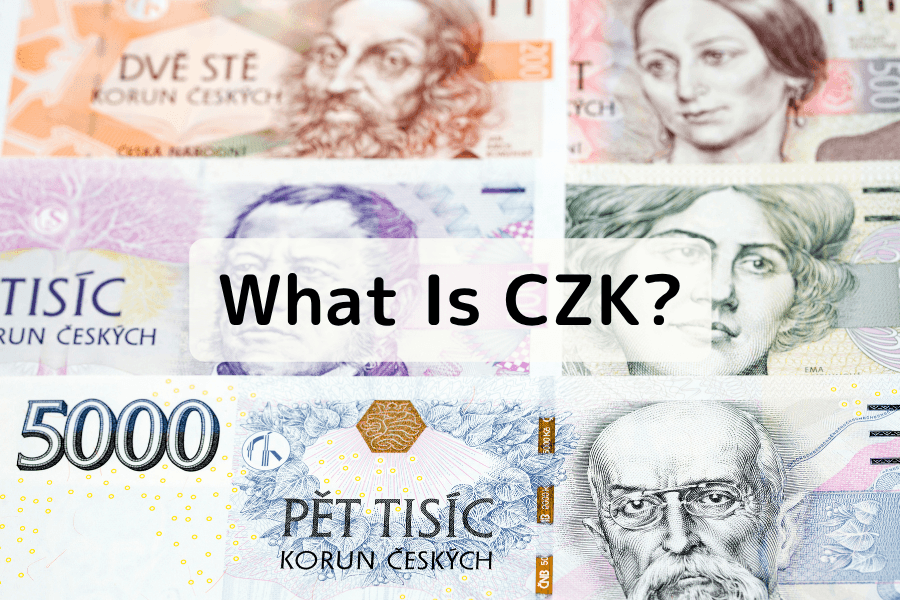
The Czech koruna (CZK) is the official currency of the Czech Republic and one of Central and Eastern Europe's key emerging-market currencies, closely influenced by the eurozone and the Czech National Bank's monetary policy.
For FX traders, the koruna is a relatively volatile, moderately liquid emerging-market currency, most often traded as EUR/CZK and USD/CZK, and especially sensitive to the rate differential and policy shifts between the European Central Bank (ECB) and the Czech National Bank (CNB).
This article covers the koruna's origins, key characteristics, exchange rate drivers, international position, and practical trading steps.
- The origins of CZK and its economic foundations
- Five key characteristics, from floating exchange rate to export dependence
- Main exchange rate drivers: CNB policy, eurozone trends, FDI
- CZK's international role and core economic indicators
- How to trade EUR/CZK step by step
1. History and Economic Foundation
The Czech koruna (CZK, symbol: Kc) was introduced on January 1, 1993, after Czechoslovakia dissolved into two independent states. It replaced the Czechoslovak koruna, with the Czech National Bank (CNB) responsible for issuance and monetary policy.
CZK initially operated under a fixed peg but transitioned to a floating exchange rate in the late 1990s. The Czech economy is anchored by automotive manufacturing (notably Skoda Auto), and this industrial base, combined with prudent monetary management, has kept CZK stable. Close EU trade ties cement the koruna's role as a key regional currency.
2. Key Characteristics
CZK exhibits several distinctive traits in the forex market.
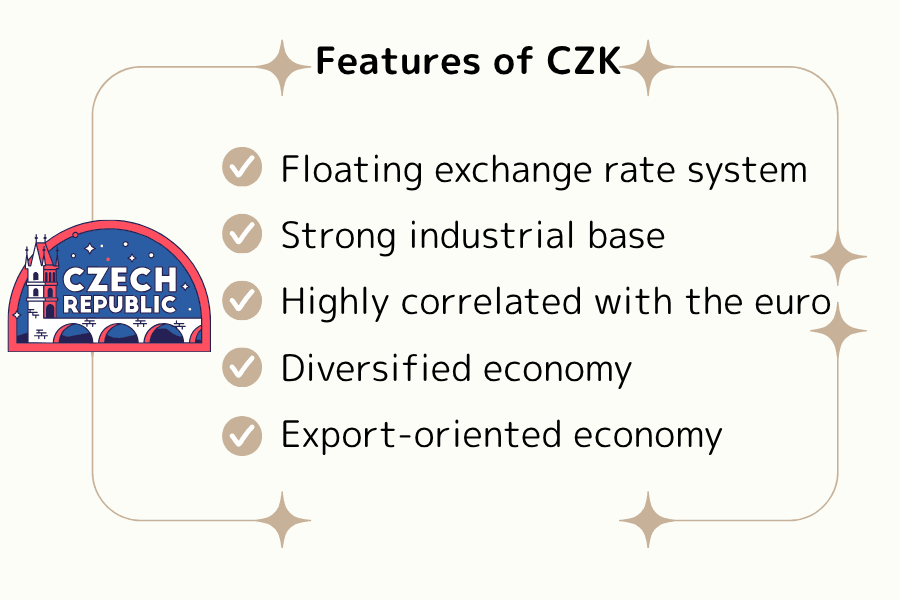
Characteristic 1: Floating Exchange Rate
Since the late 1990s, CZK has operated under a floating regime, with its value moving freely with market supply and demand. This gives CNB broader room for policy adjustment and reflects real-time market expectations more accurately than a fixed peg.
Characteristic 2: Robust Industrial Foundation
Czech industrial output, led by automotive manufacturing and precision engineering, is among the strongest in Central Europe. Manufacturers like Skoda Auto and TPCA drive exports and attract significant FDI. This gives CZK solid fundamental support, making it one of the more stable emerging European currencies.
Characteristic 3: High Correlation with the Euro
The Czech Republic is an EU member but has not adopted the euro. Its trade structure is heavily dependent on eurozone economies, particularly Germany. EUR/CZK volatility mirrors the euro's direction and Czech export strength, making this pair a key reference for traders.
Characteristic 4: Economic Diversification
Beyond industry, services (tourism, finance) and agriculture hold stable GDP shares. This reduces single-sector risk and helps sustain domestic resilience during periods of weak global demand, limiting extreme exchange rate swings.
Characteristic 5: Export-Driven Economy
Over 80% of Czech exports go to the EU, with automobiles and industrial components leading. This makes CZK highly sensitive to external demand shifts. Changes in European manufacturing conditions or trade policies are quickly reflected in the exchange rate.
3. Factors Affecting CZK Exchange Rate
Five primary forces shape the koruna's exchange rate.
Factor 1: Czech Economic Performance
GDP growth, inflation, and unemployment are core fundamental indicators. Steady growth draws foreign capital and trade activity, boosting CZK. Slowdown or deflation risk may push investors toward safe havens, pressuring the koruna.
Factor 2: Eurozone Economic Trends
Czech exports are deeply integrated with the eurozone. Manufacturing sentiment, ECB policy, and German industrial output all shift the supply-demand balance for CZK. The EUR/CZK rate is widely used to gauge the momentum gap between the two regions.
Factor 3: CNB Monetary Policy
CNB interest rate decisions and intervention strategies have a pronounced impact on CZK. Rate hikes attract foreign capital into Czech bonds, lifting the koruna. When CNB judges the currency too strong for exports, it may intervene verbally or directly. Forward guidance also shapes market expectations.
Factor 4: Global Risk Sentiment
When risk aversion rises, investors shift to safe-haven currencies like the US dollar and Swiss franc. As a non-safe-haven currency, CZK can face short-term selling pressure during geopolitical stress or financial crises.
Factor 5: Foreign Direct Investment (FDI)
Foreign companies establishing manufacturing in the Czech Republic generate real demand for CZK, supporting appreciation. Automotive, technology, and real estate are the primary FDI targets, and shifts in these sectors affect the exchange rate.
4. Economic Foundation and International Position
CZK is not a global reserve currency, but it plays a stable and practical role in the Central European region and the broader European trade network.
Key Economic Indicators for CZK
| Indicator | Potential Impact on CZK |
|---|---|
| GDP Growth Rate | Stronger growth attracts investment, lifting CZK |
| Inflation (CPI) | Moderate inflation supports rates and reinforces CZK |
| Trade Balance | Surplus widens foreign currency inflows, strengthening CZK |
| FDI Inflows | Sustained inflows improve the capital account |
| Unemployment Rate | Low unemployment stabilizes demand and the rate |
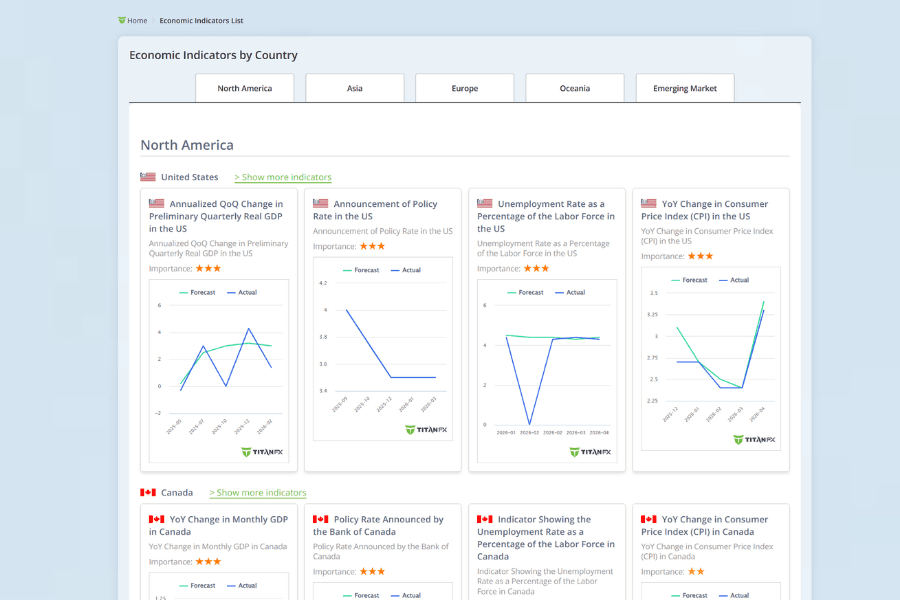
Titan FX Economic Indicator Tools
Titan FX provides free economic data from the U.S., Europe, Japan, China, and other major economies, filterable by date, country, and importance.
CZK's Role in Global Markets
Role 1: Central European Forex Participant
CZK's daily volume is modest versus major currencies, but it is actively traded during the European session. EUR/CZK is one of the region's most common pairs, offering hedging and arbitrage options.
Role 2: Regional Currency Stabilizer
CZK correlates closely with the Polish zloty (PLN) and Hungarian forint (HUF), making it a proxy for Central European economic sentiment and regional investor confidence.
Role 3: Monetary Policy Autonomy
By keeping its own currency, the Czech Republic preserves full monetary policy independence. CNB can adjust rates and exchange rate parameters to support domestic industry, giving CZK a shock-absorption advantage that individual eurozone members lack.
5. How to Trade CZK
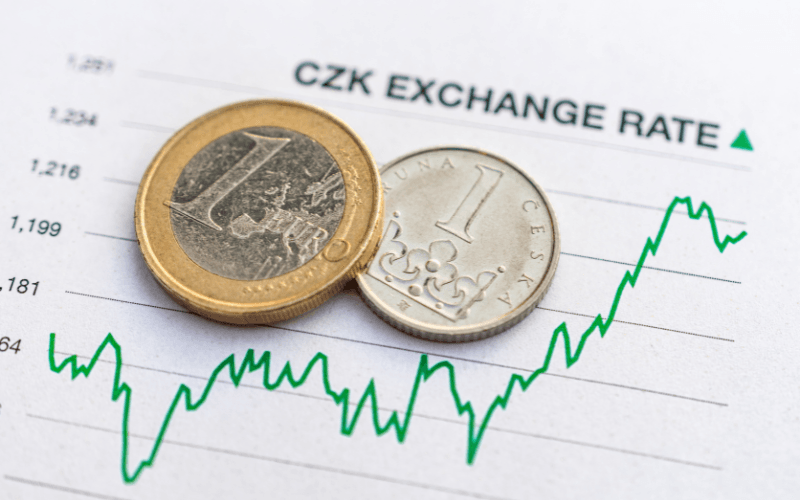
The most common way to trade CZK is through forex margin trading. Leverage lets traders control larger positions with less capital, and both long and short positions are available. The forex market operates 24 hours a day with deep liquidity.
Further reading: Forex Margin Trading Basics
Titan FX offers up to 500x leverage on CZK pairs (EUR/CZK, USD/CZK).
Trading Process with Titan FX
Step 1: Open an Account
Fast online registration. Choose Standard or Blade.
Account Opening GuideStep 2: Deposit Funds
Credit card deposits are instant.
Deposit GuideStep 3: Install MT4 or MT5
Available for Windows, Mac, iOS, Android.
MT5 Setup MT4 SetupStep 4: Select a Currency Pair
The most common CZK pair is EUR/CZK.
All Currency Pairs at Titan FXStep 5: Place a Trade
Select your instrument and execute a buy or sell order.
MT5 Order Placement MT4 Order PlacementFree Trading Tools
Titan FX offers free custom indicators and EAs (Expert Advisors) to sharpen analysis and automate execution.
Custom Indicators EA Rankings6. FAQ
Q1. Is CZK suitable for short-term traders?
CZK's liquidity is lower than major pairs, but EUR/CZK and USD/CZK offer meaningful volatility during the European session. Spreads tend to be wider than on majors, so factor that into cost calculations.
Q2. Does CZK exhibit seasonal patterns?
Yes. CZK can show seasonal tendencies tied to automotive export peaks (spring/summer) and tourism high seasons. During these periods the koruna is more sensitive to capital flows, making historical seasonal analysis useful for swing trading.
Q3. How does CZK perform when geopolitical risk rises?
CZK typically weakens during European geopolitical stress (e.g., Russia-Ukraine escalation, energy disruptions). However, the Czech Republic's EU membership and sound fiscal position make CZK more resilient than many emerging market currencies.
Q4. What risk management practices are recommended for CZK trading?
Monitor ECB meetings, German data releases, and energy prices as key event risks. Because liquidity is lower than majors, use stop-loss orders and consider avoiding the Asian session to reduce slippage and spread widening.
Q5. What fundamental variables should long-term investors track for CZK?
Key long-term indicators include Czech manufacturing PMI, industrial production growth (YoY), FDI trends, and the government budget deficit. These reveal the economic resilience behind CZK beyond short-term rate movements.
7. Summary
CZK combines a robust industrial economy with floating exchange rate flexibility. Its close eurozone trade ties link it tightly to European economic momentum, while staying outside the eurozone preserves monetary policy independence.
For traders, CZK occupies a middle ground between major and emerging currencies: moderate volatility, predictable policy, and clear regional linkages. Combining fundamental monitoring with technical analysis supports effective strategy building for both intraday and swing trading.
As Czech manufacturing upgrades and capital markets open further, CZK will maintain its relevance in global forex markets.
Further Reading
- Forex Margin Trading Basics
- EUR/CZK Trading Conditions and Live Chart
- What Is FOMC? Monetary Policy and Market Impact
The financial markets research team at Titan FX. We produce educational content across a broad range of instruments, including forex (FX), commodities (crude oil, precious metals, agricultural products), equity indices, U.S. stocks, and crypto assets.
Primary Sources (by Category)
- Official data: Czech National Bank (cnb.cz), Czech Statistical Office (czso.cz)
- International: BIS Triennial Survey, European Commission, IMF World Economic Outlook
- Trading: Titan FX (research.titanfx.com)