

What Is a Position in FX Trading?
Whether you grow your account in FX comes down not just to how well you enter, but to how you manage the positions you open. Understanding the types of positions and how to manage them is the foundation for making strategic decisions and containing the risks that come with market swings.
This article walks through the basic concept of a position, how positions are classified, and the practical management points and common misconceptions to keep in mind.
- What it is: An open trade not yet closed; direction and size drive your P/L.
- Four main types: Long, short, net position, and square (flat).
- Trading styles: Scalping, day, swing, and position trading by holding period.
- Management priorities: Unrealised P/L, stop-out, swap, and slippage.
- Mindset: Avoid overtrading — don’t enter without a signal.
1. What Is a Position?
A position is the state of a trade that has been executed but has not yet been closed (settled). In FX, once a buy or sell order has been filled and no offsetting trade has been executed against it, the trader is said to be holding a position.
While that position is open, market price moves create unrealised profit or loss; the P/L only becomes realised once the position is closed.
Once a position is open, a favourable price move produces an unrealised gain (floating profit); an adverse move produces an unrealised loss (floating loss). These swings flow directly into account equity, and if the loss expands beyond the trader's tolerance, the broker's margin-call / stop-out mechanic may force the position to close.
Even when sitting on an unrealised gain, that gain remains "on paper" — a sharp reversal can erase it quickly if the position has not been closed.
2. Types of FX Positions
In FX trading, a position can be classified by direction and by combination. Understanding these types helps traders manage risk more efficiently and adjust strategy more carefully. The four common types:
2.1 Long Position
A long position is a position opened with a buy order, typically taken in anticipation of a price rise.
For example, if a trader is long USD/JPY and the yen weakens (the dollar strengthens), closing the position after the price rises produces a profit. If the price falls, the position takes a loss.
Long positions are one of the most common trade types, especially in trend-following or fundamentally bullish contexts.
2.2 Short Position
A short position is a position opened with a sell order, typically taken in anticipation of a price decline.
For example, if a trader is short GBP/USD and the British pound weakens (the price falls), closing the position produces a profit; if the price rises, the position takes a loss.
Shorts mirror longs and are often used as a defensive setup during reversals, short-term corrections, or weaker-than-expected data releases.
2.3 Net Position
A net position is the effective net exposure in a single currency pair after offsetting all open buy and sell positions.
For example, if a trader is long 300,000 units and short 100,000 units of the same pair simultaneously, the net position is "long 200,000 units".
Conversely, holding 150,000 units short and 100,000 units long gives a net of "short 50,000 units".
Net positions simplify exposure accounting and help assess true risk exposure — but whether bilateral hedging in the same pair is allowed depends on the broker's rules.
2.4 Square Position
The exit state — also called "zero position", "flat", or "neutral" — refers to holding no open exposure in any direction. With no exposure, market moves do not create floating P/L; this state is typically used while waiting for setups or surveying market conditions.
In some cases, simultaneously holding equal-size long and short positions in the same pair (a hedge) produces a net position of zero and is therefore considered a form of square positioning. Whether brokers permit bilateral hedging differs, so check the rules before trading.
3. Trading Styles by Holding Period
FX trading can be roughly grouped into four styles depending on how long a position is held.
Each style has its own analysis approach, rhythm, and risk-tolerance requirement. Choosing a style that fits your situation supports a more stable strategy.
| Style | Holding Period | Characteristics |
|---|---|---|
| Scalping | Seconds to minutes | High-frequency entries and exits; demands fast reaction and intense focus |
| Day Trading | Within a single day | All entries and exits within the day; no overnight exposure |
| Swing Trading | Several days to weeks | Captures intermediate trends; moderate trade frequency; technical-analysis-heavy |
| Position Trading | Several weeks to months (or longer) | Entries based on fundamentals and longer-term trends; low frequency; steady style |
Holding positions overnight incurs swap points; you can check the latest rates for each symbol with the Swap Point Calendar.
4. Position FAQ
The most common questions FX traders ask about opening and managing positions.
Q1: Can I see other traders' positions?
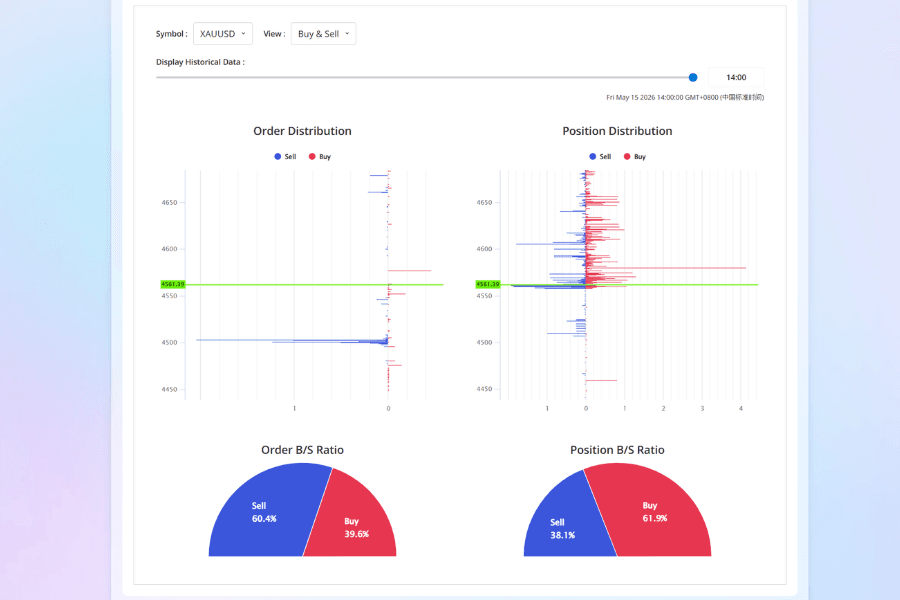
In some cases, yes. A number of FX brokers publish the distribution of buy and sell positions across their order books, letting traders see whether the majority is currently leaning long or short.
The data is usually presented as a "market sentiment map" or "open-position ratio chart" and is a useful auxiliary input for reading market mood.
Titan FX offers a free market sentiment dashboard (order and position information) that shows the long/short ratio and the distribution of open positions across popular pairs such as XAU/USD in real time. These figures help map market lean and assess the risk of either reversal or continuation.
Q2: What is rollover?
Rollover is the mechanism by which an open position is automatically rolled forward to the next settlement date before its original settlement date is reached.
This process runs automatically each day; depending on the interest-rate differential between the two currencies, the position incurs a positive or negative swap (overnight interest). Rollover is what allows positions to be held for extended periods without needing to be re-established daily.
Q3: Do all brokers have the same maximum position sizes and order limits?
No — brokers differ in maximum position size, single-order caps, and the number of positions that can be held simultaneously.
Titan FX offers a flexible environment with deep liquidity, well-suited to mid-to-high-frequency trading and larger orders.
Regardless of account size, sizing positions to fit the strategy and avoiding overconcentration is the disciplined approach.
Q4: What is slippage, and how do I avoid it?
Slippage is the gap between the order price and the actual execution price; it tends to appear in high-volatility windows or thin-liquidity environments. To reduce exposure, traders can set a "maximum allowable slippage" or use limit orders instead of market orders. Titan FX supports these settings to give traders tighter control over execution.
Q5: Is it wrong to always want a position open?
Many traders fall into the "always-in-a-position" mindset — what some call the trading equivalent of an itch. In that state, behaviour is driven more by emotion than by strategy, with knock-on effects: more low-quality trades, higher costs, and bigger drawdowns.
How to improve:
- Stick strictly to entry rules — no setup, no entry
- Take regular breaks and don't watch the market constantly
- Review your trade journal and the rationale behind each entry objectively
5. Summary
A position is one of the most fundamental and important concepts in FX trading. Entry direction, position size, ongoing risk management, and strategy adjustment all hinge on it. By understanding the definition, the types, the ratios, and the practical management techniques, traders can run their strategy with more discipline and reduce the influence of emotional trading and latent risk.
Whatever the chosen style, position management remains the core of stable trading performance. Building the right concept first, then matching it with a personal rhythm and a clear risk-management framework, is what makes long-term, consistent trading possible.
Further Reading
- What Is Slippage?
- What Is an Exit?
- What Is Averaging Down?
- Hedging in Forex
- What Is Leverage?
- Forex Trading Basics
Titan FX Research. Investor-education content covering forex (FX), commodities (oil, precious metals, agricultural products), stock indices, US equities, and crypto assets across global markets.
Primary Sources by Category
- FX broker practice: Titan FX platform rules and market-sentiment dashboards (long/short ratio charts for XAU/USD and other pairs); BIS Triennial Survey on FX market size and currency-pair liquidity data
- Trading infrastructure: FX settlement conventions; CLS Bank international settlement system; ISDA Master Agreement rollover mechanics
- Academic background: Schwager, J. D. Market Wizards on position management; Tharp, V. K. Trade Your Way to Financial Freedom on position sizing methodology
- Behavioural finance: Kahneman, D. Thinking, Fast and Slow on the "always-in-a-position" mindset and on overtrading