

RBNZ (Reserve Bank of New Zealand)
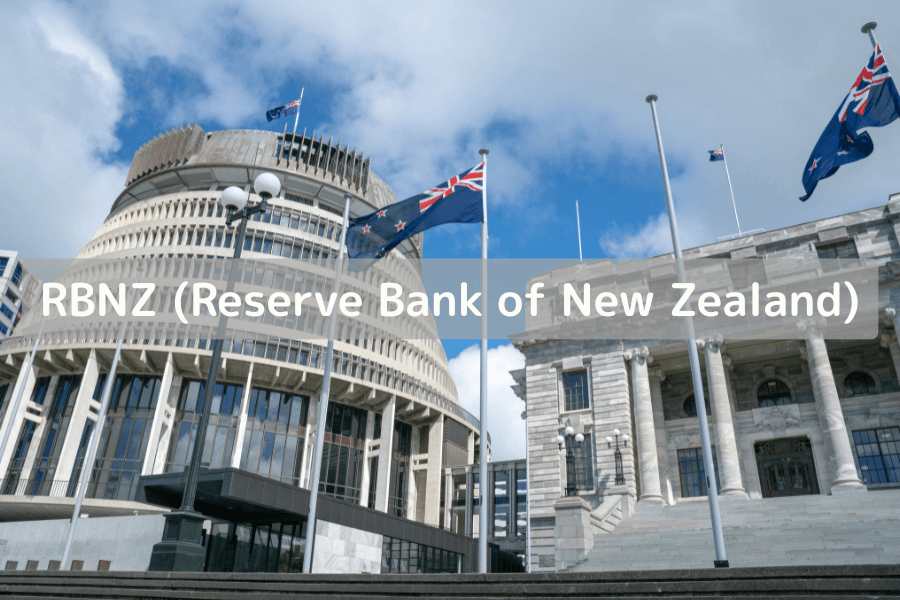
The Reserve Bank of New Zealand (RBNZ) is the country's core monetary authority, and its policy decisions directly shape New Zealand's interest-rate environment and the value of the New Zealand dollar (NZD) in the global FX market. Because New Zealand is a small, highly open, export-oriented economy, RBNZ policy often reflects shifts in global growth conditions and is closely watched by traders worldwide.
This guide walks through the RBNZ's role, how policy is set, the most important RBNZ documents to follow, and how to translate that into a practical trading approach for NZD on Titan FX. Whether you are new to FX or already trade NZD pairs actively, the goal is to give you a complete framework for tracking what the RBNZ is doing and why.
- RBNZ (Reserve Bank of New Zealand): Established in 1934, New Zealand's central bank — responsible for monetary policy under an inflation-targeting framework, financial stability supervision, NZD issuance, and payment settlement.
- Core policy tools: OCR (Official Cash Rate, set every six weeks by the MPC), MPS (quarterly detailed report), and FSR (semi-annual financial stability report).
- Impact on NZD: New Zealand is a small open economy with high export dependence, so subtle changes in RBNZ tone are reflected almost immediately in NZD. NZDUSD moves of 50–150 pips on OCR decision day are standard.
- Distinctive characteristics: One of the first central banks to adopt an explicit inflation target (1989), known for direct communication and pioneering use of macroprudential tools (such as LVR limits) on the housing market.
- Trading takeaways: Reduce leverage and confirm stops around OCR decisions, MPS releases, and MPC speeches; volatility usually peaks within 5–30 minutes of release.
- 1. RBNZ Overview: Role, Mandate, Institutional Features
- 2. Core Functions: Monetary Policy and Financial Stability
- 3. How RBNZ Sets Policy: The Mechanism Behind NZD Moves
- 4. Key RBNZ Announcements Every Trader Should Read
- 5. Trading NZD on Titan FX: Markets and Strategy
- 6. Frequently Asked Questions
- 7. Summary: Why RBNZ Matters to Traders
1. RBNZ Overview: Role, Mandate, Institutional Features
Background: What the RBNZ Is
The Reserve Bank of New Zealand (RBNZ) was established in 1934 and serves as the country's central bank, responsible for maintaining price stability, ensuring the soundness of the financial system, and managing monetary policy. Because New Zealand is a small, open economy where international trade and global price moves have outsized impact, RBNZ policy decisions tend to translate quickly into NZD price action.
The RBNZ operates under an inflation-targeting framework agreed with the New Zealand government — generally targeting CPI inflation in the 1–3% range. This framework makes policy direction transparent and gives the market a clear view of the macro environment the central bank is trying to shape. For traders, this means inflation, wages, and housing data are critical inputs for anticipating policy direction.
Institutional Features: High Transparency, Clear Signals
RBNZ monetary policy is set by the Monetary Policy Committee (MPC), which uses a collective decision model. After each meeting, the committee publishes a policy statement and concise reasoning. RBNZ communication tends to be more direct than that of many other central banks, and markets have grown used to extracting forward-rate guidance from subtle changes in language.
For newer market participants, the RBNZ has two practical advantages:
- ▸ Clear policy framework: An explicit inflation target makes rate decisions easy to interpret.
- ▸ Direct language: Statements avoid ambiguity, making the central bank's stance easier to read.
As a result, NZD is widely regarded as a currency highly sensitive to central-bank policy and economic data. Any shift in tone or outlook tends to show up in the FX rate immediately.
2. Core Functions: Monetary Policy and Financial Stability
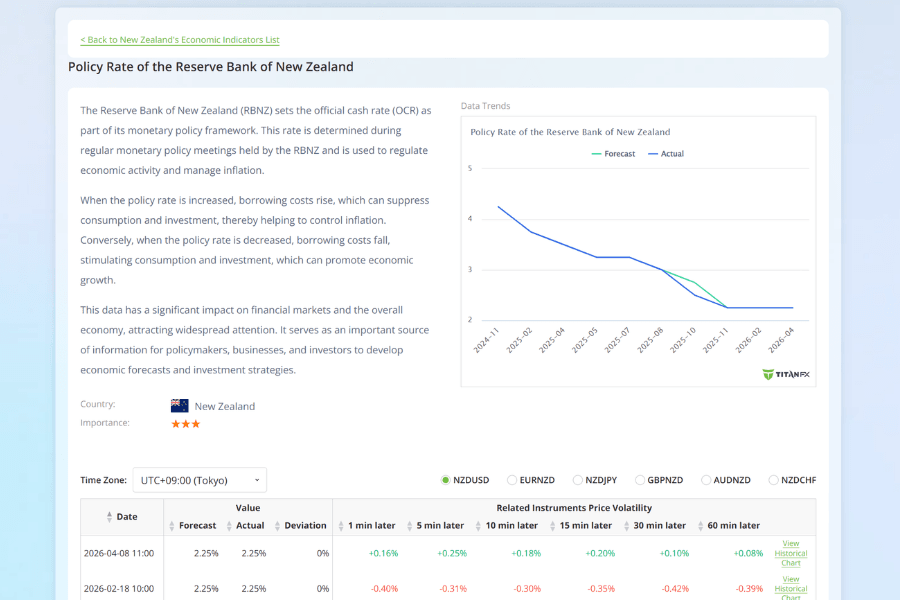
The RBNZ's day-to-day work centers on setting interest rates, supervising financial-system health, and ensuring smooth market operation. Together, these functions drive both the New Zealand economy and NZD price action.
Function 1: Setting the Official Cash Rate (OCR)
The Official Cash Rate (OCR) is the benchmark rate from which all other New Zealand interest rates derive — including mortgage rates, corporate funding costs, and consumer loan rates. By adjusting the OCR, the RBNZ tunes the pace of the broader economy: hiking to cool inflation when it is too high, cutting to stimulate spending and investment when demand is weak.
NZD is highly sensitive to interest-rate changes, so OCR decisions are reflected in the FX rate almost immediately. For FX traders, the OCR is one of the most important data points to watch.
Function 2: Maintaining Financial-System Stability
The RBNZ supervises New Zealand's banking system: assessing capital adequacy, monitoring risk exposures, and publishing periodic Financial Stability Reports. When stress emerges in housing, credit, or market sentiment, the RBNZ may use macroprudential tools — for example limiting the share of high-LVR mortgages — to slow the buildup of risk.
When financial stability is challenged, market confidence in NZD is affected as well, so this function is essential to overall market function.
Function 3: Payment System and Currency Operations
The RBNZ runs the inter-bank settlement system and oversees the issuance and circulation of physical currency. While these functions do not move FX directly, they are the infrastructure that allows financial transactions, commerce, and everyday payments to operate safely and reliably.
These three functions reinforce each other — from interest-rate adjustment to bank supervision to payment infrastructure — and together form the backbone of New Zealand's financial environment, which is essential context for understanding NZD.
3. How RBNZ Sets Policy: The Mechanism Behind NZD Moves
RBNZ policymaking is highly transparent and data-driven. Markets reprice NZD quickly based on policy direction, economic projections, and tone.
Process: How the MPC Reaches Decisions
The Monetary Policy Committee meets every six weeks to review inflation, economic activity, and external risks, and to decide whether to adjust the OCR. The process can be summarized in three steps:
- ▸ ① Policy assessment: Members debate the appropriate rate path based on the latest price, employment, and growth data — hike, cut, or hold.
- ▸ ② Financial-condition response: Once the decision is published, market interest rates, bond yields, and bank funding costs adjust immediately, reshaping the financial environment.
- ▸ ③ Real-economy effect: Households and firms adjust spending, investment, and borrowing in line with the new cost of credit, feeding into the next round of demand and inflation dynamics.
Because NZD is highly sensitive to policy expectations, markets often start to price decisions ahead of the meeting itself.
Key Signals: Data the RBNZ Watches
RBNZ decisions hinge on broad economic conditions. The data points below carry particular weight in policy decisions and tend to drive NZD moves:
- ▸ Inflation (CPI): Whether it is within the 1–3% target band.
- ▸ Wages and employment: Wage growth supports inflation; rising unemployment signals weak demand.
- ▸ Domestic demand and GDP: Whether the economy is in expansion or slowdown.
- ▸ Housing and credit: New Zealand's residential housing has outsized influence on consumption and financial stability — a long-standing focus area for the RBNZ.
- ▸ External demand and key export markets: China and Australia are major trading partners; global commodity prices feed into export earnings and policy direction.
Tone Signals: How Statements Move NZD
The tone of an RBNZ statement often moves the market faster than the rate decision itself. Hints that "further tightening may be needed" raise hike expectations; emphasis on "softening demand" is read as dovish. Because the RBNZ is so transparent, even small shifts in language can produce material NZD moves.
Policy direction, economic data, and tone signals together form the framework markets use to interpret the RBNZ — essential context for analyzing NZD volatility.
4. Key RBNZ Announcements Every Trader Should Read
The RBNZ uses several types of policy documents to communicate its assessment and direction. Understanding what each one is for makes event-driven trading more precise.
Type 1: OCR Decision
Publishes the latest benchmark rate and a concise rationale. The single most market-moving RBNZ release in the short term — when the result diverges from market expectations, NZD typically moves immediately.
Type 2: Monetary Policy Statement (MPS)
Released quarterly, the MPS is the most comprehensive RBNZ document. It covers medium-term inflation and growth forecasts, policy risk analysis, model projections, and the future rate path. It often resets market expectations on NZD direction.
Type 3: Monetary Policy Review (MPR)
A lighter update between MPS releases. Less detailed but its tone often shifts views on the next OCR decision, so traders should still read the language carefully.
Type 4: Financial Stability Report (FSR)
Focuses on financial-system soundness, with particular attention to housing prices, credit growth, and bank capital. Given New Zealand's housing-heavy household balance sheet, an FSR flagging rising risk can shift expectations on whether the RBNZ will lean more toward tightening or easing — indirectly moving NZD.
Type 5: RBNZ Speeches
RBNZ Governor and MPC member speeches are not on a fixed schedule but often telegraph policy bias on inflation, external demand, or financial conditions. Even small changes in phrasing can move NZD over short windows.
Reading Guide
- ▸ Check whether the result aligns with market expectations — bigger surprises produce bigger moves
- ▸ Watch whether tone leans hawkish or dovish — tone often signals direction earlier than the rate
- ▸ Look for revisions to inflation, growth, or financial-risk wording — these drive market repricing
- ▸ Track references to external demand — given New Zealand's trade dependence on China and Australia, external exposure is an important risk channel
- ▸ Watch the first market reaction after release — a clean break or reversal usually means market interpretation is consistent
5. Trading NZD on Titan FX: Markets and Strategy
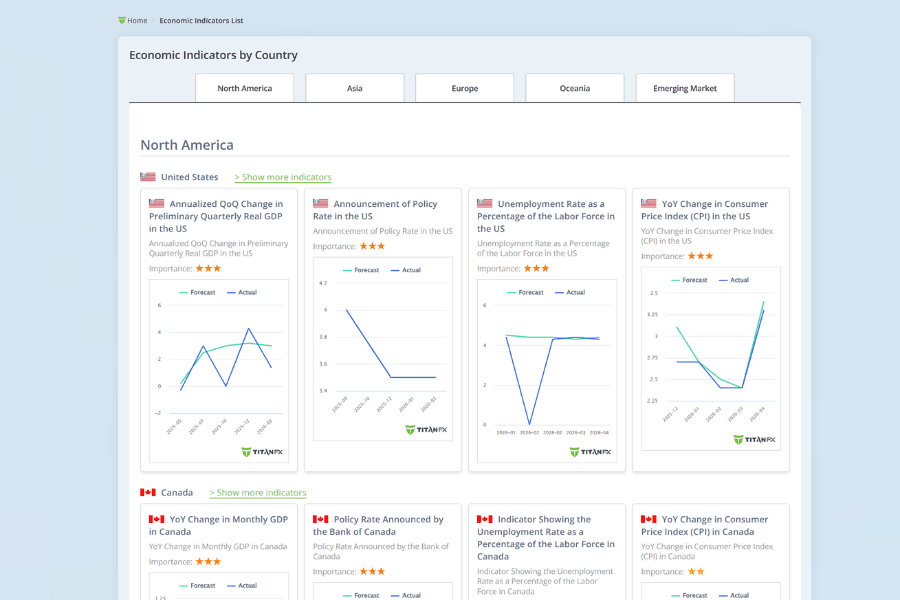
NZD is one of the most liquid major currencies and is well-suited to event trading, trend strategies, and short-term setups. Titan FX offers multiple NZD products so traders can pick the market that fits their strategy.
Tradable Products
| Category | Symbols |
|---|---|
| Major pairs | NZDUSD / NZDJPY |
| Cross pairs | EURNZD / GBPNZD / AUDNZD / NZDCAD / NZDCHF |
Trading Workflow
| Step | Action |
|---|---|
| Step 1: Open an account | Sign up on the Titan FX site with email and password; complete verification to activate the account |
| Step 2: Fund the account | Log in to the client portal and choose a deposit method (credit card, e-wallet, bank transfer) |
| Step 3: Download the platform | Titan FX offers MT4 and MT5 across Windows, Mac, iOS, and Android |
| Step 4: Place trades | Trade NZD-related products such as NZDUSD with long or short orders |
Strategy: Risk Management Around Events
NZD volatility tends to expand around policy events, key data releases, and central-bank speeches. Practical principles for stable execution:
- ▸ Reduce leverage ahead of events to avoid runaway exposure
- ▸ Wait for confirmation after a release before entering, rather than chasing the headline tick
- ▸ Use technical analysis to anchor entries and place a stop-loss
- ▸ Stay alert to false breakouts, gaps, and slippage in high-volatility windows
6. Frequently Asked Questions
Q1: How does the RBNZ differ from the Fed, ECB, and BOJ?
The RBNZ was one of the first central banks to adopt explicit inflation targeting (1989), with a clear framework and direct policy communication. The Fed runs a dual mandate (price stability plus maximum employment); the ECB and BOJ also focus on price stability but communicate more cautiously. As a small-open-economy central bank, the RBNZ is highly sensitive to global commodity prices and external demand, which is why NZD reacts more directly to RBNZ tone than larger economies' currencies do to their own central banks.
Q2: How does the OCR differ from other countries' policy rates?
The OCR (Official Cash Rate) is the inter-bank overnight rate set directly by the RBNZ, similar in role to the Fed Funds Rate target ceiling or BOJ short-term policy rate. Unlike the Fed's standard 25 bp step, the RBNZ has historically used larger moves — including 75 bp hikes during the 2022–2023 tightening cycle.
Q3: How much does NZD typically move on an RBNZ decision day?
NZDUSD moves of 50–150 pips around an OCR decision are standard, with surprise outcomes or sharp tone shifts producing 200+ pip moves. The MPS quarterly report can produce comparable secondary moves. Volatility typically peaks in the first 5–30 minutes after release, then settles as the market digests the analysis.
Q4: Why does the RBNZ pay so much attention to housing?
New Zealand's household mortgage debt as a share of GDP is among the highest globally, so housing volatility transmits to the broader economy through credit channels. Since 2013, the RBNZ has been a pioneer in using macroprudential tools — such as Loan-to-Value Ratio (LVR) limits — to manage housing-sector risk. When the RBNZ flags housing risk, the market often reads that as a more cautious overall policy stance, indirectly affecting NZD.
Q5: When is the best time to trade NZD on Titan FX?
The best windows for NZD liquidity and volatility are around RBNZ announcements (OCR decisions), New Zealand CPI and unemployment releases, and key data from major trading partners such as China and Australia. The Asian morning session (NZT 09:00–12:00) tends to be NZD's most active session. European and US sessions also matter, but liquidity and spreads can widen modestly. Reducing leverage and confirming stops before events is basic discipline.
7. Summary: Why RBNZ Matters to Traders
The RBNZ is the single most important driver of NZD: its rate decisions, policy tone, and economic projections shape NZD direction substantially. For FX traders, building a working understanding of how the RBNZ operates makes the broader macro picture more coherent and trading strategy more consistent over time.
By reading RBNZ signals carefully and combining them with Titan FX's market quotes, economic calendar, and technical-analysis tools, traders can track NZD moves more efficiently and make more disciplined, logically grounded trading decisions.
Further Reading
- What Is Monetary Policy?
- What Is GDP?
- What Is CPI?
- What Is Quantitative Easing?
- What Is the Sharpe Ratio?
- Forex Trading Basics
- What Is Leverage?
Titan FX Research. Investor-education content covering forex (FX), commodities (oil, precious metals, agricultural products), stock indices, US equities, and crypto assets across global markets.
Primary Sources by Category
- RBNZ official materials: Reserve Bank of New Zealand official site (rbnz.govt.nz); Monetary Policy Statement / Financial Stability Report (each issue); OCR Decision releases
- Policy history and framework: 1989 Reserve Bank of New Zealand Act (the world's first formal inflation-targeting legislation); LVR macroprudential reviews from 2013 onward
- Market analysis: BIS Triennial Survey (NZD turnover data); CME, Bloomberg, and Reuters RBNZ commentary
- Academic background: Bernanke, B. & Mishkin, F. (1997) "Inflation Targeting"; Svensson, L. E. O. Inflation Targeting and Optimal Monetary Policy