

What Is the FTSE Taiwan Index (TWFTSE)? Components, Features & Trading Strategies
For CFD traders, TWFTSE offers a trading instrument centered on Taiwan's semiconductor industry while also covering financial and traditional sectors. TSMC alone commands a weighting near the index cap, and given Taiwan's critical role in the global chip supply chain, TWFTSE's price action is tightly linked to the global technology cycle. This article covers the index composition, key price drivers, and practical trading strategies for TWFTSE.
- The FTSE Taiwan Index (TWFTSE) is compiled by FTSE Russell — covering roughly 87% of the Taiwan Stock Exchange's market cap.
- Around 90 constituents; the top 10 carry ~60% of the weight; TSMC alone exceeds 30% — sector concentration is very high.
- Main drivers: the semiconductor cycle, geopolitics (US-China and cross-strait), the TWD exchange rate, Fed policy, and SGX futures flow.
- TWFTSE futures trade on SGX (Singapore Exchange), providing Asian-session liquidity — the primary hedging tool for Taiwan equities.
- On Titan FX, trade the TWFTSE index CFD long or short with leverage for low capital exposure and round-the-clock responsiveness.
What Is the FTSE Taiwan Index (TWFTSE)?
The FTSE Taiwan Index (trading symbol: TWFTSE) is a market-cap-weighted stock index launched in 2002 through a collaboration between FTSE Russell, a globally recognized index provider, and the Taiwan Stock Exchange (TWSE). In 2020, the Singapore Exchange (SGX) listed futures contracts based on this index, further enhancing TWFTSE's liquidity and visibility in international markets.
| Item | Details |
|---|---|
| Official Name | FTSE Taiwan Index |
| Trading Symbol | TWFTSE (CFD) |
| Index Provider | FTSE Russell / Taiwan Stock Exchange (TWSE) |
| Number of Constituents | Approximately 129 |
| Weighting Method | Free-Float Market-Cap Weighted |
| Denomination Currency | U.S. Dollar (USD) |
| Weight Cap | Single stock maximum 20%; stocks above 4.5% collectively capped at 48% |
| Rebalancing Frequency | Quarterly (March, June, September, December) |
The weight-capping mechanism is a defining feature of TWFTSE. Because TSMC (Taiwan Semiconductor Manufacturing Company) dominates Taiwan's stock market by market capitalization, the index would be overly dependent on a single stock without weight restrictions. The 20% single-stock cap and 48% concentration cap help mitigate this concentration risk.
Compared to local futures that track the Taiwan Weighted Index (TAIEX), TWFTSE is denominated in U.S. dollars and compiled by an international institution, making it better suited for overseas investors. It serves as an important international benchmark alongside the MSCI Taiwan Index.
Top Constituents and Sector Breakdown
TWFTSE's constituents are anchored by semiconductor and electronic technology companies. The top ten holdings have a decisive impact on the index's price movements:
| Rank | Company | Code | Sector | Weight (approx.) |
|---|---|---|---|---|
| 1 | TSMC | 2330 | Semiconductor Foundry | ~20% (at cap) |
| 2 | Hon Hai (Foxconn) | 2317 | Electronics Manufacturing | ~5% |
| 3 | MediaTek | 2454 | IC Design | ~4% |
| 4 | Delta Electronics | 2308 | Power Supply / Thermal | ~2% |
| 5 | Chunghwa Telecom | 2412 | Telecom | ~2% |
| 6 | Cathay Financial Holdings | 2882 | Financial | ~2% |
| 7 | Fubon Financial Holdings | 2881 | Financial | ~2% |
| 8 | UMC | 2303 | Semiconductor Foundry | ~1.5% |
| 9 | Quanta Computer | 2382 | Servers / AI | ~1.5% |
| 10 | ASE Technology | 3711 | Packaging & Testing | ~1.5% |
As the world's largest semiconductor foundry, TSMC's single-stock weighting sits near the 20% cap, giving it unrivaled influence on the index. TSMC's quarterly earnings, advanced process node progress, and shifts in global AI chip demand often directly drive TWFTSE's short-term direction.
Sector Breakdown
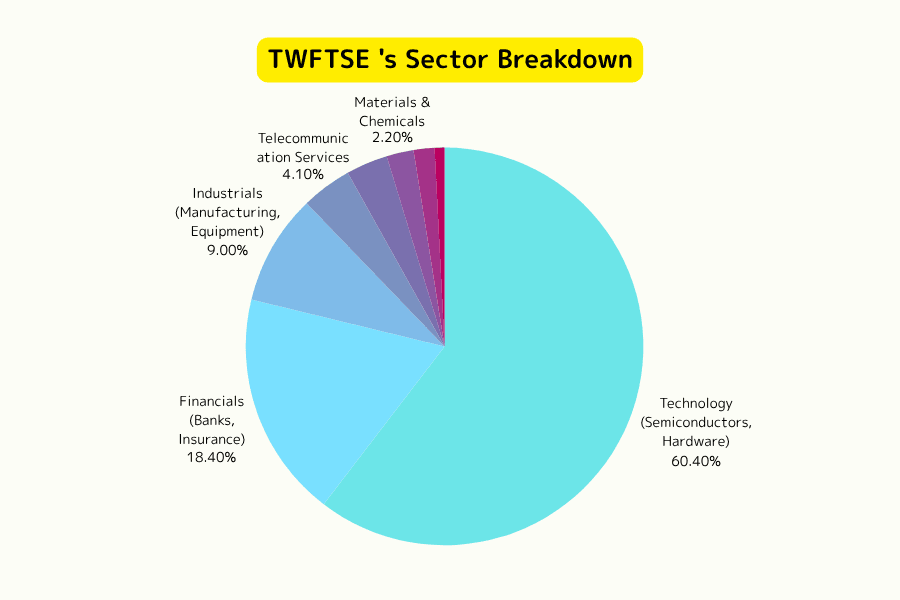
| Sector | Weight (approx.) | Key Companies |
|---|---|---|
| Information Technology | ~60.4% | TSMC, MediaTek, Hon Hai, Delta, Quanta |
| Financials | ~18.4% | Cathay Financial, Fubon Financial, CTBC, Mega Financial |
| Industrials | ~9% | Formosa Plastics, Nan Ya, Evergreen |
| Communication Services | ~4.1% | Chunghwa Telecom, Taiwan Mobile, FarEasTone |
| Materials | ~3.5% | Taiwan Cement, Asia Cement |
| Other (Consumer, Healthcare, etc.) | ~4.6% | Uni-President, Largan |
With technology stocks accounting for over 60%, TWFTSE's most prominent structural feature is its heavy tilt toward semiconductors. This makes the index highly correlated with the global semiconductor cycle and AI industry trends, and it tends to exhibit greater volatility than more diversified indices.
Key Factors That Move the Index
Macroeconomic Environment
Taiwan is an export-driven economy, with exports comprising over 60% of GDP. The following macroeconomic indicators have a significant impact on TWFTSE:
-
Taiwan GDP growth rate: reflects overall domestic and external demand
-
U.S. GDP growth rate: the United States is one of the primary export markets for Taiwan's tech products
-
U.S. CPI (Consumer Price Index): inflation data influences Fed rate policy, indirectly affecting global tech stock valuations
-
Taiwan export orders: semiconductor and electronic component export data serve as a leading indicator for TWFTSE
Industry and Corporate Factors
-
Semiconductor cycle: the boom-bust dynamics of global chip demand are directly reflected in the share prices of core constituents such as TSMC, MediaTek, and UMC
-
AI and data center demand: TSMC's advanced process node orders (3nm, 2nm) and demand outlook from customers like NVIDIA are key drivers for TWFTSE
-
Tech earnings season: TSMC reports monthly revenue and holds quarterly analyst calls -- both are critical events for the index
-
Electronics manufacturing and iPhone cycle: Hon Hai's revenue is influenced by Apple's product cycle, with Q3-Q4 typically being peak season
Geopolitical Factors
-
Cross-strait relations: shifts in political tension across the Taiwan Strait directly affect how foreign investors price risk in the Taiwanese market
-
U.S.-China tech competition: semiconductor export controls, the CHIPS Act, and technology restrictions affect Taiwan's semiconductor industry's global positioning
-
Tariff policies: U.S.-China trade friction can impact export prospects for Taiwan's tech supply chain
Currency Factors
TWFTSE is denominated in U.S. dollars, so movements in the Taiwan dollar vs. the U.S. dollar affect index performance:
- TWD appreciation: the USD-denominated TWFTSE strengthens (even if Taiwan stocks are flat)
- TWD depreciation: the USD-denominated TWFTSE faces downward pressure
- Central bank FX policy: the Central Bank of the Republic of China's intervention intensity also indirectly impacts the index
Use Titan FX's Economic Calendar to track the release times and market expectations for the key economic data mentioned above.
Advantages and Risks of Trading
Advantages
-
Strong representation of the Taiwanese market: TWFTSE covers approximately 129 large- and mid-cap stocks, broadly reflecting the overall performance of Taiwan's equity market and offering an effective way to participate in Taiwan's economic growth
-
Institutional-grade index transparency: compiled by FTSE Russell following a globally standardized index methodology, with transparent constituent selection criteria and weight calculations
-
Quarterly rebalancing: constituents are reviewed each quarter to reflect market changes in a timely manner, ensuring the index continues to track Taiwan's core listed companies
-
High global fund recognition: the launch of SGX futures has increased TWFTSE's international visibility, attracting greater participation from overseas institutional capital
-
Diversification benefits: compared to investing directly in TSMC as a single stock, TWFTSE covers multiple sectors and companies, providing a degree of diversification
-
Ample trading liquidity: all constituents are among the most liquid listed companies in Taiwan, enabling efficient CFD trade execution
Risks
-
Market volatility risk: influenced by global tech cycles and geopolitical factors, TWFTSE can experience significant short-term swings
-
Sector concentration risk: with technology stocks exceeding 60%, fluctuations in the semiconductor industry have an amplified effect on the index. TSMC's single-stock weighting near the cap means its performance has an outsized impact
-
Geopolitical risk: uncertainty surrounding the Taiwan Strait is a risk factor unique to TWFTSE. Military tensions or diplomatic friction could trigger large-scale foreign capital outflows
-
Liquidity risk: while constituent stocks themselves are highly liquid, TWFTSE CFD spreads may widen significantly during extreme market events
-
Currency risk: the USD-denominated TWFTSE is affected by TWD exchange rate fluctuations. Even when Taiwan stocks perform steadily, currency movements will be reflected in the index
Trading Strategies
Technical Analysis Tools (Titan FX Tools)
Titan FX provides multiple analysis tools to help traders assess TWFTSE's technical landscape:
-
Support & Resistance: identify key price levels for TWFTSE and assess the likelihood of breakouts or bounces
-
Order Book (Position Info): observe other traders' pending order distribution and long/short ratios
-
Trend Analysis: determine whether TWFTSE is in an uptrend, downtrend, or ranging phase
-
RSI Analysis: identify overbought or oversold conditions to help time potential reversals
-
Volatility Heatmap: understand TWFTSE's volatility patterns across different trading sessions
-
Percentage Change Ranking: compare TWFTSE's real-time performance against other indices
Specific Trading Approaches: Trend, Breakout, Event-Driven
Trend Trading
When the global semiconductor cycle is in an upswing and AI chip demand is growing steadily, TWFTSE tends to form medium-term trends lasting weeks to months. Use daily or 4-hour chart moving averages to confirm direction, and enter on pullbacks to key support levels or moving averages. The Trend Analysis tool can help confirm the trend state in real time.
Breakout Trading
TWFTSE often forms tight consolidation ranges ahead of TSMC analyst calls or Fed rate decisions. When price breaks above or below the range on strong volume, it typically triggers a rapid directional move. Use Support & Resistance to identify key levels, and RSI Analysis to filter out false breakout signals.
Event-Driven Trading
TSMC's monthly revenue announcement (around the 10th of each month), quarterly analyst calls, and Fed rate decisions can all trigger significant TWFTSE volatility. When trading around these events, position sizing is critical -- consider reducing your standard position to half or less and setting wider stop-loss distances. Use the Economic Calendar to stay ahead of key data releases.
How to Trade TWFTSE on Titan FX
On the Titan FX platform, the FTSE Taiwan Index is traded under the symbol TWFTSE as a CFD (Contract for Difference). You can also trade via WebTrader directly in your browser.
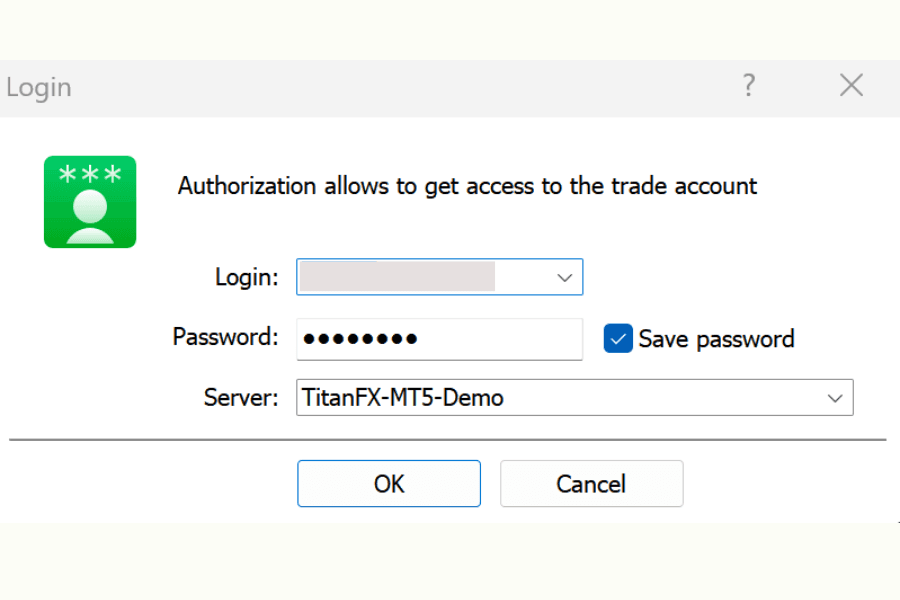
Step 1: Log In to Your Trading Account
Open a Titan FX trading account (Zero Standard or Zero Blade), complete your deposit, then download MT4 or MT5 and log in with your credentials.
Step 2: Add the TWFTSE Quote
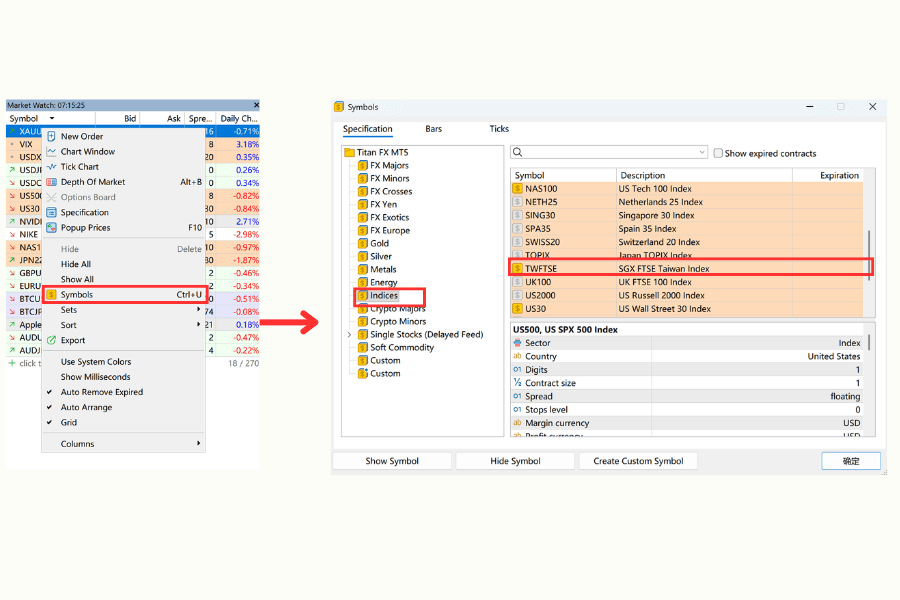
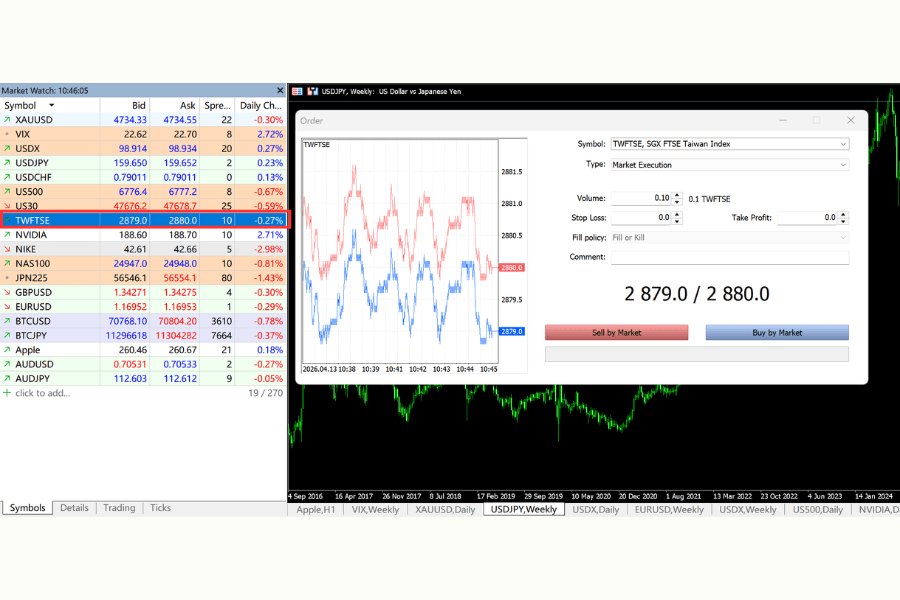
In the Market Watch window, right-click and select "Symbols." Expand the "Indices" category, find TWFTSE, and double-click to add it to your watchlist.
Step 3: Place Your Trade
Double-click the TWFTSE quote or open a chart to access the order window. Enter your lot size (minimum 0.1 lots), choose your direction (buy or sell), set your stop-loss and take-profit levels, and execute the trade.
Trading Hours (Eastern Time):
| Session | Standard Time (EST, GMT-5) | Daylight Saving Time (EDT, GMT-4) |
|---|---|---|
| Main Trading Session | 18:00 - 16:59 (Sun-Fri) | 19:00 - 16:15 & 16:30 - 16:59 |
| Friday Close | 16:55 | 16:55 |
For the latest trading conditions and spreads, see the official page.
Start Trading the FTSE Taiwan Index (TWFTSE)
Trade TWFTSE CFDs on Titan FX with up to 500:1 leverage, tight spreads, and the flexibility to go long or short. Index CFD trading is available on Zero Standard and Zero Blade accounts (not available on Zero Micro accounts).
Key Considerations for New Traders
Leverage and Risk Management
Titan FX offers up to 500:1 leverage on Zero Standard and Zero Blade accounts. Given that TWFTSE can experience significant volatility due to geopolitical factors, risk management is essential when trading with high leverage:
-
Keep the risk on any single trade within 1-2% of your account equity
-
Given TWFTSE's potential for sharp moves around Taiwan Strait developments or TSMC earnings calls, avoid setting stop-losses too tight
-
Use Titan FX's Margin Calculator to determine the required margin and appropriate position size
TSMC's Dominant Influence
TSMC's single-stock weighting sits near the 20% cap, meaning its performance effectively dictates TWFTSE's short-term direction. When trading TWFTSE, be sure to also monitor TSMC's monthly revenue data, analyst call content, advanced process node progress, and order trends from key customers (Apple, NVIDIA, etc.).
Managing Geopolitical Risk
Cross-strait tension is a risk factor unique to TWFTSE and inherently difficult to predict. When relations between mainland China and Taiwan become strained, foreign investors may sell off Taiwan equities on a large scale, causing the index to decline sharply. During periods of elevated geopolitical risk, consider reducing position sizes and strictly adhering to stop-loss levels.
Impact of Currency Fluctuations
Because TWFTSE is denominated in U.S. dollars, movements in the Taiwan dollar can amplify or offset gains and losses in the underlying Taiwan stocks. When the U.S. dollar strengthens and the Taiwan dollar weakens, TWFTSE's gains may be suppressed even if Taiwan stocks are rising. Keep an eye on USD/TWD movements when trading.
Frequently Asked Questions
What is the difference between TWFTSE and Taiwan Futures (TAIEX Futures)?
| Comparison | TWFTSE (FTSE Taiwan Index) | TAIEX Futures |
|---|---|---|
| Index Provider | FTSE Russell / TWSE | Taiwan Futures Exchange |
| Denomination | U.S. Dollar (USD) | Taiwan Dollar (TWD) |
| Constituents | ~129 stocks (with weight caps) | Tracks the TAIEX (all listed stocks) |
| Weight Cap | Single stock 20%, high-weight concentration 48% | No cap (TSMC can exceed 30%) |
| Trading Venue | SGX Futures / CFD Brokers | Taiwan Futures Exchange |
| Best Suited For | International investors, CFD traders | Domestic Taiwan investors |
TWFTSE's weight-capping mechanism results in lower concentration risk than the TAIEX, while its USD denomination makes it more accessible for overseas investors.
Do TWFTSE CFDs have an expiry date?
TWFTSE CFDs are perpetual contracts with no fixed expiry or settlement date. Traders can hold positions flexibly according to their strategy. Note that overnight positions incur swap charges -- check the Swap Calendar for the latest rates. Additionally, dividend adjustments may apply when constituents go ex-dividend.
When is the best time to trade TWFTSE?
TWFTSE's primary volatility typically concentrates during the Asian trading session (approximately 9:00 PM - 1:30 AM Eastern Time), as this period overlaps with Taiwan stock market trading hours when liquidity is at its peak. Additionally, TSMC's monthly revenue announcement (around the 10th of each month), quarterly analyst calls, and major U.S. economic data releases are periods when TWFTSE volatility tends to increase.
What is the difference between TWFTSE and the MSCI Taiwan Index?
Both are USD-denominated international indices tracking Taiwan's large-cap stocks, but they differ in several ways: TWFTSE is compiled by FTSE Russell with approximately 129 constituents and a clear weight-capping mechanism; the MSCI Taiwan Index is compiled by MSCI with different constituent counts and weighting rules. In practice, the two indices are highly correlated, but TWFTSE's weight cap results in a relatively lower TSMC allocation and slightly greater diversification.
What leverage and typical spreads apply to TWFTSE?
On Titan FX, TWFTSE CFDs can be traded with leverage up to 500:1 (actual ceiling depends on account type and regulatory jurisdiction). Spreads are floating — typically tighter during the Asian session and wider around major earnings or macro releases. Overnight positions incur swap charges; check the Swap Calendar for current rates. Actual costs vary with market conditions, so testing on a demo account before going live is recommended.
How much capital does a beginner need to trade TWFTSE?
Required capital scales with position size and risk tolerance. For example, with 1:100 leverage and a 0.1 standard lot position, roughly $200 of margin is required. Beginners should budget 5–10x the single-trade margin as a buffer for volatility and consecutive stop-outs. More critical than the minimum balance is the risk-management rule — cap single-trade risk at 1–2% of account equity rather than chasing the smallest possible stake.
How is TWFTSE correlated with NASDAQ and the PHLX Semiconductor Index (SOX)?
Because TSMC, MediaTek, and other core constituents sit at key nodes in the global semiconductor supply chain, TWFTSE shows strong positive correlation with the NASDAQ Composite and the PHLX Semiconductor Index (SOX). A rally in SOX or bullish NVIDIA/AMD earnings typically lifts TWFTSE; conversely, U.S. chip-export controls or softer AI capex signals tend to drag it down. Cross-market confirmation is a useful directional filter for TWFTSE.
How should traders manage TWFTSE exposure when geopolitical risk rises?
Taiwan Strait dynamics and U.S.–China technology competition are TWFTSE-specific geopolitical risk factors. When news or political events push risk premia higher, consider: (1) reducing position size, (2) widening stops to avoid whipsaw-outs, (3) avoiding heavy positioning around the Asian-session open, and (4) tracking foreign institutional futures net positioning as a sentiment gauge. Longer-horizon holders can hedge directionally via gold (long) or TWD (short) to dampen one-way exposure.
Conclusion
TWFTSE is an international benchmark index centered on Taiwan's semiconductor industry, bringing together companies like TSMC, MediaTek, and Hon Hai that hold critical positions in the global technology supply chain. Its high technology concentration delivers rich volatility and trading opportunities, but also demands that traders rigorously manage geopolitical and industry-cycle risks.
Tracking TSMC's operational data and analyst calls, monitoring Fed policy direction and global semiconductor demand trends, and using technical analysis tools to time entries and exits form the core framework for trading TWFTSE.
Use Titan FX's TWFTSE live quote and chart page to stay on top of market developments, and put this analytical framework into practice in your trading.
Further Reading
- VIX Volatility Index — How US equity volatility transmits strongly into TWFTSE.
- US Stock Market Hours — After-hours US news often dictates TWFTSE's next-day open.
- US Treasury Yields — How rising yields pressure Taiwan tech valuations.
- Inflation — Semiconductor orders and the global inflation cycle.
- Monetary Policy — How Fed and CBC (Taiwan) policy affect TWFTSE.
- Asset Allocation — Including Taiwan equities in a cross-region portfolio.
The Titan FX Research team covers global macroeconomic indicators, foreign exchange (FX), commodities (oil, precious metals, agriculture), equity indices, US stocks, and crypto assets, producing educational content for investors and traders.
Primary Sources by Category
- Official data and regulators: FTSE Russell — FTSE Taiwan Index methodology; Taiwan Stock Exchange (TWSE) — listed-company filings and sector classification; Central Bank of the Republic of China (Taiwan, CBC); Taiwan Financial Supervisory Commission (FSC).
- Exchanges and market data: Singapore Exchange (SGX) — FTSE Taiwan Index Futures (ticker STW); CME Group — international futures correlation data; Bloomberg, Reuters — real-time and historical index data.
- Media and historical references: Bloomberg, Reuters, Financial Times, CNA, MoneyDJ; the 2008 GFC, the 2020 COVID episode (TSMC rally), the 2022 Fed tightening regime, the 2023–2024 AI-driven TSMC-led breakouts, and various US-China-Taiwan geopolitical episodes.