

What Is TSMC ADR? Mechanism, Price Drivers, and Recent Trends
A TSMC ADR (American Depositary Receipt) is a NYSE-listed certificate, ticker TSM, that lets international investors hold a stake in Taiwan Semiconductor in US dollars without trading Taiwanese shares.
Taiwan Semiconductor Manufacturing Company (TSMC), the world's largest foundry, holds a key position in AI, high-performance computing (HPC), electric vehicles, and cloud servers, and has become a focus for international capital.
As the tech industry keeps heating up, more and more overseas investors want to take part in TSMC's growth through the US stock market. In fact, what people call "TSMC US stock" refers to TSMC ADR (American Depositary Receipt) — a way for investors to trade in US dollars and hold TSMC shares indirectly.
This article explains, in a clear structure, the definition and mechanism of TSMC ADR, the main factors that move its price, recent market trends, and common beginner questions. Whether you are new to US stocks or want to add TSMC as a long-term tech holding, use this as a complete starter guide to "TSMC US stock."
- What TSMC ADR is: TSMC's US depositary receipt on the NYSE (ticker TSM), held in USD.
- Mechanism: BNY Mellon holds the Taiwan shares and issues matching ADRs; dividends paid in USD.
- Link to Taiwan stock: Tracks Taiwan's 2330, but FX, time-zone, and flows cause short-term gaps.
- Price drivers: Process leadership, chip demand (AI/HPC/auto), USD strength, geopolitics, rates.
- How to access: No Taiwan account needed; or trade TSM via US-stock CFDs at up to 20x leverage.
1. Why Invest in TSMC US Stock (TSMC ADR)
TSMC holds an irreplaceable position in the global semiconductor industry. Its advanced process technology has long led the field, and its market share has stayed steadily above 50% of the world's foundry market.
As demand for AI, HPC, 5G, and automotive electronics grows rapidly, chips have become the core engine powering modern technology. As a key supplier, TSMC benefits directly from the explosive growth of these emerging applications.
The core value of investing in "TSMC US stock" is being able to participate in the world's most representative semiconductor company with USD-denominated assets, while enjoying the dual advantages of a Taiwan company's growth potential and the US market's liquidity.
Beyond reflecting the company's own performance, TSMC ADR is also seen by the market as a leading indicator of global tech capital expenditure and industry cycles. When the global tech investment cycle rises, TSM often leads other semiconductor or electronics stocks higher; conversely, during slowdowns it best reveals shifts in market risk appetite.
For long-term investors, the appeal of TSMC ADR lies in combining high technical barriers, stable cash flow, and international market accessibility — a core semiconductor asset with both growth and defensive qualities.
2. What Is TSMC ADR and How It Works
TSMC ADR (American Depositary Receipt) is a financial structure that Taiwan Semiconductor Manufacturing Company (TSMC) set up so international investors can invest in US dollars.
In everyday investing terms it is often called "TSMC US stock." In fact, it is TSMC's representative share form in the US market, listed on the New York Stock Exchange (NYSE) under the ticker TSM.
TSMC ADR uses Bank of New York Mellon as its depositary bank, which holds actual shares on the Taiwan market and issues matching depositary receipts in the US, letting investors trade and hold in US dollars.
Its mechanism can be simplified into three steps:
①. Share custody: The US bank holds TSMC common shares on the Taiwan market as backing assets.
②. Receipt issuance: The bank issues an equivalent amount of ADRs in the US market based on its holdings.
③. Income conversion: The depositary bank converts dividends, rights, and disclosures into USD and pays investors.
Each ADR represents a set number of TSMC common shares and reflects the moves of both markets according to the exchange rate and market price.
Because the ADR is priced in USD, its price broadly tracks the Taiwan ticker 2330, but it is still affected by the exchange rate, time-zone differences, and US-market fund flows, so small short-term price gaps can appear.
Overall, TSMC ADR gives international investors a way to invest in TSMC without opening a Taiwan brokerage account, combining the underlying value of Taiwan stock with the liquidity of the US market — an important bridge for cross-border investment.
3. Key Factors That Move the TSMC ADR Price
Beyond reflecting the company's own performance and earnings data, TSMC ADR's price moves are shaped by the interplay of external economics, technological progress, and international fund flows. The table below outlines the main drivers:
| Main factor | Direction of impact (overview) |
|---|---|
| Process leadership and progress | Process innovation lifts gross margin and market confidence |
| Global chip demand | Growth in AI, auto, and HPC drives price momentum |
| FX and USD strength | A stronger USD curbs ADR returns; a weaker USD aids recovery |
| Policy and liquidity | Geopolitics and fund flows shift the valuation mood |
Process Leadership and Progress
TSMC's core competitiveness lies in its consistently leading process technology. Each time a new-generation process (such as 3nm or 2nm) reaches volume production, chip performance and yield improve, in turn lifting gross margin and customer stickiness.
Such technological breakthroughs often trigger a re-rating of market expectations and become an important catalyst for TSMC ADR to rise.
Global Chip Demand
TSMC's results depend heavily on global semiconductor demand. When demand from AI, HPC, automotive electronics, servers, and IoT devices expands, order visibility improves and utilization rises, and the ADR price benefits accordingly.
Conversely, when consumer-electronics demand slows or capacity is oversupplied, the TSM share price often faces correction pressure.
FX and USD Strength
TSMC ADR is traded in USD, so the dollar's strength directly affects its returns. When the USD rises, returns converted into New Taiwan dollars fall and the ADR price is easily pressured; conversely, a weaker USD helps attract foreign buying back in.
At the same time, shifts in how international capital allocates across assets in different currencies also cause short-term price swings.
Policy and Liquidity Environment
US-China tech competition, export controls, and semiconductor subsidy policies all affect industry valuation and investor confidence.
In addition, the Federal Reserve's rate policy and the direction of international fund flows also change the market's preference for tech stocks.
When global capital leans toward risk assets, TSMC ADR usually strengthens in tandem; conversely, when risk aversion rises or liquidity tightens, it may face valuation pressure.
4. Recent Price Trends and Market Changes
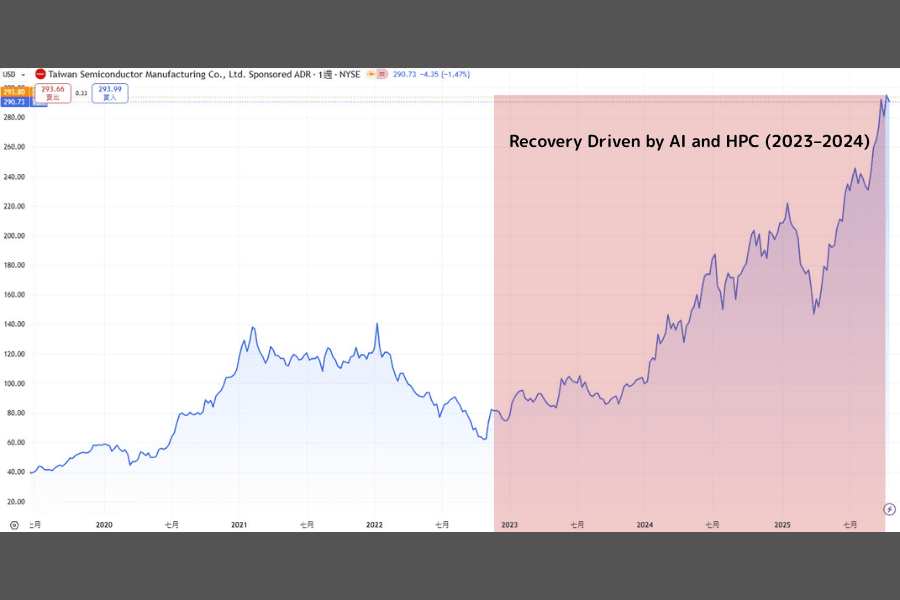
In recent years, TSMC ADR's price action has fully reflected the cyclical nature of the semiconductor industry and shifts in market sentiment. Driven by pandemic demand, rate policy, and the AI boom, the price has formed several clear swings, showing a "high-volatility, high-growth" character.
Pandemic and Supply Shortage Phase (2020–2021)
During the COVID-19 pandemic, global demand for remote work, laptops, and servers surged, tightening chip supply. TSMC's advanced-process capacity ran almost full, and revenue and gross margin kept climbing.
TSMC ADR saw a notable rally in this phase, with the price doubling, becoming one of the main forces driving the tech-stock bull market.
Rate Hikes and Cyclical Correction Phase (2022)
In 2022, global inflation heated up and the Federal Reserve began a rapid hiking cycle, raising the cost of capital, and high-valuation tech stocks generally faced pressure. At the same time, weaker consumer-electronics demand and inventory adjustments dragged the semiconductor cycle lower.
TSMC ADR fell clearly from its highs, market confidence briefly weakened, and capital in the tech sector visibly contracted.
Recovery Driven by AI and HPC (2023–2024)
From 2023, demand for generative AI and high-performance computing (HPC) grew rapidly, becoming the key force behind the semiconductor recovery. Large customers such as NVIDIA and AMD increased advanced-process orders, returning TSMC's revenue to a growth track.
TSMC ADR's price rebounded sharply from its lows and held a high range through 2024, with the market keeping strong confidence in its long-term technical lead and profitability.
Overall, TSMC ADR's moves are highly correlated with the global tech investment cycle. When demand for AI, HPC, and automotive chips expands, it often leads other semiconductor companies; during macro tightening or industry inventory adjustments, it may face larger corrections.
From a long-term view, TSMC remains a representative and resilient growth company in the global tech supply chain, and its ADR is widely regarded as an important gauge of the tech industry's cycle.
Trade US Stock CFDs with Titan FX
Titan FX offers 100+ US stock CFDs on MT4/MT5 with up to 20:1 leverage, tight spreads, and full long/short flexibility.
5. Frequently Asked Questions (FAQ)
Q1. What is the TSMC ADR ticker?
The TSMC ADR ticker is TSM, listed on the New York Stock Exchange (NYSE). Investors can trade it directly through a US stock broker.
Q2. Do TSMC ADR and the Taiwan stock price move exactly in step?
No. Their long-term trends broadly align, but they are affected by FX swings, time-zone differences, and market sentiment, so short-term price gaps can appear.
Q3. Do ADR investors receive dividends?
Yes. If TSMC pays a cash dividend, ADR investors receive a USD-denominated dividend in proportion to their holdings. Note that some banks may charge fees or withholding tax.
Q4. Do I need a Taiwan brokerage account to buy TSMC ADR?
No. TSMC ADR can be traded directly in USD through a US stock broker, unrelated to a Taiwan brokerage account. For overseas investors or those holding only a US stock account, it is a more convenient way to invest.
Q5. Are there trading-hour or liquidity limits on TSMC ADR?
TSMC ADR can be freely traded during US regular hours (ET Monday–Friday 9:30–16:00), and some brokers also support pre-market and after-hours trading. TSM is one of the top ADRs by market cap and volume, with high liquidity.
Q6. Can you invest in TSMC (TSM) through Titan FX?
Titan FX offers US-stock contracts for difference (CFDs), letting you trade US-stock instruments such as TSMC's ADR (TSM), with two-way (long/short) trading, up to 20x leverage, and no need to hold the underlying shares. Understand each instrument's volatility and manage capital before trading.
6. Conclusion
TSMC ADR (NYSE: TSM) is one of the most direct ways for international investors to take part in the growth of global semiconductors. It combines the fundamental strengths of a Taiwan company with the liquidity of the US market, letting global investors join the long-term growth of the semiconductor industry with USD-denominated assets.
As the world's largest foundry, TSMC's performance is closely tied to key tech areas such as AI, HPC, automotive electronics, and cloud computing. The TSMC ADR price reflects not only the company's profitability but also changes in global tech capital expenditure and market confidence.
For beginner investors, understanding how TSMC ADR works, the core factors that move its price, and market cycles helps build a more complete international investing perspective.
Supported by intensifying global tech competition and long-term semiconductor demand, "TSMC US stock" is not just an investment target but also an important window for observing the pulse of the global tech industry.
Further Reading
- What Time Does the US Stock Market Open?
- What Is US Pre-Market Trading?
- NYSE, NASDAQ, and AMEX: The Three Major US Exchanges
- What Is a CFD (Contract for Difference)?
The financial markets research team at Titan FX. We produce educational content across a broad range of instruments, including forex (FX), commodities (crude oil, precious metals, agricultural products), equity indices, U.S. stocks, and crypto assets.
Primary Sources by Category
- Official data and market bodies: TSMC public earnings and investor-relations information; New York Stock Exchange (NYSE) listing data; Bank of New York Mellon (BNY Mellon) depositary-receipt information
- Industry and research: research on the industry structure and cycles of the global semiconductor and foundry market (AI / HPC / automotive electronics)
- Market data: Titan FX live quotes and US-stock CFD prices; TSMC ADR (TSM) share-price analysis from major financial media