

What Is US Pre-Market Trading? Times, Rules, and Strategy
US pre-market trading is the extended session before the regular open (4:00–9:30 a.m. ET), where ECNs/ATSs match limit orders so investors can react to earnings and overnight news ahead of the bell.
As US stocks move toward a "24-hour trading era," investors no longer have to wait until night to take part in the market.
Among the sessions, "US Pre-Market Trading" has become a focus for Asian investors — it lets you capture earnings, news, and international market changes before the open, in the afternoon Asia time.
Pre-market is not just a warm-up before the open; it is also a key moment for observing market sentiment and institutional moves.
This article walks you through the definition, hours, mechanism, trading rules, advantages, and risks of US pre-market trading, and analyzes which situations best suit a pre-market strategy — helping you position ahead of the official open and grasp the market's rhythm.
- Pre-market defined: Extended trading before the regular open (ET 9:30) for stocks and ETFs.
- Hours: ET 4:00–9:30 (winter 5:00–10:30); timezone-friendly for Asian afternoons.
- Mechanism: ECN/ATS (Instinet, ARCA, BATS, EDGX) match limit orders under SEC oversight.
- Traits and risks: Institution-led, low volume, wide spreads, fast quotes, limit orders only.
- Use cases: Earnings, data, breaking events, hedging; or trade US-stock CFDs at up to 20x.
1. What Is US Pre-Market Trading?
US pre-market trading (Pre-Market Trading) is the extended session opened before the US stock market's regular open (ET 9:30), letting investors enter early to buy and sell stocks or ETFs.
This system exists mainly so investors can react to important information — corporate earnings, economic data, international events, or shifts in market expectations — before the official open. Through pre-market trading, prices absorb global information faster, so US stocks are already close to a true supply-demand balance by the open.
Unlike the regular session, pre-market participants are mainly institutional investors and professional traders, so volume is usually lower and quotes swing more. This trait makes the pre-market price an important "sentiment indicator" for gauging the day's trend.
For example, if a large tech company posts better-than-expected earnings before the open, its stock often rises noticeably in pre-market; conversely, bad news can trigger a sharp drop. These moves tend to carry into the regular open, serving as a leading signal of market sentiment and capital flow.
For Asian investors, the pre-market window falls roughly in the afternoon to evening, which is more convenient — you can grasp the market's pulse in real time without staying up for the US open.
Further reading: What time does the US stock market open?
2. US Pre-Market Hours and Market Structure
The US trading system consists of four main sessions: Pre-Market, Regular Session, After-Hours, and Overnight.
These four stages make the US market run almost around the clock, letting global investors participate flexibly across time zones and capture volatility and news changes.
The table below maps each session against Eastern Time (ET), UTC+8 (Taiwan / Hong Kong / Singapore), and Japan time UTC+9.
| Category | Eastern Time (ET) | Taiwan / HK / Singapore (UTC+8) | Japan Time (UTC+9) | Features |
|---|---|---|---|---|
| Pre-Market | 4:00–9:30 (DST) / 5:00–10:30 (Std) | 16:00–21:30 (DST) / 18:00–23:30 (Std) | 17:00–22:30 (DST) / 19:00–00:30 (Std, next day) | React early to news, earnings, and economic data |
| Regular Session | 9:30–16:00 | 21:30–04:00 (DST) / 22:30–05:00 (Std) | 22:30–05:00 (DST) / 23:30–06:00 (Std) | Highest volume, indicative pricing |
| After-Hours | 16:00–20:00 | 04:00–08:00 (DST) / 05:00–09:00 (Std) | 05:00–09:00 (DST) / 06:00–10:00 (Std) | Extended trading after earnings releases |
| Overnight | 20:00–04:00 (next day) | 08:00–16:00 (DST) / 09:00–17:00 (Std) | 09:00–17:00 (DST) / 10:00–18:00 (Std) | Provided by ATS platforms, tradable during Asian daytime |
DST usually runs from mid-March to early November each year, with standard time the rest of the period; actual start/end dates follow that year's US daylight-saving rules.
3. How US Pre-Market Trading Works and Its Rules (ECN/ATS)
US pre-market trading is not matched directly by traditional exchanges (NYSE, NASDAQ) but operates through an Electronic Communication Network (ECN) or an Alternative Trading System (ATS).
Common platforms include Instinet, ARCA, BATS, and EDGX, all regulated by the U.S. Securities and Exchange Commission (SEC).
Through electronic matching, these platforms let investors place limit orders before the open and fill against other participants (such as institutions or market makers) at agreed prices.
Basic Rules and How It Works
- Trading hours: ET 4:00–9:30 (5:00–10:30 in winter).
- Order type: Only limit orders are supported; market orders are not.
- Validity: Unfilled pre-market orders are automatically canceled at the open or rolled into the regular session (per broker rules).
- Instruments: You can trade US stocks and major ETFs, but some small-cap or thinly traded names may not be open for pre-market matching.
- Quote traits: Volume is low, quotes move fast, and the spread is usually wider than in the regular session.
Because pre-market depth is limited, your chance of a fill depends on quote competitiveness. Set prices carefully and avoid market orders to prevent slippage risk.
4. Key Traits, Advantages, and Risks of US Pre-Market Trading
US pre-market is an extended session before the regular open, led mainly by institutional investors.
Although volume is relatively small, price changes are often forward-looking and indicative of the day's trend.
For investors in Asia, the pre-market window falls in the afternoon to evening, so they can join US stocks without staying up late — an important window for observing market direction.
Market Traits
Trait 1: Quickly Prices In Market News
Pre-market is the first wave of reaction after earnings, data releases, or international news.
Investors can read sentiment and capital flow from pre-market price changes, giving them a basis for strategy before the regular open.
Trait 2: Institution-Led, with Clear Volatility
Pre-market trading is dominated by institutions and high-frequency traders, with lower retail participation.
Because resting order volume is limited, quotes are sensitive, and even small trades can cause noticeable swings.
Trait 3: Spanning Asian and European Markets
The pre-market window overlaps with Europe's early hours, so it is often affected by the European open, international oil prices, and currency moves, creating a cross-market linkage effect.
Investor Advantages and Risks
| Advantages | Risks |
|---|---|
| React early to news and earnings, grasping market direction | Low volume and insufficient liquidity |
| Avoid the sharp swings at the moment of the open | Wide spreads, unstable prices |
| Timezone-friendly; Asian investors can join directly | Limit orders only; asymmetric information |
Pre-market has the traits of "high sensitivity and low liquidity."
Paired with a clear trading plan and limit-order risk control, it lets you effectively grasp market direction and react ahead of major news.
However, without real-time information or a risk-control framework, trading rashly can leave you at the mercy of price swings.
So pre-market is better used as a reference tool for observing sentiment and shaping strategy, rather than as a main trading session.
5. When to Use US Pre-Market Trading
Although pre-market volume is limited, in specific situations it lets investors react to news first and position ahead.
The following situations are especially well suited to seizing pre-market opportunities:
Case 1: Company Earnings or Guidance Updates
Large companies (such as Apple, Tesla, and Microsoft) often release earnings or guidance before the open. Pre-market quotes usually reflect sentiment first, so investors can adjust positions based on the data and gain an edge before the open.
Case 2: Economic Data Release Windows
Key indicators such as CPI, NFP, and PPI are mostly released in the early ET morning. Through pre-market trading, investors can adjust positions or hedge in real time based on the data, avoiding sharp swings after the open.
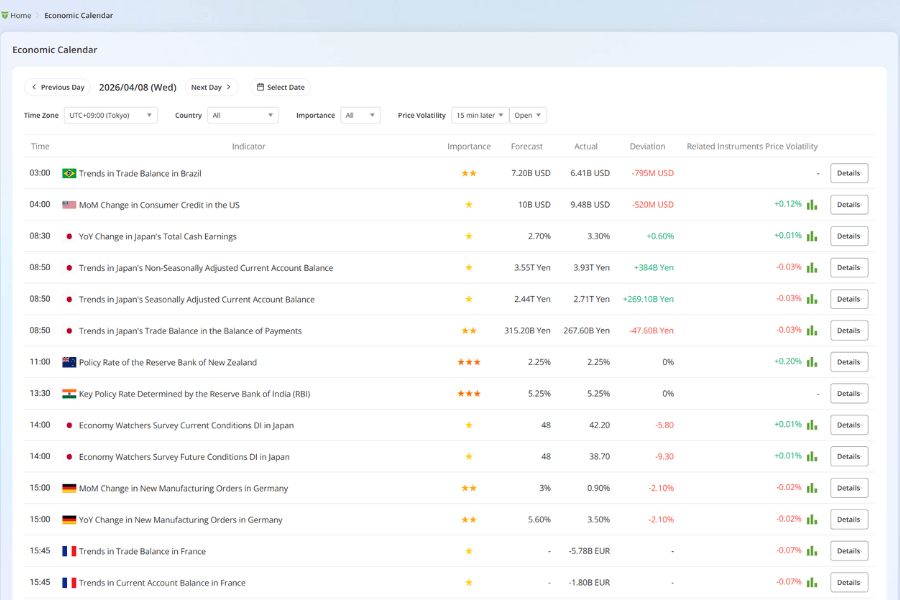
Titan FX offers a free economic calendar to check release times and forecasts for key events such as GDP, CPI, and non-farm payrolls (NFP), helping traders grasp the market's rhythm.
Case 3: Global Breaking Events Affecting the Market
If breaking news hits Asian or European markets — such as a central bank policy change or a geopolitical event — pre-market usually reacts ahead of time. Investors can adjust positions before the open to reduce gap risk.
Case 4: Short-Term Trading and Ad-Hoc Hedging
For traders familiar with the market's rhythm, pre-market volatility is high but also offers short-term entry and exit opportunities. If data or earnings are released unexpectedly, you can hedge on the fly via pre-market, boosting trading flexibility.
Trade US Stock CFDs with Titan FX
Titan FX offers 100+ US stock CFDs on MT4/MT5 with up to 20:1 leverage, tight spreads, and full long/short flexibility.
6. Frequently Asked Questions (FAQ)
Q1. What are the US pre-market trading hours?
US pre-market trading runs ET 4:00–9:30 (5:00–10:30 in winter). Converted to Asian time, that falls in the afternoon to evening for Taiwan / Hong Kong / Singapore (UTC+8), so you can join without staying up late.
Q2. How does pre-market trading differ from the regular session?
Pre-market is matched via ECN/ATS and led by institutions and professional traders. Volume is lower, spreads are wider, quotes move fast, and only limit orders are supported — unlike the high liquidity of the regular session.
Q3. Why is the pre-market price often seen as a "sentiment indicator"?
Pre-market reflects earnings, economic data, and international news first, and those changes tend to carry into the regular open, so the pre-market price is treated as a leading signal of market sentiment and capital flow.
Q4. What are the main risks of pre-market trading?
Low liquidity makes orders harder to fill, widens spreads, and causes sharp quote swings. Only limit orders are allowed and information is more asymmetric, so chasing price with market orders easily causes slippage.
Q5. Is pre-market trading suitable for Asian investors?
Yes. The pre-market session falls in the afternoon-to-evening Asian time, is timezone-friendly, and needs no late nights, making it easy to observe market direction. Use limit orders, control order size and risk, and treat it as a supporting strategy rather than a main session.
Q6. Can you trade US-stock markets at Titan FX?
Titan FX offers US-stock contracts for difference (CFDs) with two-way (long/short) trading, up to 20x leverage, and no need to hold the underlying shares. Trading hours follow platform rules; understand each instrument's volatility and manage capital before trading.
7. Conclusion
US pre-market trading (Pre-Market Trading) lets investors react to news, earnings, and market information before the official open, making it a key link in the global market's "around-the-clock trading."
For Asian investors, the pre-market window falls in the afternoon to early evening — convenient and free of late nights, while letting them grasp international market changes more immediately.
However, because pre-market volume is low and price swings are larger, it is advisable to trade with limit orders and control order size and risk, treating it as a supporting strategy rather than a main session.
Understanding how pre-market trading works and its potential risks helps investors grasp the market's rhythm more flexibly and position ahead before key news is released, seizing the initiative.
Further Reading
- What Is US After-Hours Trading?
- What Is US Overnight Trading?
- What Time Does the US Stock Market Open?
- What Is a CFD (Contract for Difference)?
Titan FX Research. Investor-education content covering forex (FX), commodities (oil, precious metals, agricultural products), stock indices, US equities, and crypto assets across global markets.
Primary Sources by Category
- Official data and market bodies: U.S. Securities and Exchange Commission (SEC) rules; ECN/ATS platform information such as Instinet, ARCA, BATS, and EDGX
- Industry and research: research on the market structure and liquidity of US extended sessions (pre-market / after-hours / overnight)
- Market data: Titan FX live quotes and US-stock CFD prices, economic calendar; US equity market analysis from major financial media