

What Is US After-Hours Trading? Times, Rules, and Strategy
US after-hours trading is extended trading conducted via electronic networks (ECNs) from 16:00 to 20:00 ET, after the regular session (9:30–16:00 ET) closes. It lets investors react to earnings and breaking news in real time, but with lower liquidity and wider spreads.
Many investors assume the US market stops once it closes, but in reality after-hours trading is the start of another key battlefield.
The after-hours session is the main time when institutions and retail investors digest earnings, economic data, and breaking events, and it is also one of the peaks of sharp price moves. Master its rules and risk traits, and you can position ahead of the major players.
This article comprehensively analyzes the importance of this extended market — from the definition, trading hours, and mechanism to the advantages, risks, and real-world use cases — to help you participate in US-stock investing more flexibly.
- Defined: extended ECN trading after the regular session, 16:00–20:00 ET
- Four sessions: pre-market, regular, after-hours, overnight (+ time table)
- Mechanism: ECNs (NYSE Arca, Nasdaq) match limit orders, under SEC oversight
- Pros & cons: react in real time, but low liquidity, wide spreads, limit-only
- Use cases: earnings, policy, hedging; also via US-stock CFDs (Titan FX up to 20x)
- 1. What Is US After-Hours Trading?
- 2. The Four US Trading Sessions at a Glance (Pre, Regular, After, Overnight)
- 3. How Does US After-Hours Trading Work? (The ECN Mechanism)
- 4. Advantages and Risks of US After-Hours Trading
- 5. When Is After-Hours Trading Appropriate?
- 6. Frequently Asked Questions (FAQ)
- 7. Conclusion
1. What Is US After-Hours Trading?
US After-Hours Trading is the extended trading stage where, after the US stock market's regular session (ET 9:30–16:00) ends, investors can still buy and sell through an Electronic Communication Network (ECN).
This system lets the market keep reacting in price to external events after the official close. Corporate earnings, economic data, policy statements, or sudden international news are often released after hours, so investors can adjust positions immediately rather than passively waiting for the next open.
After-hours trading was once led mainly by institutional investors and professional traders; now, with electronic brokers and online platforms widespread, ordinary investors can also participate directly, making the after-hours market an important link in the overall US-stock liquidity chain.
The after-hours market is characterized by high information sensitivity, relatively limited volume, and more concentrated price swings. Although not a primary session, it offers more flexibility and strategic room for investors who want to grasp the market's rhythm and react ahead of the news.
2. The Four US Trading Sessions at a Glance (Pre, Regular, After, Overnight)
The US market operates almost around the clock, from early-morning pre-market trading to the next dawn's overnight trading, each session with its own function and traits.
Understanding the time distribution and trading features of these four main stages helps you choose a session that fits your schedule and strategy.
The table below maps ET against UTC+8 (Taiwan / Hong Kong / Singapore) and Japan time UTC+9 for cross-time-zone trading.
| Category | Eastern Time (ET) | Taiwan / HK / Singapore (UTC+8) | Japan Time (UTC+9) | Features |
|---|---|---|---|---|
| Pre-Market | 4:00–9:30 (DST) / 5:00–10:30 (Std) | 16:00–21:30 (DST) / 18:00–23:30 (Std) | 17:00–22:30 (DST) / 19:00–00:30 (Std, next day) | React early to news, earnings, and economic data |
| Regular Session | 9:30–16:00 | 21:30–04:00 (DST) / 22:30–05:00 (Std) | 22:30–05:00 (DST) / 23:30–06:00 (Std) | Highest volume, indicative pricing |
| After-Hours | 16:00–20:00 | 04:00–08:00 (DST) / 05:00–09:00 (Std) | 05:00–09:00 (DST) / 06:00–10:00 (Std) | Extended trading after earnings releases |
| Overnight | 20:00–04:00 (next day) | 08:00–16:00 (DST) / 09:00–17:00 (Std) | 09:00–17:00 (DST) / 10:00–18:00 (Std) | Provided by ATS platforms, tradable during Asian daytime |
DST usually runs from mid-March to early November each year, with standard time the rest of the period; actual start/end dates follow that year's US daylight-saving rules.
Further reading: What time does the US stock market open?
3. How Does US After-Hours Trading Work? (The ECN Mechanism)
US after-hours trading does not go through traditional exchanges like NYSE or NASDAQ but relies on an Electronic Communication Network (ECN) to match orders.
These systems are regulated by the SEC (U.S. Securities and Exchange Commission) and let investors keep placing and filling orders after the regular session, ensuring transparency and order during the extended session.
How an ECN Works:
An ECN automatically matches limit orders — once both buyers and sellers set their prices, the system automatically finds matching orders to fill.
Common after-hours ECN platforms include:
- NYSE Arca: covers stocks and ETFs, with fast execution.
- Nasdaq Market Center: supports Nasdaq stocks and some ETFs.
- Instinet: mainly for institutional investors.
- BATS ECN: known for high-frequency matching and liquidity.
Three Key Points of After-Hours Trading
| Item | Description |
|---|---|
| Limit orders only | Only limit orders can be used, to avoid sharp price swings from low liquidity. |
| Fixed hours | ET 16:00–20:00. Unfilled orders are automatically canceled at the after-hours close. |
| Limited instruments | Not all stocks are open for after-hours trading; low-liquidity names may not be supported. |
Supported instruments and rules for after-hours trading vary slightly by broker, so it is advisable to confirm platform limits in advance.
Although after-hours volume is lower, ECNs provide the possibility of price discovery and extended trading, letting investors respond more flexibly to major news or after-hours earnings.
4. Advantages and Risks of US After-Hours Trading
Although it is an extended session, the function of US after-hours trading long ago went beyond supplementing liquidity. For investors, it is a key window to react to news and adjust positions in real time, but it also carries risks such as low liquidity and sharp price swings, requiring extra caution.
| Advantages | Risks |
|---|---|
| React quickly to earnings and breaking news | Low volume; unstable quotes and sharp swings |
| Flexibly adjust positions and avoid overnight risk | Wide spreads, prone to slippage |
| Extended trading time, more flexible execution | Limit orders only; limited instruments and rules |
After the close, most companies release earnings or major information. After-hours trading lets investors adjust positions immediately, gaining a faster reaction time than the next open. When breaking events hit global markets, they can also adjust strategy in time and reduce overnight exposure.
However, after-hours markets have relatively few participants and low liquidity, making orders harder to fill and widening spreads; combined with limit-orders-only and a limited range of instruments, low-liquidity stocks are especially prone to sharp price swings or slippage.
After-hours trading boosts flexibility and reaction speed but also tests an investor's grasp of market structure and risk control. It is advisable to understand broker rules before trading and tightly control order conditions and position risk.
5. When Is After-Hours Trading Appropriate?
After-hours trading is not about "trading a few more hours" but about responding quickly to market changes in specific situations. Because liquidity and execution efficiency are lower, entering after-hours has strategic value only when information is clear and the reaction is predictable. Here are four typical timings:
Company Earnings or Results Releases
US companies often release earnings and guidance after the close. When actual data diverges greatly from expectations, the stock often moves immediately. Investors can adjust positions based on fundamentals or technicals to prepare in advance for the gap risk that may appear the next day.
International Events or Policy Statements
When the Fed announces rate decisions, governments change policy, or geopolitical events occur, the after-hours market reflects them first. Investors can use after-hours trading to respond quickly, performing asset reallocation or hedging.
Recommended tool:
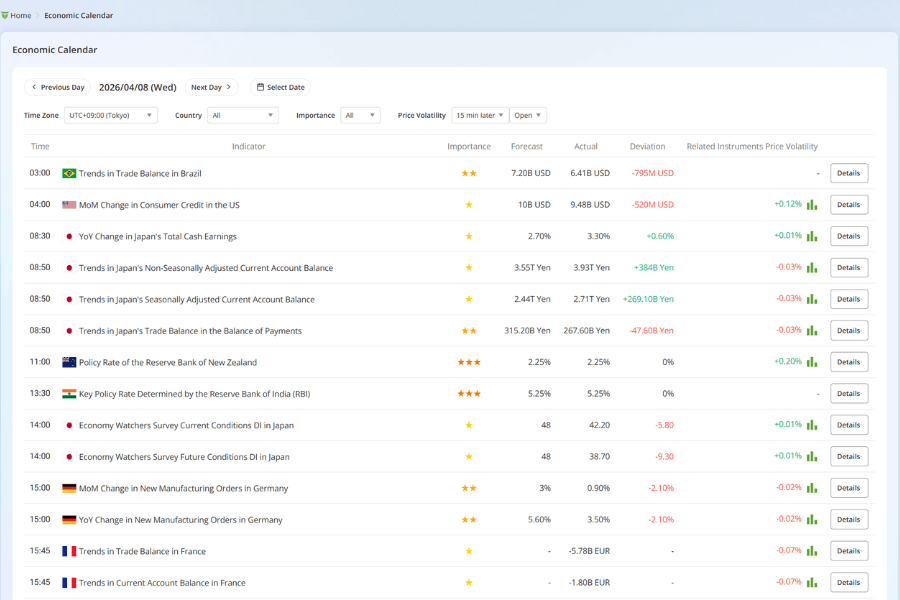
Titan FX offers a free economic calendar to track the timing of key events such as GDP, CPI, and non-farm payrolls (NFP).
Observe Sentiment to Predict the Next Day's Move
After-hours price changes can be seen as the market's "tentative reaction" to the latest news. Short-term traders can observe capital flows from volume and changes in popular names as a reference for the next day's opening strategy.
Actively Adjust or Hedge Existing Positions
If a holding releases bad news after the close (such as a big earnings miss or regulatory risk), you can immediately use after-hours trading to stop out, reduce your position, or hedge to lower overnight risk.
Trade US Stock CFDs with Titan FX
Titan FX offers 100+ US stock CFDs on MT4/MT5 with up to 20:1 leverage, tight spreads, and full long/short flexibility.
6. Frequently Asked Questions (FAQ)
Q1. What are the US after-hours trading times?
US after-hours trading runs ET 16:00–20:00 (after the regular session of 9:30–16:00). Converted to Asian time, that is roughly UTC+8 04:00–08:00 in summer (DST) and 05:00–09:00 in winter.
Q2. How does after-hours trading differ from the regular session?
After-hours is matched via ECN (Electronic Communication Network) rather than the traditional NYSE/NASDAQ exchanges. Volume is lower, spreads are wider, swings are more concentrated, and most platforms support limit orders only.
Q3. Why are many earnings released after hours?
Companies often release earnings and key information after the close to avoid sharp swings in the regular session and give the market time to digest. So stocks tend to jump sharply after hours, and it becomes a window for investors to position ahead.
Q4. What are the main risks of after-hours trading?
Low liquidity makes orders harder to fill, widens spreads, and increases slippage. Only limit orders are allowed and instruments are limited; low-liquidity names see more volatile prices.
Q5. Can retail investors participate in US after-hours trading?
Yes. With electronic brokers now widespread, ordinary investors can participate after hours, but you need broker support and should confirm its instruments and order rules; limits vary slightly by platform.
Q6. Can you trade US-stock markets at Titan FX?
Titan FX offers US-stock contracts for difference (CFDs) with two-way (long/short) trading, up to 20x leverage, and no need to hold the underlying shares. Trading hours follow platform rules; understand each instrument's volatility and manage capital before trading.
7. Conclusion
As an extension of the regular session, US after-hours trading absorbs the market's immediate reaction to earnings, policy, and breaking news, making it an indispensable link in the entire US-stock trading chain. It keeps prices continuous after the close and gives investors extra liquidity and strategic room.
Compared with the regular session, the after-hours market has lower volume, more concentrated swings, and clearer quote gaps, so price behavior is more news-driven and speculative. This trait makes after-hours trading an important window for observing market sentiment and short-term expectations.
Overall, after-hours trading brings the US market closer to a "near-24-hour" operation, strengthening its links to global capital and its speed of reaction to information.
It not only reflects the immediate value of corporate news but also quietly shapes the next day's opening tone, becoming an important gauge of market vitality and efficiency.
Further Reading
- US Pre-Market Trading: Times, Rules, and Risks
- What Is US Overnight Trading?
- What Time Does the US Stock Market Open?
- What Is a CFD (Contract for Difference)?
Titan FX Research. Investor-education content covering forex (FX), commodities (oil, precious metals, agricultural products), stock indices, US equities, and crypto assets across global markets.
Primary Sources by Category
- Official data and market bodies: U.S. Securities and Exchange Commission (SEC) rules; ECN platform information such as NYSE Arca and Nasdaq Market Center
- Industry and research: research on the market structure and liquidity of US extended sessions (pre-market / after-hours / overnight)
- Market data: Titan FX live quotes and US-stock CFD prices, economic calendar; US equity market analysis from major financial media