

US Stock Overnight Trading: Hours, ATS, Advantages, and Risks Explained
US stock overnight trading is the extended session after regular hours and after-hours close (4:00 PM-8:00 PM ET) until the next pre-market opens (4:00 AM ET). Matched on ATS platforms (Blue Ocean, Instinet, etc.), it lets Asia-based investors trade US stocks during their daytime hours without staying up overnight.
Many investors in Asian time zones face the same frustration: "I want to participate in the US market, but staying up to watch the screen isn't sustainable."
As the US stock market moves steadily toward a 24-hour trading era, this pain point is fading. With US Stock Overnight Trading, investors can engage with US equities in real time during their local daytime hours and keep pace with global market developments.
Overnight trading does more than just extend traditional market hours. It lets global investors adjust positions and strategies in real time when breaking news or major events occur. With NYSE Arca's proposal to extend electronic trading to 22 hours per business day, and with multiple major ATS platforms offering overnight matching services, "US stocks tradable around the clock" is moving from vision to practical reality.
This guide takes the perspective of investors in Asian time zones and walks through what overnight trading is, the session timing across regional time zones, the ATS matching mechanism, NYSE Arca's 22-hour plan, the advantages and risks, when to use it, and how it compares with index futures and CFDs — helping you build an efficient routine for following US markets across time zones.
- US stock overnight trading = the extended session from 20:00 ET (after-hours close) to 04:00 ET (next pre-market open).
- Matching runs on ATS (Alternative Trading Systems) like Blue Ocean ATS or Instinet — not the primary exchanges.
- Biggest advantage for investors in Asia: trade US stocks during local daytime; react instantly to overnight news.
- Main risks: low liquidity, wide spreads, sharp price moves, limited fillable size, prints may not carry into the regular session.
- Alternatives: US index futures on CME Globex and Titan FX's US-index CFDs offer deeper liquidity.
- 1. What is US Stock Overnight Trading?
- 2. Overnight Session Hours in Asian Time Zones
- 3. The Four US Trading Sessions (Pre / Regular / After / Overnight)
- 4. The ATS Matching Mechanism
- 5. NYSE Arca's 22-Hour Plan and the Push Toward 24-Hour Markets
- 6. Advantages of Overnight Trading
- 7. Risks and Limitations of Overnight Trading
- 8. When to Use US Stock Overnight Trading
- 9. Overnight Trading vs Index Futures vs CFDs
- 10. Frequently Asked Questions
- 11. Summary
1. What is US Stock Overnight Trading?
US Stock Overnight Trading refers to the extended trading session that runs after the regular session (Eastern Time 9:30–16:00) and the after-hours session (After-Hours, 16:00–20:00) close, continuing until the next pre-market open. The session was introduced to let investors across time zones react to international news and price action in real time.
Compared with the pre-market (Pre-Market) or after-hours sessions, overnight trading's defining features are longer duration and broader time coverage. It fills the gap between the close of after-hours and the next pre-market open, taking US equities closer to a nearly 24-hour continuous trading chain — freeing global investors from time-zone constraints.
Overnight trading does not run through the traditional exchanges (NYSE or NASDAQ) directly. Instead, it is powered by Alternative Trading Systems (ATS), operated by financial institutions registered with and supervised by the US Securities and Exchange Commission (SEC) to ensure transparent and safe market operation. Because the trading venue and liquidity environment differ from regular hours, overnight quotes, volume, and volatility characteristics have their own profile — effectively forming a relatively standalone market.
For investors in Asian time zones, the overnight session happens to fall during local daytime hours, which means you do not need to stay up late to participate flexibly in the US market. For investors looking to react in real time to global news or run short-term strategies, this opens up a new set of trading options and a time-zone advantage.
2. Overnight Session Hours in Asian Time Zones
A typical overnight session runs Sunday through Thursday, Eastern Time 20:00 to 04:00 (next day), filling the gap between after-hours close (20:00 ET) and the next pre-market open (04:00 ET). Some ATS platforms use slightly different boundaries; the actual session hours follow each platform's published schedule.
Overnight Hours × Asian Time Zones
| Session | Eastern Time (ET) | Beijing / Taipei / HK (UTC+8) | Tokyo (UTC+9) |
|---|---|---|---|
| Overnight (DST) | 20:00 – 04:00 (next day) | 08:00 – 16:00 | 09:00 – 17:00 |
| Overnight (Winter) | 20:00 – 04:00 (next day) | 09:00 – 17:00 | 10:00 – 18:00 |
Daylight Saving Time vs Winter Time
The US observes Daylight Saving Time (DST) from the second Sunday of March to the first Sunday of November. During DST, the overnight session in Asian time zones starts one hour earlier than during winter time. During the switch week, check the clock display on your trading platform to avoid misjudging your order timing.
Related reading: Complete Guide to US Stock Market Hours: Regular, Pre/After-Market & Overnight
3. The Four US Trading Sessions (Pre / Regular / After / Overnight)
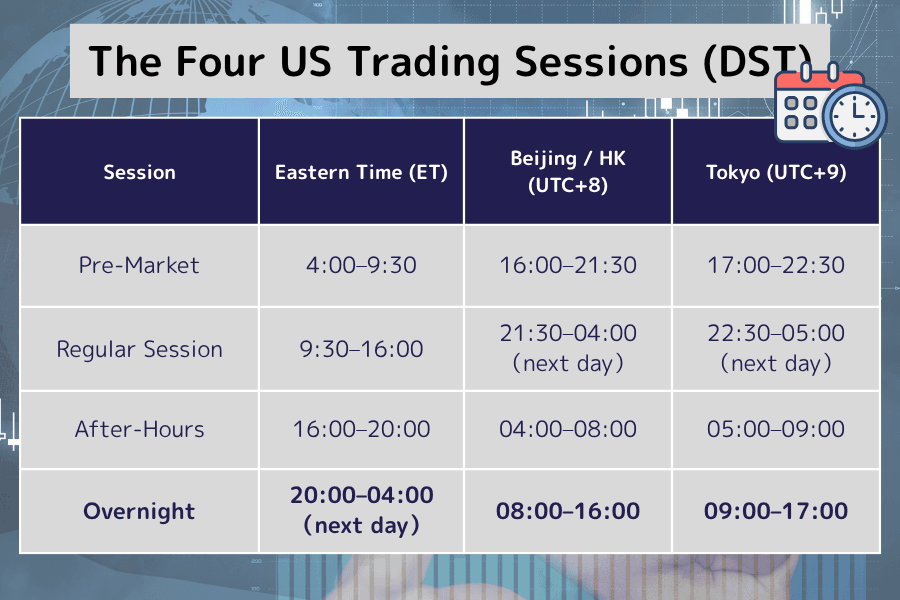
US equity trading is more than just the regular session. The full day breaks into four main windows: pre-market, regular session, after-hours, and overnight. The table below converts Eastern Time into Beijing / HK (UTC+8) and Tokyo (UTC+9) for easy cross-time-zone planning.
| Session | Eastern Time (ET) | Beijing / HK (UTC+8) | Tokyo (UTC+9) | Characteristics |
|---|---|---|---|---|
| Pre-Market | 04:00–09:30 (DST) / 05:00–10:30 (Winter) | 16:00–21:30 (DST) / 17:00–22:30 (Winter) | 17:00–22:30 (DST) / 18:00–23:30 (Winter) | Early reaction to news, earnings, and economic data |
| Regular Session | 09:30–16:00 | 21:30–04:00 (DST) / 22:30–05:00 (Winter) | 22:30–05:00 (DST) / 23:30–06:00 (Winter) | Highest volume, most reliable price discovery |
| After-Hours | 16:00–20:00 | 04:00–08:00 (DST) / 05:00–09:00 (Winter) | 05:00–09:00 (DST) / 06:00–10:00 (Winter) | Extended trading after earnings |
| Overnight | 20:00–04:00 (next day) | 08:00–16:00 (DST) / 09:00–17:00 (Winter) | 09:00–17:00 (DST) / 10:00–18:00 (Winter) | Delivered via ATS platforms; tradable during Asian daytime |
DST typically runs from mid-March through early November, with winter time covering the remaining months. Exact start and end dates follow each year's US DST rules.
Volume Across Sessions
| Session | Relative Volume | Liquidity | Bid-Ask Spread |
|---|---|---|---|
| Regular Session | 100% (baseline) | Highest | Tightest |
| Pre-Market | ~10–20% | Moderate | Wider |
| After-Hours | ~5–10% | Low | Wide |
| Overnight | ~1–5% | Lowest | Widest |
Overnight volume is typically just 1–5% of the regular-session volume, so bid-ask spreads widen noticeably. When trading overnight, pay special attention to slippage and partial-fill risk.
4. The ATS Matching Mechanism
US overnight trading is not matched directly by the New York Stock Exchange (NYSE) or NASDAQ. Instead, it runs through Alternative Trading Systems (ATS) — operated by financial institutions, registered with and regulated by the SEC to ensure transparent and safe operation. Current major overnight matching infrastructure includes institutional-grade platforms such as Blue Ocean ATS and Instinet.
ATS vs Traditional Exchanges
| Dimension | Traditional Exchange (NYSE / NASDAQ) | Alternative Trading System (ATS) |
|---|---|---|
| Operating Hours | Primarily regular session (09:30–16:00 ET) | Primarily overnight and extended sessions |
| Matching Transparency | Public auction; fully visible | Limited public visibility; book depth relatively opaque |
| Regulator | SEC + FINRA (exchange rules) | SEC (Regulation ATS) |
| Order Types | Market, limit, conditional, etc. | Most platforms support limit orders only |
| Liquidity | Highest | Lower, varies with platform scale and participation |
Key Overnight Trading Rules
- Only limit orders (Limit Order) are accepted — you set the price, and the order fills only when the limit is reached
- Any unfilled orders are auto-cancelled at 04:00 ET (Good-till-Time mechanism)
- As an extended market, volume is generally low, and not all stocks or ETFs are available for overnight trading
- Some platforms impose per-order size or notional caps to prevent large orders from triggering abnormal price moves
In short, ATS keeps US equities accessible outside the regular session, enabling investors in different time zones to participate during their local daytime. But because overnight quotes and execution speed can differ meaningfully from the regular session, it is best to rely on limit orders and stay aware of liquidity risk.
5. NYSE Arca's 22-Hour Plan and the Push Toward 24-Hour Markets
The move toward overnight trading isn't confined to the ATS layer. In October 2024, NYSE filed with the SEC to extend its NYSE Arca all-electronic exchange to 22 hours per business day (01:30–23:30 ET), leaving only a 2-hour clearing window on weekdays and keeping weekends closed. The plan awaits SEC approval before launch.
Why NYSE Arca's 22-Hour Plan Matters
- Brings a mainstream exchange close to 24/5, reducing dependence on ATS-only overnight markets
- Clearing and settlement cycles must coordinate with back-end systems such as DTCC, so a 2-hour clearing window is preserved
- Regulatory frameworks need adjustment to cover overnight circuit breakers, volatility controls, and investor protections
Broader Industry Momentum
- NASDAQ has signaled willingness to study the feasibility of "5×24" trading
- Multiple major ATS platforms already provide near-24-hour overnight access from Monday through Friday
- The Depository Trust and Clearing Corporation (DTCC) is modernizing its clearing infrastructure to support extended-hours trading
For investors in Asia and other non-US regions, this could mean direct access to US cash equities during local daytime, reducing dependence on CFDs or futures as workarounds. A complete 7×24 model is still some way off, but the market's direction is clear.
6. Advantages of Overnight Trading
Overnight trading extends the operating hours of the US market, letting investors in Asian time zones participate during local daytime and creating additional room for hedging and positioning.
Advantage 1: Trade US Equities During Asian Daytime
Overnight trading removes the time-zone constraint and lets you operate US equities during the day. It is particularly convenient for daytime-occupied traders or short-term participants, and it helps those who trade Asian markets during daytime monitor cross-market exposure on the same clock.
Advantage 2: Real-Time Response to Breaking Events
The overnight window overlaps with major Asian and European market sessions. If geopolitical events, important economic data, or company news break during this window, investors can act immediately rather than wait for the regular session to open. This is especially useful when central bank meetings, the non-farm payrolls (NFP), or geopolitical news land in Asian time — overnight offers a more direct single-stock response channel than the futures market.
Advantage 3: Positioning and Hedging in Advance
Overnight trading opens up tactical room. You can adjust exposure before or after major announcements, or use overnight moves for short-term setups, reducing gap and overnight risk.
Advantage 4: Integrating Cross-Market Information
The overnight window overlaps with major European exchanges (London, Frankfurt). International capital flows and FX dynamics reflect simultaneously in US single-stock quotes, which helps construct cross-market strategies.
7. Risks and Limitations of Overnight Trading
Risk 1: Low Volume and Insufficient Liquidity
With fewer participants, overnight volume is typically only 1–5% of the regular session, so orders may not match immediately — especially for thinly traded names or small-cap stocks. Large orders may end up only partially filled or entirely unfilled.
Risk 2: Wider Spreads and Sharper Volatility
Shallow market depth means bid-ask spreads can widen materially, and even modest-sized orders can move the price sharply, raising slippage risk. When overnight prices make abnormal moves, the regular session often mean-reverts on the open, so short-term traders should be cautious.
Risk 3: Limit-Orders Only, Limited Symbols
Today, overnight trading accepts only limit orders — market orders are unavailable — and not every stock or ETF is enabled for the overnight session. Before placing an order, confirm whether the symbol is available and understand the platform's auto-cancel rules (typically at 04:00 ET).
Risk 4: Information Asymmetry and Quote Delays
Overnight quotes come primarily from ATS venues, not from the consolidated National Best Bid and Offer (NBBO) that governs the regular session. Some quote feeds may lag or partially cover the overnight window, so verify your data source before trading.
Risk 5: Amplified Corporate-Event Risk
When a company releases major news after the close (M&A, major litigation, earnings shocks), the overnight session is the first to digest it and extreme gaps can occur. Without stop-losses in place, losses can accumulate quickly.
Overall, overnight trading provides a longer operating window and more flexibility, but also tests discipline and risk management. The recommended approach is to rely on limit orders, cap order size, and capture opportunities while limiting downside.
8. When to Use US Stock Overnight Trading
Overnight trading is not the mainstream session, but it offers meaningful flexibility and value for investors who run cross-time-zone strategies, watch global headlines, or execute short-term plays.
When International News or Unexpected Events Drive the Market
If major events — such as geopolitical flashpoints, economic releases, or central bank decisions — happen during Asian daytime, overnight trading lets you adjust exposure immediately instead of waiting for the US open.
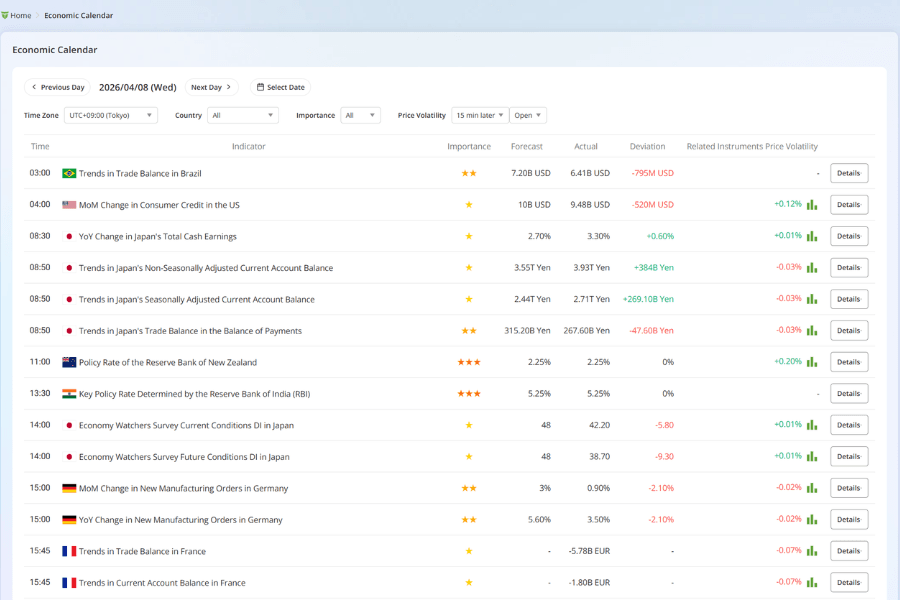
Titan FX provides the global economic indicators lookup and a free economic calendar tool that covers the timing and consensus for key releases such as GDP, CPI, and non-farm payrolls (NFP), helping you keep pace with market tempo.
When Earnings or M&A News Surface Early
If a company's earnings, profit warning, or acquisition speculation lands in the pre-market or overnight window, you can react early — building positions or adjusting stop-losses — before the regular session opens.
When Volatility Offers Short-Term Setups
Overnight volume is thin but moves can be sharp, which suits experienced short-term traders who want to read the tape and anticipate the regular session's direction.
When You Cannot Trade Overnight
For daytime-occupied investors who cannot watch the screen at night, the overnight session acts as a "daytime version" of the US market — you can place orders flexibly during Asian time without missing out on moves.
9. Overnight Trading vs Index Futures vs CFDs
For investors wanting to engage with US equities during Asian hours, three tools stand out: overnight trading, US stock index futures, and US stock CFDs. All three break past the regular-session time constraint, but their underlying mechanisms and best-fit use cases differ materially.
| Dimension | Overnight Trading | US Stock Index Futures | US Stock CFDs |
|---|---|---|---|
| Instruments | Single stocks, ETFs | Stock index futures (ES, NQ, YM, etc.) | Single stocks, indices, ETFs |
| Trading Hours | ET 20:00–04:00 (next day) | Nearly 23 hours (CME Globex) | Nearly 24 hours |
| Leverage | Usually 1× (none) | High (margin-based, large implicit leverage) | Adjustable (up to 500× depending on platform) |
| Liquidity | Low (ATS) | High (CME central matching) | Moderate to high (CFD provider) |
| Two-Way Trading | Short selling possible (borrow required) | Native two-way | Native two-way |
| Settlement | Physical delivery | Daily mark-to-market, expiration delivery | Cash-settled difference |
| Regulator | SEC (ATS) | CFTC + NFA | National regulators (e.g., VFSC) |
How to Choose
- Want to hold actual shares: Overnight trading is one of the few channels that let Asian-time investors buy or sell US cash equities directly
- Want broad index hedging: Index futures offer high liquidity and extended hours
- Want leveraged long/short flexibility: CFDs are the most flexible. Titan FX offers US stock CFDs on MT4 / MT5
Trade US Stock CFDs with Titan FX
Titan FX offers US stock CFDs on MT4/MT5 with up to 20× leverage, tight spreads, and full long/short flexibility — breaking past overnight liquidity and timing constraints.
10. Frequently Asked Questions
What is US stock overnight trading? How is it different from after-hours?
US overnight trading is the extended session that runs after the regular session and the after-hours session (16:00–20:00 ET) close, continuing until the next pre-market open (04:00 ET). Compared with after-hours, overnight trading has a longer window and is matched on ATS platforms rather than directly on traditional exchanges.
What are the overnight hours in Asian time zones?
A typical overnight session runs Eastern Time 20:00 to 04:00 the next day. In Beijing / HK time, that is DST 08:00–16:00, winter 09:00–17:00. In Tokyo time, it is DST 09:00–17:00, winter 10:00–18:00.
Are all US stocks tradable overnight?
No. Only select high-liquidity stocks and ETFs are available overnight. Thinly traded stocks, OTC names, and freshly listed IPOs are usually not supported. Check your platform before placing an order.
Can I use market orders overnight?
Usually not. The standard overnight rule is that only limit orders are accepted, to avoid market orders hitting extreme prices in thin conditions. Orders unfilled by 04:00 ET are typically auto-cancelled.
Do overnight prices affect the regular session open?
They offer a reference signal but the influence is limited. Since overnight volume is only 1–5% of regular-session volume, abnormal overnight moves often mean-revert on the open. However, if the overnight move carries a clear trend with major news, the regular session tends to follow that direction.
When will NYSE Arca's 22-hour trading plan launch?
NYSE filed the proposal in October 2024, and it remains pending SEC review. The launch date depends on regulatory approval; watch NYSE's official announcements and the NYSE Hours and Calendars page for updates.
How can investors in Asian time zones participate in overnight trading?
Three main paths: (1) place orders through an online brokerage platform that supports overnight sessions, (2) use US stock index futures (CME Globex) to hedge or scale exposure, or (3) trade US stock CFDs on MT4 / MT5 platforms for near-24-hour access. Availability depends on each platform's product list.
11. Summary
US stock overnight trading (Overnight Trading) takes the market into a near-24-hour operating era, giving global investors flexibility across different time zones. For investors in Asian time zones, the biggest advantage is being able to engage with US equities during the day and respond to international news in real time — no late-night screen time required.
That said, overnight trading is an extended market: low volume, wide spreads, limited symbols, limit-orders only. Operate accordingly — rely on limit orders, cap position size, and manage risk. As NYSE Arca's 22-hour plan, expanding ATS overnight matching, and mature alternatives like index futures and CFDs come together, investors in Asian time zones can pick the right combination of tools depending on their goal — holding cash equities, hedging an index, or running flexible two-way setups.
Used thoughtfully, overnight trading materially boosts flexibility and efficiency — but the session's characteristics demand stricter risk discipline: limits over market, modest size, symbol selection, and stop-losses always in place are what keep you capturing opportunities steadily in the extended session.
Further Reading
- US Stock Market Hours — Full map of US pre-market, regular, after-hours, and overnight sessions.
- VIX Volatility Index — Overnight headlines tend to spike VIX — essential for overnight traders.
- US Treasury Yields — Overnight Treasury moves transmit into the next day's US equity tape.
- Inflation — CPI prints land overnight for Asia and frequently drive overnight volatility.
- Monetary Policy — FOMC statements often release during Asian hours, shaping next-day US stocks.
- Asset Allocation — Portfolio thinking for cross-time-zone trading.
The Titan FX Research team covers global macroeconomic indicators, foreign exchange (FX), commodities (oil, precious metals, agriculture), equity indices, US stocks, and crypto assets, producing educational content for investors and traders.
Primary Sources by Category
- Official data and regulators: U.S. Securities and Exchange Commission (SEC) — Regulation ATS / Alternative Trading System rules; NYSE Hours and Calendars; NASDAQ Trader Calendar; SIFMA — Market Holiday Recommendations.
- Exchanges and market data: Blue Ocean ATS — overnight matching engine; Instinet — ATS pioneer; CME Group — Globex futures electronic trading; NYSE Arca — 22-hour pilot proposal; Bloomberg, Reuters — real-time and historical overnight data.
- Media and historical references: Bloomberg, Reuters, WSJ, Financial Times; Robinhood's 24/5 launch (2023), Schwab thinkorswim 24/5 (2024), the SEC 24×5 proposal discussion, Blue Ocean ATS peak volume metrics, and the broader retail extended-hours trend.