

What Are Live Cattle? Feeder Cattle Difference, Futures Specs, Price Drivers and How to Trade

Live cattle prices depend on the size of the U.S. cattle herd, feed costs, beef demand and import policy. With the U.S. herd near historic lows, live cattle futures set repeated record highs in 2025 and 2026, but also fell sharply on import policy news.
This guide explains what live cattle are, how they differ from feeder cattle, the futures contract specifications, what drives prices, the state of the U.S. herd, how prices have moved over the past five years, and how to trade live cattle with Titan FX.
- Live cattle have finished feeding and reached slaughter weight; feeder cattle are animals about to enter a feedlot
- The benchmark is CME Live Cattle futures (LE): 40,000 pounds per contract, quoted in cents per pound
- The main price drivers are herd size, feed costs, beef demand and packing capacity, import policy, and animal disease
- According to the USDA, the U.S. had about 86.2 million head of cattle and calves on January 1, 2026, slightly fewer than a year earlier
- At Titan FX, the instrument is LiveCattle, which Titan FX classifies as a soft commodity, with fixed 50:1 leverage
1. What Are Live Cattle?
U.S. beef cattle go through several stages between birth and slaughter. Calves are born on cow-calf operations, graze after weaning, then move to feedlots to be fattened on grain before they are sold to meatpackers. Live cattle does not mean every animal that has not yet been slaughtered; it refers to cattle that have finished feeding and reached slaughter weight.
Live cattle vs. feeder cattle
| Live cattle | Feeder cattle | |
|---|---|---|
| Stage | Finished feeding, ready for slaughter | Reached a certain weight, about to enter a feedlot |
| Main buyers | Meatpackers | Feedlots |
| CME futures | Live Cattle (LE) | Feeder Cattle (GF) |
| Settlement | Physical delivery | Cash-settled |
Feedlots buy feeder cattle, feed them, and sell them as live cattle. The gap between live cattle prices, feeder cattle prices and feed costs is the feedlot's margin, and it shapes how willing feedlots are to buy feeder cattle.
Unlike wheat or corn, live cattle have no harvest season. Crop prices tend to follow the seasonal cycle of planting and harvest, while live cattle supply depends on herd size, and rebuilding a herd after it shrinks takes years.
2. What Are Live Cattle Futures (LE)? CME Contract Specs
The benchmark for live cattle is CME Group's Live Cattle futures contract:
| Item | Details |
|---|---|
| Exchange | Chicago Mercantile Exchange (CME Group) |
| Ticker | LE |
| Contract size | 40,000 pounds |
| Price quotation | U.S. cents per pound |
| Settlement | Physical delivery |
A price of 224 means 224 cents, or $2.24, per pound. One contract is worth about 40,000 pounds × $2.24, or roughly $89,600.
3. What Drives Live Cattle Prices?
-
Herd size: the number of cattle available for slaughter depends on cow and calf numbers from several years earlier. A shrinking herd keeps supply tight for a long time and tends to hold prices high
-
Feed costs: feedlots fatten cattle mainly on grains such as corn. Higher feed costs squeeze feedlot margins and affect their appetite for feeder cattle
-
Beef demand and packing capacity: consumer demand for beef reaches live cattle prices through what meatpackers are willing to pay, and changes in slaughter volumes and plant capacity also shift demand for live cattle
-
Import policy and trade: the U.S. imports live cattle from Mexico and beef from other countries, so tighter or looser import rules change expectations for supply
-
Animal disease: disease affects trade and slaughter volumes. Because of the New World screwworm outbreak in Mexico, the U.S. suspended imports of Mexican cattle from May 2025, and the measures were adjusted several times afterward
4. U.S. Cattle Herd Size and USDA Reports
The USDA's Cattle report, released on January 30, 2026, showed:
| Item | January 1, 2026 | Change from a year earlier |
|---|---|---|
| All cattle and calves | About 86.2 million head | 86.5 million a year earlier |
| Beef cows that have calved | About 27.6 million head | −1% |
| Heifers kept for beef cow replacement | About 4.7 million head | +1% |
| Cattle on feed in all feedlots | About 13.8 million head | −3% |
| 2025 calf crop | About 32.9 million head | −2% |
With fewer beef cows and calves, the number of cattle available for feeding and slaughter is likely to stay limited for some time. The small increase in replacement heifers is the kind of change that appears first when a herd starts to rebuild, but the pace will depend on what later reports show.
Two USDA reports are widely followed by live cattle traders:
| Report | Frequency | Contents |
|---|---|---|
| Cattle | Every January | Total U.S. cattle, cows and calves |
| Cattle on Feed | Monthly | Cattle in feedlots with capacity of 1,000 head or more, placements and marketings |
Cattle on Feed covers only feedlots with capacity of 1,000 head or more, so its figures are not on the same basis as "all feedlots" in the table above. According to the January Cattle report, these larger feedlots held about 83% of all cattle on feed. The Cattle report also has a July mid-year edition, which was suspended in 2024 for budget reasons and reinstated in 2025.
5. Live Cattle Prices Over the Past Five Years
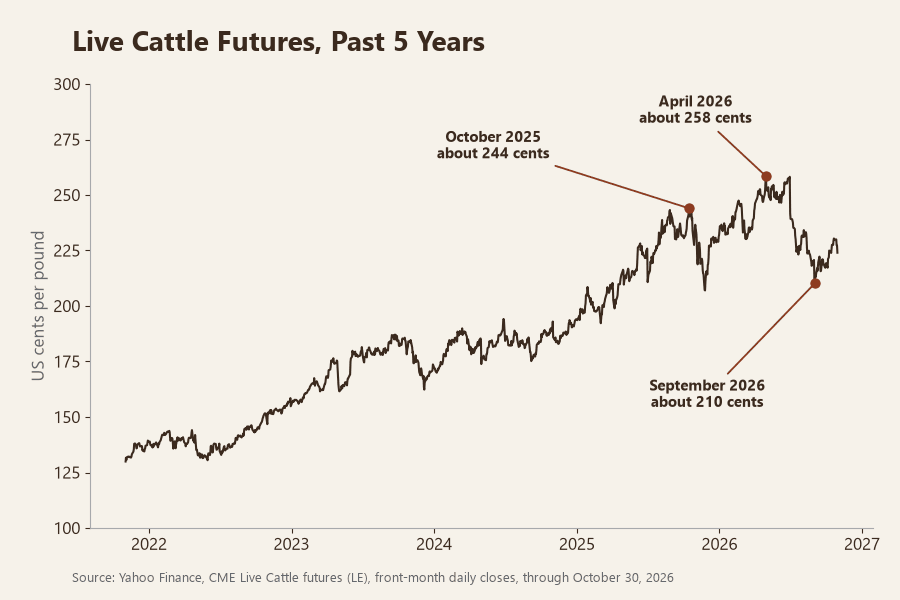
The chart below shows front-month CME Live Cattle futures daily closes over the past five years.
-
2022 to 2025: the U.S. herd kept shrinking and supply tightened. Live cattle futures climbed from about 139 cents per pound at the end of 2021 to about 244 cents on October 16, 2025
-
Late October 2025: to bring down beef prices, the U.S. government said it would quadruple the low-tariff import quota for Argentine beef. Fearing that more imports would push beef prices lower, the market sold off, and most live cattle contracts hit their daily limit down on October 24
-
2026: prices recovered to close at about 258 cents on April 30. In July, the USDA announced a phased reopening of southern border ports, and imports of Mexican cattle resumed through Douglas, Arizona on August 24. As the market reassessed supply, futures closed at about 210 cents on September 2 and about 224 cents on October 30
6. How to Trade Live Cattle CFDs: Titan FX Specs and Margin
Titan FX offers live cattle as a CFD under the name LiveCattle. Live cattle are traditionally classed as livestock, but Titan FX groups them with cocoa, coffee and corn under soft commodities.
| Titan FX LiveCattle (CFD) | CME Live Cattle futures | |
|---|---|---|
| Contract size | 200 | 40,000 pounds |
| Leverage and margin | Fixed 50:1, regardless of your account leverage setting | Set by the exchange and broker |
| Trade size | Minimum 0.1 lot, maximum 20 lots per position | Whole contracts |
| Trading hours | Server time 16:30–21:05 (Monday to Friday) | Exchange hours |
| Expiry and settlement | No expiry, cash-settled | Contract months, physical delivery |
At Titan FX, LiveCattle can be traded on MT4 and MT5; Micro accounts cannot trade soft commodities. Required margin is calculated as follows:
Formula: Required margin = lots × contract size × market price ÷ 50
Example: assuming a price of 224.000 and the minimum 0.1 lot, required margin = 0.1 × 200 × 224.000 ÷ 50 = $89.60
Beyond margin, you pay the spread when you trade, and positions held overnight incur swap. Prices can also move quickly when USDA reports come out or import policy news breaks.
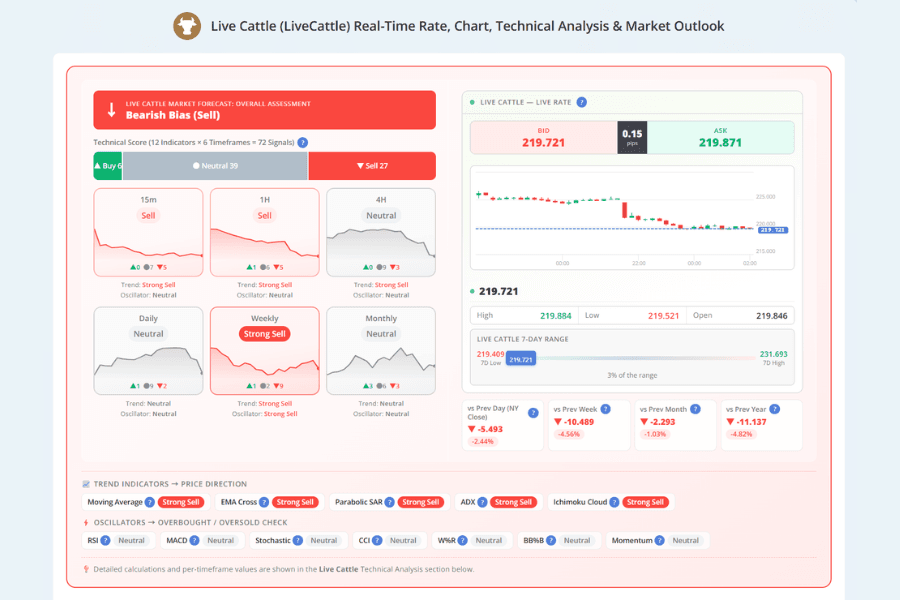
The instrument page shows the live cattle price, chart, support and resistance, and technical analysis:
7. FAQ
Q1. What is the minimum price move in live cattle futures?
The minimum price fluctuation for CME Live Cattle futures is 0.025 cents per pound. With 40,000 pounds per contract, that equals $10 per contract.
Q2. Which months do live cattle futures trade?
CME Live Cattle futures are listed for February, April, June, August, October and December. Each contract month reflects expected supply and demand for that period, so prices can differ between months.
Q3. When can I trade live cattle at Titan FX?
Monday to Friday, 16:30–21:05 server time, which is 8:30 a.m. to 1:05 p.m. U.S. Central Time, the same as the CME Live Cattle trading session. Orders cannot be placed outside these hours.
Q4. Does Titan FX charge swap on LiveCattle?
Yes. Positions held past rollover incur swap, and positions carried from Friday to Monday are charged three days. The formula is: swap = lots × contract size × long or short swap rate × decimal factor × number of days.
8. Conclusion
Live cattle are finished beef cattle ready for slaughter, and their benchmark is CME Live Cattle futures. Prices depend mainly on U.S. herd size, feed costs, beef demand, import policy and animal disease.
At Titan FX, live cattle trade as LiveCattle in the soft commodities group. When trading them, watch USDA cattle reports and changes in import policy.
Further Reading
Titan FX's financial-markets research and analysis team. We cover foreign exchange (FX), commodities (oil, precious metals, agricultural products), stock indices, U.S. equities, crypto assets and other major asset classes, producing educational content for investors.
Primary Sources (by Category)
- Official statistics and announcements: USDA NASS Cattle report (January 2026); USDA announcement on the phased reopening of southern border ports (July 2026)
- Exchange materials: CME Group Live Cattle futures contract specifications
- Titan FX trading conditions: Titan FX soft commodities page and Help Center soft commodity articles
- Market data: Yahoo Finance (CME LE front-month daily closes)