

Limit Down
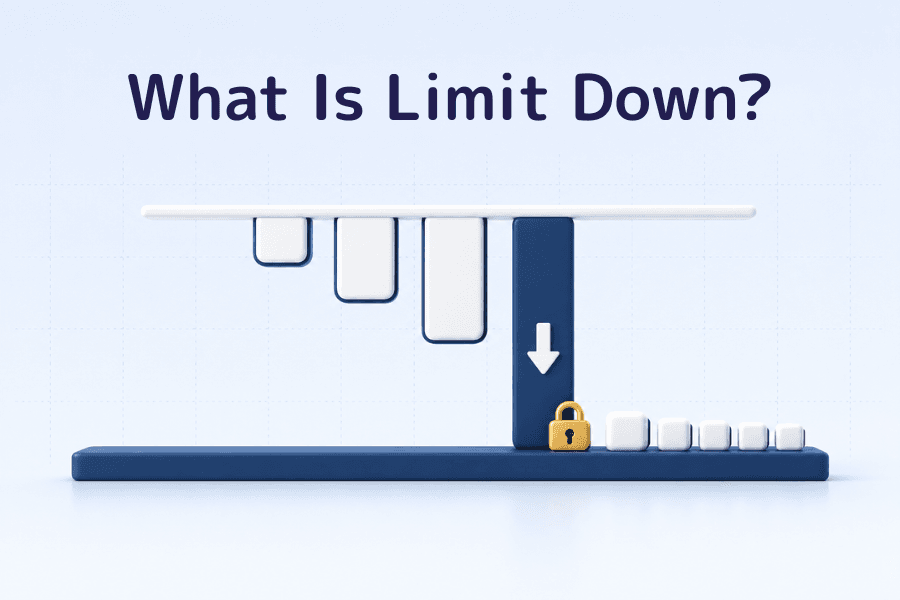
Limit down is the point at which a stock has fallen as far as the exchange allows in a single trading day, so no trade can print at a lower price for the rest of the session. That floor is the limit-down price, and a stock pinned to it is said to be locked limit down. Taiwan and mainland China cap most stocks at 10% a day, Japan uses fixed yen amounts that depend on the price level, and Korea allows 30%. Hong Kong, Singapore and the United States have no fixed daily limit-down price at all.
For a shareholder, limit down is the mirror image of limit up. When orders crowd the limit, buyers queue at limit up and sellers queue at limit down. Once a stock is locked limit down, a holder who wants out may go a long time without a fill because there are too few buyers. That is why limit down calls for more preparation in advance than limit up does.
This article covers what limit down means, how the limit-down price is calculated, whether you can still sell and how orders queue, how the rules differ across markets, why stocks hit limit down and what happens on consecutive limit-down days, what a holder can do, and the most common questions.
- Limit down means a stock has reached the exchange's daily price floor and cannot trade lower that day; trading itself does not stop
- Theoretical limit-down price = reference price × (1 − daily limit); the actual price is then aligned to the exchange's tick size
- When sell orders pile up at the limit, sellers queue for buyers; whether you get filled depends on the order book and the matching rules
- Taiwan caps most stocks at 10%, China at 10% to 30% by board, Japan uses yen amounts, Korea 30%; Hong Kong, Singapore and the US have no fixed limit-down price
- US stocks use LULD price bands that move with the price, plus trading pauses; the market-wide circuit breaker only triggers on declines
- Consecutive limit-down days compound the loss and dry up liquidity; decide the invalidation level, the stop and the position size before you buy
- 1. What Is Limit Down? Locked Limit Down, One-Price Days and When the Limit Breaks
- 2. How the Limit-Down Price Is Calculated: Formula, Tick Size and an Example
- 3. Can You Sell a Stock at Limit Down? Order Queues and Matching Rules
- 4. Daily Price Limits Around the World
- 5. Why Do Stocks Hit Limit Down? Common Causes and Consecutive Limit-Down Days
- 6. What to Do at Limit Down: Options for Holders and Trading Notes
- 7. Limit Down FAQ
- 8. Summary
1. What Is Limit Down? Locked Limit Down, One-Price Days and When the Limit Breaks
Limit down is the state in which a stock has fallen to the exchange's daily price floor and cannot trade at a lower price for the rest of the day. The floor itself is the limit-down price, and traders describe a stock sitting on it as locked limit down.
The ceiling on the other side is limit up; together they are called daily price limits.
Exchanges set daily limits to keep a single day's move within a fixed range and give the market time to digest major news. The limit applies to price, not to trading: orders can still be entered and matched at limit down, but no trade prints below the floor. The selling pressure does not disappear because of the limit; unfilled sell orders can carry over into the next session.
A few expressions come up constantly.
-
Locked limit down: sell orders are stacked at the floor, almost no one is buying, and the price sits at the limit without moving.
-
One-price limit-down day: the stock opens at the limit and stays locked all day, so the open, high, low and close are the same price and the candlestick is a single horizontal line.
-
The limit breaks: new buy orders absorb the sell orders at the floor and trades start printing above the limit-down price. The stock may lock again afterward or bounce.
-
Consecutive limit-down days: the stock closes at limit down on several days in a row, typically after major bad news, a sudden loss of liquidity or a broad market panic.
Limit down says only one thing: on that day, at that price, sellers far outnumbered buyers. The reason can be a problem at the company itself or nothing more than being caught in a market-wide sell-off. Section 5 goes through the usual causes.
2. How the Limit-Down Price Is Calculated: Formula, Tick Size and an Example
In markets that set the limit as a percentage, start with the theoretical limit-down price and then adjust it to each exchange's tick size and calculation rules.
Theoretical limit-down price = reference price × (1 − daily limit)The reference price is usually the previous close; ex-dividend days and new listings follow separate rules. With a 10% limit, a stock that closed at 100.00 has a theoretical limit-down price of 90.00 the next day.
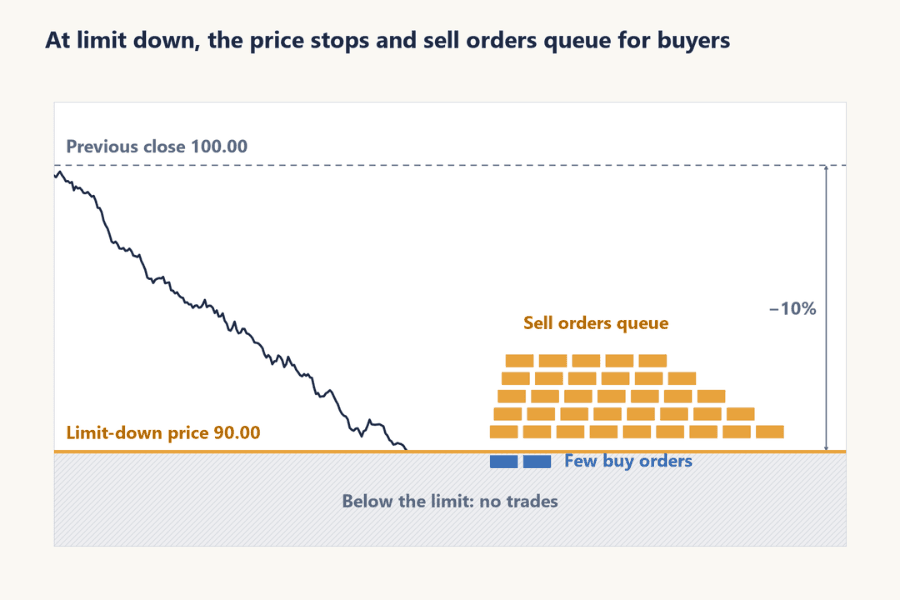
The actual limit-down price also has to land on a valid tick, and the rounded price cannot go below the floor. The Taiwan Stock Exchange's own example shows how: a reference price of 40.60 times 0.9 is 36.54, but the tick size in that price range is 0.05, so the limit-down price is rounded up to 36.55. The limit-up price of 44.66 is rounded down to 44.65.
The formula is the same for China's A-shares: limit price = previous close × (1 ± limit percentage), with the ex-rights reference price replacing the previous close on ex-dividend days. Japan works differently: the Tokyo Stock Exchange sets a fixed yen amount for each price band instead of a percentage, so a stock closing at ¥1,000 can move ¥300 either way the next day.
On consecutive limit-down days the limit is recalculated each day from the previous close, which is the previous day's limit-down price, so the decline compounds. A stock at 100 that falls limit down three days in a row at 10% ends at 100 × 0.9 × 0.9 × 0.9 = 72.9, a cumulative loss of 27.1%, not 30%.
These calculations apply to normal trading days with a limit in force. Some cases have no limit: on the Taiwan Stock Exchange, newly listed stocks (including the Innovation Board) have no price limit for their first five trading days, and ETFs holding foreign stocks have none at all.
In China, new listings also have no limit for the first five days; if such a stock moves 30% or 60% from its opening price during the session, the exchange halts it for 10 minutes.
3. Can You Sell a Stock at Limit Down? Order Queues and Matching Rules
You can enter an order at limit down. The question is whether the sell order fills. Sell orders pile up at the floor, buy orders are scarce, and a fill only happens when someone is willing to buy at the limit-down price.
-
Matching order: continuous trading runs on price-time priority. When the sell orders are all sitting at the same limit price, pending orders at that price are ranked by the time they were entered, earliest first. The opening and closing call auctions follow the auction's own rules instead.
-
Locked means no fill: if a large stack of sell orders sits at the limit and very few buyers show up, orders further back in the queue may go the whole day without filling, and the shares that did not sell carry the next session's price risk.
-
Buyers usually get filled: as long as enough sell orders remain at the limit, a buy order at the limit-down price is usually filled quickly. That is why some traders specialize in catching falling knives at limit down; the risks are covered in section 6.
-
The limit breaks: a steady flow of buy orders works through the sell orders at the floor and trades start printing above it. The stock may lock again or bounce; this is the moment that shows whether the selling has run its course.
-
The close: most markets set the closing price with a call auction. On the Taiwan Stock Exchange, for example, matching stops from 13:25 to 13:30 while orders are accepted and indicative prices are shown, and a single auction at 13:30 sets the close. Large orders entered or cancelled in those minutes can still change where a locked stock closes.
When a stock is locked limit down, entering your sell order early does not guarantee a fill; what matters is how much is queued ahead of you and how much buying comes in later.
If you cannot sell, all you can do is wait for the limit to break or for the next session, which is why risk management has to be done before limit down arrives. Section 6 explains how.
| Situation | Sellers | Buyers |
|---|---|---|
| Locked | Queue for buyers; usually no fill that day | Usually filled while enough sell orders remain |
| Limit breaks | Can sell above the limit, but the fill price is still low | Must judge bounce vs. reversal |
| Closing auction | Large orders can move the close | Same |
4. Daily Price Limits Around the World
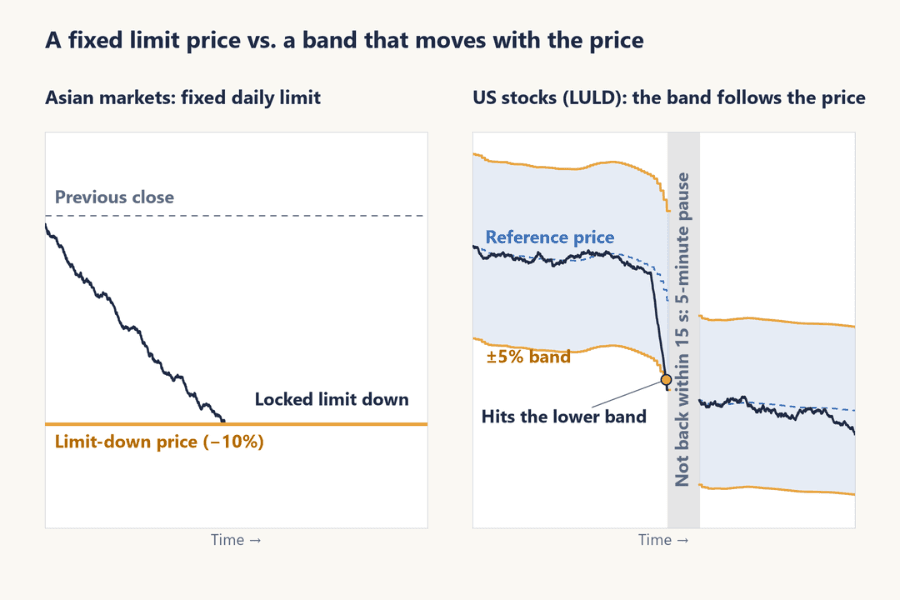
Daily price limits are a feature of some Asian stock markets, and the designs differ a great deal. Hong Kong, Singapore and the US have no fixed limit-down price; they manage abnormal moves with price bands, cooling-off periods or trading pauses instead.
None of these is a fixed limit: trading continues within a defined range after the mechanism triggers, and the price can keep falling once it lifts. The US market-wide circuit breaker only triggers on declines.
-
Taiwan: 10% for ordinary stocks and Innovation Board stocks; no limit for the first five trading days after listing or for ETFs holding foreign stocks.
-
China A-shares: 10% for ordinary main-board stocks; since July 6, 2026, main-board stocks under risk warning in Shanghai and Shenzhen have moved from 5% to 10% as well. ChiNext and the STAR Market allow 20%, the Beijing Stock Exchange 30%; new listings have no limit for the first five days.
-
Japan: the Tokyo Stock Exchange sets a fixed yen amount for each price band instead of a percentage, for example ¥150 either way for stocks under ¥1,000 and ¥700 for stocks under ¥5,000. If a stock closes at the limit on two consecutive days with no trades or only pro-rata allocation at the limit, the range in that direction is widened from the next day.
-
Korea: 30% either way from the reference price since June 2015.
-
Hong Kong: no daily limit; the Volatility Control Mechanism (VCM) applies to Hang Seng Composite LargeCap, MidCap and SmallCap constituents. If a potential trade price deviates 10%, 15% or 20% from the last trade five minutes earlier, a five-minute cooling-off period starts, during which trades can only print within a fixed price band.
-
Singapore: no daily limit; a circuit breaker triggers when a potential trade price deviates more than 10% from the reference price (the last trade at least five minutes earlier), followed by a five-minute cooling-off period in which trades must stay within 10% of the reference price.
-
Malaysia: two layers of limits. For stocks priced at RM1 or more, a static limit of 30% either way from the reference price for the day, plus a dynamic limit of 8% either way from the last traded price.
-
US stocks (individual names): no fixed limit-down price. The Limit Up-Limit Down (LULD) mechanism calculates a reference price from the last five minutes of trades and sets bands by stock tier and price level. Above $3, Tier 1 stocks such as S&P 500 and Russell 1000 constituents usually get 5% either way and other stocks 10%, with wider bands for low-priced shares.
-
LULD trading pause: when the price reaches the edge of the band it enters a limit state, and if it does not move back within 15 seconds the exchange pauses trading, normally for five minutes, before reopening.
-
US market as a whole: a separate circuit breaker applies. If the S&P 500 falls 7% or 13% from the previous close before 3:25 p.m. Eastern Time, trading halts for 15 minutes; after 3:25 p.m. those two levels no longer trigger a halt. A 20% decline stops trading for the rest of the day at any time.
-
Futures: CME's US equity index futures have a 7% limit either way outside regular US trading hours. During US hours they use tiered downside limits of 7%, 13% and 20%, coordinated with the cash-market circuit breaker, and what happens when a limit is hit depends on the session.
| Market | Daily downside limit | Notes |
|---|---|---|
| Taiwan | 10% | No limit for the first five days after listing or for foreign-stock ETFs |
| China A-shares | Main board 10%, ChiNext and STAR 20%, Beijing 30% | No limit for new listings' first five days; 10-minute halt at 30% and 60% intraday moves |
| Japan | Fixed yen amount by price band | Widened the next day after two consecutive locked days with no trades or pro-rata fills only |
| Korea | 30% | Since June 2015 |
| Hong Kong | None | VCM: 10%, 15%, 20% from the trade five minutes earlier, five-minute cooling-off |
| Singapore | None | Circuit breaker: more than 10% from the reference price, five-minute cooling-off |
| Malaysia | Static 30%, dynamic 8% | Both layers apply together |
| US stocks | None | LULD bands by tier and price; limit state of 15 seconds leads to a pause of about five minutes; S&P 500 down 7% or 13% before 3:25 p.m. ET halts 15 minutes, down 20% closes the day |
| US index futures | 7% either way outside US hours | Downside limits of 7%, 13% and 20% during US hours, coordinated with the cash-market circuit breaker |
5. Why Do Stocks Hit Limit Down? Common Causes and Consecutive Limit-Down Days
Limit down means far more people wanted to sell at the floor than to buy. The causes fall into three groups.
-
Company-specific bad news: earnings or guidance far below expectations, the loss of a major contract, accounting or governance problems, regulatory penalties. The market is repricing what the company is worth.
-
A theme runs out: stocks that rose limit up day after day on a theme often end in consecutive limit-down days when the money leaves. The faster the rise and the more concentrated the holdings, the harder the selling is to absorb.
-
A market-wide sell-off: in a crash or a panic, many stocks lock limit down at once with nothing wrong at the company. These moves follow market sentiment more than anything else.
Consecutive limit-down days are the worst liquidity a stock can have. Each day's limit is recalculated from the previous day's limit-down price, so the decline compounds, and sell orders re-form at each new floor. Until the limit breaks, almost nobody gets a fill.
To judge what comes after limit down, watch three things: whether the cause is the company or the whole market, whether the sell orders at the floor are shrinking, and the volume when the limit breaks.
Shrinking sell orders and heavier volume at the break mean trading has picked up, but the price also has to hold above the limit-down price. If the sell orders keep growing, more holders are still waiting to get out.
| Cause | Typical signs | What to watch afterward |
|---|---|---|
| Company-specific bad news | Repricing, institutional selling | Whether the impact persists and whether the company issues further announcements |
| A theme runs out | Big prior rally, concentrated holdings | Whether sell orders at the floor keep piling up |
| Market-wide sell-off | Many stocks lock limit down the same day | Whether the broader market, volatility and sentiment settle |
6. What to Do at Limit Down: Options for Holders and Trading Notes
The worst thing about limit down is wanting to sell and not being able to. Risk management therefore has to be done before the trade, and an existing position is handled according to the cause and your reason for holding it.
-
Define the invalidation level and the stop in advance: before you enter, decide the level at which the trade idea is wrong and set the stop loss from it. A stop reduces the risk of dealing with the position only after it is locked, but if major news gaps the stock or it opens at limit down, the stop may not fill at the planned price.
-
Use position size to cap your exposure to extreme moves: on a normal day with a 10% limit the most a stock can fall is 10%, but consecutive limit-down days compound, and cases such as new listings have no limit at all. When doing position sizing, allow for several days in which you cannot sell.
-
Once the stock is locked: first establish the cause, your reason for holding and the loss you can absorb. Company-specific news means judging whether the market is still repricing the stock; a market-wide sell-off usually lifts as the broader market settles. If you decide to exit, enter a sell order under the market's rules and wait for a fill; if you hold, reassess the fundamentals and the liquidity risk ahead.
-
Positions bought on margin: when the maintenance margin falls below the required level, the broker issues a margin call, and if it is not met the position is sold by force. At a locked limit down, that forced sale joins the same queue. Margin positions should be sized more conservatively than cash positions.
-
The risk of catching a falling knife: buying at the limit-down price usually fills easily, but the stock can lock limit down again the next day, and then you cannot sell either. If you trade the bounce, watch for the limit breaking, the price climbing back above the limit-down price and a change in volume, then decide on your own rules; a large decline does not make a stock cheap.
What happens when you trade US stock and index CFDs
When you trade US stock or index CFDs, the mechanisms you run into are different from an Asian limit down, but they affect quotes and fills all the same.
-
US stock CFDs: when the underlying stock is paused under LULD, quotes and fills on the related CFD can be affected too. Once trading resumes, the underlying reprices quickly and a stop loss can fill with slippage. How this is handled depends on the trading platform and the product specifications.
-
Index CFDs: when the related futures or cash market is hit by downside limits, trading pauses or a circuit breaker, liquidity, spreads and quotes on the CFD can be affected as well. Keep enough margin on open positions, count gaps and slippage as part of volatility risk, and avoid a loss cut.
-
You can go short: CFDs generally let you open a short position without first borrowing the shares, as you would to short the stock itself; the instruments, trading hours and fill conditions depend on the platform's specifications. A short loses on an upward gap after a pause just as a long loses on a downward one, and the risk management is the same.
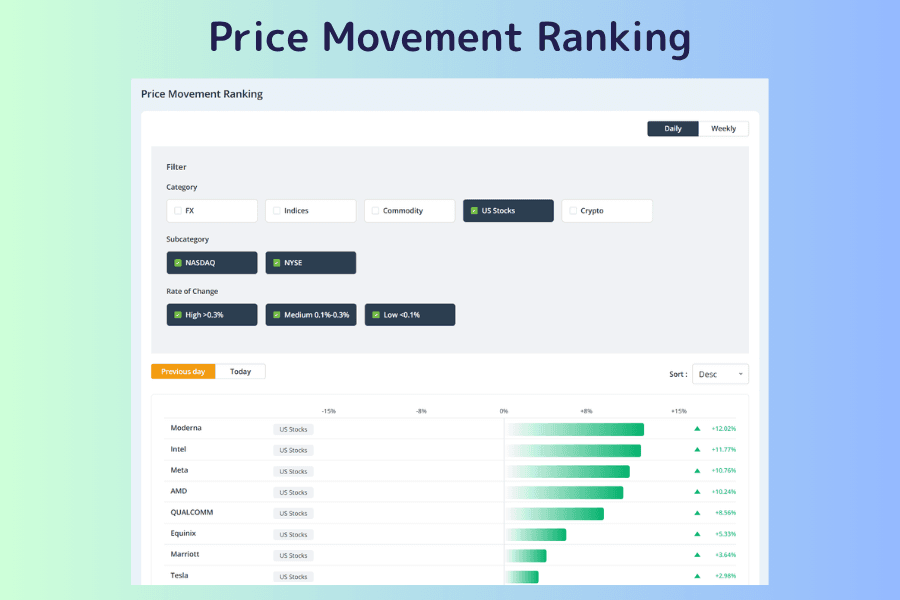
To see which US stock CFDs fell the most on a given day, use the US Stocks filter on the Price Movement Ranking. The ranking sorts instruments by the day's percentage change, and you can check on each instrument's market page whether a big decliner went through an LULD pause.
7. Limit Down FAQ
Q1: Can I still sell a stock that is locked limit down?
You can enter an order, but you may not get filled. Sell orders at the limit are queued by entry time and only move up when someone buys. When a large stack of sell orders sits at the limit and very few buyers show up, an order can go the whole day without filling even though it was entered.
All you can do is wait for the limit to break or deal with the position in the next session.
Q2: How far does a stock fall on consecutive limit-down days?
The 10% is recalculated each day from the previous day's limit-down price, so the loss compounds: two days is 1 − 0.9² = 19%, three days is 1 − 0.9³ = 27.1%, and five days is 1 − 0.9⁵ ≈ 41%. Sell orders re-form every day during a run of limit-down days and liquidity is at its worst, which is why positions must not be too large.
Q3: Can I buy a stock at limit down?
You can, but an easy fill and a good buy are two different things. Limit down can be the start of a repricing or just a bout of short-term panic. If you want to trade the bounce, at least confirm the cause of the limit down, whether the price has climbed back above the limit-down price, and your own invalidation level and stop before you act.
Q4: Is there limit down in the US stock market?
US stocks have no fixed daily limit-down price. They use LULD price bands: if the price enters a limit state and does not come back within 15 seconds, trading pauses for about five minutes.
The market as a whole has a circuit breaker: a 7% or 13% drop in the S&P 500 from the previous close halts trading for 15 minutes (not after 3:25 p.m. Eastern Time), and a 20% drop ends trading for the day.
Q5: What does it mean when the limit breaks?
The sell orders at the floor are absorbed by new buy orders and trades start printing above the limit-down price. Traders say the stock has "opened up" or that the limit has broken. The stock may lock limit down again afterward or bounce, which depends on the volume at the break and the buying that follows.
8. Summary
Limit down is the state in which a stock has fallen to the exchange's daily price floor and cannot trade lower that day, but it does not mean trading stops. The theoretical limit-down price is the reference price times (1 − daily limit), aligned to the tick size: Taiwan uses 10%, China 10% to 30% by board, Japan fixed yen amounts, and Hong Kong, Singapore and the US have no fixed limit-down price.
Orders can still be entered at limit down. Sell orders queue, while buy orders usually fill as long as enough sell orders remain. The causes fall into company-specific bad news, a theme running out and market-wide sell-offs, and consecutive limit-down days compound the loss and dry up liquidity.
Risk management belongs before the trade: define the invalidation level and the stop first, size the position for a run of limit-down days, and remember that a stop does not guarantee a fill at the planned price.
For traders of US stock and index CFDs, the equivalent mechanisms are LULD pauses, futures downside limits and the market-wide circuit breaker. Quotes and fills can be affected during a pause, prices can gap when trading resumes, and margin should leave room for the swings.
Further Reading
- Liquidation
- Liquidity
- Price Gaps: Types, Causes, and How to Analyze and Trade Them
- What Is Market Sentiment? How It Drives Forex and CFD Markets
- How to Set a Stop Loss? 5 Common Methods Compared
Titan FX Trading Strategy Lab. We produce investor-education content covering forex, commodities (crude oil, precious metals, agricultural goods), stock indices, US equities, and digital assets.
Primary Sources (by Category)
- Exchange rules: Taiwan Stock Exchange — introduction to the centralized market trading system (10% daily limit, tick sizes, no price limit for the first five days after listing, closing call auction), Operating Rules Article 62, Taiwan Innovation Board trading system; Shanghai Stock Exchange and Shenzhen Stock Exchange — trading rules (2026 revision, effective July 6, 2026); Beijing Stock Exchange — trading rules; Japan Exchange Group — daily price limits and their expansion, pro-rata allocation at the limit; Korea Exchange — widening of daily price limits to 30% in June 2015; Hong Kong Exchanges and Clearing — Volatility Control Mechanism (VCM); Singapore Exchange — Rulebook 8.14 circuit breaker; Securities Commission Malaysia and Bursa Malaysia — static and dynamic price limits
- US market mechanisms: LULD Plan (luldplan.com) — price bands, limit state and trading pauses; New York Stock Exchange — market-wide circuit breakers (7%, 13%, 20%); CME Group — price limits guide
- Market tools: Titan FX Research — Price Movement Ranking (US Stocks filter)