

Circuit Breaker
In financial markets, price volatility is normal — but when volatility escalates to panic-inducing levels, the Circuit Breaker becomes the market's last line of defence.
Far from being a technical glitch, the circuit breaker is a deliberate risk-control mechanism designed by exchanges to suppress panic and preserve market order.
When markets crash or spike violently, the circuit breaker temporarily halts trading to give the market a "cooling-off" window — preventing liquidity collapse and panic selling.
This guide walks through the definition, history, mechanics, and the differences from price limits, plus how investors should react when a circuit breaker fires.
- Definition: An automatic trading halt triggered when a market index breaches a preset volatility threshold. Originated after the 1987 Black Monday crash.
- U.S. S&P 500 three-tier system: Day-over-day declines of -7% / -13% / -20%. Halts of 15 min / 15 min / market close, respectively.
- Japan: Activates in Osaka Exchange futures only; cash equity markets use the alternative "Special Quote" and "Sequential Quote" mechanisms in place since 1994.
- China's 2016 reversal: Introduced in January 2016, triggered twice in four trading days, amplified panic, and was suspended within a week — a textbook lesson in localized calibration.
- March 2020: Four U.S. circuit breakers in one month (3/9, 3/12, 3/16, 3/18) during the COVID-19 shock.
- 1. What is a Circuit Breaker? Definition and Core Concept
- 2. How a Circuit Breaker Works: Triggers and Tiers
- 3. Which Markets Have Circuit Breakers? Global Comparison
- 4. Circuit Breakers vs Price Limits (Stop High / Low)
- 5. Strengths and Limitations
- 6. How Investors Should Respond: Practical Strategies
- 7. Conclusion
1. What is a Circuit Breaker? Definition and Core Concept
Price movement is normal in financial markets, but when sentiment turns panicky and selling cascades, short bursts of extreme volatility can distort prices and choke off liquidity.
To contain those extremes, exchanges deploy the Circuit Breaker — an automatic trading halt that gives the market a moment to cool off when volatility crosses a preset threshold.
Origin
The first circuit breaker was created in response to the 1987 "Black Monday" crash in the U.S. equity market.
That day, the Dow Jones Industrial Average fell more than 22%, panic swept the world, and trading systems jammed. The U.S. SEC and the New York Stock Exchange (NYSE) subsequently introduced the first market-wide circuit breaker. Other markets adopted similar mechanisms later, each calibrated for local conditions.
Definition
A circuit breaker is a temporary risk-control measure that halts trading for a defined period when an index moves beyond a preset volatility threshold within a short interval — not to prevent price discovery, but to buy the market time to think.
Think of it as the financial market's emergency-brake system: when prices move too fast, the system forces a pause and lets participants re-evaluate.
Core Functions
Circuit breakers stabilize markets in three ways:
- Suppress panic: Pausing during sharp moves blocks crowd-driven cascade selling.
- Preserve order: When volatility is extreme, quotes can become unreliable and systems overload. A halt lets infrastructure catch its breath.
- Maintain fairness: Pause time gives all participants a chance to digest information, leading to more rational pricing on resumption.
The point is not to intervene in markets; it is to help them regain rationality and stability. For investors, understanding the mechanism helps you stay calm during extreme sessions and execute proper risk management.
2. How a Circuit Breaker Works: Triggers and Tiers
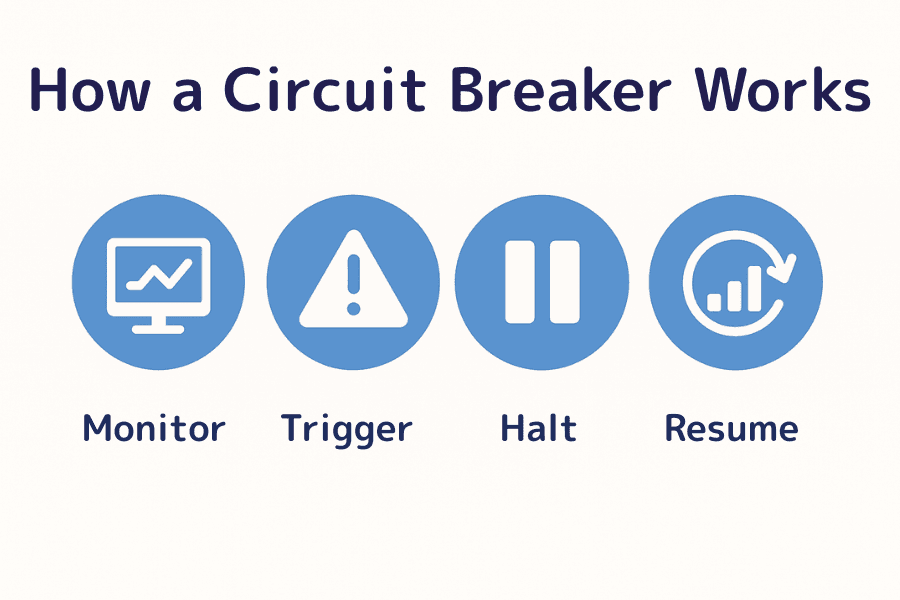
A circuit breaker is an automatic exchange procedure with four stages:
| Stage | Description |
|---|---|
| Monitor | The exchange continuously tracks the reference index or contract price. |
| Trigger | A preset percentage change (e.g. -7%, -13%, -20%) fires the next tier. |
| Halt | All trading on the affected market is suspended for a defined window. |
| Resume | After the cool-off, trading resumes; if the move continues, the next tier may activate. |
The U.S. S&P 500 has three tiers: -7% and -13% trigger 15-minute halts; -20% closes the market for the day. This three-tier model is the global reference template.
| Market | Reference | Trigger Levels | Halt Duration | Notes |
|---|---|---|---|---|
| U.S. (S&P 500) | S&P 500 | -7% / -13% / -20% | 15 min / 15 min / EOD | Mature tiered system, market-wide |
| China (CSI 300) | CSI 300 | -5% / -7% (2016) | 15 min / EOD | Suspended after 2016 panic loop |
| Hong Kong | Index futures | ±5% | ~5–15 min | Localized halt only |
| Japan (Osaka Exchange) | Index futures, individual stocks | Variable by product | 10–15 min | Cash equities use Special Quote instead |
| Korea (KOSPI) | KOSPI | -8% | 20 min | One-directional halt |
| Singapore (SGX) | STI Index, futures | -10% | ~15 min | Modeled on U.S. system |
3. Which Markets Have Circuit Breakers? Global Comparison
Not every financial market uses circuit breakers.
Circuit breakers tend to exist in centralized exchange markets (equities, futures). In Over-The-Counter (OTC) markets — for example, forex and bonds — risk control relies on liquidity adjustments rather than coordinated halts.
| Market | Has Circuit Breaker? | Implementation |
|---|---|---|
| Equity markets | Yes | Exchanges set tiered halts uniformly (U.S., China A-shares, etc.) |
| Equity index futures | Yes | Synchronized with cash markets to prevent basis explosions |
| Commodity futures | Yes | Daily price-limit bands (oil, gold, grains) |
| Forex (FX) | No | Globally distributed OTC market with no central quote venue. Platforms tighten margins, widen spreads, or pull quotes during stress. |
| Bond markets | No | Negotiated OTC trading. Some bond ETFs may halt on liquidity stress. |
Why Some Markets Don't Need Them
Circuit breakers require a central price-discovery and matching venue to monitor volatility in real time — exactly what exchange markets provide. OTC markets have no such central authority; they manage stress through margin and liquidity tools instead.
4. Circuit Breakers vs Price Limits (Stop High / Low)
Both tools restrain extreme moves, but they operate at different levels:
| Dimension | Circuit Breaker | Price Limit (Stop High / Low) |
|---|---|---|
| Trigger | Whole market or main index moves beyond a percentage threshold (e.g. -7%) | Single instrument trades to its daily upper / lower bound (e.g. ±10%) |
| Scope | Market-wide / index-wide | Single instrument |
| Effect | Halts all trading temporarily, then resumes normally | Locks one instrument while the rest of the market trades |
| Frequency | Rare — extreme stress only | Daily occurrences common in some markets |
| Purpose | Suppress panic and preserve market stability | Cap abnormal single-name moves and ensure fairness |
In practice, the two tools are complementary: price limits are point control on individual securities, circuit breakers are area control on whole markets. In March 2020, U.S. circuit breakers fired multiple times, while in Japan many individual issues hit price limits the same days.
5. Strengths and Limitations
Circuit breakers are useful but imperfect. Investors should understand both sides.
Strengths
1. Panic Suppression
A forced halt cuts off cascade selling driven by herd psychology. Investors regain composure and can avoid impulsive trades.
2. Liquidity Protection
Extreme volatility distorts quotes and can overload systems. A halt restores stable trading infrastructure and prevents a liquidity death spiral.
3. Fair Price Discovery
The pause lets all participants digest news, reducing information asymmetry and producing more rational re-opens.
Limitations
1. Magnet Effect
Academic research has identified a "magnet effect": as a market approaches a circuit-breaker threshold, traders rush to exit before the halt, accelerating the move and amplifying fear.
2. Higher Hedging Costs
Institutions that need to hedge during the halt cannot trade. They often face larger basis costs at re-open.
3. China 2016 — A Cautionary Tale
China introduced a circuit-breaker system in January 2016. It triggered twice in four trading days and amplified the panic it was designed to contain. Authorities suspended it within a week. The thresholds (5% and 7%) were too narrow given China A-shares volatility — a clear case study in why localized calibration matters.
6. How Investors Should Respond: Practical Strategies
When a circuit breaker fires, investors should act calmly and follow a few practical rules.
Strategy 1: Rely on Pre-Trade Risk Management
The biggest leverage is before extreme sessions. Set a stop loss on every trade and size positions per the 2% rule. With these in place, even a circuit-breaker-level decline only damages the account by your pre-set amount.
Strategy 2: Use the Pause for Information, Not Action
While trading is halted:
- Read news / data releases driving the move.
- Check whether your positions still match the original thesis.
- Plan for likely re-open behaviors — gaps, slippage, spreads.
Strategy 3: Defend Capital, Don't Chase Volatility
In extreme regimes, volatility is high, liquidity is low, and slippage is wide — even pros have a hard time. Retail-leaning investors should prioritize capital preservation over opportunity hunting.
Strategy 4: Learn From Past Episodes
Studying Black Swan Events like the 2008 GFC and the 2020 COVID-19 shock shows that circuit-breaker firings rarely mark the end of volatility — usually they mark a new regime. Historical context produces calmer decisions in the moment.
Frequently Asked Questions (FAQ)
Q1: Do circuit breakers exist in the forex market?
The forex market does not have a unified circuit breaker system like stock exchanges. However, some brokers implement their own mechanisms to pause order execution during extreme volatility.
Q2: What should investors do when a circuit breaker is triggered?
Stay calm, assess the situation, and avoid panic selling. Circuit breakers are designed to cool overheated markets. Wait for trading to resume and evaluate the direction carefully.
Q3: Are circuit breaker thresholds the same worldwide?
No. Each exchange sets its own thresholds. For example, the NYSE uses a 3-tier system (7%/13%/20%), while the Tokyo Stock Exchange applies different price limits per stock.
7. Conclusion
The circuit breaker is the market's emergency-stop mechanism for extreme conditions. It blocks liquidity collapse and irrational trading, and gives participants time to think.
But it does not solve the underlying problem. What actually keeps investors safe is pre-trade risk management — circuit breakers are only the last defensive layer.
From the 2008 Global Financial Crisis to the 2020 pandemic, repeated circuit-breaker activations are a reminder that extreme risk recurs. The best response is a sound position-management framework, disciplined risk control, and a stable mindset.
The circuit breaker is protection, not punishment. Understanding it correctly — and reacting calmly when it fires — is part of staying alive in markets long enough to compound.
Further Reading
- What Is the Dow Jones (US30)?
- What Is the S&P 500 (US500)?
- NYSE / NASDAQ / AMEX
- Forex Trading Basics
- What Is Stop Loss?
- What Is a Black Swan Event?
- The 2% Risk Rule
Titan FX Trading Strategy Lab. We produce investor-education content covering forex, commodities (crude oil, precious metals, agricultural goods), stock indices, U.S. equities, and digital assets.
Primary Sources (by category)
- U.S. regulatory basis: U.S. Securities and Exchange Commission (SEC) — Rule 80B; NYSE specifications for Market-Wide Circuit Breakers.
- 1987 Black Monday record: Federal Reserve Bank of St. Louis (FRED) — Dow Jones historical data, October 1987; Brady Commission Report (1988).
- 2020 COVID-19 series: CBOE — VIX Index history, March 2020 (intraday high 82.69 on 16 March 2020); S&P Dow Jones Indices — S&P 500 circuit-breaker activations on 9 / 12 / 16 / 18 March 2020.
- Magnet-effect research: Kim, Y. H., & Yang, J. J. (2004), "What Makes Circuit Breakers Attractive to Financial Markets? A Survey", Financial Markets, Institutions & Instruments.