

Tariff
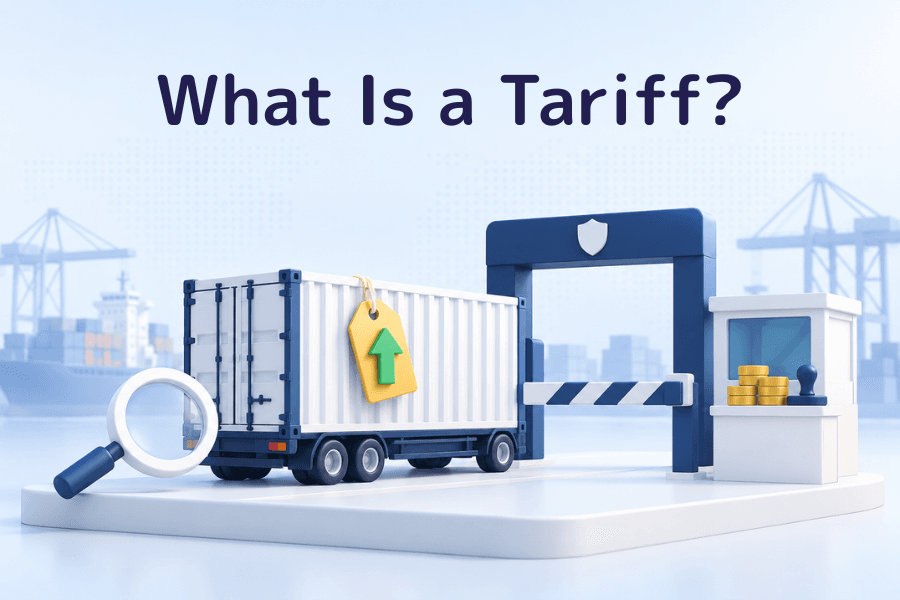
A tariff is a tax a government charges on imported goods as they clear customs. The importer pays it to the customs authority, and the amount is based on the value or the quantity of the goods. When two or more economies answer each other's tariffs with tariffs of their own, and the exchange keeps escalating, the result is a trade war. A tariff is nominally a tax on foreign goods, but the cost ends up split among importers, consumers and exporters, and it reaches financial markets through prices, corporate profits and exchange rates.
For traders, two things about tariffs matter. The first is how they transmit: a single tax collected at the border turns into changes in prices, rate expectations and exchange rates. The second is how they are announced. Tariffs mostly arrive as policy statements, executive orders or court rulings, none of which sit on an economic calendar, so the market's reaction often comes out of nowhere.
This article covers what tariffs are and the different kinds, who actually pays them, how trade wars escalate and three historical examples, the effects on prices and growth, the effects on currencies, stocks and commodities, how traders track tariff news and manage positions, and the most common questions.
- A tariff is a tax the importer pays to customs when goods enter the country; the most common form is an ad valorem duty charged as a percentage of the goods' value
- The importer remits the tax, but the cost is shared four ways: exporters cut prices, importers absorb it, consumers pay more, and exchange rates move
- A trade war is an escalating exchange of tariffs and retaliation; 1930, 2018 and 2025 are the textbook cases
- Tariffs push prices up and weigh on investment and trade; the WTO expects world goods trade growth to slow to 1.9% in 2026
- There is no fixed tariff playbook for markets: export-heavy currencies tend to weaken and affected sectors and commodities get more volatile, but the dollar and gold depend on expectations and flows
- To track tariff news, identify the stage of the event first, then check the rate, scope, effective date and exemptions, and measure the gap against what the market expected
- 1. What Is a Tariff? Definition, Types and Origin
- 2. Who Pays a Tariff? How the Cost Is Split Among Importers, Consumers and Exporters
- 3. What Is a Trade War? How It Escalates, and Three Historical Cases
- 4. How Tariffs Affect the Economy: Prices, Growth and Trade Volume
- 5. How Tariffs and Trade Wars Affect Currencies, Stocks and Commodities
- 6. How Traders Track Tariff News and Manage Positions
- 7. Frequently Asked Questions About Tariffs and Trade Wars
- 8. Summary
1. What Is a Tariff? Definition, Types and Origin
A tariff is a tax charged on imported goods at customs clearance, paid by the importer when the goods are declared. (A few countries also tax exports; this article covers only import tariffs, by far the most common kind.) Tariffs are among the oldest taxes and were once a government's main source of revenue. In modern economies they make up a small share of tax revenue, and they are used far more often to protect domestic industries, as bargaining chips, or as a tool of foreign policy.
By how they are calculated, tariffs come in three types.
-
Ad valorem duties: charged as a percentage of the declared value, for example 10%. This is the most common form.
-
Specific duties: a fixed amount per unit or per weight, for example a set sum per tonne. Common on agricultural goods and raw materials.
-
Compound duties: a combination of the two.
Ordinary tariff rates come in three common forms.
-
MFN rates and bound rates: the bound rate is the ceiling a WTO member has committed to in its tariff schedule. The most-favored-nation (MFN) rate actually applied to other members can sit below that ceiling.
-
Preferential rates: lower-than-MFN rates that members of a free trade agreement apply to each other, usually subject to rules of origin.
-
Tariff-rate quotas: a low rate applies up to a set quantity, and a higher rate applies to anything above it.
Beyond ordinary rates, there are trade remedies and extra measures, all imposed in response to specific situations.
-
Anti-dumping and countervailing duties: extra duties, imposed after an investigation, on goods exported below their normal value or goods that benefit from government subsidies, to offset unfair competition.
-
Safeguards: temporary tariff increases or quotas when a surge in imports causes serious injury to a domestic industry.
-
Retaliatory and additional tariffs: tariffs imposed in response to another country's tariffs, or imposed separately on grounds such as national security or unfair trade practices. These are the basic moves of a trade war.
| Category | Type | What it means |
|---|---|---|
| Calculation | Ad valorem | A percentage of the declared value |
| Calculation | Specific | A fixed amount per unit or weight |
| Calculation | Compound | Ad valorem and specific combined |
| Ordinary rates | MFN rate | Cannot exceed the bound rate committed at the WTO |
| Ordinary rates | Preferential rate | Applied between members of a free trade agreement |
| Ordinary rates | Tariff-rate quota | Low rate within the quota, high rate above it |
| Trade remedies and extra measures | Anti-dumping, countervailing | Offset dumping or subsidies; imposed after an investigation |
| Trade remedies and extra measures | Safeguards | Temporary protection against an import surge |
| Trade remedies and extra measures | Retaliatory, additional | Answer another country's tariffs, or cite security or unfair trade |
2. Who Pays a Tariff? How the Cost Is Split Among Importers, Consumers and Exporters
The importer is the taxpayer: the tariff is paid to customs when the goods enter the country. Who ultimately bears the cost depends on how it gets passed along afterward. Economists call this tariff incidence, and there are four main channels.
-
Exporters cut prices: to hold on to sales in the importing country, foreign exporters may lower their prices and absorb part of the tariff.
-
Importers absorb it: importers and distributors keep retail prices unchanged and take the tariff out of their own margins.
-
Consumers pay more: importers add the tariff to the retail price and the buyer pays it. This is how tariffs feed into inflation.
-
Exchange rates move: if the exporter's currency weakens, the same foreign-currency price converts into fewer units of the importer's currency, which offsets part of the tariff. In theory, the importing country's currency could also strengthen as import demand falls.
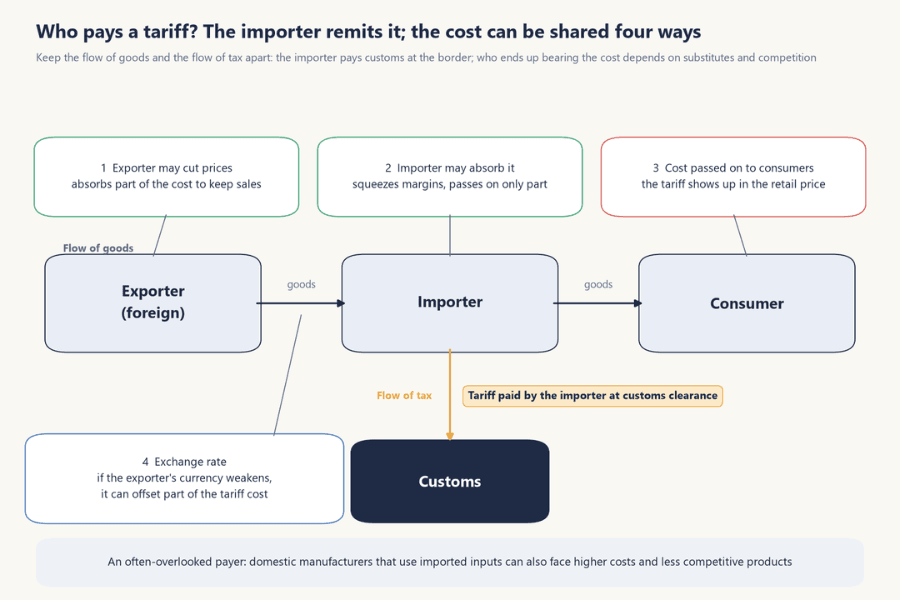
The mix of the four channels depends on the product, how many substitutes exist, and how competitive the market is. Exporters are more likely to cut prices on easily substituted goods in competitive markets; for goods with no substitutes, the cost passes through to consumers more easily.
For the tariffs the United States imposed in 2018 and 2019, most studies found that the bulk of the cost fell on US importers and consumers, with only limited price cuts by foreign exporters.
One payer is easy to overlook: domestic manufacturers that use imported materials and components. Tariffs raise their costs and make their finished goods less competitive, which is the most common side effect of industrial tariffs.
| Channel | Who bears it | When its share tends to be larger |
|---|---|---|
| Exporter price cuts | Foreign exporters | Substitutes are plentiful and competition is fierce |
| Importer absorption | Importers, distributors | Margins are wide and market share is worth defending |
| Higher retail prices | Consumers | No substitutes and steady demand |
| Exchange-rate moves | Exporting or importing country | A weaker exporter currency offsets the tariff |
3. What Is a Trade War? How It Escalates, and Three Historical Cases
A trade war is an escalating exchange in which two or more economies answer each other with tariffs or other trade restrictions. Tariffs are the main weapon but not the only one: export controls, import quotas, investment screening and blacklisting the other side's companies can all appear in the same conflict. Trade wars are also entangled with geopolitical risk, and the pace of escalation tends to follow the state of diplomatic relations.
The typical path runs like this: one side raises tariffs citing national security, unfair trade or a trade deficit; the other retaliates on a similar scale; both widen the scope or raise the rates; and it continues until negotiations produce a deal or the costs become too much for both. The "truces" and "delayed start dates" along the way are part of the trade war too.
Case 1: The Smoot-Hawley Tariff Act of 1930
In 1930 the United States passed the Smoot-Hawley Tariff Act, sharply raising duties on a wide range of imports. Several trading partners retaliated, and world trade shrank dramatically over the following years. Economists still disagree over how much it deepened the Great Depression, but it remains the textbook case of tariff retaliation causing a collapse in trade.
Case 2: The US-China tariff war of 2018–2020
Starting in 2018, the United States imposed tariffs on Chinese imports in several rounds under Section 301 of the Trade Act of 1974, and China answered with tariffs of its own; US soybeans became the emblematic target of retaliation.
The two sides signed the Phase One trade agreement on January 15, 2020, but most of the tariffs stayed in place and continued to be adjusted in the years that followed.
Case 3: The US reciprocal tariffs from 2025 and the fight over their legal basis
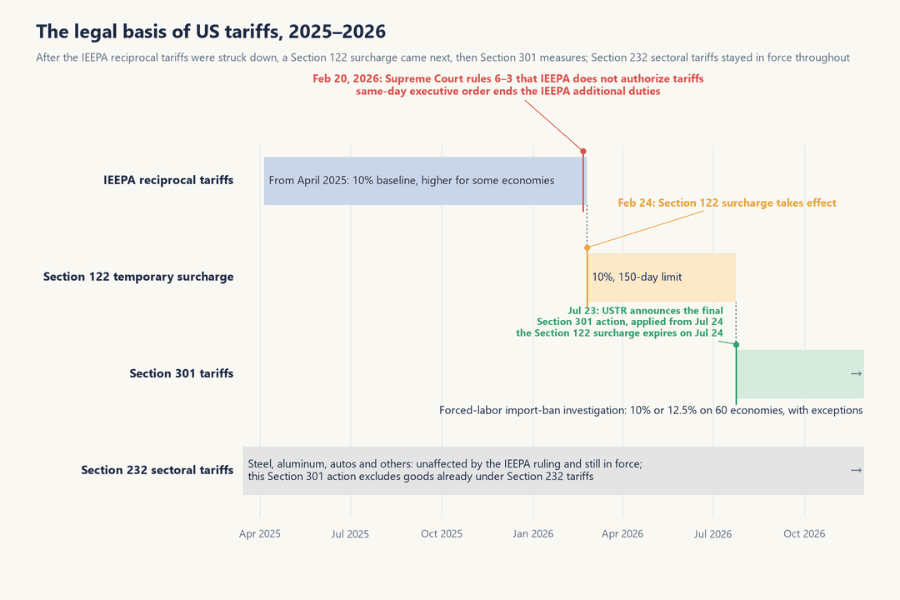
In April 2025 the United States imposed "reciprocal tariffs" on almost all of its trading partners under the International Emergency Economic Powers Act (IEEPA), with a 10% baseline and higher rates for some economies. Many countries entered negotiations, and the US-China relationship went through several rounds of escalation and truce.
On February 20, 2026, the US Supreme Court ruled 6–3 that IEEPA does not authorize the president to impose tariffs. The White House issued an executive order the same day ending those tariffs, and collection then stopped.
Separately, the administration imposed a temporary 10% import surcharge under Section 122 of the Trade Act of 1974, effective February 24, for a period of 150 days.
On July 23 the US Trade Representative announced the final action in its Section 301 investigations into the failure of 60 economies to ban imports of goods made with forced labor: tariffs of 10% or 12.5% on goods from those economies, applied from July 24, with exceptions by product and by economy. The Section 122 surcharge expired the same day.
The sectoral tariffs on steel, aluminum, autos and other goods under Section 232 were unaffected by the ruling and remain in force, and the new Section 301 action excludes goods already subject to Section 232 tariffs.
This case shows two things. First, the legal basis and the courts move markets too, so tracking tariffs means following the legal process as well as the rate. Second, tariffs resting on different legal authorities can coexist; a court striking down one authority does not void the others.
| Case | Trigger | How it escalated | Outcome |
|---|---|---|---|
| 1930 Smoot-Hawley | Protecting domestic farming and industry | Retaliation by trading partners | World trade shrank sharply |
| 2018–2020 US-China | Section 301 investigation | Tariffs in rounds, matched retaliation | Phase One deal in 2020; most tariffs kept |
| US reciprocal tariffs from 2025 | IEEPA emergency powers | Negotiations, truces and escalation with many countries | Court strikes down the IEEPA tariffs in 2026; Section 122 and Section 301 measures follow |
4. How Tariffs Affect the Economy: Prices, Growth and Trade Volume
The macroeconomic effects of tariffs run along three lines.
-
Prices: tariffs usually raise the cost of the imports they target and of goods made with imported inputs; how much reaches retail prices depends on the split described in section 2. If the rate rises only once and businesses pass it through quickly, CPI inflation runs high for about a year and eases once the base effect fades. If businesses raise prices in stages, or the policy adds tariffs in phases, the effect on inflation stretches over several quarters.
-
Growth and investment: tariffs reduce both imports and exports, raise costs for industries that rely on imported inputs, and lead firms facing uncertain rates to delay investment. Output in protected industries may rise, but overall efficiency usually falls.
-
Trade volume: businesses often front-load imports before a tariff takes effect, and trade volumes drop afterward. In March 2026 the WTO forecast that world merchandise trade growth would slow from 4.6% in 2025 to 1.9% in 2026, citing the fading of front-loaded imports, slower demand for AI-related goods, energy prices and geopolitical risk. Tariffs are only one of the reasons.
For central banks, a tariff is a classic supply shock: prices rise while growth slows, and hawks and doves draw opposite conclusions from the same data. Market expectations for the rate path swing more easily as a result, which is one reason currencies get choppy during tariff episodes.
| Area | Direction | Timing |
|---|---|---|
| Prices | Usually up | Duration depends on pass-through speed and follow-up policy |
| Growth and investment | Usually under pressure | Uncertainty delays investment; the drag lingers |
| Trade volume | Often up, then down | Front-loading before the start date, a drop afterward |
| Central bank policy | Unclear | Inflation and growth signals point in opposite directions |
5. How Tariffs and Trade Wars Affect Currencies, Stocks and Commodities
How a tariff headline moves markets depends on three things: who is being taxed, how large the tariff is, and whether the market had already priced it in. Below, the usual reactions and the exceptions, by asset class.
Currencies
-
Usual reaction: currencies of economies that depend heavily on exports to the taxing country may weaken as growth expectations are marked down. The offshore yuan, for example, often weakened during escalations of the US-China tariff war. Safe-haven currencies tend to find support when a trade war escalates. This is the usual reaction, not a fixed rule.
-
Why: tariffs cut the exporting country's foreign-currency income and growth outlook, and capital flows out. An escalating trade war raises risk aversion across the board, and money moves into safe assets.
-
Exception: the taxing country's currency has no set direction. In theory the importing country's currency should strengthen as import demand falls, but the US dollar is driven at the same time by Fed policy, safe-haven demand, Treasury yields and capital flows. After the United States announced reciprocal tariffs in 2025, the dollar actually weakened for a time. Read market sentiment and capital flows instead of applying the textbook answer alone.
Stocks
-
Usual reaction: when a tariff fight escalates, the broad market comes under pressure and the directly affected sectors swing the most, such as autos, semiconductors, retail and manufacturers that rely on imported inputs. Protected domestic industries may benefit briefly.
-
Why: tariffs squeeze corporate margins, disrupt supply chains and make earnings forecasts less reliable.
-
Exception: if the market had fully priced it in, or the final tariff comes in lower than expected, the announcement turns into good news. "Truce" headlines often trigger a rebound.
Commodities
-
Usual reaction: taxed commodities such as steel, aluminum and copper get more expensive inside the taxing country. Farm products hit by retaliation come under pressure in the exporting country, as US soybeans did when China imposed tariffs on them in 2018. Gold is supported by safe-haven demand when a trade war escalates.
-
Why: tariffs redirect commodity flows and change price spreads; inventories build up in the exporting country and supply shrinks in the importing country.
-
Exception: when a trade war drags on global growth, demand expectations for industrial metals and energy fall and prices can weaken across the board, the opposite of the tariff effect on any single commodity. Safe-haven buying of gold can also be offset by a stronger dollar or higher real interest rates.
| Asset | Usual reaction to escalation | What to watch |
|---|---|---|
| Currencies | Export-heavy currencies weaken, safe havens find support; the dollar has no set direction | Currency Strength Meter, the US Dollar Index, USD/CNH |
| Stocks | Affected sectors swing more; truce headlines spark rebounds | Sector indices of affected industries, performance relative to the major indices |
| Commodities | Taxed commodities rise, retaliation targets fall | Steel and copper, agricultural futures, gold |
6. How Traders Track Tariff News and Manage Positions
The biggest difference between tariffs and economic data is how they are released. Data follows a fixed schedule; tariffs are policy. Executive orders, USTR announcements, court rulings and negotiation outcomes can land at any time.
The market often reprices within minutes, spreads widen and slippage grows; when the announcement lands over a weekend or a market holiday, the next open gaps. Track them in four steps.
-
Step 1: identify the stage of the event: a proposal, the launch of an investigation, a formal announcement, the signing of an order, the effective date, a suspension or delay, a court ruling and a negotiated deal are all different stages. Headlines routinely blur "proposed," "under investigation" and "in effect," so rely on the original government and court documents.
-
Step 2: check the four terms: the rate, the products covered, the countries or regions covered, and the effective date. Then look at exemptions, quotas, and whether the tariff stacks on top of existing ones.
-
Step 3: compare it with what the market expected: is the rate higher or lower than expected, is the scope wider or narrower, is there a delay or an added exemption, and have negotiations moved? Markets react to the gap against expectations; a tariff the market has already priced in gets a much smaller reaction on announcement.
-
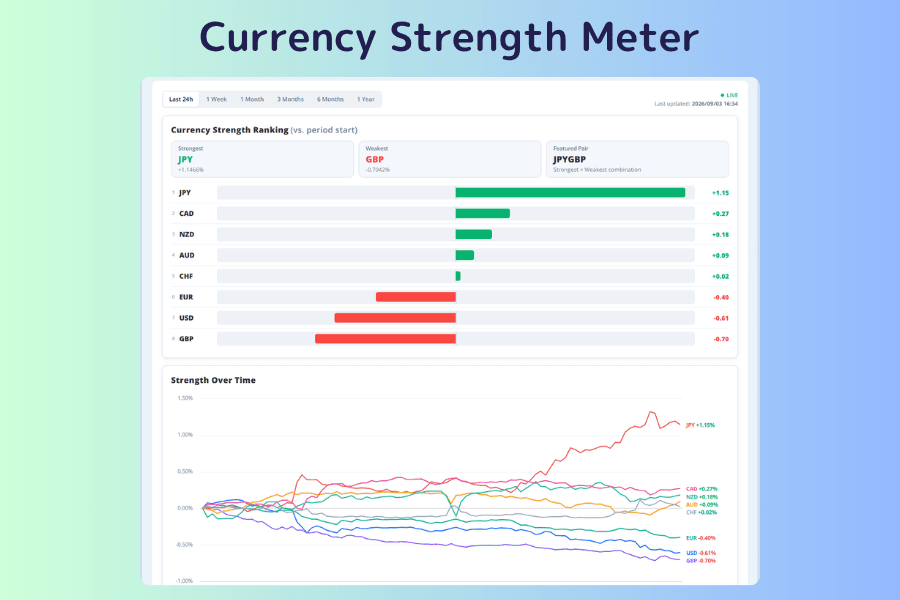
Step 4: read the price reaction: check the Currency Strength Meter first to see which currencies are weakening and which are strengthening, then equity indices, commodities, Treasury yields and volatility. For US-China tariff news, USD/CNH is one of the most widely used instruments for watching the yuan's reaction.
The effects of a tariff show up in the data months later. Use the economic calendar to follow CPI, import prices and the trade balance. The US trade balance page in the Economic Indicators List records how USD/JPY and other instruments moved after each release, so you can see how the market has actually reacted to this kind of data.
If you hold positions exposed to the news, use position sizing in advance to cut lots to a size that can absorb a gap and slippage, and check correlation so that several positions are not exposed to the same headline at once.
| Step | What to check | Tool |
|---|---|---|
| Stage of the event | Proposal, announcement, effective date, suspension, court ruling | Original government and court documents |
| The four terms | Rate, products, countries or regions, effective date, exemptions | Original government and court documents |
| Gap against expectations | Higher or lower than expected, delays, exemptions, negotiation progress | Market sentiment, pre-announcement pricing |
| Price reaction | Currencies, equity indices, commodities, yields, volatility | Currency Strength Meter, USD/CNH |
| Data check | CPI, import prices, trade balance | Economic calendar, Economic Indicators List |
| Positions | Gaps, slippage, correlation | Position sizing, correlation matrix |
The Currency Strength Meter ranks the eight major currencies by relative strength. Open it right after a tariff headline and one screen shows which currencies money is leaving and where it is going.
7. Frequently Asked Questions About Tariffs and Trade Wars
Q1: Does the importing country or the exporting country pay the tariff?
Legally, the importer in the importing country pays it when the goods are declared; the exporting country's government never receives the money. The actual cost is shared four ways: exporters cut prices, importers absorb it, consumers pay more, and exchange rates move. The mix depends on the product and the market.
Q2: Do tariffs always cause inflation?
Tariffs usually push up the prices of imported goods. If the rate rises once and businesses pass it through quickly, the price level shifts up once and CPI inflation runs high for about a year. Whether that turns into persistent inflation depends on how fast businesses pass it through, whether tariffs keep being added, and how the central bank responds.
Q3: Which side's currency falls when tariffs go up?
The currency of the taxed, export-dependent economy usually comes under pressure. The taxing country's currency has no set direction: in theory it could strengthen, but if the market cares more about policy uncertainty and capital outflows it can weaken instead, which is what happened to the dollar in 2025.
Q4: Do higher tariffs shrink the trade deficit?
Not necessarily. Tariffs reduce imports of the taxed goods, but retaliation cuts exports, and dearer imported inputs erode export competitiveness. The overall trade deficit also depends on saving, investment and the exchange rate. After the United States imposed tariffs on China from 2018, the bilateral deficit with China narrowed, but the overall goods trade deficit widened in the years that followed.
Q5: Where can I find the latest tariff rates and effective dates?
Go to the original government documents. For the United States, that means White House executive orders and proclamations and the guidance from the US Trade Representative (USTR) and Customs and Border Protection (CBP); for other economies, the finance ministry, customs authority or trade ministry.
The WTO's tariff database lists each member's MFN rates. News reports are fine for the direction of travel, but confirm rates and dates in the source documents.
8. Summary
A tariff is a tax the importer pays to customs at clearance, but its cost is shared four ways: exporters cut prices, importers absorb it, consumers pay more, and exchange rates move. An escalating exchange of tariffs is a trade war, which can also involve quotas, export controls and investment restrictions.
The economic effects are usually higher prices, pressure on growth and investment, and trade volumes that rise before the start date and fall afterward; how long they last depends on pass-through speed and follow-up policy. For central banks, the result is a dilemma in which the inflation and growth signals conflict.
The market effects vary by asset: export-heavy currencies tend to weaken, stocks in affected sectors swing more, and taxed commodities and retaliation targets move apart, while the direction of the dollar and gold depends on expectations and capital flows.
To track tariffs, identify the stage of the event, check the rate, scope, effective date and exemptions, measure the gap against expectations, then read the reaction on the Currency Strength Meter and USD/CNH. Verify the effects in CPI, import prices and the trade balance, and keep lots small enough to absorb a gap and slippage.
Further Reading
- Commodity Currency
- Trade Surplus
- Exchange Rates
- Stagflation
- What Is USD/CNH? A Guide to the Dollar-Yuan Pair
Titan FX Trading Strategy Lab. We produce investor-education content covering forex, commodities (crude oil, precious metals, agricultural goods), stock indices, US equities, and digital assets.
Primary Sources (by Category)
- Government and court documents: The White House — reciprocal tariff executive order of April 2, 2025; "Ending Certain Tariff Actions" and the Section 122 temporary import surcharge proclamation of February 2026 (Federal Register 2026-03824); memorandum on the Section 301 actions of July 23, 2026. US Supreme Court — Learning Resources, Inc. v. Trump (No. 24-1287, February 20, 2026). Office of the US Trade Representative — press release and fact sheet on the Section 301 actions of July 23, 2026; Federal Register notice 2026-15181 (applicable from July 24, 2026); Phase One trade agreement of January 15, 2020. US Customs and Border Protection — CSMS #69326983 guidance on the Section 301 duties. Congressional Research Service — Legal Sidebar on the IEEPA tariff ruling (LSB11398)
- Academic research (tariff incidence): Amiti, Redding & Weinstein (2019), The Impact of the 2018 Tariffs on Prices and Welfare, Journal of Economic Perspectives; Fajgelbaum, Goldberg, Kennedy & Khandelwal (2020), The Return to Protectionism, Quarterly Journal of Economics; Cavallo, Gopinath, Neiman & Tang (2021), Tariff Pass-Through at the Border and at the Store, AER: Insights
- International organizations: World Trade Organization — Global Trade Outlook and Statistics, March 2026; rules on most-favored-nation treatment, bound rates, anti-dumping and countervailing duties, and safeguards
- Market tools: Titan FX Research — Currency Strength Meter, Economic Indicators List (US trade balance), economic calendar