

Commodity Currency
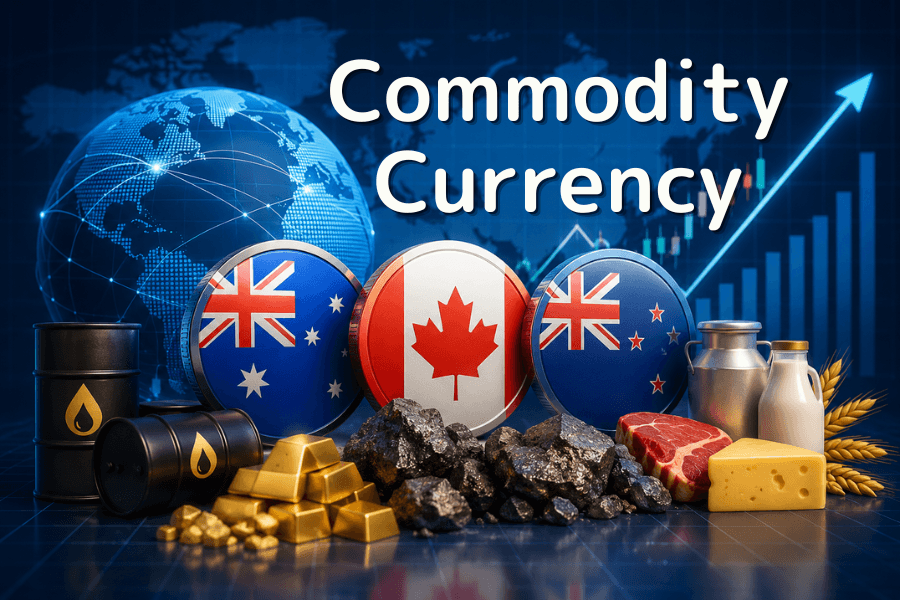
These currencies draw attention because they link "raw-material prices" directly to "exchange rates." When iron ore, crude oil, or dairy prices rise, the exporter's terms of trade improve and capital tends to flow in, so the currency strengthens; when commodity prices fall, the reverse happens. For FX traders, a commodity currency offers a route to turn a commodity trend into an exchange-rate view.
This article covers what a commodity currency is, the main commodity currencies, how commodity prices move them, the characteristics and risks of these currencies, and how traders can watch them in practice.
- A commodity currency is one whose exchange rate is closely tied to its country's commodity exports, linking raw-material prices to FX.
- The three most typical in the G10 are the Australian dollar (AUD), Canadian dollar (CAD), and New Zealand dollar (NZD), tied to metals and minerals, crude oil, and agricultural products respectively.
- The transmission runs "commodity price → export income and terms of trade → capital flows → exchange rate."
- Commodity currencies are usually risk-on currencies too, strengthening when markets are optimistic and weakening in risk-off phases.
- Beyond commodities, rates, the U.S. dollar, and market sentiment also drive them; no single factor tells the whole story.
1. What Is a Commodity Currency?
A commodity currency is a currency whose exchange rate moves closely with the price of the commodities its country exports. These economies depend heavily on exporting one or a few types of raw material, so shifts in commodity prices feed through export income directly to their exchange rates.
The mechanism is straightforward. When a country's main export rises in price, it earns more foreign currency, its terms of trade improve, and international capital tends to flow in, lifting the currency. When the export commodity falls in price, trade income shrinks and the currency comes under pressure. In effect, a commodity currency distills a country's "export fundamentals" into a single price you can trade in the FX market.
Note that a commodity currency is a relative classification, without a strict definition. The link between a currency and commodities varies in strength and changes over time. The market uses the label for currencies whose commodity link is especially pronounced.
You can view the latest correlation coefficients between major currency pairs in real time with the Correlation Matrix.
2. The Main Commodity Currencies
Among developed-market (G10) currencies, three are most often classed as commodity currencies:
- Australian dollar (AUD): Australia is a leading exporter of minerals — iron ore, coal, and gold are key, with iron ore carrying the most weight.
- Canadian dollar (CAD): Canada is a major crude-oil exporter, so the Canadian dollar tracks international oil prices closely and is often called the "oil currency."
- New Zealand dollar (NZD): New Zealand's exports center on dairy and other agricultural products, so the NZD is sensitive to those commodity prices.
Beyond these three, the currencies of resource-exporting emerging markets — the Norwegian krone (oil), the Brazilian real, the South African rand — are also treated as commodity currencies in the broad sense. They also carry higher political and liquidity risk, though, so their character is not quite the same as the G10 three.
3. Why Commodity Prices Move These Currencies
At the heart of how commodity prices affect exchange rates is a terms-of-trade transmission chain.
When an export commodity rises in price, the exporting country earns more foreign currency for the same volume, and its trade balance and current account improve. Strong exports and inflowing capital create demand for the country's currency and push the exchange rate up. This chain is especially clear for the Australian dollar — iron ore is Australia's largest export, and its price swings show a long-run positive correlation with the AUD.
That said, this transmission chain is not always reflected instantly. Market expectations, inventories, and currency hedging can all create a time lag or a short-term divergence between commodity prices and the currency.
4. Characteristics and Risks of Commodity Currencies
Two common traits are worth keeping in mind.
First, commodity currencies are usually risk-on currencies as well. When the global economy is optimistic and investors are willing to take risk, demand for raw materials rises and commodity currencies tend to strengthen alongside; when markets turn risk-off, capital pulls out of risk assets and commodity currencies weaken. Their moves therefore often point the same way as global equities and risk sentiment.
Second, commodity currencies can be more volatile. Driven by both commodity prices and risk sentiment, they see their swings amplified when those two forces resonate in the same direction. That is both an opportunity and a risk.
The mistake to avoid most is attributing a commodity currency's moves entirely to commodity prices. In reality, rate policy, the strength of the U.S. dollar, and market sentiment are just as important. Even if iron ore rises, for example, the AUD may not follow if the dollar firms at the same time or the market turns risk-off. Commodities are an important part of the picture, not the only force.
5. How Traders Watch Commodity Currencies
For traders, the value of a commodity currency is the route it offers to turn a commodity view into an FX trade. In practice, you can watch it on a few levels.
- The matching commodity: for the AUD watch iron ore and metals, for the CAD watch crude oil, for the NZD watch agricultural products — start with the key commodity behind the currency.
- Central banks and rates: keep an eye on the policy direction of the central banks of Australia, Canada, and New Zealand; shifts in the rate gap are often an important medium-term driver.
- Risk sentiment and the U.S. dollar: when risk aversion rises or the dollar firms, commodity currencies tend to come under pressure, so weigh them together with the commodity side.
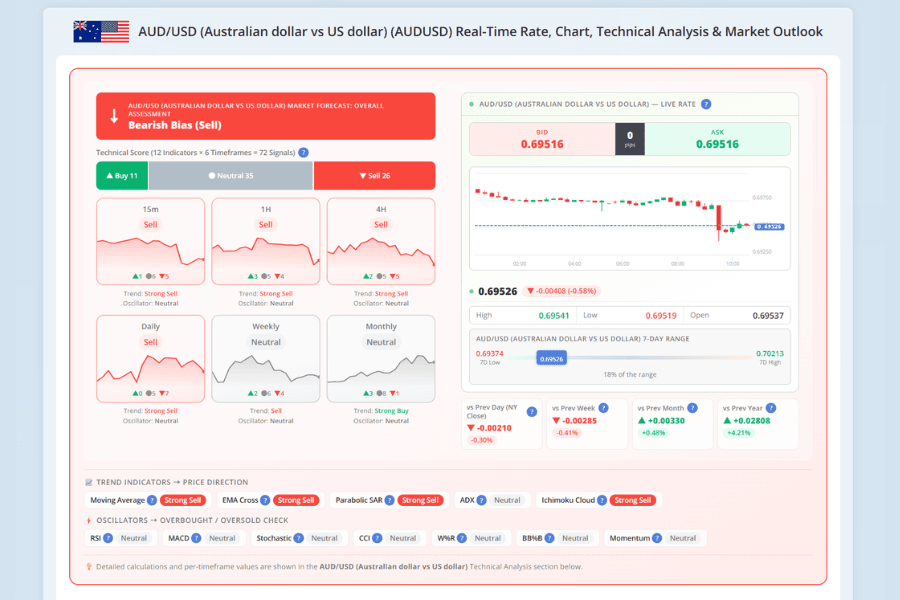
Before placing a trade, it helps to look directly at the pair's live rate and chart. For the Australian dollar, the AUD/USD live rate page offers real-time bid/ask and charts, plus scores for 12 technical indicators across 6 timeframes and an overall buy/sell read — letting you turn the commodity and rate views above into concrete price and timing decisions. Central-bank decisions and major data-release times can be tracked in advance on the economic calendar.
6. Commodity Currency FAQ
Q1: How is a commodity currency different from a safe-haven currency?
They are opposites in character. A commodity currency is risk-on, strengthening when markets are optimistic. A safe-haven currency (such as the yen or the Swiss franc) attracts buyers when markets are anxious. When sentiment turns risk-off, capital tends to flow from commodity currencies into safe havens, and the two often move in opposite directions.
Q2: Does a commodity currency always follow commodity prices?
Not necessarily. Commodity prices are an important factor, but rate policy, the strength of the U.S. dollar, and market risk sentiment also drive commodity currencies. Even if commodities rise, a commodity currency may not follow if the dollar firms or the market turns risk-off.
Q3: Do emerging-market currencies count as commodity currencies?
In the broad sense, yes. The Norwegian krone (oil), the Brazilian real, and the South African rand all move with commodity prices. Compared with the G10's Australian, Canadian, and New Zealand dollars, though, they carry higher political and liquidity risk, with greater volatility and uncertainty, so their character is not quite the same.
Q4: Do the Australian, Canadian, and New Zealand dollars rise and fall together?
Sometimes they do, sometimes they don't. All three are risk-on currencies, so in broad shifts of risk sentiment — a wholesale risk-off or a wave of optimism — they often move the same way. But each tracks a different commodity — the AUD iron ore and metals, the CAD crude oil, the NZD agricultural products — so when those commodities diverge, clear differences in strength appear among the three.
7. Summary
A commodity currency is one whose exchange rate is closely tied to the price of the commodities its country exports, with the Australian, Canadian, and New Zealand dollars the most typical in the G10. Its core logic is a "commodity price → export income and terms of trade → capital flows → exchange rate" chain that lets raw-material prices show up in the currency.
Still, a commodity currency's moves are not decided by commodities alone; rates, the dollar, and risk sentiment matter just as much, and these currencies are usually risk-on with larger swings. For traders, the value of understanding commodity currencies lies in combining the commodity trend with rates and sentiment to build a fuller FX view — and pairing that with the live rate to land on concrete entries and exits.
Further Reading
- What Is Gold CFD Trading?
- What Are Global Central Banks?
- What Is Inflation?
- What Are the FED, FRB, and FOMC?
- Forex Trading Basics
The financial markets research team at Titan FX. We produce educational content for investors across a broad range of instruments, including forex (FX), commodities (crude oil, precious metals, agricultural products), equity indices, U.S. stocks, and crypto assets.
Primary Sources (by category)
- Market data: Titan FX live rates, spreads, and swap information for currency pairs; Australian, Canadian, and New Zealand export and trade statistics
- Statistics and institutions: trade and commodity-export data from the statistical agencies of Australia, Canada, and New Zealand; monetary-policy material from their central banks (RBA, BOC, RBNZ)
- Research and reference: general treatments of commodity currencies, terms of trade, and risk sentiment in major investment education resources (Investopedia and others)