

Iron Ore
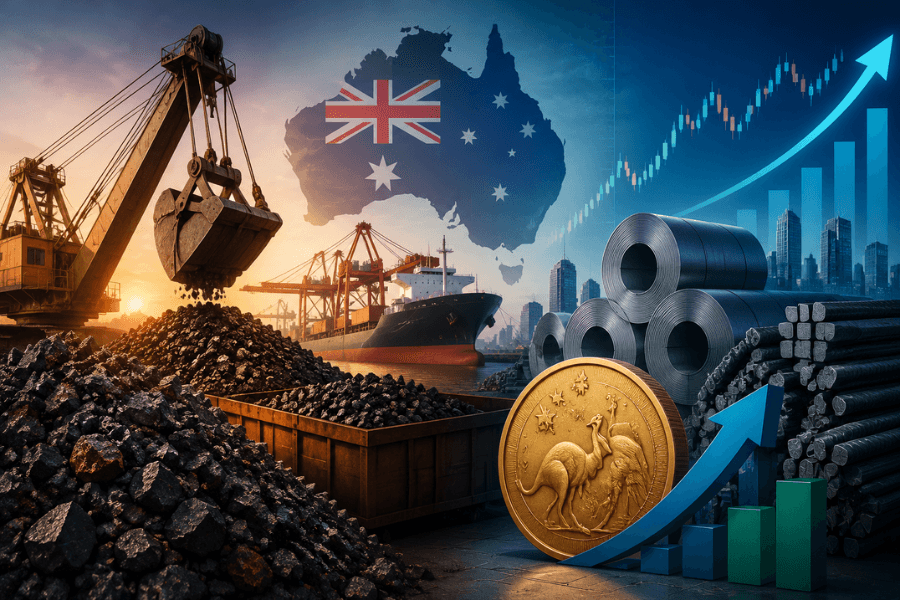
For the everyday investor, iron ore is often described as a "thermometer for the Chinese economy." China is the world's largest steel producer and the largest importer of seaborne iron ore, so the state of Chinese infrastructure spending and property construction tends to show up directly in the iron ore price.
This article covers what iron ore is and how its quality is graded, how its price is formed and benchmarked, the main factors that move the price, its relationship with the Australian dollar, and the routes through which an ordinary investor can gain indirect exposure to iron ore.
- Iron ore is the main raw material for steel; it is priced in U.S. dollars, and the most common benchmark is the CFR index for 62% iron content fines.
- Demand is concentrated in China's steel industry, while supply is concentrated among a handful of large miners in Australia and Brazil—both ends are concentrated.
- China's property and infrastructure cycle is the single biggest driver of iron ore prices over the short to medium term.
- Iron ore is Australia's top export, and its price shows a long-run positive correlation with the Australian dollar (AUD)—a textbook commodity currency.
- Most FX and CFD brokers do not offer iron ore directly, so retail traders usually gain exposure through the Australian dollar, Australian equities, or iron ore futures.
1. What Is Iron Ore?
Iron ore (Iron Ore) is rock that contains iron and from which iron can be extracted through smelting—the starting point of the steel industry. The vast majority of mined iron ore goes into blast furnaces, is reduced to pig iron, and is then refined into steel, so demand for iron ore follows the steel industry almost one for one.
The quality of iron ore is measured by its iron content (Fe grade). The higher the iron content, the better the smelting efficiency and the fewer the impurities, so the higher the price. The most widely used pricing benchmark in the international market is 62% iron content fines (62% Fe fines)—the 62% Fe delivered-price index published daily by the major price reporting agencies is the reference most often quoted in global iron ore trade.
Unlike precious metals such as gold and silver, iron ore is a pure industrial metal: it has almost no store-of-value or safe-haven function, and its demand comes directly from construction activity in the real economy. This ties its price closely to the business cycle, giving it a profile similar to copper, another industrial metal, in this respect.
For FX traders who never touch commodities directly, iron ore matters not for its own sake but because it connects Chinese demand, Australian exports, and the Australian dollar exchange rate—and that chain is the through-line of this article.
2. How the Iron Ore Price Is Formed
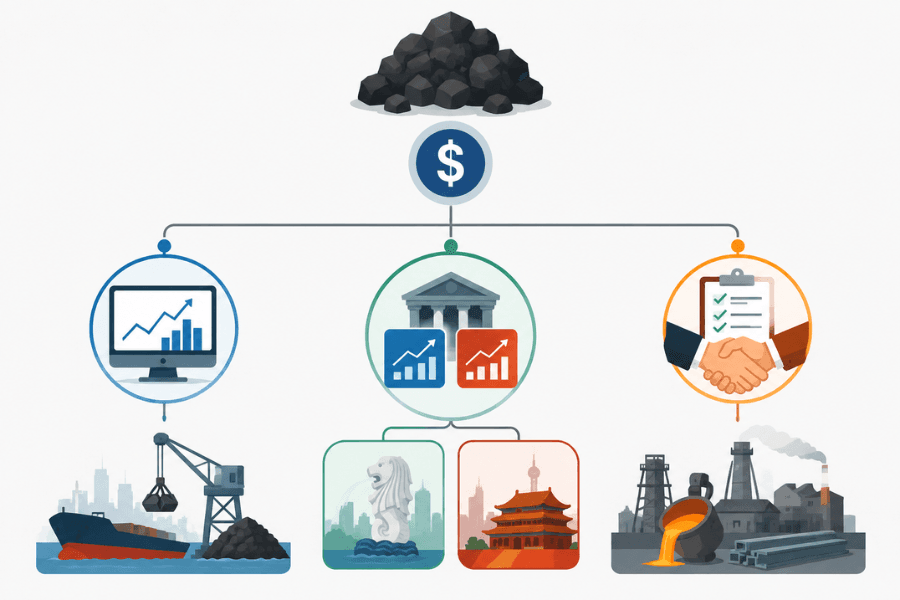
Iron ore is priced in U.S. dollars, usually per metric tonne. Its price is formed mainly through three layers:
- Spot price index: Because China is the world's largest importer of seaborne iron ore, the main spot index is benchmarked to the price of 62% iron content fines delivered to Chinese ports (CFR China). This is the reference the market quotes most often.
- Futures market: The U.S. dollar–settled iron ore futures on the Singapore Exchange (SGX) are the contracts international investors take part in most. Singapore sits close to Asia's main steel supply chain, which is why the SGX has become an important venue for global institutions to manage iron ore price risk. China's Dalian Commodity Exchange, by contrast, is priced in yuan and reflects domestic Chinese supply and demand.
- Long-term contracts and spot combined: Actual deals between miners and steel mills are mostly priced off the index plus a premium or discount, rather than at a fixed long-term contract price.
3. The Main Drivers of the Iron Ore Price
Moves in the iron ore price can be understood from two sides—demand and supply—and both are highly concentrated.
Demand side: China's steel industry
On the demand side, almost everything comes back to China. China accounts for the largest share of seaborne iron ore demand, and its steel demand depends heavily on property and infrastructure. The single biggest short-to-medium-term driver of the iron ore price is therefore Chinese steel demand. When China rolls out infrastructure stimulus or the property market recovers, iron ore prices tend to rise on the news; when property weakens, prices come under pressure. Tracking China's Purchasing Managers' Index (PMI), property data, and steel mill operating rates is a key way to read demand, and the release times for this data can be found in advance on an economic calendar.
Titan FX Economic Calendar Economic Indicators by CountrySupply side: the large miners of Australia and Brazil
The supply of seaborne iron ore is highly concentrated among a handful of large miners in Australia and Brazil (such as Rio Tinto, BHP, and Fortescue in Australia and Vale in Brazil). That concentration means a single event—a cyclone, flood, mine accident, or maintenance shutdown at a mining region—can visibly tighten supply and push prices up. Supply-side news is therefore often an important short-term variable.
Financial and policy factors
- The U.S. dollar: Iron ore is priced in dollars, so a stronger dollar is usually a headwind for dollar-priced commodities.
- Inventory levels: The level of iron ore stockpiles at Chinese ports reflects how tight or loose short-term supply and demand are.
- Policy and the environment: China's crude steel output controls and environmental production curbs directly affect demand from one period to the next.
4. Iron Ore and the Australian Dollar: What FX Traders Watch
For FX traders, the significance of iron ore shows up mainly in the Australian dollar.
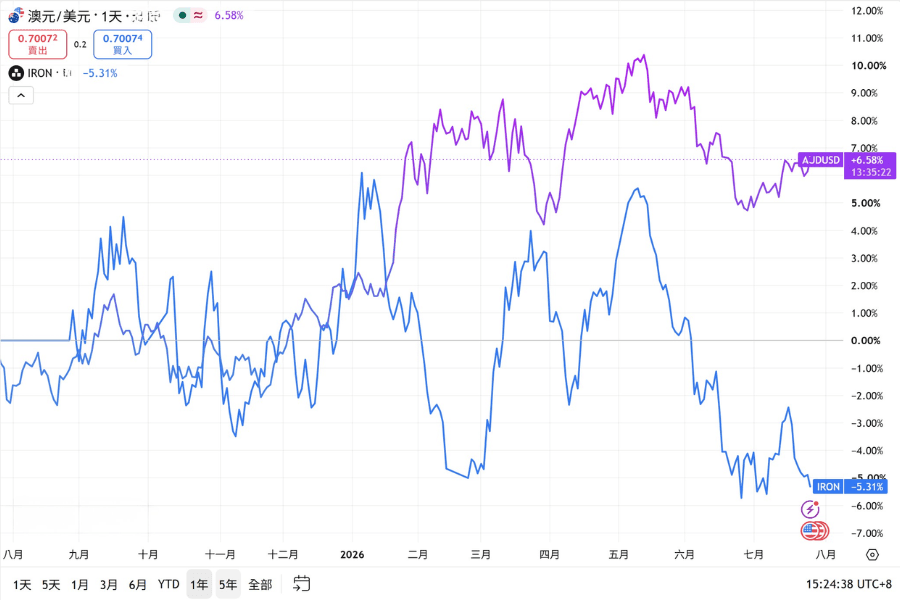
Iron ore is Australia's largest export. When the iron ore price rises, Australia's export income and terms of trade improve and capital tends to flow into the country, so the Australian dollar (AUD) tends to strengthen; when the price falls, the opposite happens. This "commodity price drives the currency" characteristic is exactly why the Australian dollar is classed as a commodity currency, and why AUD/USD shows a long-run positive correlation with the iron ore price.
Because of this, many people who trade the Australian dollar treat the iron ore price as a leading or coincident reference: iron ore reflects the fundamentals of Australian exports, and those fundamentals ultimately feed through to the exchange rate. The caveat is that this correlation is a long-run tendency rather than a daily certainty—interest rate policy, risk sentiment, and the U.S. dollar all sway the Australian dollar in the short term, so it cannot be read from iron ore alone.
5. How Ordinary Investors Can Gain Exposure to Iron Ore
It should be said up front that most FX and CFD brokers do not offer iron ore directly, and Titan FX's current lineup likewise centers on FX, precious metals (gold and silver), indices, and energy. To gain exposure to iron ore, retail investors usually use one of the following indirect routes:
- The Australian dollar (FX): Trading AUD/USD and other Australian dollar pairs is the route closest to the iron ore theme and the one with the lowest barrier to entry; in essence it is a bet on the fundamentals of Australian exports.
- Iron ore futures: Both the Singapore Exchange (SGX) and the Dalian Commodity Exchange list iron ore futures. This is the most direct route, but contract sizes and barriers are higher, making it better suited to more experienced participants.
- Mining stocks and related indices: The shares of the large miners, or the resource-heavy Australian share index (AUS200), also move with the iron ore price.
In other words, for FX traders the point of understanding iron ore is rarely to buy or sell it directly, but to make sense of what drives the Australian dollar.
6. Iron Ore FAQ
Q1: Why does the iron ore price so often follow China?
Because China is the world's largest steel producer and accounts for the bulk of seaborne iron ore demand. Almost all iron ore is used to make steel, and China's steel demand depends heavily on property and infrastructure, so China's economic conditions and policy are usually the biggest driver of iron ore prices over the short to medium term.
Q2: What does 62% iron content mean?
62% refers to the proportion of iron by weight in the ore, and it is the most common benchmark grade in the international market. The higher the iron content, the better the smelting efficiency and the fewer the impurities, so the higher the price. The reference price the market quotes each day is usually the delivered-price index for 62% iron content fines.
Q3: Why does the iron ore price affect the Australian dollar?
Because iron ore is Australia's largest export. When the price rises, Australia's export income and terms of trade improve, capital flows in, and the Australian dollar tends to strengthen; when it falls, the reverse happens. This makes the Australian dollar a textbook commodity currency, with AUD/USD showing a long-run positive correlation with the iron ore price.
Q4: Can I trade iron ore directly on an FX platform?
Most FX and CFD brokers do not offer iron ore as a direct instrument. Retail investors who want exposure to the iron ore market usually position for it indirectly—by trading the Australian dollar, iron ore futures, or resource-heavy Australian equities.
Q5: How is iron ore different from gold?
They are opposites in nature. Gold is a precious metal with a store-of-value and safe-haven function that tends to rise when markets are anxious. Iron ore is an industrial metal with almost no safe-haven quality; its demand comes directly from construction activity in the real economy, so its price hugs the business cycle and moves in the same direction as economic strength.
Q6: Is the iron ore price volatile?
Relatively so. Because demand is concentrated in China and supply among a few miners, a change at either end—a policy shift, a mine accident, a sudden move in inventories—can trigger fairly sharp price swings. This is also something to keep in mind when reading iron ore alongside the Australian dollar.
Q7: Where can I check the iron ore price?
The most widely quoted figure is the 62% Fe delivered-price index from the major price reporting agencies. For a near-real-time market price, the iron ore futures quotes on the Singapore Exchange (SGX) are a useful reference, and financial data services generally provide charts of both the index and the futures. Note that quotes from different sources (the spot index, SGX, Dalian) will differ, so make sure you are comparing the same benchmark.
7. Summary
Iron ore is the basic raw material for steel, priced off a U.S. dollar index for 62% iron content. Demand is concentrated in China's steel industry and supply among the large miners of Australia and Brazil—and that concentration at both ends makes its price both sensitive to Chinese conditions and prone to sharp moves on a single supply-side event.
For FX traders, the real value of iron ore lies in its link to the Australian dollar: as Australia's largest export, iron ore's ups and downs reflect the fundamentals of Australian exports and, over the long run, project onto the AUD exchange rate. Understanding iron ore means adding one more thread for reading commodity currencies—even if you never trade it directly.
Further Reading
- What Is a Commodity Trading Advisor?
- What Is Gold CFD Trading?
- The factors that influence gold prices
- What Is Inflation?
- What Is a Carry Trade?
Titan FX Trading Strategy Lab. We produce educational content for investors covering FX, commodities (crude oil, precious metals, agricultural products), stock indices, U.S. equities, and cryptocurrencies.
Primary Sources (by category)
- Market data and exchanges: Singapore Exchange (SGX) iron ore derivatives specifications; Dalian Commodity Exchange iron ore futures contracts
- Statistics and institutions: 62% Fe iron ore price indices from major price reporting agencies; official Australian and Chinese export and crude steel output statistics
- Research and reference: general treatments of iron ore, commodity currencies, and the AUD link in major investment education resources (Investopedia, public data from the Australian Bureau of Statistics)