
 Home
Home- Investment Guide: Strategies for Stocks, Forex, and Metals
- Spot Trading: Complete Guide to Mechanics, Assets & Risk
What Is Spot Trading? A Complete Guide to Mechanics, Popular Assets, and Trading Essentials
Spot trading is one of the most common forms of activity in global financial markets, spanning forex, precious metals, energy, and indices across multiple asset classes. Because pricing is real-time and liquidity is high, spot markets serve as a primary access point for traders entering international markets.
This guide explains the basic concept of spot trading, how it works, the most common products traded, and the key considerations to keep in mind — building a complete picture of the spot market for new and intermediate participants.
- Spot trading transacts at the current real-time market price, with no expiry or contract delivery — the most material difference vs. futures and options is faster reaction time and higher price transparency.
- Most traders participate through spot-price-based instruments (such as CFDs), avoiding physical delivery while flexibly capturing both upside and downside opportunities.
- Mainstream spot products span major forex pairs, gold (XAUUSD), silver, crude oil (WTI/Brent), and US equity indices (US30/US500/US100). Forex trades around the clock.
- Major risks include rapid price swings, leverage amplification, news-driven impact, and accumulating overnight financing — all addressable through stop-losses, position sizing, and disciplined execution.
- Beginner roadmap: choose a regulated platform → learn product characteristics → build technical-analysis fluency → practice on demo → set risk-management rules → start with small lot sizes.
1. What Is Spot Trading?
Spot trading refers to buying and selling financial assets at the current real-time market price. The price the trader sees is the actual transaction price, with no future expiry or settlement date involved. As a result, spot trading reacts quickly to information, has highly transparent pricing, and is one of the most liquid trading models in global financial markets.
Compared with futures, options, and other derivatives that have an expiry date, spot trading does not require contract negotiation, does not wait for a settlement date, and in most cases does not involve physical delivery. This simplicity and the ability to reflect supply-demand changes immediately is why spot markets are widely used across forex, precious metals, energy, and indices.
In modern financial markets, traders typically participate in spot price action through instruments that mirror spot pricing — such as Contracts for Difference (CFDs). These instruments are based on real-time spot prices, letting investors flexibly capture both up and down moves while avoiding the costs and constraints of holding the physical asset.
2. How Spot Trading Works
The core of the spot market is immediate execution at the current market price. That price is collectively formed by the buying and selling activity of traders globally, influenced by economic data, monetary policy, geopolitical events, and supply-demand changes. Market information feeds rapidly into the quote, so spot pricing has high real-time fidelity.
The mechanics of spot trading are relatively straightforward:
The trader chooses to buy or sell based on market conditions, and the system matches the trade at the current quote in real time. Because the forex market runs through a global interbank network, it operates 24 hours a day. Precious metals, energy, and stock indices trade in fixed sessions but still maintain enough liquidity to support short- and medium-term operations.
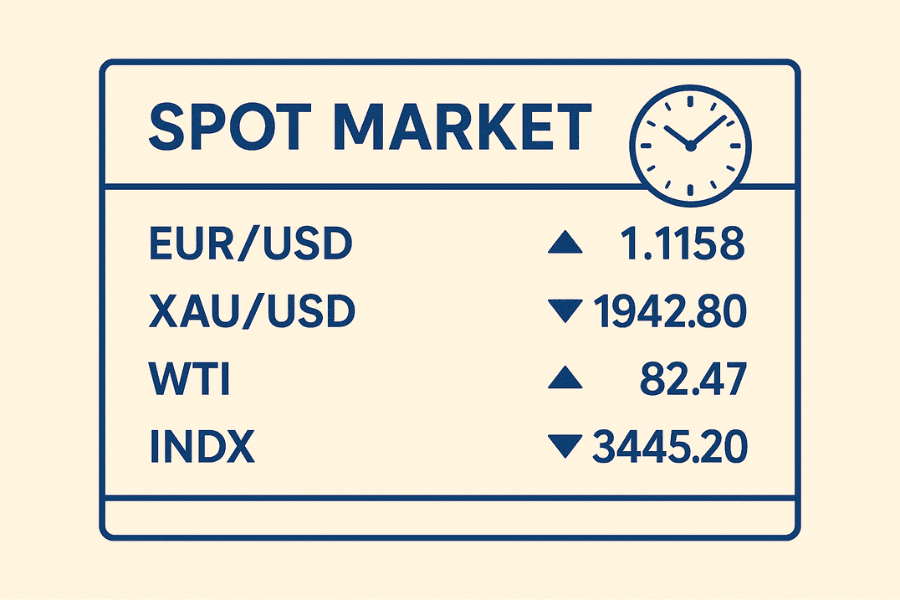
In practice, many traders use spot-price-based financial instruments for their trades — for example, Contracts for Difference (CFDs). These instruments do not produce physical delivery and have no expiry like futures contracts, so the trade flow is focused on entry, exit, and position management.
By using stop-loss orders, limit orders, and other order types, traders can manage entry/exit timing more efficiently and adjust strategies across different market conditions.
3. Key Characteristics of Spot Trading
Spot trading has the following characteristics that make it one of the most common and easily understood trading methods in financial markets:
| Characteristic | Detail |
|---|---|
| No physical holding required | Most spot trading does not involve physical delivery; investors can buy and sell directly through market quotes, avoiding storage and transportation costs. |
| Long and short both supported | Whether the market is rising or falling, the corresponding trade direction can be selected, providing high strategic flexibility. |
| Transparent cost structure | Main costs are spread and overnight financing — easily understood and calculable for risk and expected return analysis. |
| Real-time market response | Spot prices move quickly with supply-demand and news flow, providing ample opportunity for short-term and swing trading. |
| Suits multiple trading styles | Whether you are a beginner, short-term trader, or strategy-oriented mid-term operator, you can find a fit in the spot market. |
4. Popular Assets in Spot Trading
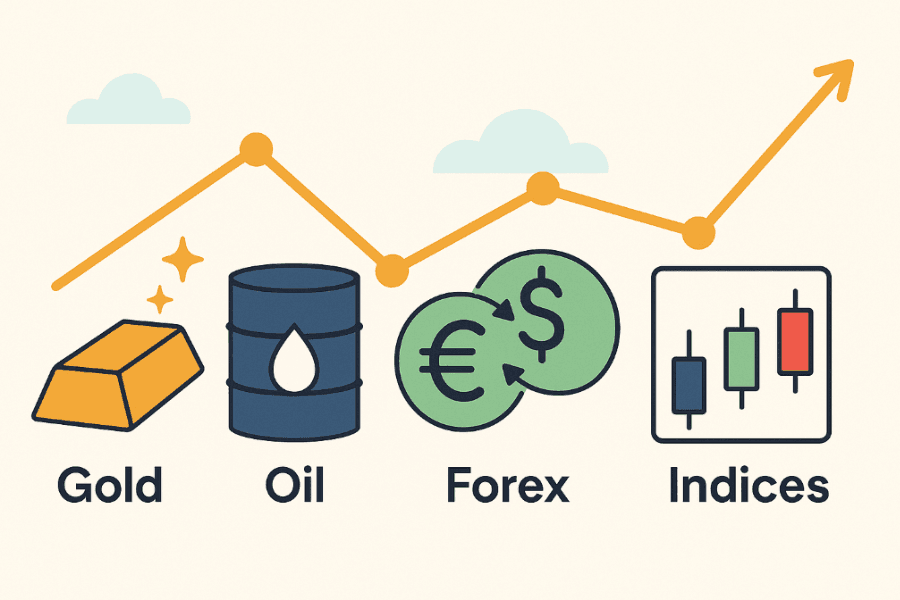
The following are commonly traded products in the spot market with high volume and noticeable volatility, with links to live prices and detailed descriptions:
| Asset Category | Examples (with links) | Characteristics |
|---|---|---|
| Gold | XAUUSD | Traditional safe-haven asset. Affected by inflation, monetary policy, and geopolitical events; price action is pronounced. |
| Silver | XAGUSD | Volatility usually higher than gold; combines precious-metal characteristics with industrial demand. |
| Crude Oil (WTI) | XTIUSD | Affected by energy demand, production policy, and inventory reports — one of the more volatile products. |
| Crude Oil (Brent) | XBRUSD | One of the major global oil benchmarks; affected by supply-demand changes and international market policy. |
| Indices | US30, US500, US100 | Reflect overall stock market performance; affected by corporate earnings, economic data, and market sentiment with rhythmic moves. |
| Major Forex Pairs | EURUSD, GBPUSD, USDJPY | Extremely high liquidity, 24-hour trading; pricing driven mainly by interest-rate policy, economic data, and capital flows. |
5. Advantages of Spot Trading
Spot trading is widely used in global financial markets because of its flexibility and transparency. The main reasons it is commonly chosen:
| Advantage | Detail |
|---|---|
| High trading flexibility | Long or short can be selected based on market direction; whether the market rises or falls, there is operational space. |
| No expiry pressure | Spot prices do not depend on contract expiry; no rollover or settlement issues like futures. |
| Strong liquidity | Forex, metals, and indices have high trading volumes; trades execute close to the market price. |
| Lower entry barrier | No need to purchase or store physical assets — trading happens through market quotes alone. |
| Diverse product range | Forex, precious metals, energy, indices — all can be flexibly chosen based on strategy. |
| Relatively transparent cost structure | Main costs are spread and overnight financing — easy to calculate for risk control. |
6. Risks and Considerations
While spot markets offer flexibility and high liquidity, traders need to understand the underlying risks and build sound risk-management habits.
| Risk / Consideration | Detail |
|---|---|
| Price volatility | Spot prices move quickly with global news, economic data, and supply-demand changes; sharp swings can occur in short windows. |
| Leverage amplifies P&L | Leverage improves capital efficiency but also amplifies losses; position size must be carefully managed. |
| News-flow sensitivity | Central bank policy, geopolitical events, and economic releases can trigger instantaneous moves. |
| Overnight holding cost | Holding positions overnight produces swap fees that affect total cost — needs to be factored into the trade plan. |
| Lack of risk-management discipline | Failure to set stops or maintain discipline produces unnecessary losses; sound risk control is the cornerstone of stable trading. |
7. How Beginners Can Start Spot Trading
For investors new to the spot market, building correct foundations and a clear plan delivers stability through the trading journey. Here is a step-by-step approach:
| Step | Detail |
|---|---|
| Step 1: Choose a regulated, transparent platform | Platform stability, transaction costs, and security are core considerations before trading. Choose a service provider with comprehensive regulatory standing and clear fee structure. |
| Step 2: Understand market and product characteristics | Study volatility drivers and price behavior across forex, metals, energy, and indices to find a trading type that fits you. |
| Step 3: Build fluency with fundamental and technical analysis tools | Beginners can start with trend lines, support/resistance, candlestick patterns, and economic data, gradually building an analytical framework. |
| Step 4: Practice on a demo account first | Demo trading helps you become familiar with platform mechanics and tests strategies and habits without taking on risk. |
| Step 5: Define a trading plan and risk-management rules | Clear stop levels, target returns, position sizes, and leverage usage rules are the keys to long-term trading stability. |
| Step 6: Start with small position sizes | Begin with low leverage and small lots; scale up as experience accumulates. |
8. Why Trade Spot With Titan FX
When choosing a trading platform, leverage flexibility, transaction costs, product diversity, and trading transparency all influence long-term trading experience. Below are the main advantages of Titan FX in the spot trading environment.
Advantage 1: Flexible high leverage, no constraint by capital size
Titan FX offers multiple account types to address different trading needs.
The Standard and Blade accounts offer up to 1,000x leverage, while the Micro account can reach 2,000x when eligible — flexible choice based on strategy.
Regardless of account capital size, Titan FX does not restrict leverage based on account balance or trading volume. Compared with brokers that reduce leverage on high-balance accounts, Titan FX provides more consistent and stable trading conditions.
Advantage 2: Low spreads and fast execution reduce trading costs
Titan FX uses ZERO POINT Technology and is co-located on Equinix high-speed servers, ensuring orders execute at millisecond speed and effectively reducing latency and slippage risk.
For forex, gold (XAUUSD), and other CFD products, Titan FX provides competitive spread structure — well-suited for traders who place high demands on cost and execution efficiency.
Advantage 3: Diverse product selection — operate multiple markets from one account
Titan FX provides 260+ forex and CFD products spanning currency pairs, precious metals, energy, equity indices, equities, and crypto.
Traders can freely allocate across different assets in one account, switching between markets without changing platforms — increasing capital efficiency and strategic flexibility.
Advantage 4: NDD execution model — pricing closer to the market
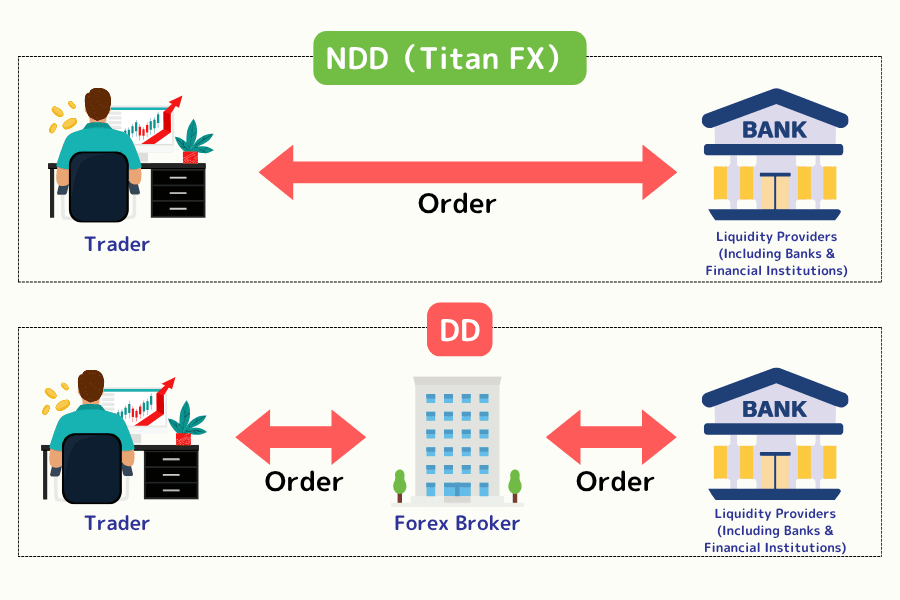
Titan FX uses an NDD (No Dealing Desk) model, where all orders are routed directly to liquidity providers without manual dealer intervention. This reduces conflict of interest and improves quote transparency.
In this model, traders can freely use Expert Advisors (EAs) for automated trading and run scalping or short-term strategies.
Note that during major data releases or unexpected events, slippage can still occur — but in NDD execution, slippage can also work in the trader's favor.
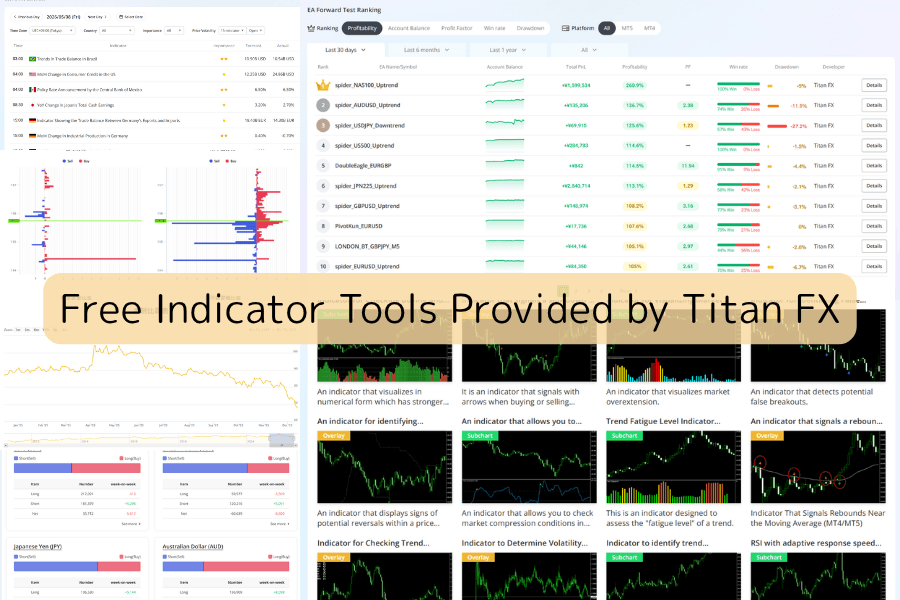
Advantage 5: Free trading tools and complete learning resources
Titan FX provides multiple free MT4 / MT5 custom indicators and EAs, and integrates educational and market-analysis resources through "Titan FX Research."
The research content covers technical analysis, trading strategy, platform tutorials, and real-time market tools — supporting traders to continuously improve their skills at every stage.
All analysis tools are accessible via the "Market Analysis" sections on the official website.
Advantage 6: Streamlined online account opening
Titan FX provides online account opening, with SMS verification supported in some regions — no ID or address proof upload required to register and start trading. Where SMS verification is not supported, the standard document upload flow completes account opening.
Titan FX Registration Page (English)9. FAQ: Common Questions
Q1. How is spot trading different from futures trading?
The key difference is expiry and settlement mechanics. Spot trading transacts at the real-time market price with no contract expiry or settlement date. Futures trading requires either closing or settlement before expiry, plus considerations like contract specifications, margin requirements, and rollover. Most retail spot participants use CFDs, which avoid physical delivery and simplify operations.
Q2. How much capital do I need to start spot trading?
It depends on the platform's minimum deposit and the pip value of the chosen product. At Titan FX, the minimum deposit is 1 USD, but in practice you should fund enough margin to absorb market volatility. Beginners can start with small lot sizes (e.g., 0.01 lot) and scale up based on win rate and money-management discipline.
Q3. Is spot trading suitable for long-term holding?
Spot prices have no contract expiry, so holding long-term is technically possible. However, swap fees accumulate over time, especially when the interest-rate differential is unfavorable. Long-term holding pairs better with fundamental analysis and macro trend judgment; short-term high-frequency traders should avoid carrying many overnight positions.
Q4. Can leverage be used in spot trading?
Yes, but leverage amplifies both gain and loss. Titan FX Standard/Blade accounts go up to 1,000x and Micro accounts up to 2,000x when eligible. Higher leverage means smaller margin required, but larger per-trade risk exposure. Capping per-trade risk to 1-2% of equity is the standard discipline that prevents over-leverage from breaking the account.
Q5. Which spot product should beginners start with?
Major forex pairs (EUR/USD, USD/JPY, etc.) are recommended. They have the highest liquidity, tightest spreads, 24-hour trading, and abundant historical data and technical-analysis references. Once familiar, beginners can gradually move into more volatile products like gold, oil, and equity indices.
Q6. What is the difference between CFDs and true spot products?
True spot trading involves transfer of ownership of the underlying asset (such as physical gold or actual foreign currency), while CFDs are derivative contracts based on spot pricing — no physical delivery is involved. For retail investors, CFDs deliver almost identical price exposure to spot at lower cost and with simpler operations, which is why CFDs have become the mainstream participation method.
10. Conclusion
Spot trading — characterized by immediate price execution, no expiry, and high liquidity — is one of the most common forms of trading in global financial markets. Combined with appropriate trading tools and risk management, traders can flexibly participate in forex, precious metals, energy, and indices according to their own strategy.
Before going live, develop a solid understanding of product characteristics, transaction costs, and underlying risks, and choose a platform with stable trading conditions and transparent operations. Doing so allows you to build long-term, disciplined trading practice in the spot market.
Further Reading
- Forex Trading Strategy: A Complete Guide for Beginners
- Forex Margin Trading Basics
- Complete Guide to the VIX (Fear Index)
- What Is the Zero-Cut System?
- Top 10 Mistakes New Forex Traders Make
Titan FX Research and Review Team — covering forex (FX), commodities (oil, precious metals, agricultural products), stock indices, US equities, and crypto assets, producing educational content for retail and institutional investors.
Primary Sources by Category
- Market structure and liquidity: BIS Triennial Central Bank Survey on FX Turnover (daily forex volume); CME Group spot product specifications; ICE Brent and NYMEX WTI crude oil standard contracts; LBMA Gold Price and Silver Price benchmarks.
- Regulatory and official data: Vanuatu Financial Services Commission (VFSC); Financial Commission (external ADR body); ESMA and FCA leverage and risk-disclosure standards for CFD products as universal regulatory benchmarks.
- Academic and industry references: Andrew W. Lo, "The Adaptive Markets Hypothesis" (Journal of Portfolio Management, 2004); Investopedia (Spot Trading entries); Bloomberg Markets and Reuters real-time pricing and market analysis.
- Company sources: Titan FX product specifications, ZERO POINT Technology spec, NDD model description, product category coverage (260+ instruments).