
 Home
Home- Investment Guide: Strategies for Stocks, Forex, and Metals
- Why Forex Beginners Fail: 10 Mistakes & 7 Risk Strategies
Why Forex Beginners Fail: 10 Mistakes & 7 Risk Strategies
Most forex beginners fail not from bad luck but from a lack of market understanding, risk management, and emotional control — common pitfalls include trading on gut feeling, skipping stop losses, over-leveraging, and overtrading.
- Main causes: weak market knowledge, poor risk management, emotional trading
- 10 failure cases: gut-feeling entries, no stop loss, short-term bias, over-leverage
- Data reality: only a portion of retail traders are profitable each month
- 7 strategies: know your pairs, start on demo/small size, master sessions, use EAs
- Core lesson: learn analysis and risk control first, profit follows
1. Why Do Forex Beginners Often Fail?
The forex market is known for its high leverage, high liquidity, and 24-hour operation, making it both an opportunity and a huge risk for beginners.
Due to a lack of practical experience and risk management awareness, beginners often see their capital shrink or even blow their accounts in a short period.
The main reasons for failure can generally be summarized into the following 3 aspects:
1. The High-Risk Nature of the Forex Market
1-1. Leverage
Leverage in forex trading can effectively magnify the scale of trades, allowing traders to operate larger positions with relatively smaller capital.
For example, using 100x leverage, you can trade a position of $100,000 with just $1,000.
Leverage increases trading opportunities, but it also magnifies losses, so it should be used with caution.
Tip: Beginners can start with a leverage ratio that suits their risk tolerance and adjust it flexibly according to market conditions.
Further reading: Advantages, Disadvantages, Calculation, and Tips for Leverage in Forex Trading
1-2. The Risk of Overtrading
Since the forex market operates 24 hours, beginners often fall into the trap of "quote addiction," constantly watching the market and placing frequent orders.
Some beginners, during the highly volatile European and U.S. crossover sessions, may make consecutive orders due to emotional swings, ultimately leading to wrong judgments and high transaction fees, resulting in a loss of up to 30%.
Tip: Set a clear trading session plan and focus on high liquidity periods, such as the overlap of the London and New York sessions (UTC+8 20:00 - 24:00).
Further reading: Forex Trading Time Analysis: Mastering the Best and Worst Trading Hours
2. Common Mindset Errors of Beginners
2-1. The Fantasy of Quick Wealth
Many beginners, influenced by social media or exaggerated advertisements, mistakenly believe that forex trading can lead to rapid wealth, overlooking the importance of learning the rules and gaining experience.
Statistics show that 78% of beginners who have not undergone systematic learning lose more than 50% of their capital within three months. Their eagerness for quick success prevents them from thoroughly studying the market and developing strategies, ultimately ending in failure.
2-2. Emotional Influence on Trading
Beginners often make poor decisions due to emotional swings, such as fear and greed. For instance, they may become overly optimistic and rush to close positions when they are in profit, or they may hope for a market reversal when in a losing position, often resulting in "small wins, big losses."
Tip: Beginners should follow the risk-reward principle, setting a minimum risk-reward ratio of 1:2 (for example, a 30-pip stop loss and a 60-pip take profit) to help control emotions and balance gains and losses.
Further reading: Indicators for Confirming Risk-Reward Ratio (Titan_RR_Assist)
3. Lack of Trading Knowledge
3-1. The Impact of Macroeconomic Data and Central Bank Policies
The forex market is deeply influenced by macroeconomic data and central bank policies. Major events, such as the U.S. Federal Reserve's interest rate decisions and Non-Farm Payrolls, often lead to sharp fluctuations in currency exchange rates, sometimes exceeding 100 pips.
Beginners who overlook these critical events may miss trading opportunities or face unnecessary losses.
Tip: Beginners should closely monitor macroeconomic data and central bank policies and incorporate them into their trading decisions.
Further reading: Global Economic Indicator Guide
3-2. Trading Tools: Essential for Risk Control
Tools like stop-loss orders and limit orders help traders effectively control risk. However, many beginners, unfamiliar with these tools, fail to protect their capital during market fluctuations.
For instance, in extreme market conditions, market orders might result in unfavorable prices due to slippage, and not setting a stop-loss can allow losses to expand.
Tip: Beginners should take time to learn and master trading tools, setting stop-loss and limit orders flexibly based on market conditions to effectively manage risk.
Further reading: How to Use Common Technical Analysis Indicators
2. Common Forex Trading Failures Among Beginners
1.Trading based on "gut feeling" without proper analysis
2.Not setting stop losses, leading to uncontrollable risks
3.Over-reliance on short-term fluctuations while ignoring long-term trends
4.Trading too many currency pairs without understanding market dynamics
5.No trading plan, entering and exiting the market randomly
6.High leverage trading with insufficient risk management
7.Over-reliance on "interest arbitrage trading" (such as high-interest rate currencies)
8.Overtrading and making random trades
9.Blindly using "averaging down" and "hedging strategies," increasing risk
10.Over-relying on online information, lacking independent judgment
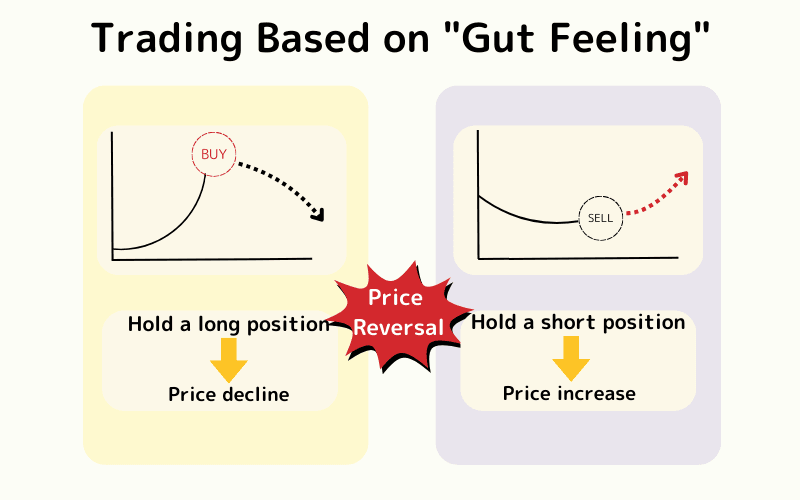
1. Trading Based on "Gut Feeling" Without Proper Analysis
Some beginners trade based on gut feeling or intuition, ignoring technical analysis and fundamental research. This often leads to poor decisions and losses.
For example, Ms. Chen saw the EUR/USD rising in the short term and assumed the price would continue to go up, but ignored market trends and economic data. As a result, the price reversed and fell, causing significant losses.
Beginners should learn technical analysis (such as moving averages, candlestick patterns, etc.) and pay attention to fundamental factors, analyzing the market from both angles before trading to avoid making hasty decisions.
2. Not Setting Stop Losses, Leading to Uncontrollable Risks
Some beginners lack risk awareness and assume that the market will follow their predictions, leading them to trade without stop losses.
Mr. Zhang traded USD/JPY, expecting the price to rise. However, due to not setting a stop loss, the loss grew larger, and he nearly lost all his capital.
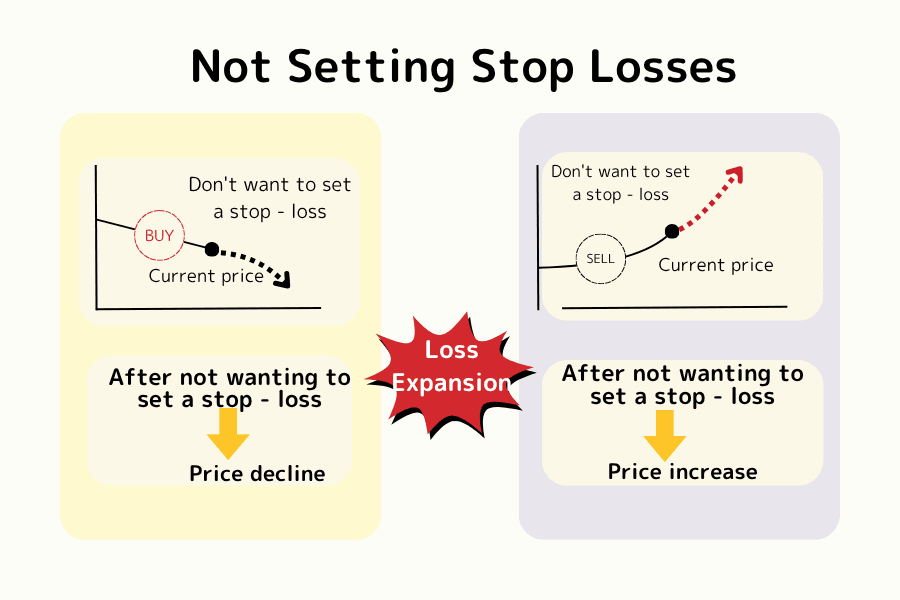
Beginners should set reasonable stop-loss levels for every trade and limit their risk per trade to 2%-3% of their capital. Once the stop loss is triggered, they should close the position without hesitation to avoid hoping for a market reversal.
3. Over-reliance on Short-Term Fluctuations While Ignoring Long-Term Trends
Many beginners focus too much on short-term market fluctuations and ignore the importance of long-term trends. Short-term fluctuations are often influenced by market sentiment, which can lead to mistakes.
For example, Ms. Gu started trading and saw a short-term pullback in EUR/USD, so she rushed to go long. However, she failed to consider the long-term strength of the USD, and the EUR continued to fall, causing a loss.
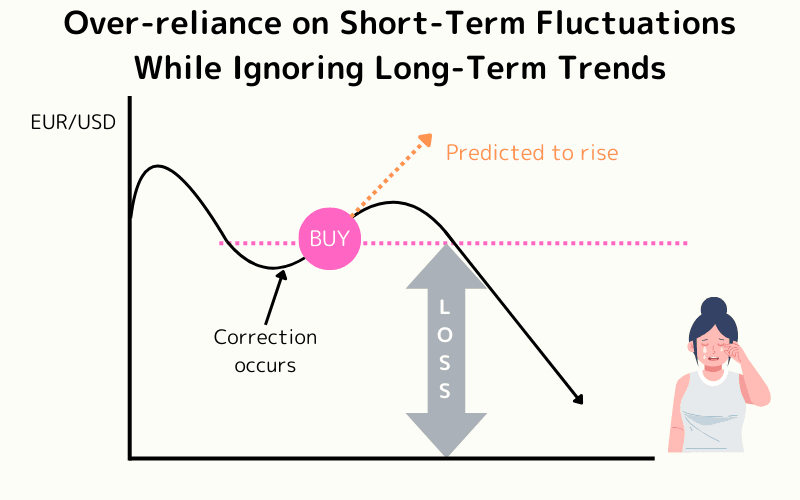
Beginners should learn to identify long-term trends and use them as the basis for trading. While short-term fluctuations may provide opportunities, long-term trends should be the primary focus for better risk management.
4. Trading Too Many Currency Pairs Without Understanding Market Dynamics
To seek more trading opportunities, beginners often trade many currency pairs at once. However, each currency pair has different dynamics, and if they cannot fully grasp these, losses are likely.
For example, Ms. Wang traded multiple currency pairs like EUR/CHF, USD/TRY, and GBP/USD, but because she couldn’t deeply analyze each currency pair's market conditions, she made incorrect predictions about EUR/CHF and missed the optimal exit for GBP/USD, resulting in multiple losses.
Beginners should focus on a few highly liquid currency pairs, such as USD/JPY and EUR/USD, and study their market trends carefully before expanding their range.
5. No Trading Plan, Entering and Exiting the Market Randomly
Many beginners lack a trading schedule and enter trades based on personal timing or impulse. Although the forex market is open 24 hours, certain times lack liquidity, which can cause significant price volatility or widen spreads.
For example, Ms. Wu could only trade during the Asian session due to her work schedule. She traded GBP/JPY during a low-liquidity period, and as a result, the large spread and price instability caused her to incur significant losses.
To avoid this, traders should understand the characteristics of different trading sessions, choose stable market periods for trading, and avoid high-risk times like during major economic data releases.
Forex Trading Time Analysis: Best and Worst Trading Hours
6. High Leverage Trading with Insufficient Risk Management
High leverage can amplify profits, but without proper risk management, it can significantly increase losses. Beginners often expect short-term gains with high leverage but overlook position control.
For example, Mr. Li used 100x leverage to trade a $100,000 position with just $1,000. When the market moved by only 0.5%, the loss wiped out most of his capital due to the large position size.
Beginners should start with low leverage, adjust it based on their risk tolerance, and strictly manage position sizes to avoid excessive exposure to risk.
7. Over-reliance on "Interest Arbitrage Trading" (High-Interest Rate Currencies)
Interest arbitrage trading involves exploiting interest rate differentials by selling low-interest currencies and buying high-interest currencies to earn the interest spread. Some beginners rely too heavily on this trading style, assuming stable returns.
However, high-interest rate currencies are more vulnerable to political and financial instability, and any price downturn can result in losses exceeding the interest spread.
For example, Mr. Zheng heard about the high interest rate of the Turkish lira and went long on USD/TRY, expecting steady profits from the interest differential. However, he did not consider the economic risks in Turkey. When Turkey's economic data turned negative, the lira depreciated sharply, and USD/TRY rose, resulting in not only losing the interest profits but also significant losses to his capital.
While interest arbitrage trading can be profitable, beginners should avoid over-relying on it. They should consider the economic fundamentals, central bank policies, and exchange rate volatility before engaging in such trades and combine it with other strategies to diversify risk.
8. Overtrading and Making Random Trades
Beginners often overtrade because of market fluctuations, blindly trying to increase their trading frequency and ignoring the associated costs and strategy effectiveness.
For example, Ms. Wang kept an eye on the market every day and placed 20 trades in a single day. This frequent trading added up costs like transaction fees and spreads, leading her to lose 8% of her capital.
To avoid overtrading, traders should set limits on the number of trades they make per week and conduct thorough analysis before each trade to ensure it aligns with their strategy rather than acting on impulse.
9. Blindly Using "Averaging Down" and "Hedging Strategies," Increasing Risk
Some beginners blindly use averaging down and hedging strategies, which increases risk. Averaging down involves buying more as the price falls, hoping for a rebound, while hedging is taking opposite positions to minimize risk. Without understanding market trends or their risk tolerance, these strategies often backfire.
For example, Ms. Sun kept adding to her EUR/USD position as the price dropped, but the loss kept increasing. She then tried using a hedging strategy, but due to platform differences, the trading costs actually went up.
Before using these strategies, beginners should assess the market trend, set reasonable risk control parameters, and avoid using them impulsively when lacking experience.
10. Over-relying on Online Information, Lacking Independent Judgment
Many beginners overly depend on online forex analysis and advice, lacking the ability to make independent market judgments. In this case, they often blindly follow the recommended strategies or currency pairs without doing their own analysis.
For example, Ms. Xu started trading and saw a "guru" on a forum recommending buying GBP/USD. Without conducting her own analysis, she followed the recommendation, only for the market to move in the opposite direction, causing a loss.
To avoid this, traders should develop independent thinking. Use online information as a reference but not as the sole basis for decisions. They should verify such recommendations through technical and fundamental analysis, creating their own trading approach.
3. How to Reduce the Risk of Failure? 7 Risk Management Strategies for Forex Beginners
Strategy 1: Understand the Characteristics of Different Currency Pairs
Strategy 2: Learn About Forex Order Types
Strategy 3: Start with a Demo Account
Strategy 4: Start with Small Trades
Strategy 5: Master Active Market Hours
Strategy 6: Learn Market Analysis Methods
Strategy 7: Control Emotions and Use Expert Advisors (EAs)
Strategy 1: Understand the Characteristics of Different Currency Pairs
In forex trading, different currency pairs have varying levels of trading volume and market volatility.
Currency pairs with lower trading volumes may experience unstable price fluctuations, resulting in higher risk. On the other hand, currency pairs with higher trading volumes tend to be more stable, reducing price volatility risks.
For beginners, currency pairs with higher trading volumes, such as EUR/USD and USD/JPY, are more suitable.
How Should Beginners Choose Currency Pairs?
Strategy 2: Learn About Forex Order Types
Forex trading offers various order types. While it is impossible to learn all of them, you should at least understand the three basic order methods:
| Order Type | Description |
|---|---|
| Market Order | Used for immediate execution of trades. |
| Limit Order | Used to trade at a more favorable price than the current market price. |
| Stop-Loss Order | Used to trade at a less favorable price than the current market price. |
Explanation of Limit and Stop-Loss Orders in MT5/MT4
Strategy 3: Start with a Demo Account
Before jumping into real trading, using a demo account is essential. Most forex platforms offer demo accounts that allow beginners to practice trading in a real market environment.
Through demo trading, beginners can become familiar with platform operations, try different technical analysis strategies, and learn to set stop-loss and take-profit orders. Demo trading also helps control emotions and avoid making mistakes due to emotional fluctuations. Only consider switching to live trading after achieving consistent profits in the demo account.
How to Open an MT4 Demo Account How to Open an MT5 Demo AccountStrategy 4: Start with Small Trades
Different forex brokers offer varying initial deposit requirements.
For example, Titan FX’s Zero Micro account provides a chance to trade with small capital, with trade sizes starting from 0.1 micro lots (100 currency units) and leverage up to 1000:1, with no minimum deposit requirement.
This means that even beginners can start trading with minimal capital and gradually gain experience and build capital.
Can You Start Forex Trading with $100? A Beginner's Guide to Micro Investing
Strategy 5: Master Active Market Hours
Instead of trading randomly, it's better to trade during market hours with high liquidity, which increases the chances of successful trades and improves performance. The periods of high market liquidity are as follows:
| Market | Taiwan/Hong Kong/Singapore/Malaysia Time | Japan Time | US Daylight Time (DST) |
|---|---|---|---|
| Tokyo Market | 07:00–09:00 | 08:00–10:00 | 18:00–20:00 (previous day) |
| London Market | 15:00–18:00 | 16:00–19:00 | 10:00–13:00 |
| New York Market | 20:00–01:00 (next day) | 21:00–02:00 (next day) | 08:00–15:00 (next day) |
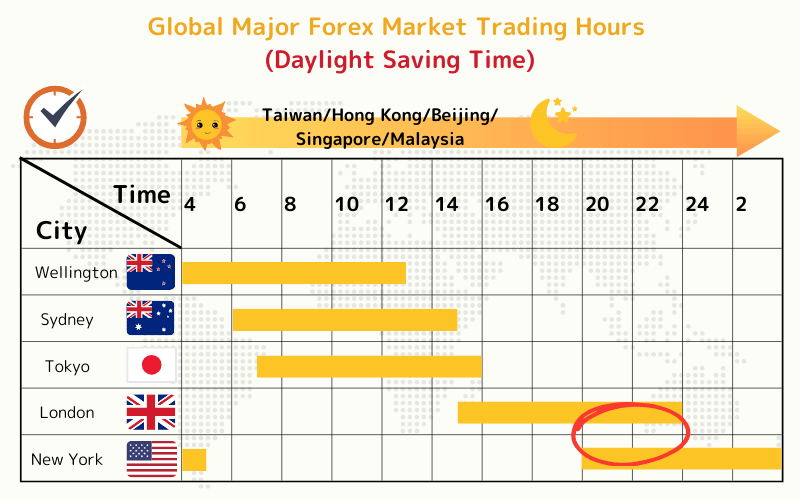
The overlap between the London Market and the New York Market is the most active trading time of the day.
Although active price fluctuations do not guarantee profits, these time slots provide traders with more efficient opportunities to profit from price movements.
If you want to learn more about the characteristics of the Tokyo, London, and New York markets, please read:
Forex Trading Hours: Active Market Times and What You Need to Know
Strategy 6: Learn Market Analysis Methods
To avoid trading based on intuition or price feel, learning how to analyze the market is necessary. Forex market analysis methods are generally divided into two types: Technical Analysis and Fundamental Analysis.
Technical Analysis:
This method involves analyzing past price movements to predict future trends. By using charts, indicators, and other tools, technical analysis helps traders identify trends and patterns in price fluctuations.
What Is Technical Analysis? What Are Suitable Indicators for Beginners?
Fundamental Analysis:
This method involves forecasting price trends based on various factors affecting currency values, such as a country’s political and economic situation. Fundamental analysis helps traders understand the underlying factors in the market, such as economic data and central bank policies.
Forex Fundamental Analysis: Concepts, Goals, Influencing Factors, Advantages, and Methods
Strategy 7: Control Emotions and Use Expert Advisors (EAs)
In forex trading, emotions often influence decisions. Rushing to trade to make up for losses or taking on too much risk due to overconfidence can lead to failure.
To avoid emotional trading, traders should remain calm, focus on market analysis, and set stop-loss orders to manage risk.
Additionally, using Expert Advisors (EAs) can help minimize emotional interference. EAs execute trades based on pre-set rules, ensuring that trades are not influenced by emotional fluctuations, helping traders stay rational and reducing the risk of impulsive trading.
What Are Expert Advisors (EAs)? What Are Their Advantages?
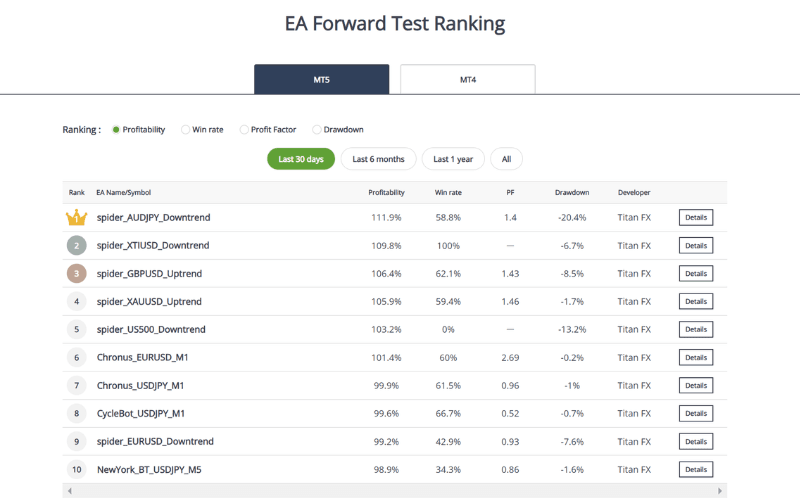
Titan FX also offers dozens of free EA trading programs.
4. How Many Forex Traders Are Profitable Each Month? Data Reveals Trader Profit Trends
Titan FX has published data on the percentage of profitable customers each month. Traders can view the percentage of profitable customers for the previous month and over the past two years.
The data is presented in graphical format, allowing users to check the monthly profit ratio and view the 6-month moving average to smooth out short-term fluctuations and help traders grasp long-term market trends.
Calculation Method:
Profitable Customer Ratio = Number of customers with asset increases ÷ Total number of trading customers
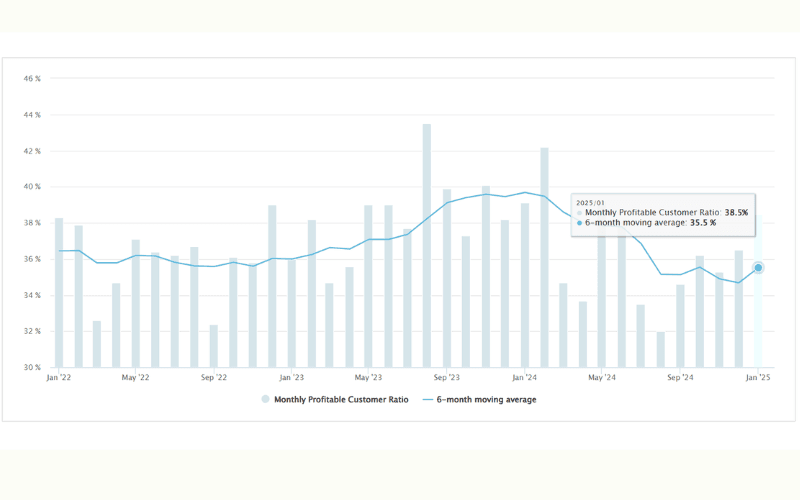
This data helps traders assess changes in the market environment, providing a more solid foundation for trading decisions.
Titan FX Monthly Profit Ratio Chart
5. How to Reduce the Risk of Failure in Forex Trading?
Beginners can accumulate experience by trading small amounts or using demo accounts to avoid taking high risks too early.
Demo trading uses virtual funds, so there are no real losses, helping traders familiarize themselves with the platform and test strategies.
Practicing with a demo account before real trading can help reduce risks and increase the likelihood of success.
Beginners can read the following articles:
How Beginners Can Learn Forex Trading
Forex Trading Beginner's Guide
6. Summary
Forex trading offers great opportunities for beginners, but high leverage, 24/7 market operation, and market volatility also bring significant risks. Common reasons for beginner failure include lack of market knowledge, insufficient risk management, and emotional trading, such as over-leveraging, not setting stop-losses, blindly relying on online information, or overtrading.
To reduce the risk of failure, traders should start with small trades or demo trading, learn technical and fundamental analysis, master risk management techniques, such as setting stop-losses, controlling position sizes, and using EAs to avoid emotional decisions. Additionally, choosing highly liquid currency pairs, understanding active market hours, and establishing a clear trading plan will help improve trading stability.
7. FAQ
Q1. What is the most common reason forex beginners fail?
The most common causes are entering on gut feeling without analysis, not setting stop losses, and over-leveraging or overtrading. They all share a lack of risk management and emotional control, which makes large, fast losses likely.
Q2. How should beginners start to lower the risk of failure?
Start with demo trading and small positions, get comfortable with the platform and order types, learn technical and fundamental analysis, and always set a stop loss, keeping per-trade risk within 2–3% of your capital.
Q3. How many forex traders are actually profitable each month?
According to broker-published client data, only a portion of retail traders are profitable in any given month — underscoring the importance of risk management and discipline.
Further Reading
Titan FX Research Team — investor-education content across forex, commodities (oil, precious metals, agriculture), stock indices, U.S. equities, and crypto assets.
Primary Sources (by Category)
- Education: Titan FX — Demo account and trading education
- General: Investopedia — Common Forex Trading Mistakes